
SLS-130 · Lesson 12 of 12 · 19 min
Case study: redesigning a service experience
▶ Video coming soon A video version of this lesson is on the way.
This final lesson brings the course together in one case study. Through September and October 2026, Juniper & Pine Home redesigned the experience of buying and receiving a large appliance. It was the store's biggest source of complaints and, as the journey map in lesson 2 showed, the stage where customers were most likely to decide not to come back. The redesign used nearly every tool in the course: a journey map, a service blueprint, standards and promises, complaint data, channel changes, self-service, measurement and a retention check. A shorter second case at Ridgeline shows how the same approach works in a business account.
The case is told in six phases. Each phase ends with the questions a team should be able to answer before moving on. Working through them is good practice for redesigning any service experience.
Phase 1: Define the problem and the scope
Bev started by defining the scope narrowly: "the experience of a household buying a large appliance in the store, from the sale to the first month of use". She left out online-only sales, furniture and mattresses, not because they did not matter but because one well-run project is better than a sprawling one. She named a small team: herself; Marcus Dube, operations and loss prevention; Tessa Yellowbird, e-commerce and marketing; Carl Jensen, the store's top appliance salesperson; and Aiden, representing newer associates. She also asked one delivery crew lead, Hamid, to join the meetings, because the delivery crews had never been asked for their view.
The team agreed on a goal in plain words: "Customers know exactly when their appliance will arrive, it arrives on time and undamaged, and if anything goes wrong it is fixed with one contact." Each part of that sentence could be measured.
- Questions to answer: Which customers and which part of the journey are in scope? Who owns the project? What does success look like, in words and numbers?
Phase 2: Gather evidence
The team collected four kinds of evidence. First, the complaint log from lesson 5, filtered to appliance sales: 84 complaints over the previous three months. Second, the service records from lesson 8, counting contacts about appliance orders by reason. Third, survey results: delivery CSAT and the 30-day recommendation question from lesson 10. Fourth, and most revealing, conversations: Aiden and Tessa phoned twelve recent appliance customers, chosen at random, and asked them to describe the experience from start to finish. Hamid described the same deliveries from the crew's side.
| Measure (appliance orders, July to September 2026) | Value |
|---|---|
| Appliance deliveries | 1,520 |
| Contacts asking when the delivery would arrive | 236 |
| Deliveries outside the promised window | 101 |
| Deliveries with damage to the product or home | 38 |
| Deliveries where the appliance did not fit or could not be installed | 27 |
| Delivery CSAT, top-two-box | 68 in 100 |
| 30-day NPS for appliance buyers | +9 |
| First contact resolution for appliance issues | 61 in 100 |
The customer conversations added detail the numbers could not. Several customers said the worst part was not the waiting but the uncertainty: they could not plan their day. Two said nobody had asked whether the new fridge would fit through their door. One said the associate who sold her the dishwasher had been wonderful, and then nobody at the store seemed to know anything about her order. Hamid explained that crews often received the route at 7 a.m., with no notes about stairs or narrow doors, and that when an appliance did not fit, they had no authority to do anything but take it back.
- Questions to answer: What do the numbers say? What do customers and front-line staff say? Where do they agree and disagree?
Phase 3: Map the journey and the blueprint
The team turned the evidence into a journey map and a service blueprint, combining the methods from lesson 2. The map showed three pain points: uncertainty about delivery time, deliveries that failed because of fit or access, and the hand-off after the sale, when customers lost their named contact. The blueprint found the causes below the line of visibility.
| Pain point | Root cause found in the blueprint | Gap from lesson 3 |
|---|---|---|
| Uncertainty about delivery time | Routes planned at 7 p.m. the night before; four-hour windows; no tracking | Delivery gap and communication gap |
| Appliances that did not fit | No measurement or access questions at the time of sale | Standards gap: no standard for checking fit |
| Lost contact after the sale | Order notes stored in the delivery system, which associates and phone staff could not see | Delivery gap: staff lacked information to serve |
| Problems needing several contacts | Phone staff could not rebook deliveries or approve small fixes | Delivery gap: no authority to solve |
- Questions to answer: What are the main pain points? What causes each one behind the scenes? Which gaps are involved?
Phase 4: Design the changes
The team listed possible fixes for each cause and then chose a small set they could actually deliver in six weeks. They judged each idea on its likely effect, its cost and how quickly it could be done.
| Change | Pain point addressed | Owner |
|---|---|---|
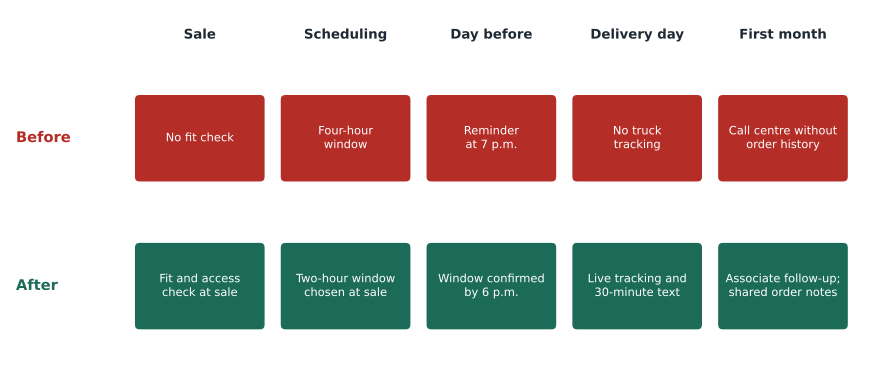
| Fit and access checklist at the sale: door widths, stairs, turns, water and power connections | Appliances that did not fit | Carl and Aiden (associates) |
| Customer chooses a two-hour window at the time of sale, based on route zones | Uncertainty about delivery time | Marcus (operations) |
| Routes finalized by 4 p.m.; window confirmed by text by 6 p.m. the evening before | Uncertainty | Marcus |
| Live tracking link and a 30-minute warning text on the day | Uncertainty | Tessa (e-commerce) |
| Order notes visible to associates, phone staff and crews in one record | Lost contact; repeat contacts | Marcus and Tessa |
| Phone staff and crews may rebook and approve goodwill up to 100 dollars | Problems needing several contacts | Bev |
| Selling associate calls each appliance customer within three days of delivery | Lost contact after the sale | Associates |
| Help article and short video on preparing for delivery | Fit and access; uncertainty | Tessa |
The team also updated the store's standards, as in lesson 3, so the new promises were specific and measurable: a two-hour window chosen at sale; confirmation by 6 p.m. the evening before; arrival inside the window for at least 95 in 100 deliveries; a follow-up call within three business days. Associates were trained to describe the process in the same words, so customers heard the same promise from everyone.
Two ideas were rejected. A suggestion to offer free delivery on all appliances was dropped because customers had not complained about the fee. A suggestion to add a chatbot for delivery questions was postponed, because the tracking link was expected to answer most of those questions more simply. Choosing what not to do is part of design.
- Questions to answer: Which changes address the root causes? Who owns each one? What new standards and promises follow? What has been deliberately left out?
Phase 5: Pilot, measure and adjust
The changes went live for appliance orders on October 5, 2026, in a pilot covering the store's own delivery crews. The team agreed in advance which measures would show success and what result would count as a problem. After five weeks, the data looked like this.
Worked problem
Comparing the pilot with the baseline
In the five weeks of the pilot (October 5 to November 8, 2026), Juniper & Pine made 590 appliance deliveries. There were 24 contacts asking when the delivery would arrive, 22 deliveries outside the window, 9 with damage and 4 that did not fit. Compare each with the baseline rates from July to September, per 100 deliveries.
Show solution
- Baseline arrival-time contacts: 236 ÷ 1,520 × 100 = 15.5 per 100. Pilot: 24 ÷ 590 × 100 = 4.1 per 100.
- Baseline late deliveries: 101 ÷ 1,520 × 100 = 6.6 per 100. Pilot: 22 ÷ 590 × 100 = 3.7 per 100, so 96.3 in 100 arrived on time, above the 95 standard.
- Baseline damage: 38 ÷ 1,520 × 100 = 2.5 per 100. Pilot: 9 ÷ 590 × 100 = 1.5 per 100.
- Baseline failed fit: 27 ÷ 1,520 × 100 = 1.8 per 100. Pilot: 4 ÷ 590 × 100 = 0.7 per 100.
- Caution: the pilot ran for five weeks, in autumn rather than summer, and the numbers of damage and fit problems are small, so those changes could partly be chance.
Answer: Arrival-time contacts fell from about 15.5 to about 4.1 per 100 deliveries, late deliveries from about 6.6 to 3.7, damage from 2.5 to 1.5 and failed fits from 1.8 to 0.7. The improvements in timing are large and clear; the changes in damage and fit are encouraging but based on small numbers, so the store should keep measuring.
Survey and service measures moved too. Delivery CSAT rose from 68 to 81 in 100 top-two-box, from 214 responses during the pilot. First contact resolution for appliance issues rose from 61 to 77 in 100. The 30-day NPS was not yet available for most pilot customers, because their 30 days had not passed; the team agreed to review it in December.
Not everything worked at once. In the first week, associates forgot the fit checklist on about a third of sales. Bev added it as a required step in the sales system, so an order could not be completed without it, and compliance rose above 95 in 100. The follow-up calls also proved hard to keep up on busy weekends, so the team allowed associates to send a personal text instead when a call was not possible.
- Questions to answer: Did the measures improve? By how much, and how confident can we be? What did not work, and what was adjusted?
Phase 6: Make it stick and share what was learned
A redesign fails if it fades once the project team moves on. The team wrote the new process into the store's standard procedures, added the key measures to Bev's monthly board from lesson 3, and scheduled a review for February 2027. They also presented the results to the regional director, who planned to try the same changes at the company's other locations in 2027.
Bev finished the project with a short meeting to thank everyone, including Hamid's crews, whose ideas about access notes had prevented most of the failed deliveries. The team also agreed to apply the same method to furniture special orders next, the source of the sofa-promise problem in lesson 3.
- Questions to answer: Is the new process written down and measured? Who reviews it, and when? What will the team redesign next?
A shorter case: onboarding a RoomFlow customer at Ridgeline
At Ridgeline, Maya and Farida Haddad used the same six phases on a smaller scale: the first 60 days of a new RoomFlow software customer. Evidence came from support tickets, the annual recommendation survey and calls with five recent customers. The pain point was clear: customers bought RoomFlow to stop double-booked meeting rooms, but in the first month many rooms were still double-booked, because staff kept using the old paper sign-up sheets alongside the software.
The root cause was not the software. It was that Ridgeline's onboarding consisted of a single setup call with the customer's office manager; nobody helped the customer explain the change to the rest of their staff. The redesign added a short launch kit, a one-page guide and posters for meeting-room doors, a 30-minute training session for each customer's staff, and a check-in call at 30 days to review booking data. Ridgeline piloted it with three new customers in September and October 2026, including Halverson Law. Support tickets in the first 30 days fell from an average of 9 per customer to 3, and all three pilot customers rated their onboarding 6 or 7 on the effort question. Farida planned to make the kit standard from January 2027.
What the cases show
Both redesigns followed the same pattern: define a narrow scope, gather evidence from customers and front-line staff, find the root causes behind the pain points, design a small set of changes with owners, pilot and measure honestly, then make the changes permanent. In both cases the most valuable improvements were not the most expensive. They came from fixing information flows, setting clear standards and giving staff authority, the parts of the service-profit chain from lesson 1 that are easiest to overlook.
For salespeople, the lesson is that service and selling are part of one experience. The fit checklist made appliance sales slightly longer, but customers trusted the associates more, and returns caused by failed fits nearly disappeared. The RoomFlow launch kit took Ridgeline staff extra time, but customers who used the software successfully renewed and recommended it. Good service is not something that happens after the sale. It is part of what makes the next sale possible.
Common mistakes
MistakeTrying to redesign every part of the experience at once.
InsteadChoose a narrow scope, such as one product type and one part of the journey, and do it well.
MistakeRelying only on numbers or only on stories.
InsteadCombine data with conversations with customers and front-line staff, including people such as delivery crews.
MistakeJumping to solutions before finding root causes.
InsteadUse a blueprint and the gaps model to find why each pain point happens.
MistakeDeclaring success from a short pilot with small numbers.
InsteadCompare with a baseline, note the limits of the data and keep measuring.
MistakeLetting improvements fade after the project.
InsteadWrite the new process into standard procedures, track the measures and schedule a review.
Summary and key terms
- Redesigning a service experience follows six phases: define the scope and goal; gather evidence from data, customers and front-line staff; map the journey and blueprint to find root causes; design a small set of changes with owners, standards and consistent promises; pilot and measure against a baseline, adjusting what does not work; and make the changes permanent while sharing what was learned.
- At Juniper & Pine, fixing route planning, fit checks, shared order records and staff authority cut arrival-time contacts from about 15.5 to 4.1 per 100 deliveries and raised delivery CSAT from 68 to 81 in 100.
- At Ridgeline, a launch kit and staff training cut first-month support tickets for new RoomFlow customers from 9 to 3.
- The most valuable fixes were in information, standards and authority, not expensive extras.
- Scope
- The boundaries of a redesign project: which customers and which part of the journey are included.
- Baseline
- Measurements taken before a change, used to judge its effect.
- Pilot
- A limited trial of a change before rolling it out more widely.
- Root cause
- The underlying reason a pain point happens.
- Onboarding
- Helping a new customer start using a product or service successfully.
- Standard procedure
- The written, agreed way a process is carried out, so improvements last.
Practice problems
Work each problem on paper first, then reveal the answer to check.
Why did the team ask delivery crews to join the project?
Show answer
Crews see problems customers and store staff do not, such as late routes and missing access notes; their evidence revealed root causes.
In a pilot of 400 deliveries, 14 arrived late. What share arrived on time, in 100?
Show answer
(400 − 14) ÷ 400 × 100 = 96.5 in 100.
Name one idea the Juniper & Pine team rejected and why.
Show answer
Free delivery on all appliances, because customers had not complained about the fee; or a delivery chatbot, postponed because the tracking link was expected to answer most questions.
Lesson quiz · 5 questions
Score 60% or more to complete this lesson.
Create a free account to save your progress, take quizzes and earn a certificate.