
SLS-130 · Lesson 11 of 12 · 20 min
Loyalty and retention
▶ Video coming soon A video version of this lesson is on the way.
In the second week of November 2026, Darnell Brooks asked Maya to prepare for a meeting that would happen in January: the planning session for Riverbend Dental Group's printer contract renewal in February. "Don't start with the price," he said. "Start with whether they're actually loyal. Do they use us because they like us, or because switching is a nuisance? Those are different customers, and they renew for different reasons." At Juniper & Pine, Bev was asking a similar question about the store's repeat customers: how many came back, how often, and what made the difference.
This lesson explains what customer loyalty is and is not, how to measure retention and churn, how to estimate customer lifetime value, what drives customers to stay or leave, and what service teams can do to keep good customers. Loyalty program design, points cards and rewards, belongs to the retail marketing course, SLS-257, and managing large business accounts belongs to SLS-220; this lesson focuses on the service side of loyalty.
What loyalty means
Customer loyalty has two parts. Behavioral loyalty is what customers do: they keep buying, renew contracts, buy more and choose the business over competitors. Attitudinal loyalty is how they feel: they prefer the business, trust it and would recommend it. The two usually go together, but not always.
A customer can buy repeatedly without any real preference, simply because the store is closest or the contract is hard to change. This is sometimes called spurious loyalty or inertia: it looks like loyalty in the sales figures, but it disappears quickly when a competitor makes switching easy. A customer can also like a business and still not buy again, perhaps because they have no current need. The most valuable customers show both kinds: they buy and they care.
| Low attitudinal loyalty | High attitudinal loyalty | |
|---|---|---|
| High repeat buying | Spurious loyalty: buys out of habit or convenience; at risk if a competitor makes switching easy | True loyalty: buys and prefers; most valuable and most likely to recommend |
| Low repeat buying | No loyalty: little connection either way | Latent loyalty: likes the business but buys rarely; may need a reason or reminder |
Maya's question about Riverbend was exactly this. The clinic had renewed once before. But Helen Park had told her in October that a competitor had offered a cheaper contract, and Janet had said no mostly because she did not want to deal with new printers during flu season. That sounded like inertia, not preference. Maya had three months to give the clinic reasons to stay that were stronger than convenience.
Retention and churn
Customer retention is the share of customers at the start of a period who are still customers at the end. Churn, or attrition, is the share who left. For subscription and contract businesses, such as Ridgeline's managed print and RoomFlow software, retention is easy to see, because customers either renew or cancel. For retailers, it is harder, because customers rarely announce they have left; they simply stop coming. Retailers therefore measure repeat purchase rate, the share of customers who buy again within a set period, such as 24 months.
The standard retention calculation excludes new customers who joined during the period, because they were not there at the start. Including them would make retention look better than it is.
Worked problem
Calculating retention and churn
On January 1, 2026, Ridgeline had 120 managed print customers. During the year it won 26 new ones. On December 31 it expects to have 132 customers, if renewals due in December go as planned. Calculate the expected retention and churn rates for 2026.
Show solution
- Customers at the end who were also there at the start: end total minus new customers: 132 − 26 = 106.
- Retention: 106 ÷ 120 × 100 = 88.3 in 100.
- Customers lost: 120 − 106 = 14.
- Churn: 14 ÷ 120 × 100 = 11.7 in 100, which with retention adds to 100.
Answer: Expected retention for 2026 is about 88 in 100 and churn about 12 in 100. Counting new customers in the numerator would give a misleading 132 ÷ 120 = 110 in 100.
Customer lifetime value
Lesson 1 estimated the margin lost when one Juniper & Pine household leaves. Customer lifetime value, often shortened to CLV, makes that estimate more careful. It is the total profit a business expects from a customer over the whole relationship. A simple version multiplies the margin a customer brings each year by the number of years the customer is expected to stay.
The expected number of years can be estimated from churn. If a fixed share of customers leaves each year, the average customer stays about one divided by the churn rate. With churn of 12 in 100, or 0.12, the average customer stays about 1 ÷ 0.12 = 8.3 years. This is a rough average; real customers vary widely, and more careful methods discount future profits because money received later is worth less than money received now. FIN-201 covers discounting.
Worked problem
Estimating lifetime value for a managed print customer
A typical Ridgeline managed print customer pays 14,000 dollars a year, and Ridgeline keeps a margin of 30 in 100 after toner, parts and technician time. Annual churn is 12 in 100. Estimate the lifetime margin of an average customer, without discounting, and the effect of cutting churn to 8 in 100.
Show solution
- Annual margin: 14,000 × 0.30 = 4,200 dollars.
- Expected lifetime at 12 in 100 churn: 1 ÷ 0.12 = 8.33 years.
- Lifetime margin: 4,200 × 8.33 = about 35,000 dollars.
- At 8 in 100 churn: 1 ÷ 0.08 = 12.5 years; 4,200 × 12.5 = 52,500 dollars.
- Difference: 52,500 − 35,000 = 17,500 dollars more per customer.
Answer: An average customer is worth about 35,000 dollars of margin over its lifetime at current churn. Cutting churn from 12 to 8 in 100 would raise that to about 52,500 dollars, an increase of about half, which shows why small improvements in retention are worth real effort.
Why customers stay and why they leave
Customers stay for a mix of reasons. Some are positive: they get good value, the product works, the service is reliable and the people are trusted. Some are practical: switching takes time, effort or money, called switching costs. And some are emotional: they like the people, identify with the brand or feel a sense of relationship.
Customers leave for reasons that are often more predictable than businesses admit. Studies of business-to-business churn often find that service problems and poor relationships, rather than price alone, are behind many departures, even when customers say price was the reason. Price is an easy thing to say. Underneath it there is often a long run of small frustrations, such as unreturned calls, confusing invoices and repeated faults, that made the customer open to a competitor's offer.
| Common reason for leaving | Early signs a service team can see |
|---|---|
| Repeated service failures | Rising number of tickets or complaints; the same fault recurring |
| Poor relationship or neglect | Fewer contacts; calls not returned; the key contact has changed and nobody met the new one |
| Better offer from a competitor | Customer asks for detailed pricing, contract terms or the end date |
| Changing needs | Customer mentions growth, closure, merger or new leadership |
| Lower use of the product | Fewer pages printed, fewer RoomFlow bookings, longer gaps between store visits |
| Billing problems | Invoice disputes, late payments, questions about charges |
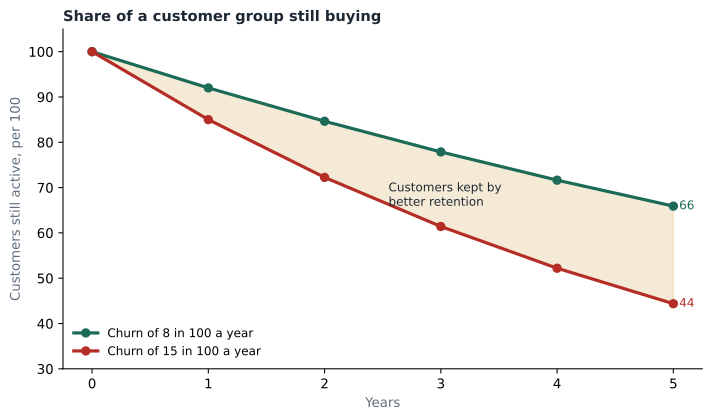
The chart shows why churn matters so much: the effect compounds. After five years, a group of customers with churn of 8 in 100 a year still has about 66 of every 100 customers; with churn of 15 in 100 a year, it has about 44. Each year's lost customers also take away the next year's purchases and referrals.
What service teams can do to keep customers
Service teams influence loyalty more than almost anyone else, because they handle the moments when customers find out whether promises are real. Several practices make a measurable difference.
- Solve problems the first time, with little effort for the customer. Lesson 10's effort research and lesson 8's first contact resolution both point here.
- Recover well from failures, quickly and fairly, as in lesson 6.
- Watch for warning signs, such as rising tickets, falling use or a changed contact, and act before the renewal or the next purchase.
- Contact customers when nothing is wrong. A check-in call, a useful tip or a heads-up about a coming change builds the relationship that carries a business through its next failure.
- Make it easy to stay. Simple renewals, accurate invoices and no surprise price increases remove reasons to look elsewhere.
- Be honest when a customer is better served elsewhere. A business that recommends the right option, even a competitor's, earns trust that often brings the customer back later.
Making it hard to leave is not the same as making customers loyal. Long cancellation processes, hidden auto-renewals and confusing exit fees may keep customers for a while, but they create resentment, complaints and, increasingly, legal risk. The FTC and many states regulate automatic renewals and cancellation of consumer subscriptions, and several states require that online sign-ups can be canceled online. The best retention strategy is giving customers good reasons to stay.
Maya's retention plan for Riverbend
Maya used the warning-sign table to review the clinic. She found three: the reception printer jams in October, which had been fixed; the monthly invoice confusion, which had been fixed in lesson 2's story; and a new clinic director, Dr. Felix Nwosu, who had started in September and had never met anyone from Ridgeline. That third sign worried her most. The person who would sign the renewal had no relationship with Ridgeline and had only heard about the problems.
Her plan, agreed with Darnell, had four steps. In late November she would request a short introductory meeting with Dr. Nwosu and Janet. She would bring a one-page summary of the year's service: faults, response times, the jam problem and how it was solved, and the invoice change, including the credit Ridgeline had applied without being asked. In December she would review the clinic's print volumes and suggest a change that would lower its monthly cost slightly by moving two little-used printers to a cheaper plan. And in January she would present the renewal with options, not a single price. The aim was to turn inertia into preference before February.
Winning customers back
Some customers leave despite everyone's efforts. A respectful win-back contact can bring a share of them back, especially if the reason they left has since been fixed. The first step is to find out why they left, with a short, genuine question rather than a sales pitch. If the problem was delivery timing and the store has since redesigned its deliveries, saying so is useful news, not pressure. Customers who left because of a change in their own needs should be thanked and left alone. Win-back efforts work best when they are rare, honest and specific; repeated generic offers to former customers mostly produce unsubscribes.
Retention in the store
At Juniper & Pine, Bev measured retention through repeat purchases. Of the 1,640 households that bought something in the first half of 2024, the store's records showed that 590 had bought again by the end of June 2026, a 24-month repeat purchase rate of 590 ÷ 1,640 × 100 = 36 in 100. Households that had contacted the service team with a problem had a lower rate overall, but those whose problem had been solved on the first contact came back at about the same rate as households with no problem at all. That finding persuaded the regional director that first contact resolution deserved investment.
Common mistakes
MistakeTreating repeat buying as proof of loyalty.
InsteadCheck attitudinal loyalty too; habit and switching costs create spurious loyalty that vanishes when a competitor makes switching easy.
MistakeCounting new customers in the retention rate.
InsteadRetention compares customers at the end who were also there at the start with the starting total.
MistakeAccepting price as the whole reason customers leave.
InsteadLook for the service problems and neglected relationships that usually come first.
MistakeContacting customers only when something is wrong or the contract is due.
InsteadCheck in when nothing is wrong, and meet new decision-makers early.
MistakeMaking it hard to cancel as a retention strategy.
InsteadGive customers reasons to stay; barriers to leaving create resentment and legal risk.
Summary and key terms
- Customer loyalty combines behavioral loyalty, what customers do, with attitudinal loyalty, how they feel.
- Repeat buying without real preference is spurious loyalty and is fragile.
- Retention is the share of starting customers still customers at the end of a period, excluding new ones; churn is the share who left.
- Retailers often measure repeat purchase rate instead.
- Customer lifetime value estimates the margin from a customer over the whole relationship; a simple estimate multiplies annual margin by one divided by the churn rate.
- Customers often leave because of accumulated service problems and neglect, even when they mention price, and there are visible warning signs.
- Service teams keep customers by solving problems first time, recovering well, watching warning signs, checking in when nothing is wrong and making it easy to stay rather than hard to leave.
- Behavioral loyalty
- Loyalty shown by actions, such as repeat purchases and renewals.
- Attitudinal loyalty
- Loyalty shown by preference, trust and willingness to recommend.
- Spurious loyalty
- Repeat buying from habit or switching costs without real preference.
- Retention rate
- The share of customers at the start of a period who remain customers at the end.
- Churn
- The share of customers lost in a period.
- Customer lifetime value
- The total profit expected from a customer over the whole relationship.
Practice problems
Work each problem on paper first, then reveal the answer to check.
A business starts the year with 200 customers, wins 40 and ends with 210. What is its retention rate?
Show answer
210 − 40 = 170 retained; 170 ÷ 200 × 100 = 85 in 100.
With churn of 10 in 100 a year, roughly how long does the average customer stay?
Show answer
1 ÷ 0.10 = 10 years.
Name two warning signs that a business customer may leave.
Show answer
Any two of: rising tickets or recurring faults; fewer contacts or a changed key contact; requests for contract details; lower product use; billing disputes.
Lesson quiz · 5 questions
Score 60% or more to complete this lesson.
Create a free account to save your progress, take quizzes and earn a certificate.