
SLS-130 · Lesson 3 of 12 · 19 min
Service standards and promises
▶ Video coming soon A video version of this lesson is on the way.
Two weeks after the journey-mapping session, Bev brought the store's eleven sales associates together before opening. She had a single sheet of paper. "Last month we told customers four different things about how long a special-order sofa takes," she said. "Somebody said six weeks, somebody said eight, somebody said 'about two months', and one of you said 'we'll call you'. All of those were said in good faith. Three of those customers complained when the sofa took ten weeks. We don't have a sofa problem. We have a promise problem."
This lesson is about the promises an organization makes to customers, the standards it sets so staff keep those promises consistently, and the gaps that open up when promises and delivery do not match. The ideas apply equally to a furniture store and to a business contract with written response times.
Expectations come from promises
Customers judge service by comparing what they receive with what they expected. If a sofa arrives in eight weeks, a customer told six weeks is disappointed, and a customer told ten weeks is pleased. The sofa and the eight weeks are identical. The difference is entirely in the expectation.
Expectations come from many places: what the customer has experienced before with this business and with competitors, what friends and reviews say, the price paid, and, most of all, what the business itself promises. Promises are made explicitly in advertising, on websites, in policies and in contracts. They are also made implicitly, by what salespeople say, by the look of the store and by the price. A showroom full of expensive furniture implies careful delivery even if nobody says so.
This gives every salesperson real power over customer satisfaction, and a real temptation. Promising the earliest possible date helps close a sale today and creates a complaint in two months. The discipline of good service is to make promises the organization can keep, and then to keep them. Many service teams use the phrase underpromise and overdeliver, but it can be overdone: a promise so cautious that the customer buys elsewhere helps nobody. The aim is an accurate promise with a small, deliberate margin.
The gaps model of service quality
In the 1980s three researchers, A. Parasuraman, Valarie Zeithaml and Leonard Berry, studied why service often disappoints customers even in well-run companies. They described five gaps that can open between what customers expect and what they get. The model is still taught because it points to where a problem starts, which tells you who needs to fix it.
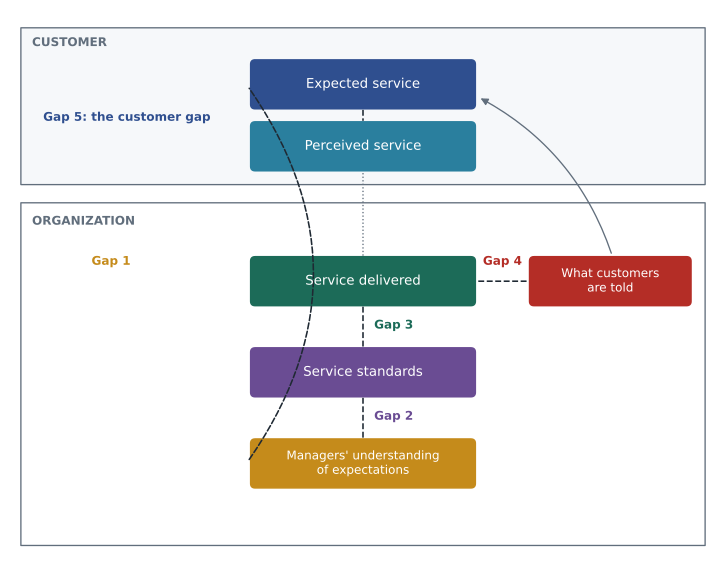
| Gap | What goes wrong | Juniper & Pine example |
|---|---|---|
| 1. Knowledge gap | Managers do not know what customers expect | Head office assumes customers care most about price, but the journey map shows delivery timing matters more |
| 2. Standards gap | Managers know, but do not turn it into clear standards | Everyone agrees delivery windows are too long, but no target window is ever set |
| 3. Delivery gap | Standards exist, but staff or systems do not meet them | The target is a two-hour window, but routes are planned too late to give one |
| 4. Communication gap | What is promised to customers differs from what is delivered | An associate tells a customer "we'll be there first thing", when the window is 8 to 12 |
| 5. Customer gap | What the customer receives falls short of what they expected | The customer took the morning off, waited, and felt let down |
The first four gaps are inside the organization, and the fifth is what the customer feels. The value of the model is diagnostic. If a business closes gap 4 by training staff to stop overpromising, but gap 3 remains because routes are still planned too late, customers will still be disappointed, only less surprised. Fixing service usually means working on more than one gap.
What makes a good service standard
A service standard is a specific, measurable description of how the organization will serve customers. Standards turn a vague intention, such as "we deliver promptly", into something staff can do and managers can check. Good standards share several features.
- Specific: they describe one observable behavior or result, such as "return customer calls within one business day".
- Measurable: someone can tell whether the standard was met, from a record or an observation.
- Based on what customers value: they come from evidence about expectations, not from what is easiest internally.
- Achievable with the people, tools and processes the organization actually has.
- Known by everyone who needs to meet them, and explained so staff understand why they matter.
- Reviewed regularly, because customer expectations and the business change.
Standards can cover outcomes, such as resolving a problem, timing, such as answering the phone within four rings, and behavior, such as greeting every shopper within a minute of entering the department. Behavioral standards should be written carefully. A standard that tells staff exactly what words to say can sound robotic. A standard that describes the purpose, such as "every customer is acknowledged, even if you are busy", leaves room for judgment.
| Weak standard | Stronger standard |
|---|---|
| We provide fast delivery | Customers are offered a delivery date at the time of sale and receive a two-hour window by 8 p.m. the evening before |
| We return calls promptly | Customer voicemails and emails are answered within one business day, and every reply names a next step |
| We are friendly | Every shopper is acknowledged within one minute of entering a department, even if the associate is with another customer |
| Service problems are taken seriously | Every complaint is logged the same day, assigned an owner and closed or updated within three business days |
Standards in business contracts: service level agreements
In business-to-business service, many standards are written into the contract as a service level agreement, or SLA. Ridgeline's managed print contract with Riverbend Dental Group includes three: a technician responds to a printer fault within four business hours; a fault is fixed, or a loan printer supplied, within one business day; and toner is delivered before it runs out, because the printers report their levels automatically. The contract also says what happens if Ridgeline misses: a service credit of 5 in 100 of that month's charge for each missed response, up to a limit.
SLAs make promises precise, which helps both sides. But they have limits. An SLA measures what is easy to measure, such as response time, and can miss what matters most to the customer, such as whether the same fault keeps coming back. A supplier can meet every SLA and still have an unhappy customer. Darnell's advice to Maya was to read every SLA as the minimum, not the goal. "Nobody renews because we responded within four hours," he said. "They renew because the printers just work, and when they don't, someone they trust sorts it out."
Maya also learned the difference between response time and resolution time. A response is the first action, often a call back or a technician being assigned. Resolution is the problem actually solved. Customers care much more about resolution, and a quick response followed by days of waiting can feel worse than a slower but complete fix.
Worked problem
Checking SLA performance and service credits
In September 2026 Riverbend Dental Group logged 6 printer faults. Ridgeline's technicians responded in 2, 3, 5, 1, 6 and 3 business hours. The SLA requires a response within 4 business hours, with a service credit of 5 in 100 of the monthly charge for each miss, up to 20 in 100 in total. The clinic's monthly charge is 1,180 dollars. How many responses missed the SLA, what share met it, and what credit is owed?
Show solution
- Compare each response with the 4-hour limit: 2 (met), 3 (met), 5 (missed), 1 (met), 6 (missed), 3 (met).
- Missed responses: 2. Met: 4 of 6, which is 4 ÷ 6 × 100 = 66.7 in 100.
- Credit rate: 2 × 5 in 100 = 10 in 100, which is below the 20 in 100 limit.
- Credit: 1,180 × 0.10 = 118 dollars.
Answer: Two responses missed the four-hour target, so 4 of 6 (about 67 in 100) met it, and the clinic is owed a credit of 118 dollars. Maya should tell the clinic about the credit before it asks, explain what caused the misses, and say what is being done.
Policies customers can see
Some promises are policies that customers read: return policies, warranty terms, delivery fees, price-match rules. These are promises too, and the law shapes some of them. In South Dakota, the state's deceptive trade practices law (SDCL chapter 37-24) prohibits misleading customers about the terms of a sale, and the Federal Trade Commission Act prohibits deceptive practices nationwide. Shoppers in South Dakota have no general legal right to return an item simply because they changed their mind; a store's return policy is its own promise. Once a store states a policy, though, it must honor it, and misstating it can be a deceptive practice. Products also come with legal protections against defects, which SLS-150, Sales Law and Ethics, covers in detail.
Juniper & Pine's return policy allows furniture to be returned within 30 days if unused, with a restocking fee for special orders. Bev made two changes after the promise meeting. First, the policy was printed on every receipt and on the website product pages, so customers saw it before buying rather than after. Second, associates were trained to mention the restocking fee on special orders out loud, at the moment of sale. Complaints about "hidden" fees dropped to almost none, not because the fee changed but because nobody was surprised by it.
Making promises consistent
The sofa problem Bev described is common: the organization's standard was clear, but individual promises varied because each associate estimated from memory. The fix was a simple one. Juniper & Pine added a field to its sales system that showed the current lead time for each supplier, updated weekly by the purchasing team, and a standard sentence for associates: "The supplier is currently quoting eight to ten weeks. I'll text you when it ships, and again when we have a delivery date." The sentence did three things: it gave an honest range, it named who was responsible for the delay, and it promised updates, which customers value almost as much as speed.
Consistent promises matter even more in business accounts, where several people from the same supplier talk to the customer. If Maya tells Riverbend that a RoomFlow upgrade will happen this month and the support team says next quarter, the clinic hears that Ridgeline does not know what it is doing. Teams that share one record of what was promised, usually in the CRM, avoid this. SLS-140 covers how CRM notes support this.
Checking that standards are being met
A standard that nobody checks slowly stops being a standard. Juniper & Pine reviews its service standards each month using records it already has: the time each voicemail and email was answered, the delivery windows sent and met, and the complaints logged and closed. Bev posts three numbers on the staff-room board: the share of messages answered within one business day, the share of deliveries that arrived inside their window, and the number of complaints still open after three days. She chose few numbers on purpose. A wall of twenty charts is ignored; three numbers that staff can affect are discussed at every huddle.
When a standard is missed again and again, the first question is whether the standard is wrong, not whether the staff are lazy. If associates cannot answer emails within a business day because they spend Saturdays on the floor, the fix may be to give one person on each shift time for messages, or to change the standard to something the store can actually keep and still tell customers honestly. Changing a standard is acceptable; quietly ignoring it is not, because the promise to customers stays in place either way.
Common mistakes
MistakePromising the earliest possible date to close a sale.
InsteadGive an accurate promise with a small margin, and promise updates if dates may change.
MistakeWriting standards as slogans, such as "we deliver fast".
InsteadMake standards specific and measurable, such as a two-hour delivery window sent by 8 p.m. the evening before.
MistakeFixing only the communication gap.
InsteadCheck all four internal gaps; if delivery cannot meet the standard, better wording alone will not satisfy customers.
MistakeTreating an SLA as the goal.
InsteadAn SLA is the minimum; customers judge resolution, recurrence and how problems are handled.
MistakeTelling customers about policies only after a problem.
InsteadState policies and fees clearly before the sale, in writing and in conversation.
Summary and key terms
- Customers judge service against expectations, and expectations come largely from the organization's own promises, explicit and implicit.
- The gaps model describes four gaps inside the organization (knowledge, standards, delivery and communication) that add up to the customer gap between expected and received service.
- Good service standards are specific, measurable, based on what customers value, achievable, known and reviewed.
- In business contracts, service level agreements set minimum response and resolution times, often with service credits for misses.
- Visible policies such as return policies are promises shaped by consumer protection law, and must be stated clearly before the sale.
- Consistent promises need shared, current information and agreed wording.
- Service standard
- A specific, measurable statement of how the organization will serve customers.
- Gaps model
- A model of five gaps between customer expectations and the service received, four of them inside the organization.
- Service level agreement (SLA)
- Contract terms setting minimum service levels, such as response and resolution times.
- Response time
- The time until the first action on a customer's request.
- Resolution time
- The time until the customer's problem is actually solved.
- Service credit
- A reduction in charges paid to a customer when an SLA is missed.
Practice problems
Work each problem on paper first, then reveal the answer to check.
A customer is told a sofa will take six weeks and it takes eight. Another is told ten weeks and it takes eight. Why do they feel differently?
Show answer
Satisfaction depends on the gap between expectation and delivery; the promise set different expectations.
Which gap is at fault if the standard is a two-hour delivery window but the warehouse cannot plan routes in time?
Show answer
The delivery gap (gap 3): a standard exists but the operation cannot meet it.
A contract credit is 4 in 100 of a 2,500-dollar monthly charge per missed response. Three responses are missed. What is the credit, assuming no cap?
Show answer
3 × 4 in 100 = 12 in 100; 2,500 × 0.12 = 300 dollars.
Lesson quiz · 5 questions
Score 60% or more to complete this lesson.
Create a free account to save your progress, take quizzes and earn a certificate.