
ROOF-220 · Lesson 6 of 12 · 25 min
Fully adhered systems
▶ Video coming soon A video version of this lesson is on the way.
The new roof on the parish hall at St. Brendan's was fully adhered: every square foot of EPDM glued to the cover board below. On Monday afternoon, October 26, after the tear-off, Sabine, Felix and Rory laid 4 in of polyiso over the plank deck and a 1/2 in high-density polyiso cover board on top, fastening both layers together with long wood-deck screws and plates. By 3:00 p.m. they were rolling bonding adhesive. On Tuesday morning the sun came up into a thin mist, and Sabine would not let anyone open a pail until she had read her thermometer and done some arithmetic.
This lesson covers fully adhered single-ply systems: where they are used, what they are glued to, the kinds of adhesive, how contact bonding adhesive is applied, weather limits including the dew point, and the safety rules for adhesives.
What fully adhered means
In a fully adhered system, the membrane is bonded to the substrate over its whole area. Wind uplift is resisted by the bond between membrane and cover board, by the strength of the cover board and insulation, by the bond or fasteners holding them to each other, and by their attachment to the deck. Every layer has to hold, because the wind pulls on all of them. A beautifully adhered membrane on a cover board that is not properly fastened will lift off in a storm, cover board and all.
Fully adhered roofs are chosen for:
- Roofs with odd shapes, many penetrations or slopes, where large loose sheets would be hard to secure.
- Roofs where billowing and its noise are unwanted, such as over schools, churches and offices.
- High wind zones, where adhered assemblies reach high uplift ratings.
- Decks that do not hold membrane fasteners well.
- Appearance: an adhered roof lies flat and smooth.
Their limits are weather (adhesives need dry surfaces and suitable temperatures), cost (adhesive and the extra insulation attachment), time to apply, and the solvent vapor from many adhesives.
The substrate
A membrane can only be bonded to a surface that is firm, smooth, clean, dry and approved by the maker for that adhesive. Common substrates:
- Cover boards: high-density polyiso, gypsum-based boards with glass facers, or other boards on the maker's list. They give a tough, even surface that adhesive bonds to well.
- Polyiso insulation with a facer approved for adhering; some systems adhere directly to insulation.
- Concrete decks, primed where the maker requires.
- Plywood or oriented strand board in some systems.
Joints between boards are kept tight, edges flush, and steps between boards ground or filled. Any dust, frost, water or loose facer is a place where the bond will fail.
Holding down the boards
Under an adhered membrane, the insulation and cover board must resist the full uplift on their own attachment. Makers specify many more fasteners per board than under a mechanically attached roof, or full adhesion of the boards with foam or hot asphalt, with closer patterns at the perimeter and corners.
Worked problem
Insulation fasteners for the hall
The hall roof is 78 ft by 58 ft. Cover boards and insulation are 4 ft by 8 ft, fastened together through both layers. The maker requires 12 fasteners per board in the field and 16 in the perimeter and corners. Forty boards fall in the perimeter and corner zones. How many boards and fasteners are needed?
Show solution
- Roof area = 78 × 58 = 4,524 ft².
- Board area = 4 × 8 = 32 ft²; boards per layer = 4,524 ÷ 32 = 141.4, so 142.
- Field boards = 142 − 40 = 102.
- Fasteners = 102 × 12 + 40 × 16 = 1,224 + 640 = 1,864.
Answer: About 1,860 fasteners and plates through two layers, plus cut boards and waste. The fasteners went through 4-1/2 in of board and the 1-1/2 in planks, so 6 in screws gave about 1-1/2 in of penetration into the wood.
Kinds of adhesive
| Adhesive | How it works | Typical limits |
|---|---|---|
| Solvent-based bonding adhesive | contact adhesive applied to both surfaces, allowed to flash off, then mated | flammable; dry surfaces; above the dew point; ventilation |
| Low-solvent or low-VOC bonding adhesive | contact adhesive with less solvent | often slower to flash off; narrower temperature range |
| Water-based adhesive | applied to the substrate (and sometimes the sheet), membrane laid in it or mated after drying | needs temperatures above about 40 °F and no freezing until cured; slow in cool damp weather |
| Low-rise foam adhesive | two-part polyurethane foam in beads, membrane (usually fleece-backed) laid into it | temperature limits for foam and canisters; bead spacing by zone |
| Spray adhesive | canister or bulk spray contact adhesive | overspray control; wind |
| Self-adhered backing | factory-applied adhesive under a release film | temperature and primer limits |
The membrane's maker decides which adhesives may be used with its membrane, on which substrates, at what rate and in what weather. On the hall, Sabine used the maker's low-VOC solvent-based bonding adhesive, which suited the cool October weather better than a water-based one.
Applying contact bonding adhesive
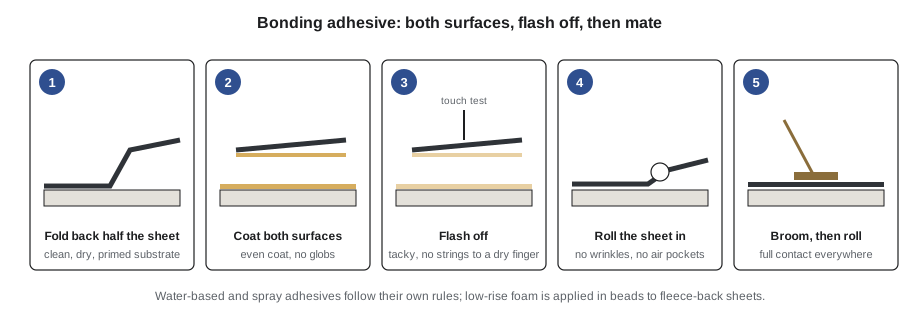
Contact adhesive works only when both surfaces are coated and the solvent has largely evaporated, so the two tacky films grab each other on contact. The routine on the hall:
- Position the relaxed sheet exactly where it will go. Fold it back lengthwise on itself to expose half of the substrate and the underside of half the sheet.
- Stir the adhesive thoroughly; solids settle in the pail.
- Apply an even coat to both the substrate and the underside of the sheet with a medium-nap roller, avoiding globs, puddles and bare spots. Keep the adhesive off the seam areas, where tape will go later, by leaving those edges uncoated or masked.
- Let it flash off. Touch the adhesive with a clean, dry finger, pushing straight down; when it feels tacky but no adhesive strings or comes off on the finger, it is ready. Too soon and the trapped solvent forms blisters; too late and the films no longer grab.
- Roll the folded sheet back onto the substrate in one smooth motion, without stretching it or letting wrinkles form. The crew does this together, keeping the fold moving evenly.
- Immediately broom the sheet down with a stiff push broom from the center outward, then roll it with a weighted roller to press every part into contact.
- Repeat for the other half.
Rory's job on Monday was the pail and the substrate roller. Felix coated the sheet. Sabine watched the flash-off. Once, she held them back a full five minutes in the shade of the church tower. "Cold board, slow solvent," she said. "The clock is a guide. Your finger's the test."
Coverage
Adhesive coverage is the area covered by a given volume. For contact adhesives, makers usually state it as finished area, meaning the area of membrane bonded, with both surfaces coated. A typical solvent-based bonding adhesive might bond about 60 ft² per gallon of finished area; the actual figure is on each product's data sheet.
Worked problem
Bonding adhesive for the hall
The hall's 4,524 ft² of field membrane will be bonded with adhesive covering 60 ft² of finished area per gallon. It comes in 5 gal pails. How many pails are needed?
Show solution
- Adhesive = 4,524 ÷ 60 = 75.4 gal.
- Pails = 75.4 ÷ 5 = 15.1, so 16 pails.
Answer: Sixteen pails for the field, plus more for the wall flashing (lesson 10). Sabine ordered 18, because cold boards soak up a little more and an opened pail cannot be returned.
Checking the coverage as work goes is the same idea as the yield test of ROOF-210: mark the area a pail is expected to cover and see whether it does. Running far over means the coat is too thick and will be slow to flash off; running far short means bare spots.
Weather and the dew point
Adhesives depend on dry surfaces. Moisture between the adhesive and the substrate, or on the adhesive film, ruins the bond. Three weather checks come before every adhesive day:
- Temperature: the air, the substrate and the adhesive must be within the maker's range. Adhesive stored overnight in a cold truck spreads poorly and flashes off slowly; Ridgecap keeps pails in a heated trailer in spring and fall.
- Surface moisture: no dew, frost, rain or wet boards.
- Dew point: the temperature at which moisture in the air condenses. As solvent evaporates, it cools the adhesive film. On a cool, humid day the film can drop below the dew point, and water condenses on it, a problem called blushing. A blushed film looks dull or milky and will not bond.
A common rule, which many makers follow, is to keep the surface at least 5 °F above the dew point, and to stop if blushing appears.
Worked problem
Tuesday morning at the hall
At 8:00 a.m. on Tuesday the air was 45 °F with relative humidity of 85 in 100, giving a dew point of about 41 °F. The cover board surface read 43 °F. By 10:00 a.m. the air was 54 °F, relative humidity 60 in 100, dew point about 40 °F, and the surface 52 °F. When could adhesive work start, using a margin of 5 °F?
Show solution
- 8:00: surface − dew point = 43 − 41 = 2 °F, less than 5 °F. Wait.
- 10:00: surface − dew point = 52 − 40 = 12 °F, more than 5 °F, and the board was dry.
Answer: Work started at about 10:00 a.m., once the mist had burned off and the board was dry to the touch. The crew spent the first two hours priming the seam areas on Monday's sheet, which needed no adhesive, and finishing the edge metal.
Adhesive work also stops early enough in the afternoon that the day's sheets are bonded and rolled before the temperature drops and dew forms. On the hall that meant the last sheet was down by 3:30 p.m. in late October.
Low-rise foam adhesive
Low-rise foam adhesive is a two-part polyurethane that comes in canisters or in bulk with a dispensing cart. It is applied in beads, which rise slightly as they foam, and a fleece-backed membrane is laid into the wet beads and rolled. The fleece gives the foam something to grip. Bead spacing is set by the maker and the wind zone, typically 12 in apart in the field and closer in perimeters and corners. Foam adhesives are also used to adhere insulation and cover boards. They need the canisters and the surface within their temperature limits, and the crew must lay the membrane within the foam's working time.
Adhesive safety
- Read the safety data sheet for every adhesive, primer and cleaner. Under OSHA's Hazard Communication Standard, the label and SDS give the hazards, protective equipment and first aid.
- Solvent-based adhesives are flammable. No smoking, no open flame, no grinding sparks nearby. Keep pails closed when not in use and store them away from heat.
- Vapor can enter the building. Shut off or cover rooftop air intakes and tell the occupants; at the hall, the intakes for the kitchen fan and the furnace were taped over with poly and the hall was closed for the three days.
- Wear chemical-resistant gloves and eye protection; some products call for respirators in enclosed or poorly ventilated areas.
- Rags soaked with adhesive or solvent are kept in a closed metal container and removed from the roof at the end of the day.
- Wet adhesive is extremely slippery; walk on bonded membrane or protected paths, not on coated areas.
What can go wrong
| Defect | Cause | Prevention |
|---|---|---|
| Blisters or bubbles | solvent trapped by mating too soon; moisture in substrate | proper flash-off; dry substrate |
| Loose areas | adhesive past its open time; bare spots; dust | touch test; even coat; clean surface |
| Wrinkles | sheet not relaxed; stretched while rolling in | relax sheet; roll in evenly |
| Blushing | surface below the dew point as solvent evaporates | dew point check and margin |
| Boards lifting with membrane | boards under-fastened | correct fastener pattern by zone |
By Tuesday at 3:15 p.m. all three sheets on the hall were bonded and rolled. Rory walked the roof with Sabine, pressing with his boot heel. One spot near the church wall felt soft; a tap with a knife handle sounded hollow. Sabine marked it. "We'll cut it, glue it and patch it tomorrow, with the seams," she said. "Better we find it than Mrs. Doyle's ceiling does."
Common mistakes
MistakeCoating only one surface with contact adhesive.
InsteadCoat both the substrate and the membrane, let them flash off, then mate.
MistakeMating before the adhesive has flashed off.
InsteadUse the dry-finger touch test: tacky with no strings.
MistakeIgnoring the dew point on cool, humid days.
InsteadKeep the surface a safe margin above the dew point and watch for blushing.
MistakeUnder-fastening insulation and cover board under an adhered membrane.
InsteadFollow the maker's board fastening or adhesion pattern for each zone.
MistakeLeaving air intakes open while using solvent adhesives.
InsteadShut off or cover intakes and tell the occupants.
Summary and key terms
- Fully adhered membranes are bonded over their whole area; every layer down to the deck must resist uplift.
- Substrates must be firm, smooth, clean, dry and approved for the adhesive.
- Boards under adhered membranes need more fasteners or full adhesion, closer at perimeters and corners.
- Contact bonding adhesive goes on both surfaces, flashes off until tacky, then the sheet is rolled in, broomed and rolled.
- Coverage is stated as finished area per unit volume; check it as work goes.
- Watch temperature, surface moisture and the dew point; follow the SDS and protect occupants from vapor.
- Fully adhered
- A system in which the membrane is bonded to the substrate over its whole area.
- Cover board
- A thin, tough board over insulation that protects it and gives a firm surface for the membrane.
- Contact adhesive
- An adhesive applied to both surfaces and allowed to flash off before they are pressed together.
- Flash-off
- The time for solvent to evaporate from an adhesive until it is tacky and ready to mate.
- Dew point
- The temperature at which moisture in the air condenses on a surface.
- Blushing
- Condensation on an adhesive film as evaporating solvent cools it below the dew point.
- Low-rise foam adhesive
- A two-part polyurethane adhesive applied in beads that rise slightly as they cure.
Practice problems
Work each problem on paper first, then reveal the answer to check.
A roof of 3,000 ft² uses adhesive at 60 ft² finished per gallon. How many 5 gal pails?
Show answer
3,000 ÷ 60 = 50 gal; 50 ÷ 5 = 10 pails.
Surface 48 °F, dew point 45 °F, margin 5 °F. Can adhesive work start?
Show answer
No: 48 − 45 = 3 °F, less than the 5 °F margin.
What does the dry-finger test check?
Show answer
That the adhesive has flashed off: tacky with no strings or transfer.
Why do boards under an adhered membrane need more fasteners?
Show answer
Wind pulls on the membrane, which pulls on the boards; their attachment carries the full uplift.
Name two signs of a poor bond found on a walk-over.
Show answer
Soft or spongy spots; hollow sound when tapped; blisters.
Lesson quiz · 5 questions
Score 60% or more to complete this lesson.
Create a free account to save your progress, take quizzes and earn a certificate.