
ROOF-220 · Lesson 4 of 12 · 24 min
PVC membranes
▶ Video coming soon A video version of this lesson is on the way.
Friday, October 23, was a service day. Sabine, Owen and Rory took the small truck to Corso's Trattoria, a family restaurant in a two-story building with a 66 ft by 50 ft roof covered in white PVC since 2018. The owner, Paolo Corso, had called about a drip over the bar. On the roof the cause of one problem was obvious before they reached it: the kitchen exhaust fan, mounted on a curb near the middle of the roof, had no grease containment, and a brown, sticky stain about 5 ft by 6-1/2 ft spread downwind of it. The other problem took longer to find: a split at the outside corner of the fan curb flashing, hidden under the grease.
"Good thing it's PVC," Owen said, kneeling by the stain. "If this were EPDM it'd be soft as a sponge by now." This lesson covers PVC membranes: what they are, why plasticizers matter, what PVC must be kept away from, where it is the right choice, and how it is welded and repaired.
What PVC is
PVC, polyvinyl chloride, is one of the most common plastics in the world. On its own it is rigid, as in plumbing pipe. Roofing PVC is made flexible by mixing in plasticizers, oily liquids that sit between the PVC molecules and let them slide past one another. Stabilizers, fire retardants, pigments and ultraviolet absorbers are added, and the compound is made into sheets by calendering or extrusion, with a polyester scrim or glass mat inside.
Like TPO, PVC is a thermoplastic, so it is welded with hot air. PVC generally welds more easily than TPO over a wider range of temperatures and speeds, and it stays weldable as it ages, as long as the surface is cleaned.
Types of PVC sheet
ASTM D4434 classifies PVC roofing sheet by its reinforcement:
- Type II sheets are reinforced with a glass-fiber mat or scrim, mainly for dimensional stability: they resist shrinking and growing. They are usually adhered or ballasted, with a minimum thickness of 45 mil.
- Type III sheets are internally reinforced, usually with polyester scrim, and may have a fabric backing. They are used for mechanically attached and other systems, minimum 45 mil.
- Type IV sheets are internally reinforced with higher strength requirements than Type III, with a minimum thickness of 36 mil. They are used where high strength at fasteners is needed.
Common thicknesses are 50, 60 and 80 mil, in widths up to 10 ft and in fleece-backed versions. Unreinforced PVC is made for flashing corners and odd shapes. Specifications sometimes add requirements beyond D4434, such as a minimum thickness over the scrim.
Plasticizers and why they matter
Plasticizers are what make PVC flexible, and they are also what make PVC sensitive. Over time and with heat, some plasticizer can migrate out of the sheet. A sheet that loses too much becomes stiff and, eventually, brittle, so it can crack in cold weather or shatter when struck. Modern PVC formulas use plasticizers that move far less than those in the first PVC roofs of the 1970s and 1980s, some of which did fail this way, and modern sheets are reinforced so shrinkage cannot tear them apart. Still, the way plasticizers behave explains the most important rule about PVC: what it can touch.
If PVC sits against a material that attracts its plasticizer, the plasticizer moves into that material. The PVC loses flexibility, and the other material may be damaged too. That is why PVC has a strict compatibility list.
What PVC must not touch
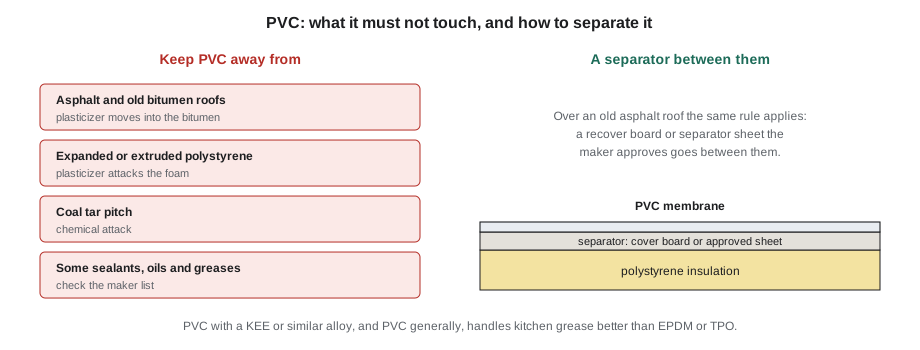
- Asphalt and bitumen: old built-up roofs, modified bitumen, asphalt cements and asphalt-based primers. Plasticizer moves into the bitumen. A PVC recover over an old asphalt roof needs a recovery board or a separator sheet the maker approves.
- Polystyrene insulation, both expanded (EPS) and extruded (XPS). Plasticizer attacks the foam, and the PVC stiffens. A separator, such as a cover board or a glass-fiber separator sheet, goes between them.
- Coal tar pitch, found on some older roofs.
- Some sealants, oils, solvents and rubbers. Only the maker's sealants and accessories are used.
- Other membranes: PVC is never welded to TPO, and is joined to EPDM or bitumen only through details the makers approve.
Rory asked how the crew would know whether an old roof under a PVC recover contained asphalt. "Core cuts," Sabine said. "You look before you price, and you look again before you lay anything."
Where PVC is chosen
- Restaurants and food plants, where grease, animal fats and cooking oils land on the roof. PVC, and especially PVC alloyed with KEE (ketone ethylene ester) or similar polymers, resists them better than EPDM or TPO.
- Chemical plants and labs, where exhaust contains chemicals that attack other membranes; the maker's chemical resistance chart is checked for each chemical.
- Roofs with many details: PVC's easy welding and flexible flashing make complicated roofs easier to flash.
- Fire-rated assemblies: PVC's chlorine content makes it self-extinguishing, and it reaches high fire ratings in many assemblies.
- Colored roofs: PVC is made in many colors, and printed patterns, for roofs that people see.
PVC usually costs more than TPO of the same thickness, which is why the cheaper membrane covers most warehouses and PVC covers most restaurants.
Worked problem
Comparing membrane cost for a small roof
Corso's roof is 3,300 ft². In 2018 the membrane cost about 1.05 per square foot for 60 mil PVC and 0.82 for 60 mil TPO, before labor. What was the difference in membrane cost, and what is it as a share of the TPO cost?
Show solution
- PVC = 3,300 × 1.05 = 3,465.
- TPO = 3,300 × 0.82 = 2,706.
- Difference = 3,465 − 2,706 = 759.
- Share = 759 ÷ 2,706 = 0.280, about 28 in 100 more.
Answer: About 760 more for the membrane, a small part of the total job cost. The prices are illustrations, not quotes; for a restaurant, the grease resistance is worth far more than the difference.
Grease on roofs
Even PVC is not grease-proof. Years of fat landing on any membrane will stain it, make it slippery and, over time, harm it. Kitchen exhaust fans throw grease out with the exhaust air, and grease also runs down the fan housing and drips onto the curb. Building and fire codes require kitchen exhaust systems to be cleaned and maintained, and many owners add a grease containment system: a tray or box around the fan with an absorbent filter that catches grease before it reaches the roof. The filters are changed as part of the exhaust cleaning schedule.
Grease on a roof is also a fire hazard and a slip hazard. Sabine had the crew lay a rubber mat on the walking route before anyone went near the stain.
Cleaning and repairing PVC
The routine at Corso's:
- Scrape off the thick grease with plastic scrapers and bag it. Steel scrapers can cut the membrane.
- Wash the area with the membrane maker's approved cleaner or a mild detergent solution, rinse, and dry. Never use solvents that the maker does not approve; some attack PVC.
- Inspect the cleaned membrane. Around the Corso's fan it was stained but still flexible, except for a patch about 2 ft by 3 ft right below the fan's drip lip, which had stiffened and showed fine cracks when folded.
- Cut out membrane that is cracked or stiff, back to sound material, and weld in a new piece with laps all round, or weld a patch over it if the maker allows.
- Clean the weld area on the old sheet with the maker's cleaner, let it dry, then test-weld and peel before welding the repair.
- Weld with a hand welder and roller, probe the welds once they cool, and seal any cut edges the maker says to seal.
For the split at the fan curb, Owen cut out the old corner flashing and welded in a new pre-molded outside corner, lapped onto the curb flashing and the field. The split, he explained, had started where the original installer had stretched a flat patch around the corner instead of using a pre-molded piece, leaving a thin spot. "PVC lets you get away with a lot," he said. "Not forever."
Worked problem
Sizing the repair piece
The cracked area under the fan is 24 in by 36 in. The cut-out goes 2 in past the damage on each side, and the new piece laps 4 in past the cut-out on every side for welding. What size is the cut-out, and what size is the new piece?
Show solution
- Cut-out = (24 + 2 × 2) by (36 + 2 × 2) = 28 in by 40 in.
- New piece = (28 + 2 × 4) by (40 + 2 × 4) = 36 in by 48 in.
- Weld length around the piece = 2 × (36 + 48) = 168 in = 14 ft.
Answer: A 36 in by 48 in piece with rounded corners, and 14 ft of hand weld to probe.
Welding PVC compared with TPO
The welding method is the same for both thermoplastics, but Owen pointed out the differences he noticed:
- PVC usually welds at somewhat lower heat than TPO for the same speed, and is less likely to scorch.
- PVC welds show a small bead of melted material, called bleed-out, at the edge of a good weld; many crews use it as a quick visual check.
- Aged PVC welds well after cleaning; aged TPO may need more preparation.
- The settings still come from a test weld on the day's sheet, in the day's weather.
Some older PVC systems used solvent welding, in which a solvent such as tetrahydrofuran softens the surfaces so they fuse. It is rarely used now because of the fumes and the skill needed, but roofers may meet it on repairs.
Identifying the membrane on a service call
Service calls often start with a roof nobody at Ridgecap installed, and the first job is to know what it is. Sabine's checklist:
- Ask the owner for the roofing records, warranty or invoice. Many PVC and TPO sheets also have the maker's name printed along the lap edge.
- Look and feel: EPDM is rubbery, stretches easily and is usually black; TPO and PVC are smoother, stiffer plastics, usually white or gray.
- Look at the seams: tape or adhesive seams with a lap sealant bead suggest EPDM; narrow welded seams with no sealant suggest a thermoplastic.
- Look at a cut edge where one is exposed, or take a small sample: the scrim and the layers can be seen.
- Make a test weld on a sample or an out-of-the-way spot: TPO and PVC will weld to their own kind and not to each other.
At Corso's there was no doubt: the 2018 warranty was in Paolo's office, and the maker's name ran along every lap. On a roof with no records, Sabine said, a wrong guess means a repair that peels off in a month.
Walkway pads
Before leaving Corso's, the crew welded walkway pads from the roof hatch to the exhaust fan and to the rooftop unit, a route the exhaust cleaning company and the refrigeration technician used every few weeks. Walkway pads are thicker, textured sheets of the same material, welded along their edges to the roof membrane, with gaps between pads so water can drain.
Worked problem
Walkway pads for Corso's
The route from the hatch to the fan is 30 ft and from the fan to the rooftop unit is 18 ft. Pads are 30 in by 30 in, laid with 2 in gaps. How many pads?
Show solution
- Route length = 30 + 18 = 48 ft = 576 in.
- Each pad plus gap = 30 + 2 = 32 in.
- Pads = 576 ÷ 32 = 18 pads.
Answer: Eighteen pads. Owen added a pad at each side of the fan curb where technicians kneel, for 20 in all.
Paolo Corso signed the service ticket at 2:30 p.m. and agreed to have the exhaust cleaning company install a grease containment box and change its filter at every cleaning. The drip over the bar stopped that night, he told Glen the next week.
Common mistakes
MistakeLaying PVC directly on polystyrene insulation or an old asphalt roof.
InsteadUse a separator sheet or recovery board the maker approves.
MistakeCleaning grease with solvents not on the maker's list.
InsteadUse the maker's cleaner or a mild detergent, rinse and dry.
MistakeWelding PVC to TPO.
InsteadThey do not weld to each other; use only approved transitions.
MistakeStretching a flat patch around an outside corner.
InsteadUse a pre-molded or properly formed unreinforced corner.
MistakeIgnoring the source of grease after cleaning it up.
InsteadRecommend grease containment and regular exhaust maintenance.
Summary and key terms
- PVC is made flexible with plasticizers and is welded with hot air.
- ASTM D4434 Types II, III and IV differ in reinforcement and strength.
- Plasticizer migration makes PVC incompatible with asphalt, polystyrene, coal tar and some sealants; separate them.
- PVC, especially KEE-alloyed PVC, is chosen for restaurants and chemical exposure, and for complex or fire-rated roofs.
- Grease on a roof needs cleaning, repair of damaged membrane and containment at the source.
- PVC welds readily, even when aged, after proper cleaning and a test weld.
- PVC
- Polyvinyl chloride; as a roofing membrane, made flexible with plasticizers and welded with hot air.
- Plasticizer
- An oily additive that makes PVC flexible; it can migrate into incompatible materials.
- KEE
- Ketone ethylene ester, a polymer alloyed with PVC or used on its own to improve chemical and grease resistance.
- Separator sheet
- A sheet placed between a membrane and an incompatible material.
- Grease containment
- A tray or box with an absorbent filter around a kitchen exhaust fan.
- Bleed-out
- A small bead of melted material at the edge of a welded seam.
- Walkway pad
- A thick, textured pad welded or adhered to the roof to protect it on traffic routes.
Practice problems
Work each problem on paper first, then reveal the answer to check.
Why must PVC be separated from polystyrene insulation?
Show answer
Plasticizer migrates into the foam, attacking it and stiffening the PVC.
A damaged area is 16 in by 20 in. The cut-out is 2 in larger on each side and the new piece laps 4 in beyond that. What size is the new piece?
Show answer
Cut-out 20 by 24 in; new piece 28 by 32 in.
Name two places where PVC is a better choice than TPO.
Show answer
Restaurants with grease exhaust; chemical exposure; complex detail-heavy roofs.
What is grease containment?
Show answer
A tray or box with an absorbent filter around an exhaust fan to catch grease.
A walkway route is 40 ft; pads 30 in with 2 in gaps. How many pads?
Show answer
480 ÷ 32 = 15 pads.
Lesson quiz · 5 questions
Score 60% or more to complete this lesson.
Create a free account to save your progress, take quizzes and earn a certificate.