
ROOF-220 · Lesson 3 of 12 · 24 min
TPO membranes
▶ Video coming soon A video version of this lesson is on the way.
After lunch on that first Monday, Owen Kraus took Rory to the material staging area at the west end of the warehouse roof. Pallets of white TPO rolls sat on plywood under breathable tarps, each roll about 10 ft long and as thick as a culvert pipe. Beside them stood the robotic welder, a low machine on rubber wheels with a long nozzle and a pressure wheel, and a rack of hand welders and silicone rollers. "This is the membrane you'll see most in your career," Owen said. "It's white, it's welded, and it's unforgiving if you don't respect the heat."
TPO, thermoplastic polyolefin, has grown in the past thirty years from a new product to the most widely installed single-ply membrane in North America. Rory had already seen it twice: at the Northgate Medical Building wind repair in the spring and at the Eastport Distribution warehouse service call in the summer. This lesson covers what TPO is, how it is built, its strengths and weaknesses, how it is stored and handled, and how it changes with age.
What TPO is
TPO is a blend of polypropylene, a stiff plastic, and ethylene-propylene rubber, which adds flexibility. The polymers are blended with fire retardants, ultraviolet stabilizers, antioxidants and pigments, then extruded into sheets. Because the blend is thermoplastic, two pieces of TPO can be fused together with heat: hot air softens the surfaces and pressure joins them into one piece of material. A good TPO weld is stronger than the sheet around it.
TPO contains no plasticizers, unlike PVC, so it does not become brittle as plasticizers leave over time. Its long-term life depends on its stabilizers and on the thickness of the material protecting the scrim.
How a TPO sheet is built
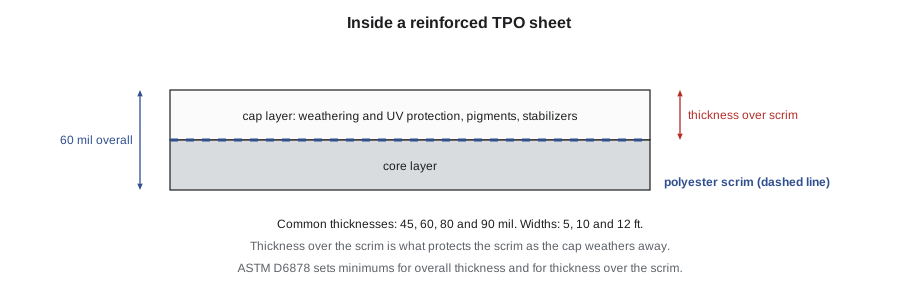
Almost all TPO roofing sheet is reinforced. It is made by laminating a top or cap layer and a bottom or core layer with a polyester scrim between them. The cap layer carries most of the weathering additives and the white pigment. The thickness of material over the scrim is important: as the top surface slowly weathers away over the years, that layer is what keeps the scrim covered. ASTM D6878 sets minimums for both the overall thickness and the thickness over the scrim.
TPO is sold in:
- Thicknesses of 45, 60, 80 and 90 mil. 60 mil is the common commercial choice; 45 mil is the minimum most makers offer for warranties.
- Widths of 5, 8, 10 and 12 ft. Narrow half sheets are made for perimeter and corner zones of mechanically attached roofs (lesson 5).
- Lengths of 100 ft per roll, with shorter rolls for the widest sheets.
- Colors: mostly white, also tan and gray. White TPO typically reflects about 75 to 85 in 100 of sunlight when new.
- Smooth or fleece-backed versions, the fleece for adhering with foam or adhesive.
TPO also comes as unreinforced flashing for forming corners, and as a range of accessories: pre-molded pipe boots and corners, T-joint covers, TPO-coated metal that can be bent into edges and welded to, walkway rolls, and cover strips.
Why TPO is chosen
- Welded seams. Hot-air welds are strong, fast with a robotic welder, and can be checked with a probe. Most leaks on welded roofs are at details, not field seams.
- Reflectivity. White TPO keeps roof temperatures down, helps meet cool-roof requirements and saves on cooling.
- Cost. TPO is usually cheaper than PVC for the same thickness.
- No plasticizers. It is less sensitive to contact with polystyrene and asphalt than PVC, though it still needs the maker's approval for each.
- Wide sheets and quick installation on large, simple roofs like warehouses.
Weaknesses
- Welding window. Older TPO, once its surface has weathered, can be harder to weld. Repairs on aged TPO need careful cleaning and test welds, and sometimes a special preparation product (see below).
- Heat. TPO is damaged by too much heat as easily as it is joined by enough. Scorching during welding thins the sheet and can expose the scrim.
- Chemical resistance. TPO resists many chemicals but not all; animal fats and some oils can affect it over time. Restaurant roofs usually get PVC or a maker-approved grease-resistant sheet.
- Variation between makers. TPO formulas differ from maker to maker, and so do their weld settings, accessories and instructions. One maker's TPO should be welded to another's only where both approve.
- Stiffness in cold. TPO is stiffer than EPDM in cold weather, so it is harder to work and lay flat on a cold morning.
Storage and handling
Owen ran through Crew 3's rules for TPO on the roof:
- Rolls stored off the roof surface on pallets or plywood, in their original wrapping until used, covered with breathable tarps. Plastic tarps trap condensation.
- Rolls stacked no higher than the maker allows, and weighted or strapped so wind cannot roll them.
- Loads spread over the deck. Pallets placed over joists or beams where possible, never in one heap in the middle of a deck span. Ridgecap's estimator gives the crew a staging plan for every large job.
- Rolls lifted with the right equipment: a crane or hoist to the roof, roll carts or two-person lifts on the roof. A 60 mil roll 10 ft by 100 ft weighs about 300 lb.
- Accessories, cleaners and primers kept in a locked job box or trailer, the solvents away from heat.
- In cold weather, rolls kept warm if possible, and unrolled to relax in the sun before use.
Worked problem
Loading the hoist
Alum Creek's material hoist is rated for 2,000 lb. A roll of 60 mil TPO weighs 300 lb, and the roll cradle weighs 90 lb. How many rolls can go up in one lift?
Show solution
- Capacity left for rolls = 2,000 − 90 = 1,910 lb.
- Rolls = 1,910 ÷ 300 = 6.4, so 6 rolls.
- Load with 6 rolls = 6 × 300 + 90 = 1,890 lb, under the 2,000 lb rating.
Answer: Six rolls per lift. Owen loads five, because the cradle only holds five safely and because roll weights on the delivery slip vary.
Unrolling and laying TPO
Rory helped Owen and Felix lay the last field sheets on the east side that afternoon. The routine:
- Check the insulation below: boards tight, flush and fastened, no gaps wider than the maker allows, nothing wet.
- Snap a chalk line or use the lap line printed on the sheet to set the position of the sheet edge.
- Unroll the sheet along the line and let it relax. TPO lies flatter after 15 to 30 minutes in the sun.
- Line up the sheet so it overlaps the previous sheet by the lap printed or specified, typically 6 in for fastened seams.
- Fasten the sheet edge with plates and screws (lesson 5) before the wind can get under it.
- Weld the lap (lesson 8) as soon as practical, then move on.
TPO sheets are laid so that laps shed water where the roof slope makes that possible: the upslope sheet laps over the downslope one, like shingles. On a nearly flat roof this matters less than on a sloped one, but makers still ask for it.
Aging and the welding window
A new TPO surface welds easily. As the sheet ages, its surface oxidizes and picks up dirt, pollen and pollution. After a few years, welding new TPO onto the old sheet takes more care:
- Clean the area thoroughly with the maker's cleaner and a clean, lint-free cloth, then let it dry completely.
- For older sheets, use the maker's weathered-membrane preparation product if the maker calls for one, which removes the oxidized surface layer.
- Make a test weld on the old sheet itself and peel it before welding the repair.
- If the old sheet will not take a good weld, use the maker's alternative, for example a tape-based repair or a larger replacement section.
"At Eastport, the TPO was six years old and welded fine after cleaning," Owen told Rory. "I've seen fifteen-year-old sheets that took three tries and a different cleaner. You don't know until you test."
Cool roofs and dirt
White TPO's reflectivity drops as it gets dirty. Rating programs list both an initial reflectance and a three-year aged value. A typical white TPO might reflect around 80 in 100 of sunlight new and around 65 to 70 in 100 after three years outdoors. Cleaning the roof restores part of the loss. Some energy codes and cities in the United States set minimum reflectance for low-slope roofs on certain buildings; the designer checks which apply.
Worked problem
Roof surface temperatures
On a sunny July afternoon at 86 °F, a black roof surface can reach about 165 °F, and a clean white one about 105 °F. By how many degrees does the white surface run cooler, and how much hotter than the air is each?
Show solution
- Difference = 165 − 105 = 60 °F.
- Black roof above air = 165 − 86 = 79 °F.
- White roof above air = 105 − 86 = 19 °F.
Answer: The white roof runs about 60 °F cooler. Typical values only: wind, insulation and dirt change them. A cooler membrane also ages more slowly.
Receiving and checking material
Owen had Rory check the morning's delivery against the order before any roll went up the hoist. On a single-ply job, the wrong product can look exactly like the right one:
- Check the label on each roll for the maker, product name, thickness, width, length and color. A 45 mil roll and a 60 mil roll of the same width look alike from the ground.
- Check the lot or batch numbers and keep a record; the maker may ask for them if a warranty question arises years later.
- Check for damage: crushed cores, cuts through the wrapping, wet cartons of accessories, bent coated metal.
- Check accessories: pre-molded corners, pipe boots, T-joint covers, cover strip, coated metal, cleaner and sealant should all be from the same maker and system.
- Check fasteners and plates: the specified type and length, in the quantities ordered.
- Report shortages and damage the same day, and set damaged material aside, marked, so it is not used by mistake.
Worked problem
Checking a delivery
The order for the last week was 12 field rolls 10 ft by 100 ft, 4 half-sheet rolls 5 ft by 100 ft, and 8 boxes of 7 in fasteners with 500 per box. The delivery slip shows 12 field rolls, 4 half rolls and 7 boxes of 7 in fasteners plus 1 box of 6 in. How much membrane area arrived, and what is wrong?
Show solution
- Field rolls = 12 × 10 × 100 = 12,000 ft².
- Half rolls = 4 × 5 × 100 = 2,000 ft².
- Total gross membrane = 14,000 ft².
- Fasteners: 7 × 500 = 3,500 of the right length; one box of 6 in screws is too short for the 6 in of insulation plus penetration.
Answer: The membrane is all there; the short box was set aside and returned. A box of short screws mixed into the right ones would have meant fasteners that never reached the deck.
TPO on the warehouse
The Alum Creek specification called for 60 mil reinforced white TPO from one maker, mechanically attached over two layers of polyiso, with that maker's fasteners, plates, accessories and edge metal, and a 20-year warranty. It had been chosen over the original ballasted EPDM for three reasons that Lena Hartwig, the owner's facilities manager, had explained at the pre-job meeting in August: the stone was too heavy for the solar panels planned for 2028, the dark roof made the loading area offices hot in summer, and welded seams could be checked with a probe. "I want to see somebody check every seam," she had said. Sabine had told her she would.
At 3:00 p.m. the wind came up out of the west. Owen sent Rory to fasten the edge of the sheet they had just unrolled before anything else. "Remember the twenty-ninth," he said. Rory asked what had happened on the twenty-ninth. "Lesson for tomorrow," Owen said.
Common mistakes
MistakeWelding one maker's TPO to another's without approval.
InsteadFormulas differ; join different makers' TPO only where both approve, and test-weld first.
MistakeWelding to aged TPO without cleaning and a test weld.
InsteadClean with the maker's products, let dry, test-weld on the old sheet and peel it.
MistakeCovering rolls with plastic tarps.
InsteadUse breathable tarps; plastic traps condensation on the sheets.
MistakeLeaving an unrolled sheet unfastened while doing something else.
InsteadFasten each sheet edge as soon as it is positioned.
MistakePiling all the rolls in one place on the deck.
InsteadSpread loads as the staging plan shows, over supports where possible.
Summary and key terms
- TPO is a blend of polypropylene and rubber; it is a thermoplastic and is joined by hot-air welding.
- Reinforced TPO has a cap layer, a polyester scrim and a core layer; thickness over the scrim protects the scrim.
- It is sold 45 to 90 mil thick and 5 to 12 ft wide, mostly white.
- Strengths: welded seams, reflectivity, cost and no plasticizers.
- Weaknesses: harder to weld when aged, damaged by excess heat, limited grease resistance, varies by maker.
- Store rolls off the deck under breathable tarps, spread the loads and fasten sheets as they are laid.
- TPO
- Thermoplastic polyolefin, a weldable single-ply membrane made from polypropylene and rubber.
- Cap layer
- The top layer of a TPO sheet, carrying the pigment and weathering additives.
- Thickness over scrim
- The thickness of membrane above the reinforcing scrim, which protects it as the surface weathers.
- Half sheet
- A narrow sheet used in perimeter and corner zones of mechanically attached roofs.
- Welding window
- The period and conditions in which a membrane can still be welded reliably.
- Coated metal
- Sheet metal with a factory-applied TPO or PVC coating that membrane can be welded to.
- Reflectance
- The share of sunlight a surface reflects, given new and after aging.
Practice problems
Work each problem on paper first, then reveal the answer to check.
Why can TPO be welded but EPDM cannot?
Show answer
TPO is a thermoplastic that softens with heat; EPDM is cured and does not melt.
A hoist is rated 1,500 lb; rolls weigh 300 lb and the cradle 90 lb. How many rolls per lift?
Show answer
(1,500 − 90) ÷ 300 = 4.7, so 4 rolls.
What should be done before welding new TPO to a sheet that is ten years old?
Show answer
Clean it with the maker's cleaner or preparation product, let it dry, and make and peel a test weld on it.
Why does the thickness over the scrim matter?
Show answer
It keeps the scrim covered as the surface weathers away.
A white roof reflects 80 in 100 new and 68 in 100 after three years. How much reflectance was lost?
Show answer
12 points, or 12 ÷ 80 = 15 in 100 of the original.
Lesson quiz · 5 questions
Score 60% or more to complete this lesson.
Create a free account to save your progress, take quizzes and earn a certificate.