
ROOF-220 · Lesson 1 of 12 · 25 min
Single-ply roofing systems
▶ Video coming soon A video version of this lesson is on the way.
On Monday, October 19, 2026, Rory Quintero climbed the ladder tower at the Alum Creek Freight warehouse and stepped onto the biggest white roof he had ever seen. After the Elmcrest bungalow, Crew 5 had more people than shingle jobs, and Wes Tremblay had lent Rory to Crew 3, Ridgecap's single-ply crew, for the last two weeks of October. The foreperson, Sabine Larocque, met him at the top with a hard hat sticker that said CREW 3 and a pair of soft-soled boots. "Change into these," she said. "Out here, the roof is one sheet thick. Anything that cuts a boot sole cuts the roof."
Sabine had spent 17 years in the trade, 12 of them on single-ply, and she trained Ridgecap's welders for the membrane maker. Her lead welder was Owen Kraus, a journeyworker who ran the robotic welder, and the crew had been on the warehouse since the Tuesday after Labor Day. Rory's first job that morning was to walk the finished part of the roof with her and learn what he was looking at.
This lesson introduces single-ply roofing: what a single-ply membrane is, the three main membrane families, the three ways the sheets are held down, how the parts of the roof work together as an assembly, and the standards and safety rules that apply. Later lessons take each membrane and each attachment method in turn.
What single-ply means
A single-ply membrane is one factory-made sheet that, laid in a single layer and joined at its seams, forms the whole waterproofing of a low-slope roof. In ROOF-210 Rory built roofs from two or more plies of bitumen-saturated felt or modified bitumen, so that one layer could fail and another would still keep water out. A single-ply roof has no second layer to fall back on. Its quality comes from the quality of the sheet, made under factory control, and from the care taken with every seam, fastener and detail on the roof.
Single-ply sheets are made in wide rolls, from about 5 ft to 50 ft wide depending on the material, and they are laid with relatively few seams. They are light: a 60 mil sheet weighs about 0.3 lb/ft², compared with 2 to 4 lb/ft² for a gravel-surfaced built-up roof. They need no kettle and, for most systems, no open flame. White sheets reflect most of the sunlight that falls on them, which keeps buildings cooler in summer.
Their weaknesses follow from the same features. One layer means one puncture is one leak. Foot traffic, dropped tools, sharp gravel, glass and screws are all threats, and so are the people who work on rooftop equipment after the roofers leave. Seams are made on the roof, in the weather, by people, and every meter of seam has to be right. That is why single-ply crews put so much effort into protecting the roof and checking their work.
The three membrane families
Three membranes cover most single-ply roofs in Canada and the United States:
- EPDM (ethylene propylene diene monomer) is a synthetic rubber. It is a thermoset: the rubber is cured, or vulcanized, in the factory, like a car tire, and after that it cannot be melted. EPDM seams are made with tape or adhesive. Most EPDM is black, though white EPDM is made. It has been used on roofs since the 1960s.
- TPO (thermoplastic polyolefin) is a blend of polypropylene and rubber. It is a thermoplastic: it softens when heated and hardens again when it cools, so its seams are welded with hot air. Most TPO is white. It arrived in the 1990s and is now the most widely installed single-ply membrane in North America.
- PVC (polyvinyl chloride) is also a thermoplastic, made flexible by adding plasticizers. It is welded with hot air like TPO. It has been used on roofs since the 1960s and resists grease, many chemicals and fire well.
Thermosets and thermoplastics behave so differently that the difference decides almost everything about how the roof is seamed, flashed and repaired. A roofer who reaches for a hot-air welder on an EPDM roof, or for seam tape on a PVC roof, has started the wrong repair.
| Feature | EPDM | TPO | PVC |
|---|---|---|---|
| Chemical family | thermoset rubber | thermoplastic | thermoplastic |
| Seams | tape or adhesive | hot-air welded | hot-air welded |
| Usual color | black (white made) | white or tan | white or gray |
| Repairs on aged sheet | clean, prime, tape | clean, then weld | clean, then weld |
| Grease and oils | damaged | limited resistance | good resistance |
| Contact with asphalt | avoid | avoid | never without separation |
| Contact with polystyrene | acceptable | acceptable | never without separation |
Other single-ply sheets exist, including KEE (ketone ethylene ester) membranes, chlorosulfonated polyethylene (often called by an old trade name, Hypalon), and newer thermoplastic blends. They are less common, and each one comes with its own maker's instructions. This course concentrates on EPDM, TPO and PVC.
Reinforced, non-reinforced and fleece-backed sheets
Single-ply sheets are made in three main constructions:
- Non-reinforced sheets are the membrane material alone. Non-reinforced EPDM can stretch a great deal and is made in very wide sheets for adhered and ballasted roofs.
- Reinforced sheets have a polyester scrim, a woven or knitted fabric, sealed inside the sheet. The scrim gives strength and resistance to tearing at fasteners, so reinforced sheets are used for mechanically attached roofs. Almost all TPO and PVC roofing sheets are reinforced.
- Fleece-backed sheets have a felt-like polyester fleece bonded to the underside. The fleece gives a surface for low-rise foam or other adhesives to grip, adds puncture resistance, and lets the sheet go over rougher surfaces.
Thickness is given in millimeters in Canada and in mils (thousandths of an inch) in the United States: 45 mil, 60 mil, 80 mil and so on. A mil is a thousandth of an inch, so 60 mil is 0.060 in. Thicker sheets cost more, last longer and resist punctures better.
Worked problem
Converting membrane thickness
A data sheet lists a TPO membrane as 2.03 mm, and another as 0.060 in. What is each in mils?
Show solution
- 1 mm = 1 ÷ 0.0254 = 39.37 mil.
- 2.03 mm = 2.03 × 39.37 = 79.9 mil, sold as 80 mil.
- 0.060 in = 0.060 × 1,000 = 60 mil.
Answer: 80 mil and 60 mil. Read the actual measured thickness on the data sheet as well as the nominal one; the standards allow a small tolerance below nominal.
Three ways to hold the membrane down
A single-ply membrane is only as good as its attachment. Wind passing over a roof lowers the pressure above it, and air leaking up from inside the building can push from below. Together they try to lift the membrane off the roof. There are three main ways to resist that pull:
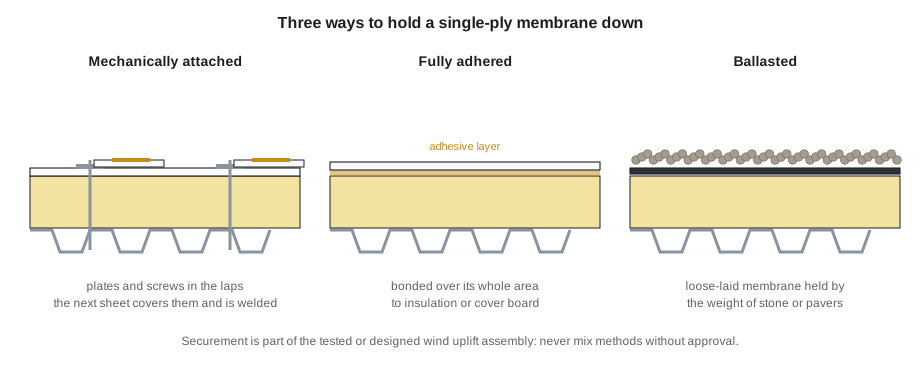
- Mechanically attached: the sheet is fastened to the deck with screws and plates, usually in the seams, so each fastener row is covered by the next sheet. The membrane between fastener rows is loose and can billow slightly in wind. Lesson 5.
- Fully adhered: the sheet is bonded over its whole area to the insulation or cover board below with bonding adhesive, low-rise foam or a self-adhered backing. The insulation and cover board must be firmly attached to the deck too. Lesson 6.
- Ballasted: the sheet is laid loose and held down by the weight of round river stone or concrete pavers, with fastening only at the perimeter and penetrations. Lesson 7.
Some roofs combine methods, for example adhered sheets at the perimeter and corners with ballast in the field, or induction-welded systems in which plates are fastened first and the membrane is bonded to their coated tops with an induction tool from above. Whichever method is used, it is part of a designed or tested assembly. A crew does not swap one method for another, or change a fastener spacing, without approval from the designer and the maker.
The roof as an assembly
Rory had learned in ROOF-120 and ROOF-210 that a low-slope roof is a stack of layers, each with a job. A single-ply roof has the same layers, and on Alum Creek Sabine pointed them out at a tear-off edge:
- The deck: here a steel deck, fluted, carrying all loads to the joists. Concrete, wood and other decks are covered in ROOF-310.
- A vapor retarder where the design calls for one, to keep moist indoor air out of the insulation.
- Insulation: on Alum Creek, two layers of polyisocyanurate (polyiso) boards with their joints staggered.
- A cover board where specified: a thin, tough board such as gypsum or high-density polyiso that protects the insulation and gives the membrane a firm surface. Adhered systems usually need one.
- The membrane, with its seams, flashings and accessories.
The membrane maker's warranty covers a whole system: the membrane, its accessories and the specific insulation, cover boards, fasteners and adhesives tested with it. Using a different fastener or adhesive, even a good one, can void the warranty and change the wind resistance of the roof. On a single-ply job, the maker's installation manual and the job specification sit in the truck, and Sabine expected her crew to look things up rather than guess.
Wind uplift: tested assemblies
How strongly the roof must resist uplift depends on the building's height, shape and location and on where on the roof the area lies. Wind pulls hardest at the corners, then along the perimeter, and least in the middle, or field, of the roof. Designers divide the roof into these zones and specify more attachment where the pull is greatest.
In Ohio, the Ohio Building Code (based on the 2021 International Building Code) requires roofs to resist the wind loads calculated by the ASCE 7 standard, and accepts uplift resistance proven by recognized tests such as FM 4474, UL 580 and UL 1897, or by listings from FM Approvals. Insurers often require an FM approval rating such as 1-90, meaning the assembly resisted 90 lb/ft² in testing. Membrane makers publish tested assemblies giving the exact deck, insulation, fasteners, spacing and membrane, and the designer picks one that meets the calculated wind load for each zone.
For the crew, the important point is that the fastener pattern, the sheet width and the adhesive rate on the drawings are not suggestions. They are the conditions under which the assembly passed its test.
Slope, drainage and the roof's surroundings
Single-ply membranes are made for low-slope roofs. The International Building Code sets a minimum slope of 1/4 in per foot (2 in 100) for single-ply roofs on new construction, and makers want water off the roof within about 48 hours after rain. Tapered insulation, crickets and drains are covered in ROOF-310. On a re-roof, Sabine said, the first question is always where the water goes.
Single-ply roofs are also affected by what sits on them. Restaurants vent grease onto their roofs. Rooftop units are serviced by technicians who drop screws. Solar panels and their racking add loads and traffic. Each affects which membrane is chosen and how it is protected, and later lessons return to them.
Worked problem
Sheets and seams on a warehouse roof
Alum Creek's field area between the perimeter half sheets is 302 ft long and 182 ft wide. TPO field sheets 10 ft wide are laid with 6 in laps, running the long way. How many field sheets cross the width, and about how many feet of field seam are there?
Show solution
- Net width of each sheet = 10 − 0.5 = 9.5 ft.
- Sheets = 182 ÷ 9.5 = 19.2, so 20 sheets, the last one trimmed.
- Seams between 20 sheets plus the two seams onto the perimeter sheets = 21 seams.
- Seam length = 21 × 302 = 6,342 ft.
Answer: Twenty field sheets and about 6,340 ft of field seam, not counting end laps, perimeter seams and details. Every foot of it has to be welded and probed.
Standards for single-ply membranes
Membranes are made and tested to product standards that set minimum thickness, strength, tear resistance, low-temperature flexibility, resistance to heat aging and ultraviolet light, and other properties:
- ASTM D4637 covers EPDM sheet. It has types for non-reinforced, scrim-reinforced and fabric-backed sheets.
- ASTM D6878 covers TPO sheet, including minimum overall thickness and minimum thickness over the scrim.
- ASTM D4434 covers PVC sheet, with types for different reinforcements.
- Fire performance of the roof covering is classified with ASTM E108 or UL 790 as Class A, B or C, and the class applies to the whole assembly as tested.
A roofer does not need to memorize these standards, but should know that a membrane meets them, that the data sheet says which, and that the specification may require a particular thickness or type.
Safety on single-ply roofs
Single-ply work has fewer burn hazards than built-up and torch work, but it has its own:
- Falls. Large, flat, white roofs feel safe, and the edge is a long way off. Under OSHA 1926.501(b)(10), roofers on low-slope roofs more than 6 ft above a lower level are protected by guardrails, safety nets, personal fall arrest systems, or a combination of a warning line with one of these or a safety monitor. Ridgecap sets its warning lines at least 6 ft from the edge, and anyone outside them uses travel restraint or fall arrest.
- Skylights and openings. A skylight is not a floor. Skylights are covered with screens rated for the load or guarded on all sides. Alum Creek had eight, all with screens.
- Slips. A white membrane with dew, frost or a skin of dust on it is very slippery, and so are wet bonding adhesives and the release films peeled off taped seams.
- Glare and heat. White roofs reflect sunlight back up into faces and eyes. Sunglasses rated for UV, sunscreen and extra water are part of the kit in summer.
- Hot-air welders and electricity. Welders run on 230 to 240 V power from generators or building outlets and reach hundreds of degrees at the nozzle. Lesson 8 covers them.
- Adhesives, primers and cleaners. Many are flammable and give off solvent vapor. Lessons 6 and 9 cover them.
- Wind. A loose sheet of membrane acts like a sail. Rolls and cut sheets must be weighted or fastened as they are laid.
"You'll get bored of hearing it," Sabine told Rory, "but on this roof the edge is the thing that kills you, and the wind is the thing that embarrasses you."
Protecting the roof
Because the roof is one layer, Crew 3 treated it like a finished floor from the moment it went down:
- Soft-soled boots only, checked for stones and screws in the treads at the ladder.
- Plywood or foam pads under ladders, carts, material stacks and generators.
- Tools in buckets or on pads, never dropped on the sheet. Fasteners, screws and cut-offs swept up as work goes.
- Rubber-wheeled carts only, and no wheelbarrows dragged with their legs down.
- Walkway pads laid on routes to rooftop equipment before the roof is handed over (lesson 10).
- Other trades on the roof are told the rules, and their work areas are protected.
At the end of the walk, Sabine handed Rory a small seam probe, a hooked steel tool with a rounded tip, and showed him how to drag it along a weld. "Every seam on this roof gets this," she said. "Every one. That's single-ply."
Common mistakes
MistakeTreating single-ply as foolproof because it is one sheet.
InsteadOne layer means every puncture and every bad seam is a leak; protect the roof and check every seam.
MistakeUsing the same repair method on every membrane.
InsteadIdentify the membrane first: EPDM is taped or glued; TPO and PVC are welded.
MistakeChanging fasteners, spacing or adhesive because it seems equivalent.
InsteadThe attachment is part of a tested or designed assembly; changes need approval.
MistakeWalking a white roof in work boots with stones in the treads.
InsteadSoft soles, clean treads, and pads under ladders, carts and stacks.
MistakeLeaving cut sheets or open rolls unweighted.
InsteadWeight or fasten membrane as it is laid; wind turns loose sheets into sails.
Summary and key terms
- A single-ply membrane is one factory-made sheet, seamed on the roof, forming the whole waterproofing.
- EPDM is a thermoset rubber seamed with tape or adhesive; TPO and PVC are thermoplastics seamed by hot-air welding.
- Sheets may be non-reinforced, scrim-reinforced or fleece-backed; thickness is in mils.
- Membranes are held down by mechanical attachment, full adhesion or ballast, as part of a tested or designed assembly.
- Wind pulls hardest at corners and perimeters, so those zones get more attachment.
- Fall protection, skylight protection, wind and protecting the finished sheet are constant concerns.
- Single-ply membrane
- A factory-made sheet laid in one layer and seamed on the roof to form the whole waterproofing.
- Thermoset
- A material cured in manufacture that cannot be melted again; EPDM is a thermoset.
- Thermoplastic
- A material that softens when heated and hardens when cooled, so it can be welded; TPO and PVC are thermoplastics.
- Scrim
- A polyester fabric sealed inside a reinforced membrane for strength and tear resistance.
- Fleece-backed
- Having a felt-like fabric bonded to the underside for adhesion and puncture resistance.
- Field, perimeter and corner zones
- Areas of a roof with increasing wind uplift, given increasing attachment.
- Mil
- A thousandth of an inch (0.0254 mm), used for membrane thickness in the United States.
Practice problems
Work each problem on paper first, then reveal the answer to check.
What is the main difference between a thermoset and a thermoplastic membrane for a roofer?
Show answer
A thermoplastic can be welded with heat; a thermoset cannot and is seamed with tape or adhesive.
Convert 1.14 mm to mils.
Show answer
1.14 × 39.37 = 44.9, sold as 45 mil.
Name the three main attachment methods.
Show answer
Mechanically attached, fully adhered and ballasted.
Which zone of a roof gets the most attachment, and why?
Show answer
The corners, because wind uplift is greatest there.
Field sheets 10 ft wide are lapped 6 in. How many cross a field 130 ft wide?
Show answer
130 ÷ 9.5 = 13.7, so 14 sheets.
Lesson quiz · 5 questions
Score 60% or more to complete this lesson.
Create a free account to save your progress, take quizzes and earn a certificate.