
ROOF-220 · Lesson 2 of 12 · 23 min
EPDM membranes
▶ Video coming soon A video version of this lesson is on the way.
On Monday, October 26, Sabine took Rory and Felix Amador off the warehouse for three days to re-roof the parish hall at St. Brendan's Church. The hall is a one-story building from 1962, attached on its north side to the stone wall of the church, with a wood plank deck and a roof 78 ft by 58 ft. Its roof was a black EPDM membrane, fully adhered in 1994, and it was leaking at the seams. The church's insurer did not allow open flame anywhere on the property, the hall was in use every day, and the parish wanted a roof that would last another thirty years. EPDM again was the answer, and at 7:30 a.m. the three of them were cutting the old one off.
The old sheet taught Rory more about EPDM in an hour than a data sheet could. It was still flexible after 32 years in the sun. But it had shrunk: along the church wall it was pulled tight across the angle where the roof meets the wall, and at one corner it had torn away from its flashing. The seams, made with liquid splice adhesive in 1994, peeled apart by hand in places. "The rubber's fine," Sabine said, pulling up a flap. "It's the glue and the details that let go. Remember that when you make the new seams on Wednesday."
This lesson covers EPDM: what it is, how it is made and sold, its strengths and weaknesses, how it ages, how it is attached and seamed, and what it can and cannot touch.
What EPDM is
EPDM is ethylene propylene diene monomer, a synthetic rubber made from ethylene and propylene, which come from natural gas and oil, with a small amount of a diene that allows the rubber to be cured. The rubber is mixed with carbon black, which gives standard EPDM its black color and protects it from ultraviolet light, along with oils, curing agents and processing aids. The mixed compound is calendered into thin sheets, laminated into the final thickness, and then cured with heat and pressure in large autoclaves, often while the sheet is rolled up on a mandrel. Curing links the rubber molecules together permanently, which is why EPDM is a thermoset and cannot be welded.
White EPDM is made with a white top layer, colored with titanium dioxide, over a black core. It reflects sunlight and is used where a cool roof is wanted, but it costs more and has its own seaming products.
Sheet types and sizes
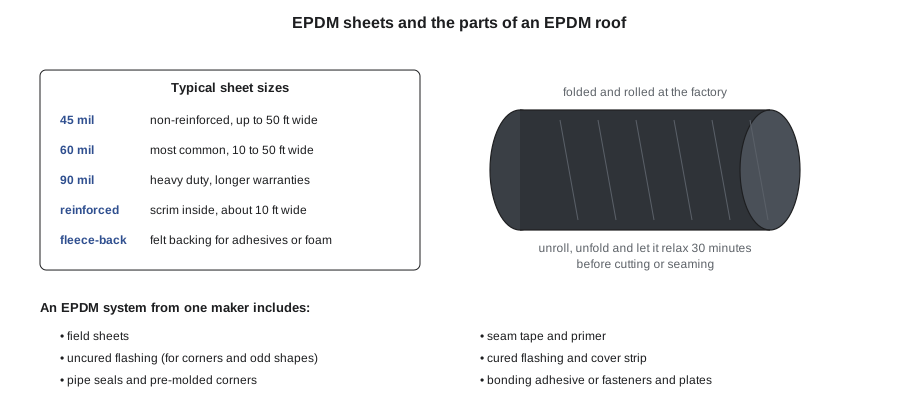
EPDM is sold in three main forms:
- Non-reinforced sheet, the most common. It stretches a great deal (several hundred in 100 before breaking) and is made in widths up to 50 ft and lengths up to 200 ft. Big sheets mean few seams. It is used for fully adhered and ballasted roofs.
- Reinforced sheet, with a polyester scrim inside, usually 10 ft wide. It resists tearing at fasteners and is used for mechanically attached roofs.
- Fleece-backed sheet, with a felt backing, for adhering with low-rise foam or adhesive over rougher surfaces.
Common thicknesses are 45, 60 and 90 mil. 60 mil is the usual choice for a commercial roof; 90 mil is used where long warranties, heavy traffic or hail are expected. ASTM D4637 sets minimum properties for EPDM sheet, with Type I for non-reinforced, Type II for scrim-reinforced and Type III for fabric-backed sheet.
Wide EPDM sheets are folded lengthwise in the factory before rolling, so a 50 ft sheet comes on a roll only about 8 to 10 ft long. On the roof the roll is unrolled, then the folds are opened out. Most makers want the sheet left to relax for about half an hour before it is cut, seamed or adhered, so that the stresses from folding and rolling ease and the sheet lies flat. Many sheets are dusted with talc or a similar powder in the factory so the folds do not stick together; that dust has to be cleaned off seam areas before any tape or adhesive goes on.
Worked problem
Choosing sheets for the parish hall
The hall roof is 78 ft long and 58 ft wide. Sabine wants the sheets to run the length of the roof and to extend 1 ft past each edge to wrap the edges and go up the church wall. Non-reinforced sheets 20 ft wide are laid with 3-1/2 in laps for taped seams. How many sheets are needed across the width, how long should each be cut, and what is the total sheet area?
Show solution
- Width to cover = 58 + 2 × 1 = 60 ft.
- Three sheets cover 3 × 20 − 2 × (3.5 ÷ 12) = 60 − 0.58 = 59.42 ft; that is 7 in less than the full width with both extensions. The roof itself is still fully covered; only the extension at the church wall drops from 12 in to 5 in. Sabine accepts it because the wall flashing is a separate sheet that laps onto the field membrane.
- Cut length = 78 + 2 × 1 = 80 ft.
- Sheet area = 3 × 20 × 80 = 4,800 ft².
Answer: Three sheets 80 ft long, 4,800 ft² of membrane, with two field seams of 78 ft each. A single 50 ft sheet plus one narrow sheet would have meant fewer seams, but the 20 ft sheets were what the supplier had in stock in October, and Felix said three people could handle them safely.
Why EPDM is chosen
- Durability. EPDM resists ultraviolet light, ozone and weathering very well. Many EPDM roofs have lasted thirty to forty years.
- Flexibility in cold and heat. EPDM stays flexible far below freezing and does not soften in summer heat, so it handles Midwest winters and building movement well.
- Stretch. Non-reinforced EPDM can stretch to bridge small cracks and movement without tearing.
- No flame or heat needed. Seams are taped or glued, so EPDM is suited to wood buildings, occupied buildings and sites where hot work is not allowed.
- Large sheets. Fewer seams mean fewer places to fail and faster installation on simple roofs.
- Repairable. Aged EPDM can be cleaned, primed and patched.
Weaknesses and how roofers deal with them
- Seams are the weak point. EPDM's seams are only as good as the tape or adhesive and the care taken to clean and prime them. Older liquid-adhesive seams, like the 1994 seams on the hall, are a common source of leaks. Modern tape seams are much more reliable (lesson 9).
- Shrinkage. Non-reinforced EPDM can shrink slowly over the years. Where it is fastened at walls and curbs, shrinkage pulls it tight across the angle, a condition called bridging, and can tear flashings away. Makers now require the sheet to be secured at the base of every wall, curb and angle change, often with a reinforced securement strip, so the shrinkage pulls against the fastening, not the flashing.
- Oils and grease. Petroleum products, animal fats and vegetable oils make EPDM swell and soften. It is a poor choice near restaurant exhausts or where oils are handled, unless protected.
- Punctures. Black EPDM is tough but not puncture-proof. Thicker sheets, fleece backing and walkway pads help.
- Heat gain. Black EPDM absorbs sunlight and gets hot, which raises cooling costs and may not meet cool-roof rules where they apply. White EPDM or a coating can help.
- Wrinkles and appearance. Large loose sheets can show wrinkles; they do not leak, but owners notice them.
How EPDM is attached
EPDM is used with all three attachment methods:
- Fully adhered: non-reinforced or fleece-backed sheet bonded with contact bonding adhesive, water-based adhesive or low-rise foam (lesson 6). The hall was fully adhered.
- Mechanically attached: reinforced sheet fastened in the seams with plates and screws, or with batten strips covered by cover strips (lesson 5).
- Ballasted: non-reinforced sheet laid loose and covered with stone or pavers (lesson 7). Many EPDM roofs from the 1980s and 1990s, like the original Alum Creek roof, were ballasted.
Every EPDM system includes perimeter securement: the sheet is fastened at the roof edge and at the base of walls, curbs and other angle changes, so wind and shrinkage cannot pull it away from the flashings.
The parts of an EPDM system
An EPDM roof uses a family of products from one maker:
| Product | What it is | Where it goes |
|---|---|---|
| Field sheet | cured EPDM, non-reinforced or reinforced | the main roof area |
| Seam tape | a strip of cured adhesive, usually 3 in wide | field seams |
| Primer | a solvent-based or low-solvent primer | seam and flashing areas before tape |
| Uncured flashing | unvulcanized EPDM that stretches and holds a shape | inside and outside corners, odd shapes |
| Cured cover strip | a strip of cured EPDM with tape backing, often 6 in | over T-joints, edge metal, batten strips |
| Pre-molded accessories | pipe seals, corners, T-joint covers | standard penetrations and corners |
| Bonding adhesive | contact adhesive for the field and flashings | fully adhered areas |
| Lap sealant | a sealant run along the edges of some seams and flashings | where the maker specifies |
| Securement strip | a reinforced EPDM strip with tape edges | base of walls and curbs, perimeter |
Uncured flashing deserves a note. It is EPDM that has not been vulcanized, so it can be stretched and formed around an outside corner or a pipe and will hold the shape. It slowly cures in the sun after installation. It is used only where the maker allows, in small pieces, and never as a field sheet.
Aging, cleaning and repairs
Over years in the sun, the surface of EPDM oxidizes and picks up dirt and a chalky film. A seam or patch will not stick to that surface. Repairs on aged EPDM follow a routine:
- Scrub the repair area with the maker's weathered membrane cleaner or primer on a scrub pad until the dull surface layer is removed and the rubber is black and even.
- Wipe off the residue and let the area dry.
- Prime the repair area and the patch, and let the primer flash off.
- Apply a patch of cured cover strip or tape-backed patch with rounded corners, at least 3 in beyond the damage on every side.
- Roll the patch firmly and seal its edge with lap sealant where the maker requires.
Rounded corners matter: a square corner on a patch is where peeling starts.
Worked problem
Patch size
A puncture in an EPDM roof is a tear 5 in long. Patches must extend at least 3 in past the damage on all sides. What is the smallest patch, and how big a piece of 6 in cover strip is that?
Show solution
- Length = 5 + 2 × 3 = 11 in.
- Width = 0 + 2 × 3 = 6 in, if the tear is a straight line.
- A 6 in cover strip cut 11 in long, corners rounded, just fits. Sabine would cut it 12 in long for margin.
Answer: At least 11 in by 6 in. In practice a wider patch, cut from a 9 in strip or from a sheet with tape applied, gives more room for error.
What EPDM can and cannot touch
- Petroleum products, solvents, oils and greases: keep them off. That includes asphalt roofing cement, many caulks and the oil that drips from rooftop units.
- Asphalt and bitumen: avoid direct contact; new EPDM over an old bituminous roof needs a recovery board or separator.
- Polystyrene insulation: generally acceptable under EPDM, unlike PVC, but the adhesive or primer must be one the maker approves for that insulation, because solvent can dissolve polystyrene.
- Sealants: use only the maker's lap sealant, water cut-off mastic and pourable sealer.
- Other membranes: EPDM can be joined to TPO or PVC only with transition details the makers approve.
EPDM on the parish hall
By noon on Monday the old membrane and the soggy fiberboard under it were in the bin, and the plank deck had been checked. Two planks near the church wall were soft and were replaced by the carpenter the parish had on standby. In the afternoon the crew fastened the new insulation and cover board (lesson 6), and Felix unrolled the first sheet along the south edge to relax while they worked. Rory noticed it was folded in four lengthwise. "Open it out and leave it," Felix said. "It's like a shirt out of the package. Give it half an hour and the creases go."
By the end of the day the first sheet was adhered. The hall's caretaker, Mrs. Doyle, came up the ladder at 4:30 to look and asked why the roof was black again when everything new she saw was white. "Black rubber has a forty-year record on buildings like this," Sabine said, "and we can glue it without a flame. You'll have a warmer hall in winter and a slightly warmer one in July."
Common mistakes
MistakeTrying to heat-weld EPDM.
InsteadEPDM is a thermoset; seam it with tape or adhesive as the maker specifies.
MistakeApplying tape or adhesive over dusty or weathered EPDM.
InsteadClean seam and repair areas with the maker's cleaner or primer until the rubber is clean and even.
MistakeCutting or seaming a sheet as soon as it is unrolled.
InsteadLet the sheet relax, typically about half an hour, so folds and stresses ease.
MistakeLeaving out base securement at walls and curbs.
InsteadSecure the sheet at every angle change so shrinkage and wind cannot pull the flashings.
MistakeUsing asphalt cement or ordinary caulk on EPDM.
InsteadUse only the maker's sealants; petroleum products attack EPDM.
Summary and key terms
- EPDM is a cured synthetic rubber; it cannot be welded and is seamed with tape or adhesive.
- It comes non-reinforced (wide sheets), reinforced (for mechanical attachment) and fleece-backed, typically 45 to 90 mil thick.
- It is durable, flexible in cold, needs no flame and comes in large sheets with few seams.
- Seams, shrinkage at walls, oils and grease, and punctures are its weak points.
- Aged EPDM must be cleaned and primed before patching; patches have rounded corners.
- Keep petroleum products, asphalt and non-approved sealants off EPDM.
- EPDM
- Ethylene propylene diene monomer, a cured synthetic rubber roofing membrane.
- Vulcanize
- To cure rubber with heat and chemicals so its molecules link permanently.
- Uncured flashing
- Unvulcanized EPDM that can be stretched and formed around corners and pipes.
- Cover strip
- A strip of cured EPDM with a tape backing, used over joints and edge metal.
- Bridging
- A membrane pulled tight across an angle instead of following it, often from shrinkage.
- Securement strip
- A reinforced strip fastened at the base of walls and curbs to hold the membrane against shrinkage and wind.
- Relaxing
- Leaving an unrolled sheet flat so the stresses from folding and rolling ease.
Practice problems
Work each problem on paper first, then reveal the answer to check.
Why can't EPDM be welded?
Show answer
It is cured (vulcanized) in the factory, a thermoset, so it does not melt.
A roof is 100 ft wide. Sheets 20 ft wide are lapped 3-1/2 in. How many sheets cross it?
Show answer
Net width 19.71 ft; 100 ÷ 19.71 = 5.07, so 6 sheets.
What causes bridging at a wall, and what prevents it?
Show answer
Shrinkage of the sheet pulling across the angle; securement at the base of the wall.
What must be done to aged EPDM before a patch goes on?
Show answer
Scrub it clean with the maker's cleaner or primer, dry it and prime it.
Name two things that should not touch EPDM.
Show answer
Petroleum oils and grease, asphalt cement, non-approved sealants.
Lesson quiz · 5 questions
Score 60% or more to complete this lesson.
Create a free account to save your progress, take quizzes and earn a certificate.