
ROOF-120 · Lesson 1 of 12 · 28 min
What a roof has to do
▶ Video coming soon A video version of this lesson is on the way.
Rory Quintero's first week of building science did not start in a classroom. It started in a wet attic. Dana Renaud had taken the Crew 2 pickup to a call on Linden Street, where an owner had found brown stains on a bedroom ceiling every March for three years. Two other roofers had been out. Both had put a new bead of sealant around the plumbing vent and called the job done. Both times the stain came back.
Dana handed Rory a flashlight and sent him up through the ceiling hatch. The underside of the roof boards was black with mold along the eaves. The insulation was flattened and gray in a band about a meter wide above the outside walls. The plumbing vent was bone dry. "So it's not the vent," Rory called down. "No," said Dana. "It never was. Come down and I'll tell you what a roof actually does, and then you'll know what went wrong here."
This course is about the science behind roofing: why roofs are built the way they are, what each layer does, and how the materials behave. Roofers who understand that science can read a roof the way a mechanic reads an engine. They find the real cause of a leak, they choose materials that work together, and they avoid building in the next failure. This first lesson sets out the jobs every roof has to do. Every later lesson in the course explains how one part of the roof does one or more of those jobs.
A roof is a system, not a covering
Most people think of a roof as the shingles or the membrane they can see. Roofers think of it as an assembly: a set of layers that work together, each doing at least one job. On a house, the assembly runs from the shingles down through the underlayment, the deck, the rafters or trusses, the attic air space, the insulation, the ceiling air barrier and vapor control, and the ceiling itself. On a commercial low-slope roof, it runs from the membrane down through the cover board, the insulation, the air and vapor barrier and the structural deck.
Because the layers work together, a change to one layer changes how the others behave. Add insulation without adding ventilation or air sealing and the roof deck gets colder, so moisture that used to dry out may now condense. Put a dark membrane where a white one was and the insulation runs hotter all summer. Fasten a membrane well in the field of the roof but leave the edge weak, and the whole roof can peel away in one storm. A good roofer always asks what else a change will affect.
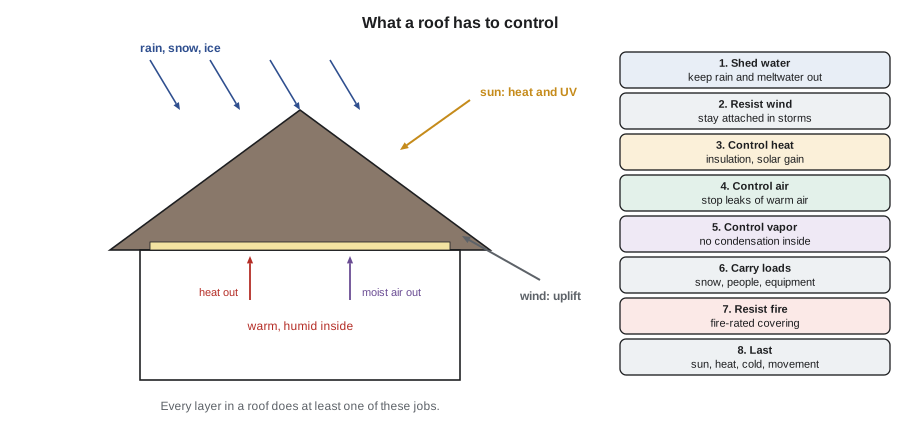
Job 1: keep water out
Keeping water out is the job everyone expects. It is also the hardest to do perfectly for 20 or 30 years. Water reaches a roof as rain, snow, hail, meltwater, condensation and wind-driven spray. Roofs handle it in two different ways, and the difference shapes every material choice in this course.
- Steep-slope roofs shed water. Shingles, tiles, slate, wood shakes and metal panels overlap like the feathers on a bird. Each piece laps over the one below, and gravity carries the water down and off the roof before it can work its way back up through the laps. These coverings are not waterproof at every joint; they depend on slope, overlap and an underlayment beneath them.
- Low-slope roofs hold water back. On a nearly flat roof, water moves slowly and may stand for hours. Overlapping pieces would leak, so low-slope roofs use a continuous waterproof membrane with sealed seams: built-up roofing, modified bitumen, single-ply sheets or liquid-applied coatings. The membrane must be watertight even with water standing on it.
Either way, the roof must also move the water somewhere useful. Gutters and downspouts carry it away from the walls and foundation of a house. Drains, scuppers and conduits carry it off a commercial roof. A roof that keeps water out but dumps it against a wall or onto a sidewalk where it freezes has only done half of its job.
Water is patient. It moves by gravity, but it also moves sideways and even uphill. Wind pushes rain up under laps. Capillary action pulls water into narrow gaps between two flat surfaces, the way a paper towel soaks up a spill. Surface tension lets drops cling to the underside of a flashing and run back toward the wall. Ice dams hold meltwater on the roof long enough for it to back up under shingles. Most roofing details, from the drip edge to the counterflashing, exist to defeat one of these tricks.
Worked problem
How much water lands on a roof in a storm
During a summer storm, 1 inch of rain falls in one hour on the 28,000 ft² Ashgrove Plaza roof. How much water must the drains carry, how much does it weigh, and what is the average flow per minute? The roof has four drains.
Show solution
- Change the rain depth to feet: 1 in = 1/12 ft ≈ 0.0833 ft.
- Volume = area × depth = 28,000 ft² × 0.0833 ft ≈ 2,333 ft³.
- One cubic foot holds about 7.48 gallons and weighs about 62.4 lb, so 2,333 ft³ ≈ 17,450 gal, weighing about 145,600 lb (about 73 tons).
- Flow per minute = 17,450 gal ÷ 60 min ≈ 291 gal/min.
- Shared by four drains: 291 ÷ 4 ≈ 73 gal/min each, if the roof slopes evenly to all four.
Answer: About 17,450 gallons (about 73 tons) of water in an hour, roughly 291 gal/min in total or about 73 gal/min per drain. One blocked drain sends its share to the other three or leaves it standing on the roof.
That example shows why a plugged drain is an emergency on a low-slope roof. Water that cannot leave builds up. Each inch of standing water adds load, and the deeper the pond, the more the deck sags, which lets the pond grow deeper still. Building codes require secondary (overflow) drainage on many roofs with parapets for exactly this reason, and the structural designer sets how deep water may get before it overflows.
Worked problem
The weight of a pond
After a storm, Rory finds a pond about 2 inches deep covering about 430 ft² beside a clogged drain on a warehouse roof. What does the water weigh, and what load does it add per square foot?
Show solution
- Volume = 430 ft² × (2 ÷ 12) ft ≈ 71.7 ft³.
- Weight ≈ 71.7 × 62.4 lb ≈ 4,470 lb (more than two tons).
- Load per square foot = 4,470 ÷ 430 ≈ 10.4 lb/ft².
- Rule of thumb: each inch of water weighs about 5.2 lb/ft², so 2 in ≈ 10.4 lb/ft².
Answer: About 4,470 lb of water, adding about 10.4 lb/ft². Clear the drain and report the pond: a deck that ponds once will pond again.
Job 2: stay on the building in the wind
Wind does not just push on a building; it pulls on the roof. As wind flows over the roof edge, it speeds up and the air pressure above the roof drops, so the roof is sucked upward. At the same time, wind entering doors, windows and gaps on the windward side pushes up on the deck from inside. The two effects add together. The suction is strongest at the corners and along the edges, which is why storm damage so often starts with a peeled corner or a lifted strip of edge metal.
A roof resists wind through how it is attached: nails and sealant strips on shingles, fasteners and plates or adhesives on membranes, ballast stones or pavers on loose-laid roofs, and edge metal that clamps everything down at the perimeter. Lesson 10 covers wind uplift and securement in detail. For now, remember that a roof is only as strong as its weakest attachment, and the weakest attachment is usually at an edge.
Job 3: control heat
Buildings are heated in winter and often cooled in summer. The roof is where a lot of that energy escapes, because warm air rises and because the roof faces the sky, the sun and the coldest night air. Insulation in or on the roof slows heat flow. On houses it usually sits on the attic floor; on low-slope commercial roofs it usually sits on top of the deck, under the membrane.
The roof surface itself also matters. A dark roof in full summer sun can reach about 175 °F on its surface, while a white one may stay around 115 °F. The same roof can drop to −4 °F or colder on a clear winter night. That daily and yearly swing makes materials expand and contract, ages asphalt and plastics, and drives moisture in and out of the assembly. Lesson 5 explains how heat moves and how insulation is measured.
Job 4: control air
Warm indoor air is lighter than cold air, so it rises and tries to escape through the top of the building. This is called the stack effect. Any hole in the ceiling or roof assembly, such as gaps around pot lights, plumbing stacks, attic hatches, wiring holes or the joints between insulation boards, becomes a chimney. The escaping air carries heat with it, which wastes energy. Worse, it carries moisture.
An air barrier is a continuous layer that stops this airflow. On a house it is usually the sealed ceiling drywall or a sealed polyethylene sheet; on a commercial roof it is a membrane on the deck or a properly sealed roof membrane itself, tied into the wall air barrier at the edges. Air barriers fail at their joints and penetrations, so continuity is everything.
Job 5: control water vapor
Indoor air always holds some water vapor, from people breathing, cooking, showering, plants, humidifiers and processes such as dishwashers or pools. When that warm, moist air reaches a cold surface, it cools. Cool air cannot hold as much vapor, and once it falls below its dew point, the vapor condenses into liquid water or frost. In a roof, that cold surface is often the underside of the deck in an attic, or the underside of the membrane or cover board on a low-slope roof.
Moisture reaches the roof in two ways: carried by leaking air, and by slow diffusion through materials. Air leakage usually moves far more moisture than diffusion does. A single small gap can carry liters of water into an attic over a winter, while a whole ceiling's worth of diffusion carries much less. That is why roofers and builders stress air sealing first and vapor control second. A vapor retarder slows diffusion; it is placed on the warm side of the insulation in a heating climate like central Ohio's. Lesson 4 covers air, vapor and ventilation together.
Dana's Linden Street attic was a moisture problem, not a leak through the roof covering. Warm, humid air from the house leaked up through gaps around a bathroom fan and a ceiling light, and the soffit vents were blocked by insulation, so the air could not be flushed out. Frost built up on the cold roof boards all winter and melted in March, dripping onto the insulation and through the ceiling. Sealant on the plumbing vent could never have fixed it.
Job 6: carry loads
The roof structure carries several kinds of load, and roofers add to or change some of them:
- Dead load: the weight of the roof itself, including the deck, insulation, membrane or shingles, and any ballast. A second layer of shingles or a gravel ballast adds dead load the structure may not have been designed for.
- Snow and rain load: snow piles and drifts, especially beside parapets, taller walls and rooftop units. Rain on snow and ponded water add more.
- Live load: people, materials and equipment during construction and maintenance. Stacking a full pallet of shingles or insulation in the middle of a span can overload a deck that is fine under snow spread evenly.
- Equipment loads: rooftop heating and cooling units, solar panels, antennas and their supports.
Roofers do not design structures, but they must not overload them. Land materials over beams, columns and walls, spread loads out, and ask before adding weight such as an extra roof layer or pavers. The building code sets the design snow load for each location, and only an engineer or the original design can say what a structure will carry.
Job 7: resist fire
Roof coverings are tested and classified for how well they resist fire spreading across them and burning brands landing on them. In both Canada and the US, coverings are rated Class A (the best), Class B or Class C. Canada uses CAN/ULC-S107 for the tests and the US uses ASTM E108 or UL 790. A rating applies to the whole tested assembly, so a Class A shingle may be Class A only over a particular deck and underlayment. The building code says which class is required, depending on the building type, its size and how close it sits to neighbors.
Roofing work itself is a fire risk, as you learned in ROOF-110: torches, kettles and hot-air welders all bring heat close to combustible materials. Material choices can reduce that risk, for example using a self-adhered or cold-applied product at a wood curb instead of a torch.
Job 8: last
A roof is expected to do all of these jobs for years with little attention. Durability depends on resisting:
| Enemy | What it does to a roof | How roofs resist it |
|---|---|---|
| Ultraviolet (UV) light | breaks down asphalt, plastics, rubber and sealants | mineral granules, gravel, coatings, UV-stable formulations, metal caps |
| Heat | ages asphalt and makes it brittle; softens adhesives | reflective surfaces, ventilation, heat-resistant products |
| Cold and freeze-thaw | cracks brittle materials; ice expands in gaps and lifts laps | flexible modified materials, eave protection, good drainage |
| Thermal movement | expands and shrinks metals and membranes daily | expansion joints, cleats, loose details that allow movement |
| Building movement | deck deflection, settling, shrinking wood | flexible flashings, base sheets, expansion joints |
| Water standing for days | speeds aging, grows algae and plants, adds load | slope to drains, crickets, regular cleaning |
| Foot traffic and impact | punctures, crushed insulation, hail damage | walkway pads, cover boards, impact-rated products |
| Chemicals and grease | kitchen exhaust grease softens some membranes | grease guards and chemical-resistant membranes near exhausts |
No roof lasts forever. A reasonable life for an asphalt shingle roof is about 15 to 30 years depending on the product and climate; a well-built modified bitumen or single-ply roof often lasts 20 to 30 years; copper, slate and clay tile can last far longer. Maintenance, such as clearing drains, resealing details and fixing small damage early, adds years to any roof.
How the jobs fit together
Each layer in the assembly does one or more jobs. Knowing which layer does which job is the first step in diagnosing a problem.
| Layer | Main jobs | Examples |
|---|---|---|
| Roof covering or membrane | shed or hold back water, resist UV, fire and hail | shingles, metal, modified bitumen, TPO, EPDM |
| Underlayment and eave protection | second line of defense against water | synthetic underlayment, felt, self-adhered membrane |
| Cover board | protect insulation, give a firm base, add fire and hail resistance | gypsum, wood fiber, high-density polyiso |
| Insulation | control heat; may support the membrane | polyiso, EPS, XPS, mineral wool, glass fiber |
| Air barrier and vapor control | stop air leakage; slow vapor diffusion | self-adhered membrane on deck, sealed polyethylene, sealed drywall |
| Deck | carry loads; hold fasteners; resist wind and fire | plywood, OSB, boards, steel, concrete |
| Ventilation (attics) | remove moisture and summer heat from the attic | soffit, ridge and roof vents |
| Flashings and edge metal | seal joints and edges; hold the roof down | drip edge, step flashing, copings, counterflashing |
When a roof fails, ask which job was not being done. A wet ceiling might be a failed covering (job 1), a moisture problem (jobs 4 and 5) or blocked drainage (job 1 again, at a gutter). The cure depends entirely on the cause.
Reading a roof: questions to ask
Dana gave Rory a checklist he still keeps in the back of his notebook. It works on any roof, steep or low-slope:
- Where does the water go? Follow it from the highest point to the gutter or drain. Look for places it could stand or back up.
- What is the roof made of, layer by layer? Is it one system, or have different materials been mixed?
- How is it held down, especially at the edges and corners?
- Where are the penetrations, curbs and walls? Most leaks start at these details, not in the open field.
- Where is the insulation, and where are the air barrier and vapor control? Are there signs of air leakage or condensation, such as frost, rust, stains or mold?
- Is there ventilation, and is it working?
- Is the structure sagging, ponding or overloaded?
- How old is the roof, and how has it been maintained?
Answering those questions before reaching for a sealant gun is what separates a roofer from a patcher.
What happened on Linden Street
Dana's crew fixed the Linden Street house in a single day. They sealed the air leaks around the bathroom fan and ceiling light from the attic side, connected the fan to a proper insulated duct running to a roof outlet, installed baffles at the eaves so the insulation could no longer block the soffit vents, and replaced the stained boards near the eave. The owner called the next March to say the ceiling was dry for the first time in four years.
"Sealant is a band-aid," Dana told Rory on the drive back. "Figure out which job the roof wasn't doing, and fix that."
Common mistakes
MistakeAssuming every ceiling stain is a leak in the roof covering.
InsteadCheck for condensation, air leakage, blocked ventilation and plumbing or HVAC leaks before blaming the shingles or membrane.
MistakeTreating the roof as just the visible covering.
InsteadThink of the roof as an assembly in which every layer does a job, and consider how a change to one layer affects the others.
MistakeStacking materials anywhere on a roof.
InsteadLand loads over beams, walls and columns, spread them out, and never assume the deck can carry extra weight.
MistakeIgnoring standing water on a low-slope roof.
InsteadClear drains, report ponding and remember that each inch of water adds load and speeds aging.
Summary and key terms
- A roof is an assembly of layers that work together; changing one layer changes how the others behave.
- Steep-slope roofs shed water with overlapping units; low-slope roofs hold it back with a continuous membrane and drain it away.
- Wind suction pulls up on roofs, most strongly at corners and edges.
- Roofs control heat with insulation and surface reflectance, and control air leakage and vapor to prevent condensation.
- Roofs carry dead, snow, rain, live and equipment loads; roofers must not overload them.
- Coverings are fire-rated Class A, B or C as tested assemblies.
- Durability means resisting UV, heat, cold, movement, standing water, traffic and chemicals.
- Assembly
- All the layers of a roof working together, from the covering down to the ceiling or deck.
- Water-shedding roof
- A roof covering of overlapping units, such as shingles, that relies on slope and laps to carry water off.
- Membrane roof
- A continuous waterproof covering with sealed seams, used on low-slope roofs.
- Stack effect
- The tendency of warm indoor air to rise and leak out through the top of a building.
- Dew point
- The temperature at which air becomes saturated and its water vapor begins to condense.
- Dead load
- The permanent weight of the building materials themselves.
- Live load
- Temporary loads such as people, materials and equipment.
- Fire classification
- The Class A, B or C rating of a roof covering assembly based on standard fire tests.
Practice problems
Work each problem on paper first, then reveal the answer to check.
Name the two main ways roofs deal with water.
Show answer
Steep-slope roofs shed water with overlapping units; low-slope roofs hold it back with a continuous sealed membrane.
How much does a pond 1 inch deep over 200 ft² weigh?
Show answer
200 × (1/12) ≈ 16.7 ft³, about 1,040 lb, adding about 5.2 lb/ft².
Where is wind suction strongest on a roof?
Show answer
At the corners and along the edges.
Which usually carries more moisture into a roof assembly: air leakage or diffusion?
Show answer
Air leakage.
What three fire classes are used for roof coverings?
Show answer
Class A, Class B and Class C, with Class A the most resistant.
Lesson quiz · 5 questions
Score 60% or more to complete this lesson.
Create a free account to save your progress, take quizzes and earn a certificate.