
RCDD-160 · Lesson 3 of 12 · 23 min
Using the TDMM efficiently under time pressure
▶ Video coming soon A video version of this lesson is on the way.
By the end of February, Daniel will have read the whole TDMM once and parts of it twice. The trouble, Roz points out, is that reading is not the same as remembering, and seven weeks is not long enough to read a manual of that size again from cover to cover with care. The final weeks need a different way of using the reference: not reading it, but working it. This lesson describes how Roz has him use the TDMM under time pressure, and how any candidate can get the most from the hours that remain.
The TDMM is BICSI's design reference and the primary authority for the exam content. It is long, detailed and organized by subject area: transmission principles, spaces, pathways, cabling, bonding and grounding, power, firestopping, wireless, special systems, data centers, outside plant, testing, administration and project management, among others. This course does not reproduce its text, tables or figures, and you should not rely on any summary, including this one, in place of it. What follows is a method for using your own copy well.
Why rereading is the weakest strategy
Learning research is consistent on one point that surprises many candidates: rereading feels productive but produces weak long-term memory. It creates familiarity, the sense that you have seen a page before, which is easily mistaken for knowing it. On a closed-book exam, familiarity is not enough; you need to retrieve the fact or method without the page in front of you. The strategies that build retrieval are practice testing, where you answer questions from memory, and spaced practice, where you return to the same material at increasing intervals. Both are harder than rereading, and both work better.
Roz's rule for the final weeks is simple: no passive reading without a task. Every time Daniel opens the TDMM, he has a question to answer, a summary to write from memory and then check, a calculation to work, or a list of practice items to explain. The manual becomes the answer key for his own testing, not a book he reads.
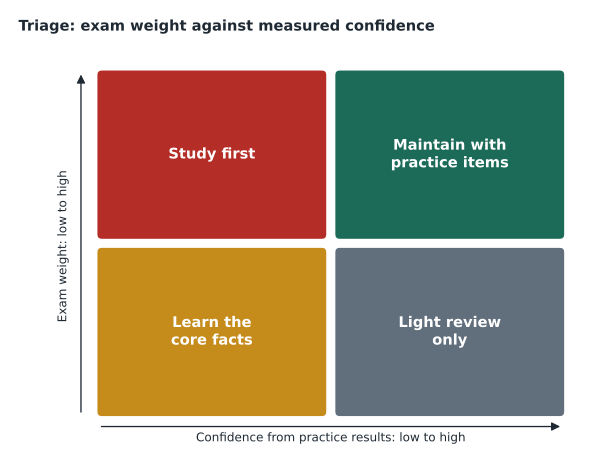
Triage: weight against confidence
With limited hours, every subject competes for time. Roz has Daniel sort every subject area into a simple grid. One axis is exam weight, judged from the blueprint and the size of the subject in the reference material. The other is his confidence, judged not by feeling but by his practice results: the share of items he gets right in each area over the last month. High-weight, low-confidence areas come first. High-weight areas where he is already strong get maintenance: regular practice items, little rereading. Low-weight, low-confidence areas get a short burst to learn the core facts. Low-weight areas he already knows get almost nothing.
Daniel's grid puts bonding and grounding, data center design and project administration in the first box. Horizontal and backbone cabling, which he knows from the field, sit in the maintenance box, with a warning from Roz that field knowledge needs checking against the standards. Audiovisual systems and residential cabling go in the learn-the-core box. The grid is redrawn every two weeks as his practice results change.
| Area | Weight | Recent practice result | Box |
|---|---|---|---|
| Bonding and grounding | High | Low | Study first |
| Data centers | Medium to high | Low | Study first |
| Project management and administration | Medium | Low | Study first |
| Horizontal and backbone cabling | High | High | Maintain |
| Spaces and pathways | High | Medium | Maintain, with calculation drills |
| Audiovisual and residential | Low | Low | Learn the core |
| Transmission principles | Medium | High | Light review and calculations |
Working a chapter in ninety minutes
For each area in the first box, Roz gives Daniel a ninety-minute routine. In the first ten minutes he writes, from memory, everything he can about the area: key terms, limits, methods, the reasons behind them. In the next forty minutes he opens the TDMM and checks his list against it, correcting errors in red and adding what he missed in green. The red items are the most valuable; they are things he believed and was wrong about. In the next twenty minutes he turns the red and green items into question cards. In the last twenty he answers a set of practice items on the area and explains each answer, right or wrong, by pointing to where the reference supports it.
The routine has a cost: it is tiring, and the first few sessions feel slow. Its value shows within two weeks, when Daniel's practice results in those areas start to rise. The free recall at the start is especially important. It forces retrieval before review, and it exposes what he does not know rather than letting the page reassure him.
Question cards and spaced review
BICSI's handbook recommends TDMM study and mentions flash cards as a study aid. Whether you buy a set or make your own, the method matters more than the format. A good card asks one thing and has one answer. It asks for understanding as well as facts: not just what the limit is, but why it exists or what happens if it is exceeded. Cards that are answered correctly move to longer intervals; cards that are missed come back the next day. Daniel uses a free spaced-repetition app on his phone and reviews for twenty minutes every morning on the bus.
- Write cards in your own words; never copy text from the reference.
- One fact or one method per card; split long cards.
- Add the reason on the back, so you learn why, not just what.
- Include calculation cards that ask for a method and a quick worked number.
- Delete cards you have answered correctly many times; spend the time on the hard ones.
The error log
The most useful document Daniel will produce in the final weeks is his error log. Every practice item he gets wrong, and every item he gets right by guessing, goes into a spreadsheet with five columns: the topic, what he chose, what the key was, why he chose wrongly, and what he now knows. The why column matters most. Roz asks him to choose from a short list: did not know, misremembered, misread the stem, fell for a distractor type, ran out of time, or calculation error. Patterns in that column tell him what to fix. If most errors are misreading, the fix is reading discipline, not more content. If most are calculation errors, the fix is drills.
Once a week Daniel sorts the log by topic and by reason, and the top three rows become the next week's priorities. In the last week before the exam, he rereads only the what-I-now-know column, which by then is a compact list of exactly the facts and traps that have caught him.
| Topic | Chose | Key | Why wrong | Now I know |
|---|---|---|---|---|
| Bonding | Bond racks in series to the busbar | Bond each rack directly to the busbar | Field habit | Racks are not daisy-chained; each gets its own bonding conductor. |
| Pathways | 60 meters between pull points | 30 meters between pull points | Misremembered | Sections longer than 30 meters need a pull box; confirm in the standard. |
| Project | Issue a change order | Answer the request for information | Wrong phase | A question about the documents is answered by an RFI response, not a change order. |
| Fiber loss | 2.9 dB | 2.4 dB | Calculation error | Count connector pairs, not connectors. |
Using practice items well
Practice items are only as good as their source and the way they are used. Items written for an older edition of the TDMM may test limits or terms that have since changed, and items from informal sources can simply be wrong. When a practice item disagrees with the current reference, the reference wins, and the disagreement goes in the error log as a lesson about the source. Daniel keeps a note of which practice sources have proven reliable.
Timed practice should match the exam's pace. At 150 minutes for 100 items, the average is a minute and a half per item. Daniel's weekly sets of 40 items get 60 minutes. Untimed practice has its place early, when he is learning, but in the final weeks every set is timed. After each set he spends as long reviewing as he spent answering, because the review is where the learning happens.
Sleep, breaks and limits
Time pressure tempts candidates to study late and give up sleep. That is a poor trade. Memory consolidation happens largely during sleep, and a tired brain reads stems carelessly. Roz's plan caps Daniel's study at two and a half hours on weeknights and five hours on Saturdays, with Sundays mostly free, and it includes short breaks every fifty minutes. The cap is not generosity; it is the plan's way of making sure the hours he does study are good ones.
The plan also has a stop rule. If Daniel finds himself rereading the same paragraph three times without taking it in, he stops, takes a ten-minute walk and switches to a different kind of task, such as calculation drills or question cards. Fatigue shows up as misreading long before it shows up as forgetting.
The last ten days
The final ten days change the balance again. New material stops; it is too late to learn a large area well, and trying to do so only displaces what is already secure. Daniel's last ten days in the plan are built around three things: his error log's what-I-now-know column, his question cards on the shortest review intervals, and two short timed sets to keep his pace sharp. He also rereads the parts of the candidate handbook and his Pearson VUE confirmation that cover exam day, so that nothing about the process is new.
Roz adds one more task: a one-page summary sheet, written from memory and checked against the reference, of the limits and methods he most often confuses. He cannot take it into the exam, but writing it twice in the last week, once early and once two days before, is itself retrieval practice. On the evening before the exam, the plan says to read it once and then stop.
Worked problem
Planning one week of study time
In week 4 of the plan, Daniel has 14 hours. Bonding is in the study-first box and power and wireless are in the maintain box. Roz asks him to allocate the hours using the routine in this lesson. How might he split them?
Show solution
- Two ninety-minute routines on bonding and grounding: 3 hours.
- One ninety-minute routine on power distribution: 1.5 hours.
- One ninety-minute routine on wireless and special systems: 1.5 hours.
- Calculation drills, three sessions of 40 minutes: 2 hours.
- Timed set of 40 items with review: 2 hours.
- Daily card review, 20 minutes on 6 days: 2 hours.
- Error log sorting and replanning: 1 hour; spare for overrun: 1 hour.
Answer: About 14 hours, weighted toward the study-first area, with every activity type included.
Worked problem
Reading an error log
By early November 2026, after his first diagnostic sets, Daniel's error log had 62 entries. The reasons were: did not know 14, misremembered 11, misread the stem 19, distractor type 9, ran out of time 2, calculation error 7. What should he change?
Show solution
- Misreading is the largest group: 19 of 62, about three in ten.
- Knowledge gaps (did not know plus misremembered) total 25, so content still matters.
- Calculation errors at 7 suggest more drills, with a check step.
- Running out of time is rare, so pacing is not the problem.
Answer: Add a deliberate second reading of every stem and a check step for calculations, while keeping the content routine for the topics behind the 25 knowledge errors.
Common mistakes
MistakeRereading the manual cover to cover in the last weeks.
InsteadUse the manual to check free recall and to explain practice answers.
MistakeStudying the areas you enjoy because they feel productive.
InsteadUse a weight-against-confidence grid built from practice results.
MistakeCopying text from the reference onto cards.
InsteadWrite cards in your own words, with the reason on the back.
MistakeDoing practice items without reviewing them.
InsteadSpend as long reviewing as answering; log every error and lucky guess.
MistakeTrusting every practice item.
InsteadWhen a practice item disagrees with the current reference, the reference wins.
MistakeTrading sleep for study hours.
InsteadCap study time and protect sleep; tired candidates misread stems.
Summary and key terms
- Rereading builds familiarity, not retrieval; practice testing and spaced review build memory for a closed-book exam.
- Use the reference as an answer key for your own testing, not as a book to reread.
- Triage subjects by exam weight and by confidence measured from practice results.
- A ninety-minute routine of free recall, checking, card writing and practice items works an area efficiently.
- An error log with a reason for every miss shows whether to fix knowledge, reading or calculation.
- Timed practice should match the exam's pace of about a minute and a half per item.
- Protect sleep and take breaks; fatigue shows up first as misreading.
- Retrieval practice
- Recalling information from memory, for example by answering questions, to strengthen it.
- Spaced repetition
- Reviewing material at increasing intervals to improve long-term memory.
- Free recall
- Writing down everything you remember about a topic before checking the source.
- Error log
- A record of every missed or guessed item, with the reason and the correction.
- Triage
- Sorting topics by importance and need so that time goes where it does the most good.
Practice problems
Work each problem on paper first, then reveal the answer to check.
Why is rereading a weak strategy for a closed-book exam?
Show answer
It builds familiarity rather than the ability to retrieve facts without the page.
What are the two axes of the triage grid?
Show answer
Exam weight and confidence measured from practice results.
What is the first step of the ninety-minute routine?
Show answer
Ten minutes of free recall from memory.
What is the average time per item on the current exam?
Show answer
About a minute and a half.
Which column of the error log matters most?
Show answer
The reason the item was missed.
What should you do when a practice item disagrees with the current reference?
Show answer
Trust the reference and log the source as unreliable on that point.
Lesson quiz · 5 questions
Score 60% or more to complete this lesson.
Create a free account to save your progress, take quizzes and earn a certificate.