
RCDD-160 · Lesson 1 of 12 · 26 min
The RCDD exam today: format, rules and booking
▶ Video coming soon A video version of this lesson is on the way.
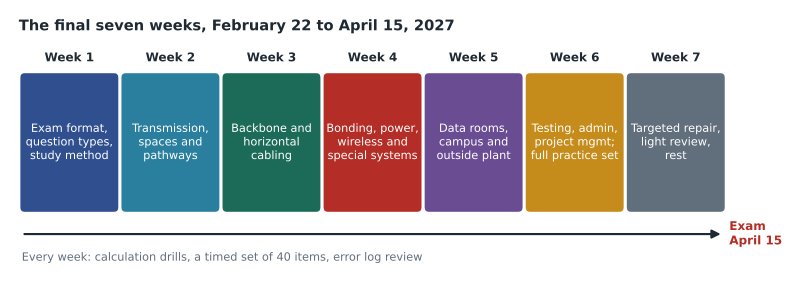
In the second week of November 2026, Daniel Oyelaran sits down with Roz Achterberg in the small meeting room at Lakehead Signal Design Group in Duluth. He has been studying since the middle of August, about eight hours a week, and his application to BICSI is in. Roz has a printout of his October diagnostic practice set on the table. He scored well on cabling and pathways, which he knows from five years of pulling and terminating cable, and poorly on bonding, project administration and the data center questions. The exam he is aiming for is in the middle of April 2027. Roz's job today is to turn the next five months into a plan, and to make the final seven weeks, from February 22 to April 15, the most productive weeks of his preparation.
This course follows that plan. Each lesson is one part of the final preparation: knowing exactly what the exam is, how its questions are built, how to study the reference material efficiently, how to drill the calculations, how to review each area of design knowledge, how to manage time on test day, and how to use a full practice set to decide what to do next. The review lessons assume you have studied RCDD-101 to RCDD-116 or equivalent material. They do not teach each topic from the beginning; they show you what to check, what to practice and where candidates commonly go wrong.
Start from the source, not from memory
The first rule of final preparation is to read the current candidate handbook again, all of it, before planning anything. BICSI publishes the RCDD certification handbook, and it is the only authoritative statement of eligibility, fees, exam delivery, retake rules and renewal. Exam programs change. Delivery vendors, item counts, fees and blueprints have all changed over the life of the credential, and they will change again. Summaries in courses, forums and study guides, including this one, can go out of date. Roz makes Daniel download the handbook again, check its version number and date against the BICSI website, and keep it in the front of his binder.
At the time of writing, the current handbook is Version 15, released in 2024 alongside the 15th edition of BICSI's Telecommunications Distribution Methods Manual, the TDMM. The facts in this lesson come from that handbook. Confirm each one against the version you download, because a candidate who plans around an old fee, an old wait period or an old item count can lose weeks.
The format in one table
According to the Version 15 handbook, the RCDD exam is a computer-based test delivered by Pearson VUE. You may take it at a Pearson VUE test center or online through OnVUE, Pearson's remotely proctored service. It contains 100 scored items and allows two and a half hours. There are no scheduled breaks; if you take an unscheduled break, the clock keeps running. Items use three formats: standard multiple choice with one correct answer, multiple response where you select more than one answer, and enhanced matching. Items generally offer three to five options.
| Feature | What the current handbook says |
|---|---|
| Delivery | Pearson VUE, at a test center or online through OnVUE |
| Length | 100 scored items |
| Time allowed | Two and a half hours (150 minutes) |
| Breaks | None scheduled; any break counts against your time |
| Item formats | Multiple choice, multiple response, enhanced matching |
| Options per item | Generally three to five |
| Passing standard | Criterion-referenced, set by the Angoff method |
| Reference material | The TDMM is the primary reference for the exam content |
Two points about the passing standard matter for planning. First, the exam is criterion referenced: you are measured against a standard of minimum competence set by subject matter experts, not against other candidates. Nobody fails because others did well. Second, BICSI does not publish a passing score. You will see numbers quoted online, but they are not official, and planning to scrape past a guessed cut score is a poor strategy. Plan to know the material well enough that the exact cut score does not matter.
What candidates can bring
Candidates generally cannot bring the TDMM, notes or reference books into the exam; the exam is commonly described as closed book. This has a large effect on how you prepare. You cannot look up a separation distance, a bend radius or a conduit fill rule during the exam, so the facts you need must be in your head, and the methods you need for calculations must be practiced until they are automatic. Check the current handbook and Pearson VUE's candidate rules for what is permitted, such as identification and whether a calculator, an on-screen calculator or a whiteboard is provided. Do not plan on any aid until you have confirmed it in the rules for your booking.
The blueprint and how to use it
The exam is built from a blueprint, also called an exam outline, which comes from a job task analysis of what practicing designers do. The blueprint groups the work into broad domains and gives each a share of the items. Published outlines for the current version have commonly been reported as four domains: defining the scope of an ICT design, designing ICT solutions, supporting the bid or tender process, and supporting the installation process, with the design domain carrying by far the largest share. Those weights come from secondary sources, not from BICSI directly in this course's research, so confirm the current outline in BICSI's handbook or candidate materials before you build a study plan around them.
Whatever the exact numbers, the shape is clear. Most items test whether you can make design decisions: choosing media, sizing spaces and pathways, laying out cabling, bonding, protecting and powering systems, and integrating wireless, security, audiovisual and building systems. A smaller but significant share tests scope and requirements, bid documents, and construction-phase work such as submittals, inspections, testing and closeout. A candidate who studies only design technology and skips project delivery is giving away items.
Eligibility and your booking window
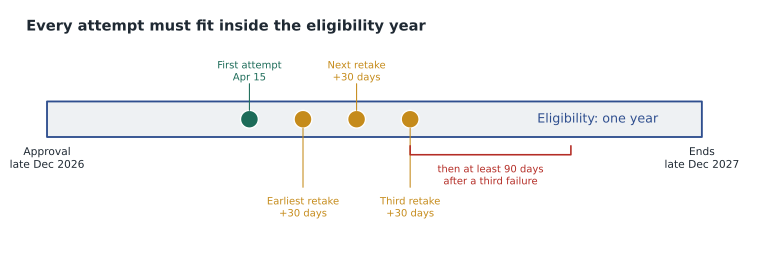
Your booking has to fit inside your eligibility window. Under the current handbook, BICSI asks candidates to allow about 30 days for application approval, and an approved application is valid for one year from the approval date. You schedule the exam with Pearson VUE using the instructions in your approval, and every attempt, including any retakes, must fall inside that year. If eligibility lapses, you must apply again.
Daniel applied in November 2026. If BICSI approves him in late December, as he expects, his eligibility runs to late December 2027. That gives him room for his planned April attempt and, if needed, several retakes later in the year. Roz insists he books as soon as the approval arrives, because a booked date concentrates the mind and because popular test center dates can fill weeks ahead.
| Step | Rule in the current handbook | Daniel's plan |
|---|---|---|
| Apply | Online through the BICSI profile, with résumé and supporting documents | Application submitted November 2026 |
| Approval | Allow about 30 days | Expected in late December 2026 |
| Eligibility | One year from approval | Runs to late December 2027 |
| Book | With Pearson VUE, inside the eligibility year | Book in January for mid-April 2027 |
| Retake if needed | Wait at least 30 days; 90 days after a third failure | A retake could fall in late May or June 2027 |
Retakes, fees and what they mean for planning
The current handbook sets a waiting period of at least 30 days between unsuccessful attempts, rising to 90 days after a third unsuccessful attempt. Each retake has a retest fee paid to the testing provider. At the time of writing the handbook lists the application fee, which includes the first attempt, at 510 US dollars for BICSI members and 725 US dollars for non-members, and the retest fee at 230 US dollars for members and 355 for non-members. Fees change, so check them when you book.
Retake rules are worth knowing for two reasons. The first is practical: if your first attempt does not go well, you should already know when you can sit again and how much it will cost, so that a disappointing day becomes a scheduling decision rather than a crisis. The second is psychological: knowing that a retake is possible, affordable and usually scheduled within weeks takes some of the pressure off the first attempt. Roz tells Daniel plainly that many good designers needed more than one attempt, and that the plan includes a fallback.
Test center or online
Both delivery methods give the same exam under the same content and timing rules. The difference is the environment. A test center gives you a controlled room, a maintained workstation and staff who handle problems. Online delivery through OnVUE lets you test from home or the office, but you must provide a private room with a clear desk, a computer that passes Pearson's system test and a reliable connection, and you are monitored by webcam and microphone for the whole exam. A dropped connection, a family member opening the door or a notebook left on a shelf can end an online session.
Daniel lives in an apartment with thin walls and a shared internet connection. He plans to book the test center. Roz suggests he drive there one evening in March, find the parking and time the trip, so that nothing about the location is new on exam day. If you choose online delivery, run Pearson's system test on the exact computer and network you will use, more than once, and do a full rehearsal in the room: cleared desk, closed door, phone in another room.
Identification and the confirmation email
The name on your Pearson VUE booking must match your identification exactly. A missing middle name, a different spelling or a reversed order of names can mean being turned away. When the booking confirmation arrives, Roz has Daniel read it line by line: the date, the time and time zone, the address, the identification required, the arrival time, and the rules on rescheduling and cancellation. Rescheduling is usually possible up to a set number of days before the appointment, sometimes with a fee; missing the appointment without notice may forfeit the attempt.
Worked problem
Checking the eligibility arithmetic
Daniel's approval arrives, in his plan, on December 23, 2026. He books April 15, 2027. If he does not pass, the earliest retake is 30 days later. If he then needs a second retake 30 days after that, does it still fall inside his eligibility year?
Show solution
- Eligibility runs for one year from approval: to about December 23, 2027.
- First attempt: April 15, 2027.
- Earliest retake: 30 days later, May 15, 2027.
- A second retake 30 days after that: about June 14, 2027.
- Both dates are well inside the window, with months to spare.
Answer: Yes. Even three attempts by mid-summer leave half the eligibility year unused, so Daniel has a realistic fallback without a new application.
Worked problem
Estimating study hours left
The handbook recommends substantial TDMM study time, commonly quoted as 150 hours or more for a mid-career candidate. Daniel logged 104 hours from mid-August to early November. He can study 8 hours a week until February 21, losing two weeks over the holidays, then 14 hours a week for the final seven weeks. Will he reach 150 hours, and by how much?
Show solution
- Weeks from the second week of November to February 21: about 15, less 2 holiday weeks, gives 13 weeks.
- 13 weeks × 8 hours = 104 hours.
- Final seven weeks: 7 × 14 = 98 hours.
- Total: 104 already logged + 104 + 98 = 306 hours.
Answer: He will reach about 306 hours, roughly twice the commonly quoted minimum. Roz's view is that the extra time is right for a candidate whose design experience is shorter than his installation experience.
Building the seven-week plan
Roz's plan for the final seven weeks is built on three ideas. First, review follows the weight of the blueprint, so design topics get most of the hours, but no domain gets none. Second, every week mixes three activities: reading and summarizing one area, drilling the calculations that belong to it, and answering timed practice items across all areas, so that earlier topics are not forgotten. Third, the last week is for a full timed practice set, targeted repair of weak areas and rest, not for new material.
| Week | Dates (2027) | Main review | Also every week |
|---|---|---|---|
| 1 | Feb 22 to 28 | Exam format, question types, study method | Calculation drill, 40 timed items |
| 2 | Mar 1 to 7 | Transmission, spaces and pathways | Calculation drill, 40 timed items |
| 3 | Mar 8 to 14 | Backbone and horizontal cabling | Calculation drill, 40 timed items |
| 4 | Mar 15 to 21 | Bonding, power, wireless and special systems | Calculation drill, 40 timed items |
| 5 | Mar 22 to 28 | Data centers, campus and outside plant | Calculation drill, 40 timed items |
| 6 | Mar 29 to Apr 4 | Testing, administration, project management; full practice set on Saturday | Error log review |
| 7 | Apr 5 to 15 | Targeted repair, light review, rest | Exam on Thursday, April 15 |
Common mistakes
MistakePlanning from a forum post or an old study guide.
InsteadDownload the current handbook, check its version and date, and plan from it.
MistakeAssuming you may bring the TDMM or notes.
InsteadPlan for a closed-book exam unless the current rules for your booking say otherwise.
MistakeGuessing a passing score and aiming for it.
InsteadBICSI does not publish one; aim to know the material well enough that it does not matter.
MistakeBooking late in the eligibility year.
InsteadBook early so that retakes, if needed, still fit inside the window.
MistakeIgnoring the smaller domains.
InsteadScope, bid and installation-phase items are a real share of the exam.
MistakeChoosing online delivery without a full rehearsal.
InsteadRun the system test and rehearse in the actual room, or book a test center.
Summary and key terms
- The current handbook is the only authoritative source for exam format, fees, retakes and renewal; reread it before planning.
- The current exam has 100 scored items in two and a half hours, delivered by Pearson VUE at a center or online, with no scheduled breaks.
- Item formats are multiple choice, multiple response and enhanced matching.
- The passing standard is criterion referenced and set by the Angoff method; no passing score is published.
- The exam is commonly described as closed book; confirm what is permitted for your booking.
- Eligibility lasts one year from approval, and every attempt must fall inside it.
- Retakes need at least a 30-day wait, rising to 90 days after a third failure.
- Candidate handbook
- BICSI's official statement of eligibility, fees, exam rules and renewal for the RCDD.
- Blueprint
- The exam outline that sets the domains tested and their share of items.
- Criterion-referenced exam
- An exam that measures candidates against a fixed standard, not against each other.
- Angoff method
- A standard-setting method in which experts judge how a minimally competent candidate would perform on each item.
- Eligibility window
- The one-year period after approval in which every attempt must be taken.
- OnVUE
- Pearson VUE's remotely proctored online testing service.
Practice problems
Work each problem on paper first, then reveal the answer to check.
How many scored items does the current handbook describe?
Show answer
100.
How long is the exam?
Show answer
Two and a half hours, with no scheduled breaks.
Name the three item formats.
Show answer
Multiple choice, multiple response and enhanced matching.
Does BICSI publish a passing score?
Show answer
No. The standard is criterion referenced and set by the Angoff method.
How long is an approved application valid?
Show answer
One year from approval.
What is the minimum wait after an unsuccessful attempt?
Show answer
30 days; 90 days after a third unsuccessful attempt.
What must match exactly between your booking and your identification?
Show answer
Your name.
Lesson quiz · 5 questions
Score 60% or more to complete this lesson.
Create a free account to save your progress, take quizzes and earn a certificate.