
RCDD-160 · Lesson 11 of 12 · 23 min
Test-day strategy and managing time
▶ Video coming soon A video version of this lesson is on the way.
Two and a half hours for 100 items sounds generous until you are inside it. Daniel's autumn timed practice sets showed the problem: he spent four minutes on a hard calculation early in a set, then rushed the last ten items and misread two of them. Knowledge is necessary, but on the day it is turned into marks by pacing, reading discipline and calm. This lesson sets out the test-day strategy Roz builds with him, from the evening before to the moment the result appears. Rules and procedures belong to BICSI and Pearson VUE and change from time to time; follow your confirmation and the current candidate rules over any summary, including this one.
The pace
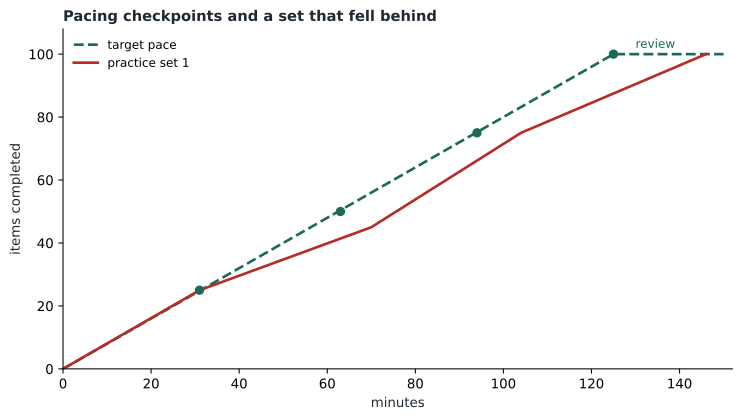
At 150 minutes for 100 items, the average is 90 seconds per item. Some items take twenty seconds; some calculation or analysis items take three minutes. The goal is not to spend exactly 90 seconds on each, but to finish a first pass through every item with time left for review. Roz sets Daniel a target of about 75 seconds per item on the first pass, which finishes the items in about 125 minutes and leaves about 25 minutes to revisit flagged items. She also gives him checkpoints, so that he can see whether he is on pace without constant arithmetic.
| Checkpoint | Items completed | Time used (minutes) | Time remaining (minutes) |
|---|---|---|---|
| First quarter | 25 | About 31 | About 119 |
| Halfway | 50 | About 63 | About 87 |
| Third quarter | 75 | About 94 | About 56 |
| First pass complete | 100 | About 125 | About 25 |
| Review of flagged items | Flagged items | Up to 150 | 0 |
If Daniel reaches a checkpoint behind schedule, he does not panic; he speeds up by flagging sooner, not by reading less carefully. If he is ahead, he does not slow down; extra time is worth more at the end, for review, than in the middle.
Flag and move on
The most useful habit for pacing is the flag. Pearson VUE's interface typically lets candidates mark items for review and return to them before ending the exam; confirm the features in the tutorial at the start of your exam. Roz's rule for Daniel is the two-minute rule: if he has worked an item for two minutes without being confident, he chooses his best answer, flags the item and moves on. Never leave an item blank on the first pass. Unanswered items earn nothing, and there is no indication that a wrong answer costs more than a blank one; check the handbook, but plan to answer everything.
Flags fall into three groups, and Daniel learns to note which kind each is, mentally or on the provided whiteboard if one is allowed. A long calculation he set aside for time. An item where he narrowed the options to two and wants a fresh look. An item he simply did not know, where review is unlikely to help. In review, he works the first two kinds and spends little time on the third.
Reading discipline under pressure
Under time pressure, reading gets faster and worse. The methods from lesson 2 must become automatic: read the stem, find the role, phase, authority and qualifier, predict the answer, then read the options. For long scenario stems, Roz suggests reading the final question sentence first, so that he knows what he is looking for in the scenario. For negative items, such as which is not or all except, he pauses before answering and confirms that the option he chose is the false one.
For calculation items, he writes the givens with units before calculating, works step by step, and checks the result for reasonableness before choosing. If the result does not match an option, he checks units and the most common traps from lesson 4 before reworking the whole problem. If time is short, he estimates: many distractors are far enough apart that an approximate answer identifies the key.
Changing answers
Candidates often believe that their first instinct is usually right and that changing answers is dangerous. Studies of test-taking have generally found the opposite: when candidates change answers for a reason, such as noticing a qualifier they missed or recalling a fact, changes from wrong to right outnumber changes from right to wrong. The rule Roz gives Daniel is simple: change an answer when you have a specific reason, never because of a vague feeling.
The evening and morning before
The plan for April 14, the evening before the exam, is deliberately light: read the one-page summary sheet once, check the confirmation email for the time and address, lay out identification and anything else the rules require, and stop studying by early evening. Sleep matters more than one more hour of cards. On the morning of the exam, Daniel will eat a normal breakfast, avoid more caffeine than usual, and leave early enough to arrive at the center with time to spare, because late arrival can forfeit the appointment.
For online candidates, the morning includes the system check, a cleared desk and room, closed applications, a charged device or connected power, a stable network, and a sign on the door. Personal items must be out of reach, and anything the proctor considers a violation can end the session. A test center removes most of those risks, which is why Daniel chose one.
| When | Task |
|---|---|
| One week before | Second summary sheet from memory; reread exam-day sections of the handbook and confirmation |
| Two days before | Short timed set; light card review; confirm route and parking |
| Evening before | Read summary once; lay out identification; stop studying early; sleep |
| Morning | Normal breakfast; leave early; arrive with time to spare |
| At the center | Check in; store belongings; use the tutorial to learn the interface |
| During the exam | Checkpoints; flag and move on; reading discipline; review flags |
Managing nerves
Some anxiety helps; it sharpens attention. Too much narrows it, and stems blur. Daniel's practice sets are timed and taken in one sitting, partly so that the exam feels familiar. Roz also teaches him a short reset: when he notices he has read a stem three times without taking it in, he sits back, takes three slow breaths, relaxes his shoulders and rereads the final question sentence. The reset takes fifteen seconds and saves minutes.
A hard run of items is normal. Exams mix difficulties, and a cluster of hard items in a row is not a sign that the exam is going badly. Daniel's practice log shows that he often feels worst about sets he scores well on, because the items he remembers afterwards are the ones he struggled with.
Breaks, problems and the end
The current handbook describes no scheduled breaks, and any break taken counts against your time. Plan to sit through the whole exam: use the washroom before check-in and avoid large drinks. If you must take a break, follow the proctor's instructions; the clock keeps running.
If a technical problem occurs, such as a frozen screen or a lost connection, tell the proctor at once, or use the online chat for remote delivery, and follow their instructions. Note the time and what happened. Testing providers have procedures for incidents, and BICSI's handbook describes how to report concerns after the exam. Do not try to fix the computer yourself.
At the end, the interface usually asks you to confirm that you want to end the exam. Use any remaining time to review flagged items before confirming. Under the current handbook, candidates who pass are notified at the test site, and those who do not pass receive a score report; lesson 12 covers what to do with either result.
Rehearsing the day
Roz insists that Daniel's last two timed sets will be full rehearsals of the routine, not just of the items. In each, he will start at the same time of day as his booking, eat the same breakfast, sit for the full time without getting up, and use the same checkpoints and flags. After each rehearsal, he will record three numbers: the time at each checkpoint, the number of items flagged, and the number of flagged items he changed in review and whether each change was right. Over the two rehearsals, the numbers will tell him whether his pacing is reliable, whether he is flagging too much or too little, and whether his changes help.
His autumn practice sets suggest what to watch for: in one 40-item set in October he flagged 11 items, far too many to review well, and he ran out of time before reaching half of them. The rehearsals are meant to bring the flag count down to a number he can actually review, and the record of changed answers is meant to show whether his changes help. If they do, that evidence gives him confidence in the method, which is worth as much on the day as any fact.
Timed practice items on strategy
Roz also writes a few items about strategy itself, to make the rules stick.
Item 1. With 30 minutes left, a candidate has 22 unanswered items and 10 flagged. What should come first? A, review the flagged items. B, answer the 22 unanswered items. C, recheck the first ten items. D, end the exam. Answer: B. Unanswered items earn nothing; flagged items already have answers.
Item 2. A stem reads which of the following is not a function of a primary protector. What is the main reading risk? A, misreading units. B, missing the negative and choosing a true statement. C, the stem is too short. D, the options are too long. Answer: B.
Item 3. A candidate has narrowed an item to two options but cannot decide after two minutes. What does the two-minute rule say? A, keep working until sure. B, choose the better of the two, flag it and move on. C, leave it blank. D, end the exam. Answer: B.
Item 4. A calculation result does not match any option. What should the candidate check first? A, the time remaining. B, units and common traps such as connector pairs or rounding, before reworking from scratch. C, the item number. D, the previous item. Answer: B.
Item 5. The candidate feels the exam is going badly after a run of hard items. What does the evidence from practice suggest? A, the exam is probably lost. B, difficulty is mixed, and feelings during a set are a poor guide to the score. C, slow down to be sure. D, change all earlier answers. Answer: B.
Worked problem
Recovering pace
Suppose that at the halfway checkpoint Daniel has completed 41 items in 63 minutes. How many seconds per item must he average on the remaining 59 items to finish the first pass at 125 minutes, and what should he change?
Show solution
- Time left to 125 minutes: 125 − 63 = 62 minutes, or 3720 seconds.
- Seconds per item: 3720 / 59 = 63 seconds.
- That is faster than 75 seconds but realistic if he applies the two-minute rule strictly and flags long calculations at once.
Answer: About 63 seconds per item; he should flag sooner, not read less carefully.
Worked problem
Deciding whether to change an answer
Suppose that in review Daniel returns to an item asking for the maximum number of consolidation points in a horizontal link. His first answer was two. Reading again, he recalls that the standard allows only one. Should he change?
Show solution
- He has a specific reason: he recalls the rule and sees he misread the question the first time.
- A specific reason justifies a change.
Answer: Yes. Change for a specific reason, not for a feeling.
Common mistakes
MistakeSpending four minutes on one item early in the exam.
InsteadApply the two-minute rule: answer, flag and move on.
MistakeLeaving items blank to come back later.
InsteadChoose a best answer on the first pass, then flag it.
MistakeSpeeding up by reading less carefully.
InsteadSpeed up by flagging sooner; keep reading discipline.
MistakeStudying late the night before.
InsteadStop early and sleep.
MistakeChanging answers on a vague feeling.
InsteadChange only for a specific reason.
MistakeAssuming a run of hard items means failure.
InsteadDifficulty is mixed; keep to the plan.
Summary and key terms
- The average pace is 90 seconds per item; aim for about 75 seconds on the first pass to leave time for review.
- Use checkpoints at each quarter to check pace without constant arithmetic.
- Apply a two-minute rule: answer, flag and move on; never leave an item blank on the first pass.
- Keep reading discipline under pressure: final question first in long stems, care with negative items.
- Change answers only for a specific reason.
- Prepare the evening before lightly, sleep, arrive early, and follow the provider's rules on breaks and problems.
- First pass
- A complete run through every item, answering each and flagging those to revisit.
- Flag
- A mark that lets you return to an item before ending the exam.
- Checkpoint
- A planned point at which you compare items completed with time used.
- Two-minute rule
- A personal limit after which you answer, flag and move on.
- Reset
- A short pause to restore focus when reading breaks down.
Practice problems
Work each problem on paper first, then reveal the answer to check.
What is the average time per item on the current exam?
Show answer
90 seconds.
At 75 seconds per item, how long does a first pass of 100 items take?
Show answer
About 125 minutes.
What should you do after two minutes on an item without confidence?
Show answer
Choose a best answer, flag it and move on.
When should you change an answer?
Show answer
When you have a specific reason.
Does the clock stop during an unscheduled break?
Show answer
No.
What should you do if the screen freezes?
Show answer
Tell the proctor at once and follow instructions; note the time.
Lesson quiz · 5 questions
Score 60% or more to complete this lesson.
Create a free account to save your progress, take quizzes and earn a certificate.