
RCDD-160 · Lesson 2 of 12 · 24 min
How RCDD questions are written
▶ Video coming soon A video version of this lesson is on the way.
Daniel's October diagnostic set had a pattern that Roz spotted at once. On items about installation, he often chose the answer that matched what crews do on site rather than what the standards require. On one item about the maximum length of patch cords in a channel, he picked the length his last contractor allowed, not the length the cabling standard sets. On another, about where to put a telecommunications room, he chose the room the architect usually offers rather than the location the pathway standard recommends. He knew the material; he was answering a different question from the one being asked. Roz's first task in the final weeks is to teach him how RCDD items are written, so that he answers the question on the screen.
Where items come from
Professional certification items are not written by one person on a whim. For the RCDD, as for most credentialing exams, the process starts with a job task analysis: practicing designers describe the tasks they perform and the knowledge those tasks need. That analysis becomes the blueprint. Subject matter experts then write items mapped to specific parts of the blueprint, using the program's reference material, chiefly the TDMM, as the authority for correct answers. Each item is reviewed by other experts for accuracy, clarity and relevance, edited to a consistent style, and often tried out before it counts toward scores. Items that perform poorly, for example because strong candidates miss them as often as weak ones, are revised or removed.
Three consequences follow. First, every item has an answer that the reference material supports; local custom, a manufacturer's preference or a contractor's habit is not the authority. Second, items are meant to test what a competent designer needs to know, not trivia, so the best study question is always: why would a designer need this? Third, the wrong options, called distractors, are written to be attractive to someone with a partial understanding. They are usually common misconceptions, close but wrong numbers, answers that are true but do not answer the question, or field practices that conflict with the standard.
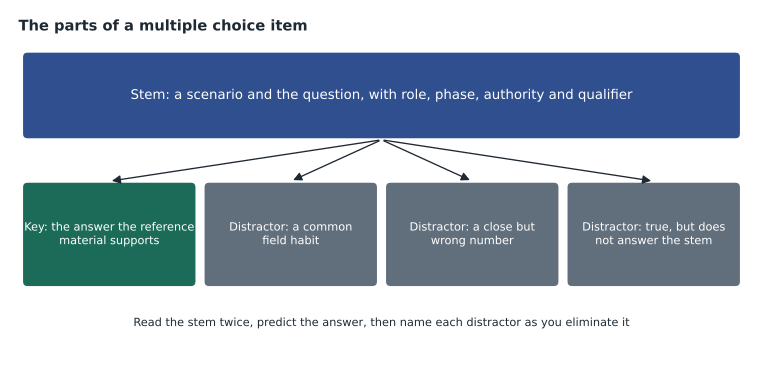
The anatomy of an item
A multiple choice item has a stem, which sets up the situation and asks the question, and a set of options: one key, the correct answer, and several distractors. Well-written stems contain everything needed to answer and nothing designed to trick. They may include details that are not needed, because real design situations include irrelevant information, but they do not hide the question. The options are usually similar in length and grammar, so that the key does not stand out.
RCDD items fall into a few broad kinds. Recall items ask for a fact: a distance, a term, a rating. Application items describe a situation and ask what the designer should do or specify. Analysis items present a design, a drawing description, a test result or a set of requirements and ask what is wrong, what is missing or what follows. Calculation items ask you to compute a value such as a fill, a loss, a conductor size or a cooling load. The proportion of each kind is not published, but practicing designers expect more application and analysis than pure recall, and practice sets should reflect that.
| Kind of item | What it asks | Example of a stem |
|---|---|---|
| Recall | A fact, term or limit | Which standard covers telecommunications administration? |
| Application | What to do in a situation | A floor has no furniture plan. How should outlet counts be estimated? |
| Analysis | What is wrong or what follows from given information | A test report shows a failed link at 92 m. What is the most likely cause? |
| Calculation | A numeric result | What is the loss budget for this campus link? |
Reading the stem
Roz teaches Daniel to read every stem twice, the second time looking for four things. The role: is the question asked from the point of view of the designer, the installer, the owner or the inspector? The phase: is this planning, design, bidding, construction or closeout? The authority: does the question ask what a standard requires, what a code requires, what is recommended practice, or what the owner's standard says? And the qualifier: words such as best, first, most likely, minimum, maximum, primary, except and not.
Qualifiers change answers. If an item asks for the minimum bend radius during installation of a cable, and you answer with the bend radius after installation, you will choose a wrong but plausible number. If it asks what the designer should do first when a client requests a design, and you choose a technical decision instead of gathering requirements, you have answered a later step. Negative items, such as which of the following is not a recognized backbone medium, reverse the usual search; read them slowly and check each option against the stem.
- Underline, mentally or on the provided whiteboard, the role, phase, authority and qualifier.
- Restate the question in your own words before reading the options.
- Predict the answer, then look for it among the options.
- If your predicted answer is not there, reread the stem; you may have missed a qualifier.
Standard, code, practice and owner requirement
Many of Daniel's misses came from confusing kinds of authority. A cabling or pathway standard is a voluntary document that becomes binding when a contract or owner standard adopts it. A code, such as the National Electrical Code or a building or fire code, is law where it has been adopted, and it is enforced by the authority having jurisdiction. Recommended practice is what the reference material advises where the standards leave a choice. An owner's standard can be stricter than any of these. RCDD items usually make clear which kind of authority they are asking about, and the right answer depends on it.
Safety and life-safety requirements always come from code. If an item asks whether a cable may be installed in a particular space, think first about the code and its fire ratings. If it asks for the maximum length of a horizontal link, think of the cabling standard. If it asks how a large owner should manage its labeling across many buildings, think of the administration standard and good practice. And if an item contrasts what the owner wants with what code requires, code wins; the designer's job is to meet code and then serve the owner.
Multiple response items
Multiple response items ask you to select more than one option, and the current item formats include them. Read the instruction carefully: some items say exactly how many to choose, others say select all that apply. Treat each option as a true or false statement about the stem, judged on its own. Do not assume that a certain number of options must be correct. A common error is to choose two good options and then add a third weaker one because three seemed expected.
The scoring rules for partial answers are not something to guess at; assume you need every correct option and no incorrect ones. That means multiple response items reward precise knowledge. If you know three options are definitely right and are unsure of a fourth, decide on the fourth using the stem's authority and qualifiers rather than instinct.
Enhanced matching items
Enhanced matching items present two lists and ask you to pair them, for example standards with their subjects, test parameters with their definitions, or spaces with their functions. They test organized knowledge: you need to know not only each fact but how facts relate. Work from the items you are surest of, because each confident match removes an option and makes the rest easier. If the format allows an option to be used more than once or not at all, the instructions will say so; read them before starting.
| Format | What to do | Common trap |
|---|---|---|
| Multiple choice | Predict, then find the key; eliminate distractors | Choosing a true statement that does not answer the question |
| Multiple response | Judge each option on its own against the stem | Adding a weak option to reach an expected count |
| Enhanced matching | Start with the pairs you are surest of | Ignoring instructions about reusing options |
Distractors that catch designers
After reviewing his diagnostic set, Daniel kept a list of the kinds of distractors that caught him. Field habit: the answer that matches what crews often do, such as tying cables tightly with plastic ties, rather than what the standards recommend. Close numbers: a bend radius of four times when the item asks about a cable that needs ten, or a separation of 50 when the answer is 100. Units: an answer in feet when the stem is in meters, or in kilowatts when the stem asks for British thermal units per hour. Right answer, wrong phase: a construction step offered in a planning question. And true but irrelevant: a statement that is correct in general but does not answer this stem.
Roz's advice is to name the distractor. When Daniel eliminates an option, he says to himself why it is wrong: field habit, wrong phase, wrong unit. That habit slows him down slightly during practice and speeds him up on exam day, because he learns to recognize the patterns quickly.
Scenario items and the Harbourview habit
Many RCDD items are short scenarios: a building, an owner, a constraint and a decision. Daniel has an advantage here, because he has spent a year inside one real project. Roz encourages him to picture Harborview whenever a scenario describes a similar building: where the rooms are, how the riser runs, what the clinic floors need. Placing an abstract stem in a familiar building makes the constraints concrete and the wrong options easier to see.
The habit has one limit. A scenario item describes its own building, not yours. If the stem says the telecommunications rooms are not stacked, or that the owner has no growth plans, or that the campus link is 900 meters rather than 400, the answer must follow the stem. Use the familiar project to visualize, never to overwrite the facts given. When a detail in the stem surprises you, that detail is usually the point of the item.
A related trap is answering from the most recent course you studied. In the week Daniel reviews bonding, every stem starts to look like a bonding question. Mixed timed sets, which the plan includes every week, train him to identify the topic from the stem rather than from what is on his mind.
Worked problem
Taking an item apart
A practice item reads: 'During the design of a new office floor, the architect proposes placing the telecommunications room in a corner of the building beside the parking ramp, to keep the core free for lease space. What should the designer do first?' The options are: A, accept the location and design longer pathways; B, assess whether all outlets can be served within the horizontal distance limit and discuss alternatives with the architect; C, specify a second telecommunications room; D, specify Category 8 cabling to support longer runs.
Show solution
- Role: designer. Phase: design. Qualifier: first.
- Option A accepts the problem without analysis; it skips a step.
- Option C may be the eventual answer, but it is a solution before the analysis.
- Option D is wrong on the facts; Category 8 supports shorter runs, not longer ones.
- Option B analyses the constraint against the distance limit and engages the architect, which is the right first step.
Answer: B. The item tests the designer's role and the order of work, not just the distance limit.
Worked problem
A multiple response item
A practice item reads: 'Which of the following should a designer obtain before sizing an equipment room? Select all that apply.' The options are: the expected equipment list and rack count; the planned cooling capacity of the building's mechanical system; the electrical engineer's preferred conduit brand; the owner's plans for growth over the design life.
Show solution
- Equipment and rack count drive floor space: needed.
- Cooling capacity affects whether the room can serve the planned load: needed.
- Conduit brand has nothing to do with room size: not needed.
- Growth plans drive spare space: needed.
Answer: The first, second and fourth options. Each correct option is judged on its own; the conduit brand is a distractor that sounds technical.
Common mistakes
MistakeAnswering with what crews usually do.
InsteadAnswer with what the reference material and standards say a designer should do.
MistakeSkipping qualifiers such as first, minimum or except.
InsteadFind the qualifier on the second reading and let it guide the answer.
MistakeTreating a standard as law.
InsteadCodes are law where adopted; standards bind through contracts and owner standards.
MistakeChoosing a true statement that does not answer the stem.
InsteadCheck each option against the question, not just against the facts.
MistakeAdding options in a multiple response item to reach an expected count.
InsteadJudge each option independently.
MistakeIgnoring units in calculation items.
InsteadCheck the unit the stem asks for before choosing.
Summary and key terms
- Items are written by subject matter experts from a job task analysis, mapped to the blueprint and checked against the reference material.
- Every item has a key and distractors designed to attract partial understanding.
- Read every stem twice, looking for role, phase, authority and qualifier.
- Codes are law where adopted; standards, recommended practice and owner requirements are different kinds of authority.
- Judge each option in a multiple response item on its own; start enhanced matching with the surest pairs.
- Name each distractor as you eliminate it: field habit, close number, wrong unit, wrong phase, true but irrelevant.
- Stem
- The part of an item that sets up the situation and asks the question.
- Key
- The correct option.
- Distractor
- An incorrect option designed to attract candidates with partial understanding.
- Job task analysis
- A study of what practitioners do, used to build an exam blueprint.
- Qualifier
- A word such as best, first, minimum or except that changes what the stem asks.
- Authority having jurisdiction
- The body that enforces codes in a location.
Practice problems
Work each problem on paper first, then reveal the answer to check.
What four things should you look for on the second reading of a stem?
Show answer
Role, phase, authority and qualifier.
What is a distractor?
Show answer
A wrong option designed to attract partial understanding.
When a code and an owner's preference conflict, which governs safety?
Show answer
The code.
How should you approach a multiple response item?
Show answer
Treat each option as a separate true or false judgment against the stem.
Where should you start in an enhanced matching item?
Show answer
With the pairs you are surest of.
Name three common kinds of distractor.
Show answer
Field habit, close but wrong number, true but irrelevant (also wrong unit and wrong phase).
Lesson quiz · 5 questions
Score 60% or more to complete this lesson.
Create a free account to save your progress, take quizzes and earn a certificate.