
RCDD-114 · Lesson 3 of 12 · 20 min
Public safety radio coverage
▶ Video coming soon A video version of this lesson is on the way.
At the second design coordination meeting, a fire prevention officer from the Duluth fire service sits at the end of the table. She has one question for the design team. 'When my crews are in the basement parking of this building, or in the stairwell between the third and fourth floors, can they talk to each other and to dispatch on their portable radios?' Nobody answers right away. Roz finally says what everyone is thinking. 'Not without help. The parking level is below grade and the clinic has shielded rooms. We need an in-building public safety radio system, and we need to design its pathways to survive a fire.'
Firefighters, police and paramedics depend on two-way radios. When those radios fail inside a building, responders lose contact with each other and with incident command at the moment they most need it. Investigations after major incidents in North America have repeatedly found radio failures inside large buildings, tunnels and below-grade spaces. Building and fire codes and local bylaws have responded by requiring in-building coverage for public safety radio in many new buildings. For the RCDD, public safety coverage is different from Wi-Fi or cellular in one crucial way: it is a life safety system, so it carries survivability, backup power, monitoring and testing requirements that comfort systems do not.
Where the requirements come from
In the United States, requirements usually come from the International Fire Code, Section 510, and from NFPA 1225, Standard for Emergency Services Communication, which since its 2022 edition contains the requirements formerly found in NFPA 1221. States and local jurisdictions adopt these documents, often with amendments, and many fire departments publish their own design and testing requirements. Signal boosters must meet the Federal Communications Commission rules in 47 CFR Part 90, and many must be registered with the FCC before operation. Because adoption and amendments vary, the first step on every US project is to ask the authority having jurisdiction, usually the fire marshal, which editions and local rules apply.
Whatever the source, the requirements usually answer the same questions. Which buildings need coverage? How strong must the signal be, and how is quality judged? What share of each floor must have coverage, and which areas must have nearly complete coverage? How long must the system run on backup power? How must cables and equipment be protected from fire? How must the system be monitored, and how often must it be tested? The RCDD needs to know the answers early, because several of them, especially survivability and backup power, have large effects on pathways, spaces and cost.
Which buildings and which areas
Requirements typically apply to new buildings above a certain size or height, buildings with below-grade levels, and buildings constructed of materials that block radio signals, such as concrete, steel, metal cladding and coated glass. Many jurisdictions exempt small and low-rise buildings or allow an owner to prove by testing that existing outdoor coverage is already adequate. The usual approach is to test the building, or predict its performance during design, and to require a system only where coverage falls short.
Coverage is measured floor by floor. Most requirements set one target for general areas and a higher target for critical areas. Critical areas are the places responders must be able to communicate from: fire command centers, fire pump rooms, exit stairs, exit passageways, elevator lobbies, standpipe cabinets, sprinkler valve rooms and similar spaces named by the authority. A common pattern in US practice is 95 of every 100 general areas on each floor and 99 of every 100 critical areas, while some documents and bylaws use 90 for general areas and require full coverage of critical areas. The designer must use the numbers the local authority adopts.
Signal strength and quality
Public safety requirements use two measures. The first is a minimum received signal level, commonly −95 dBm at the responder's radio for signals coming into the building from the outdoor system. The second is a quality measure called delivered audio quality, or DAQ, which rates how understandable speech is on a scale from 1 (unusable) to 5 (perfect). Many requirements call for DAQ 3.0, meaning speech understandable with only occasional repetition, while some local rules require DAQ 3.4. For digital radio systems, DAQ corresponds to bit error rates and signal-to-interference ratios that test equipment can measure. Both directions matter: responders must hear dispatch, and dispatch and other responders must hear them.
The designer also has to make sure the in-building system does not cause harm outside. A poorly adjusted amplifier can push too much signal back toward the outdoor network or oscillate, creating interference that affects responders across a wide area. That is why requirements include limits on amplifier gain and output, isolation between the donor antenna and the indoor antennas, approval from the radio system licensee, and acceptance tests before the system is put in service.
Grid testing
Coverage is verified by dividing each floor into a grid of test areas, measuring the signal in the center of each area with a calibrated portable radio or test receiver, and counting how many areas pass. Requirements usually specify the grid size, such as squares up to a certain dimension or a minimum number of areas per floor, and how many failures are allowed. Critical areas are tested separately. The test results become part of the acceptance documentation and the baseline for annual tests.
Worked problem
Does the parking level pass?
The below-grade parking level of Harbourview is divided into 20 equal test areas. During acceptance testing, 19 areas meet the required signal level and delivered audio quality, and one area in a corner behind the elevator shaft fails. The local requirement is 95 of every 100 general areas. Does the level pass?
Show solution
- Share of areas passing: 19 ÷ 20 = 0.95.
- Required share: 95 of every 100, or 0.95.
- 0.95 meets the requirement exactly.
Answer: The level passes, but with no margin. A second failed area would cause it to fail, so the designer should consider adding an antenna near the elevator shaft before the final test.
Backup power
Public safety radio systems must keep working when normal power fails, because that is exactly when responders need them. Requirements set a minimum runtime on backup power at full load. In US practice based on the fire code and NFPA 1225, a common requirement is 12 hours at full capacity, which can be met with batteries alone or with a shorter battery runtime plus a standby generator. Some Canadian bylaws require a shorter period, such as 4 hours on an independent uninterruptible supply. The designer must also allow for the space, ventilation, weight and enclosure ratings of the batteries, and for monitoring of the power supply.
Worked problem
Sizing the battery
The Harbourview public safety amplifier and its remote units draw 160 W at full load from a 24 V DC supply. The local requirement is 12 hours of operation on batteries. The battery manufacturer recommends using no more than 80 of every 100 parts of rated capacity. What battery capacity in ampere-hours is needed?
Show solution
- Energy needed: 160 W × 12 h = 1,920 Wh.
- Current-hours at 24 V: 1,920 ÷ 24 = 80 Ah of usable capacity.
- Rated capacity allowing for the 0.8 factor: 80 ÷ 0.8 = 100 Ah.
Answer: About 100 Ah at 24 V. In practice the designer also adds allowances for battery aging and temperature, which the manufacturer specifies.
Survivability of cables and equipment
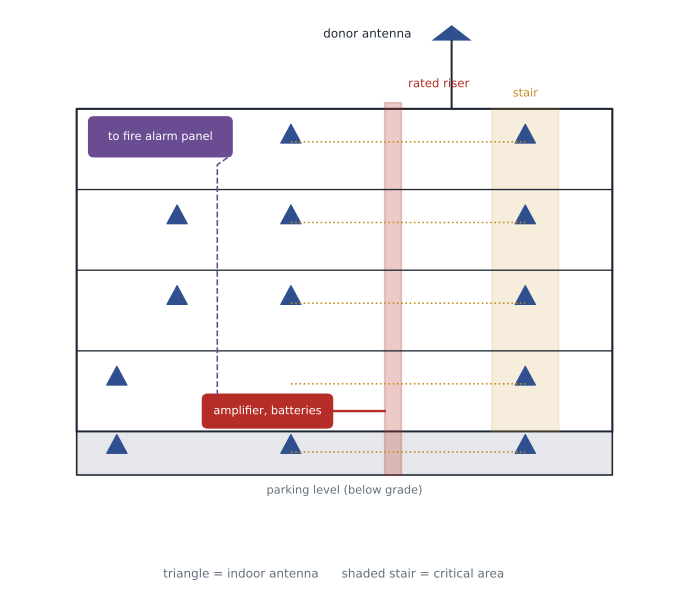
A life safety system that fails early in a fire is not much use. Requirements therefore protect the parts of the system whose failure would disable large areas. The most common provision in US practice is that backbone cables, such as the riser between the amplifier and the floors, be installed in pathways with a fire-resistance rating, typically two hours, or use cables rated to keep working for that period, with exceptions in some jurisdictions for low-rise sprinklered buildings or buildings whose structure has a lower rating. Branch cables on each floor that feed only a few antennas generally do not need the same protection, because losing one antenna affects only a small area.
Equipment such as amplifiers, remote units and battery systems is usually required to be in weatherproof or dust-tight enclosures, with NEMA 4 or similar ratings commonly specified, and located in rooms that are protected from fire. The donor antenna and its cable must be protected and bonded where they enter the building. Each of these requirements affects the RCDD's work: rated shafts or rated cable for the riser, rated rooms or enclosures for equipment, and coordination with the architect, the electrical engineer and the fire protection engineer.
| Requirement area | Typical provisions (confirm locally) | What it means for the ICT design |
|---|---|---|
| Signal level | About −95 dBm inbound; quality DAQ 3.0 or 3.4 | Antenna density and amplifier sizing |
| Coverage | High share of general areas; near-complete coverage of critical areas | Antennas in stairs, fire command center, pump room and similar spaces |
| Backup power | 12 hours at full load in US practice; shorter periods in some bylaws | Battery space, ventilation and monitoring |
| Survivability | Two-hour rated pathway or cable for the backbone, with exceptions | Rated risers or rated cable; coordination with fire separations |
| Enclosures | NEMA 4 or similar for amplifiers and power supplies | Equipment selection and room layout |
| Monitoring | Alarms for amplifier, antenna, power and battery faults reported to a constantly attended location or the fire alarm system | Interface with the fire alarm control unit |
| Testing | Acceptance test and annual retest by qualified people | Access to equipment and test documentation |
Monitoring and the fire alarm interface
Public safety radio systems must report their own faults. Typical requirements include supervisory signals for amplifier failure, antenna malfunction, loss of normal power, battery charger failure and low battery capacity, sent to the fire alarm system or another constantly attended location. In practice this means a hard-wired or listed interface between the amplifier's alarm outputs and the fire alarm control unit. The RCDD should show these connections on the drawings and coordinate them with the fire alarm designer, because the interface and its pathway are often forgotten until commissioning.
Who is qualified to design and test
Many authorities now require that public safety systems be designed, installed and tested by qualified people, defined by a license, a professional registration or an industry certification. Some US jurisdictions require certifications in in-building public safety communications, and some Canadian bylaws require testing by a registered engineer or technologist with radio experience. The RCDD who is not personally qualified should plan for a specialist and should ensure that the specialist's requirements for space, pathways, power and monitoring are captured in the ICT design.
Bringing it into the Harbourview design
Daniel and Roz build a list of what the Harbourview design needs: a donor antenna location on the roof with a clear view toward the public safety radio sites, a rated room on the ground floor for the amplifier and batteries, a riser in a two-hour rated shaft, antennas in every stairwell and in the parking level, the fire command center and the pump room, a monitored interface with the fire alarm system, and space for a public safety system separate from the cellular DAS. Roz explains that some jurisdictions allow public safety and cellular signals to share a single system, but many fire services prefer or require a dedicated one so that commercial systems cannot affect responder communications. In this project the fire service has asked for a dedicated system, so the two will share some pathways but not equipment.
Common mistakes
MistakeTreating public safety coverage as another cellular DAS.
InsteadIt is a life safety system with survivability, backup power, monitoring and testing requirements that commercial systems do not have.
MistakeAssuming one national rule applies everywhere.
InsteadRequirements come from adopted codes and local bylaws. Confirm the applicable rules with the local authority.
MistakeProtecting every branch cable with rated pathways.
InsteadRequirements usually target the backbone. Protecting every branch adds cost with little benefit, unless the authority requires it.
MistakeLeaving the fire alarm interface for commissioning.
InsteadMonitoring connections need design, pathways and coordination with the fire alarm designer.
Summary and key terms
- In-building public safety radio coverage keeps responders in contact inside large, below-grade and radio-blocking buildings.
- Requirements come from adopted fire codes and standards, local bylaws and fire department standards, and vary by jurisdiction.
- Typical criteria include a minimum signal level around −95 dBm, delivered audio quality of 3.0 or 3.4, and higher coverage targets for critical areas.
- Backup power, rated backbone pathways, protective enclosures and monitored alarms make the system survivable.
- Grid testing verifies coverage at acceptance and every year after.
- Delivered audio quality (DAQ)
- A scale from 1 to 5 describing how understandable speech is over a radio link.
- Critical area
- A space named by the authority where responders must have nearly complete radio coverage, such as stairs and the fire command center.
- Survivability
- The ability of cables and equipment to keep working for a set time during a fire.
- Grid test
- A coverage test that divides a floor into equal areas and measures signal in each one.
- Authority having jurisdiction
- The organization or official responsible for enforcing code requirements and approving the system.
- Supervisory signal
- An alarm that reports a fault condition in a life safety system to a monitored location.
Practice problems
Work each problem on paper first, then reveal the answer to check.
A floor has 40 test areas and 37 pass. What share passes, and does it meet a 95 of 100 requirement?
Show answer
37 ÷ 40 = 0.925, which does not meet 0.95.
A system draws 120 W and needs 12 hours of backup. How much energy is needed?
Show answer
1,440 Wh.
Why are branch cables usually exempt from survivability requirements?
Show answer
Losing one branch affects only a few antennas, whereas losing the backbone disables large areas.
Lesson quiz · 5 questions
Score 60% or more to complete this lesson.
Create a free account to save your progress, take quizzes and earn a certificate.