
RCDD-113 · Lesson 2 of 12 · 21 min
Bonding and grounding terminology
▶ Video coming soon A video version of this lesson is on the way.
Daniel's first assignment on Harbourview was not a drawing. Roz handed him three documents, the electrical engineer's preliminary single-line diagram, a manufacturer's installation guide for an entrance protector and the bonding section of the clinic group's IT design standard, and asked him to make a list of every term in them that described a grounding or bonding part. He came back with forty-one terms. 'Some of these are the same thing,' he said. 'The electrical drawing calls it a ground bar, the protector guide calls it a ground, and the owner standard calls it a TMGB.' Roz nodded. 'That is why the vocabulary gets its own lesson. If the people on a project use different words for the same part, somebody installs the wrong thing.'
This lesson sorts the vocabulary into four groups: the electrical system terms an RCDD must understand to coordinate with the electrical engineer, the telecommunications bonding terms from ANSI/TIA-607, the network-topology terms used for equipment bonding, and the older names that still appear on drawings, in owner standards and in the field.
Electrical system terms
The electrical system starts at the service, the point where the utility's conductors connect to the building's wiring. At or near the service the building's grounded conductor, usually the neutral, is connected to the equipment grounding system and to the grounding electrode system. That one connection, the main bonding jumper, is what makes the neutral and the grounding system the same reference at the service. Downstream of the service the neutral and the grounding conductors are kept separate, except at a separately derived system such as a transformer, where a new neutral-to-ground connection is made.
A grounding electrode is a conductive object in contact with the earth: a driven ground rod, a buried ground ring, the reinforcing steel in a concrete footing, an underground metal water pipe or a building's structural steel where it is effectively grounded. The grounding electrode system is all the electrodes present at a building bonded together. The grounding electrode conductor connects the service equipment to that system. In the National Electrical Code these parts are covered in Article 250, which uses the terms grounding electrode, grounding electrode system, grounding electrode conductor and bonding jumper.
An equipment grounding conductor, sometimes called the ground wire in the field, runs with the circuit conductors from a panel to the equipment it serves, so that a fault from a live conductor to a metal enclosure has a low-impedance path back to the source. That path lets enough current flow to open the breaker or fuse quickly. It is the conductor that the green or bare wire in a power cord connects to.
| Term | Short definition | Where an RCDD meets it |
|---|---|---|
| Service | Where utility conductors connect to building wiring | Location of the main electrical room and the PBB connection |
| Main bonding jumper | The single neutral-to-ground connection at the service | Explains why the service is the reference point for the ICT bonding network |
| Grounding electrode system | All electrodes at a building bonded together | What the ICT bonding network ultimately connects to |
| Grounding electrode conductor | Connects service equipment to the electrode system | Path for lightning and fault energy to earth |
| Equipment grounding conductor | Runs with a circuit to bond equipment enclosures back to the source | Present in every power cord, but not a substitute for ICT bonding |
| Separately derived system | A source such as a transformer with its own neutral-to-ground bond | Transformers serving data rooms may create a new local reference |
The National Electrical Code requires an intersystem bonding termination, described in 250.94, at the service equipment and at the disconnecting means of each separate building. It provides an accessible place to connect the bonding conductors of communications, CATV and radio systems. For the RCDD, the important idea is that there should be an accessible, identified place at or near the service where other systems' bonding conductors connect to the electrical grounding system without opening live equipment.
Telecommunications bonding terms
ANSI/TIA-607 names the parts of the telecommunications bonding infrastructure, and the names changed in the C and D revisions, which is why Daniel found so many versions. The current names, used throughout this course, describe what each part does.
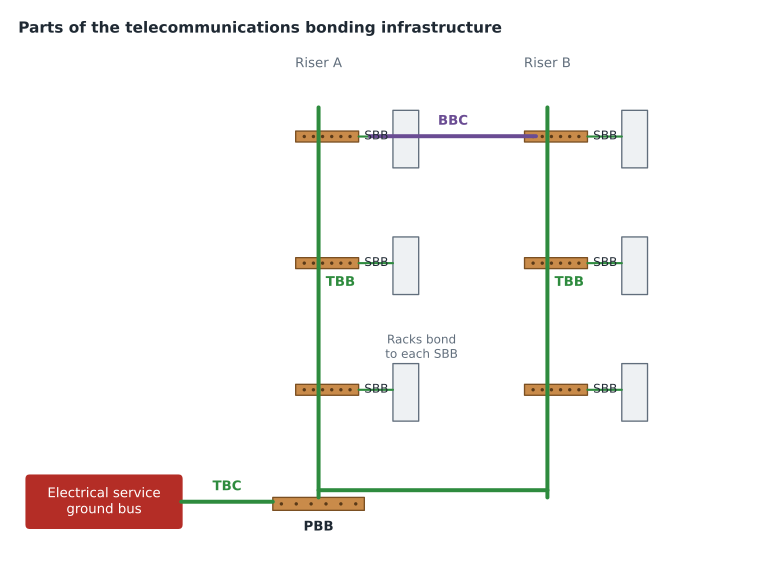
The primary bonding busbar, or PBB, is the main busbar of the telecommunications bonding network. It is usually located in the entrance facility or the main equipment room, close to the electrical service if possible, and it is the point where the telecommunications bonding network connects to the building's electrical grounding system. There is normally one PBB per building.
The telecommunications bonding conductor, or TBC, connects the PBB to the electrical service equipment's grounding, typically to the service's ground bus or to the intersystem bonding point. It is the single controlled connection between the two systems that lesson 1 described.
A secondary bonding busbar, or SBB, is a busbar in a telecommunications room, equipment room or other ICT space other than the one with the PBB. Each SBB is the local reference for that space: racks, cable trays, cable shields and equipment in the room bond to it.
The telecommunications bonding backbone, or TBB, is the conductor that runs from the PBB to the SBBs, usually following the backbone cabling pathway. In a tall building there may be more than one TBB, each running up a different riser.
A backbone bonding conductor, or BBC, interconnects TBBs, typically at the top floor and at least every few floors in buildings with several backbones, so that the parallel backbones do not drift apart in potential. It was once called the grounding equalizer.
Rack bonding busbars, unit bonding conductors and rack bonding conductors complete the chain inside a room: a small busbar or bonding strip on each rack or cabinet, short conductors from equipment to that rack busbar and a conductor from each rack to the SBB or to an equipment bonding network in the room.
| Current name (ANSI/TIA-607-D and -E) | Abbreviation | Older name still seen | Older abbreviation |
|---|---|---|---|
| Primary bonding busbar | PBB | Telecommunications main grounding busbar | TMGB |
| Secondary bonding busbar | SBB | Telecommunications grounding busbar | TGB |
| Telecommunications bonding conductor | TBC | Bonding conductor for telecommunications | BCT |
| Telecommunications bonding backbone | TBB | Telecommunications bonding backbone | TBB |
| Backbone bonding conductor | BBC | Grounding equalizer | GE |
| Rack bonding busbar | RBB | Rack grounding busbar or rack ground bar | RGB |
The older names are not wrong so much as out of date. Many owner standards, contractor details and manufacturer catalogs still use TMGB and TGB, and the exam may describe a part by function rather than by name. A good habit is to put both names in a specification the first time a part appears, for example 'primary bonding busbar (PBB, formerly TMGB)', so that every reader recognizes it.
The change from 'grounding busbar' to 'bonding busbar' was deliberate. The committee wanted to emphasize that the main job of these parts is bonding: equalizing potential across the ICT system. Their connection to earth happens through the building's electrical grounding system, not through any electrode of their own.
Bonding network topology terms
Inside equipment rooms and data centers, designers also describe how equipment is bonded together. Two families of topology appear in standards and in the telecommunications carrier world, and they come with their own terms.
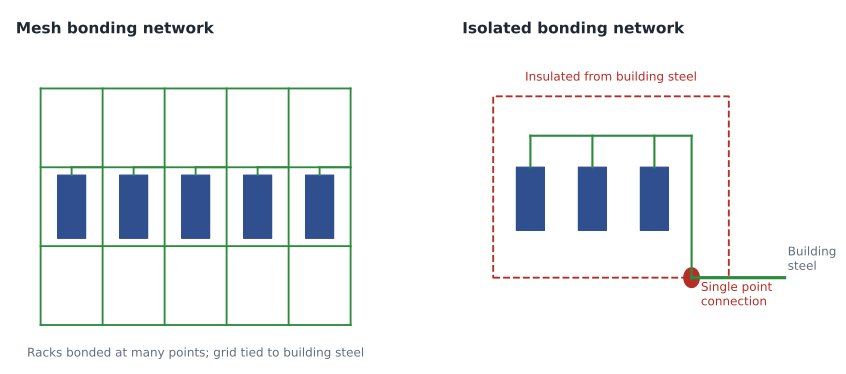
A common bonding network, or CBN, is the set of metal parts in a building that are intentionally or incidentally bonded together: structural steel, reinforcing steel, metal pipes, raceways, cable trays and equipment frames. In a well-designed building the CBN is dense and well interconnected, and ICT equipment is bonded to it at many points. Most commercial buildings and enterprise data rooms use this approach.
A mesh bonding network, or mesh-BN, is a CBN deliberately made into a grid, for example a copper grid under a raised floor or overhead in a data center, with every rack bonded to the nearest point. The mesh keeps impedance low across the whole area and gives noise and surge currents many parallel paths.
An isolated bonding network, or IBN, keeps a group of equipment insulated from the CBN except at one point, the single point connection window. Telecommunications carriers have used IBNs in central offices so that surge currents cannot flow through the equipment from one side to the other. IBNs require strict discipline: any accidental connection to the CBN elsewhere defeats them, and every cable entering the isolated zone must be controlled. They are rare in enterprise buildings, and Roz advised Daniel to treat any request for one as a question for the equipment maker and the owner rather than a default.
Words that cause trouble
Some words are used loosely enough on site to cause real mistakes. 'Clean ground' and 'dedicated ground' usually mean a request for an isolated ground of the kind lesson 1 warned against, though sometimes they mean an isolated ground receptacle circuit, which is a different and legal arrangement covered in lesson 9. 'Earth ground' is redundant but usually means the grounding electrode system. 'Ground loop' describes the noise problem that occurs when two points of a signal circuit are connected to grounds at different potentials and current flows between them through a cable shield or a signal conductor. A good bonding network reduces ground loops by making the potential differences small. Breaking the bonding to 'cure' a ground loop is a safety hazard.
'Ground' as a noun is the worst offender. In an electrician's mouth it might mean the equipment grounding conductor. In a technician's mouth it might mean a cable shield or the 0-volt reference of a circuit board. To an equipment maker it might mean the frame of a chassis. When Daniel heard the word in a meeting, Roz expected him to ask which ground was meant.
'Neutral' is another. The neutral is a current-carrying conductor that returns current to the source in normal operation. It is connected to the grounding system only at the service and at separately derived systems. Using the neutral as a ground, or connecting neutral and ground at a sub-panel, puts normal load current on the bonding network and can create both shock hazards and noise. When the existing clinic building's electrician found a neutral-to-ground connection in a sub-panel during the post-storm investigation, Priya Raman added a correction to the work order immediately.
| Phrase heard on site | What it usually means | What to ask or do |
|---|---|---|
| Clean ground or dedicated ground | An isolated earth electrode for ICT equipment | Explain the single-point connection rule; refer to the standard |
| Isolated ground circuit | A receptacle with an insulated equipment grounding conductor run back to the panel | Legal under the code when installed correctly; see lesson 9 |
| Ground loop | Noise from current flowing between two references at different potential | Improve bonding rather than breaking it |
| Ground it to the pipe | Bond to a water pipe as an electrode | Confirm the pipe is metal, underground and bonded; do not rely on it alone |
| Neutral and ground tied at the sub-panel | An improper neutral-to-ground connection downstream of the service | Report to the electrical engineer; it must be removed |
Writing it down
Daniel's final step was a project glossary, a single page in the specification listing each part with its current name, abbreviation, older name and a one-line definition. Roz insisted that the electrical engineer review it so that both disciplines' drawings would use the same names. Priya added one line of her own: the electrical drawings would label the TBC termination point at the service as 'ICT bonding connection' so that the electrician would know exactly where to land the conductor.
The glossary also helped the cabling contractor. Tomasz Wiercinski said that in his experience half the bonding problems he saw in finished buildings came from installers not knowing what a part was for. A crew that knows the SBB is the local reference will not use it as a convenient place to mount an unrelated panel, and a crew that knows the TBB is a bonding conductor, not a grounding electrode conductor, will not try to drive a ground rod at the top of a riser.
Worked problem
Translating an old owner standard
The clinic group's IT standard, written in 2009, says: 'Each IDF shall have a TGB bonded to the TMGB via the TBB. The TMGB shall be bonded to the building service ground via a BCT. The GE shall interconnect TBBs at the top floor.' Rewrite it with current names, keeping the meaning.
Show solution
- Replace TGB with secondary bonding busbar (SBB).
- Replace TMGB with primary bonding busbar (PBB).
- TBB stays the same: telecommunications bonding backbone.
- Replace BCT with telecommunications bonding conductor (TBC).
- Replace GE (grounding equalizer) with backbone bonding conductor (BBC).
- Replace IDF, the old intermediate distribution frame, with telecommunications room (TR) for consistency with the TIA standards.
Answer: Each telecommunications room shall have a secondary bonding busbar (SBB, formerly TGB) bonded to the primary bonding busbar (PBB, formerly TMGB) by the telecommunications bonding backbone (TBB). The PBB shall be bonded to the electrical service grounding by a telecommunications bonding conductor (TBC, formerly BCT). A backbone bonding conductor (BBC, formerly GE) shall interconnect TBBs at the top floor.
Common mistakes
MistakeUsing 'ground' without saying which ground.
InsteadName the part: equipment grounding conductor, grounding electrode system, SBB, cable shield or circuit reference.
MistakeMixing old and new TIA names in one specification.
InsteadUse current names and give the older name in brackets the first time each appears.
MistakeTreating an isolated bonding network as a routine choice.
InsteadUse a mesh connected to the common bonding network unless the owner and equipment maker require an IBN and can maintain it.
MistakeConnecting neutral to ground at a sub-panel.
InsteadBond neutral to ground only at the service and at separately derived systems.
Summary and key terms
- The service's main bonding jumper makes the neutral and grounding system a single reference at the service.
- The grounding electrode system is all electrodes at a building bonded together; the ICT bonding network connects to it through the electrical service.
- Current TIA names: PBB, SBB, TBC, TBB, BBC and rack bonding busbars; older names are TMGB, TGB, BCT and GE.
- The renaming from grounding to bonding emphasizes that these parts equalize potential.
- A mesh bonding network tied to the common bonding network is normal for enterprise ICT spaces; isolated bonding networks are special cases.
- Ask which ground is meant whenever the word is used loosely.
- Primary bonding busbar (PBB)
- The main busbar of the telecommunications bonding network, connected to the electrical service grounding.
- Secondary bonding busbar (SBB)
- The local busbar in a telecommunications room or other ICT space.
- Telecommunications bonding conductor (TBC)
- The conductor from the PBB to the electrical service grounding.
- Telecommunications bonding backbone (TBB)
- The conductor from the PBB to the SBBs.
- Backbone bonding conductor (BBC)
- A conductor interconnecting two or more TBBs.
- Common bonding network (CBN)
- The bonded metal parts of a building, to which equipment is bonded at many points.
- Isolated bonding network (IBN)
- Equipment bonded together but insulated from the CBN except at one connection point.
Practice problems
Work each problem on paper first, then reveal the answer to check.
What is the current name for the TMGB?
Show answer
Primary bonding busbar (PBB).
What does the TBC connect?
Show answer
The PBB to the electrical service grounding.
Why did TIA rename grounding busbars as bonding busbars?
Show answer
To emphasize that their job is equalizing potential, with the connection to earth made through the electrical system.
What is a ground loop, and what is the right cure?
Show answer
Noise from current flowing between two references at different potentials; improve bonding rather than breaking it.
Lesson quiz · 5 questions
Score 60% or more to complete this lesson.
Create a free account to save your progress, take quizzes and earn a certificate.