
RCDD-113 · Lesson 10 of 12 · 20 min
UPS, batteries and generators
▶ Video coming soon A video version of this lesson is on the way.
The clinic group's facilities manager asked the question at the first design meeting: 'When the power goes out, what keeps running, and for how long?' Every ICT design has to answer it. A short outage of a few seconds can reboot every switch in a building and take ten minutes to recover from. A long outage can last hours. In a building with clinics, the answer also has to meet the code requirements for health care facilities, which are stricter than for offices.
Backup power for ICT systems usually has two layers. An uninterruptible power supply, or UPS, bridges the gap instantly and keeps equipment running for minutes. A standby generator starts within seconds and carries the load for hours or days. This lesson covers UPS types and sizing, battery technologies and their rooms, generators and transfer switches, and how the pieces fit together for Harbourview.
What a UPS does
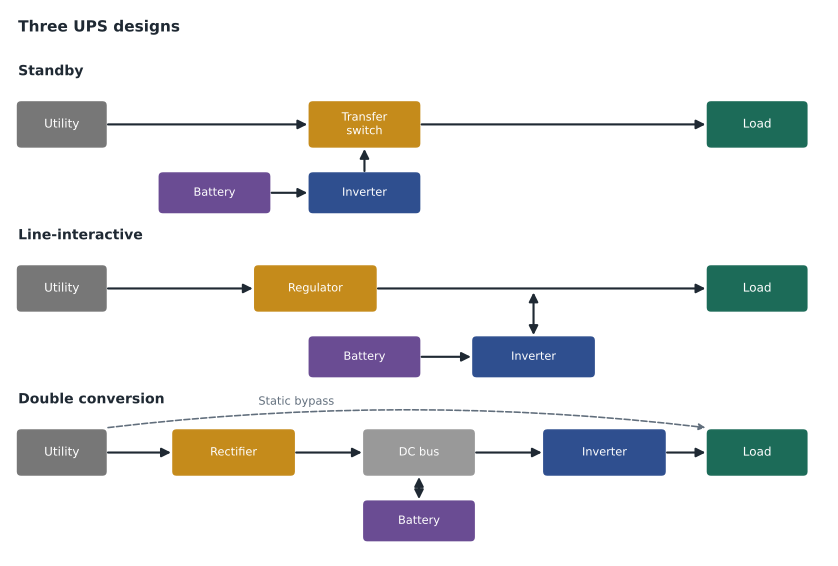
A UPS stores energy, normally in batteries, and delivers it to the load without interruption when the utility supply fails or goes out of tolerance. Depending on its design, it may also clean up the normal supply by correcting voltage sags, swells and noise. Three designs are common.
A standby, or offline, UPS passes utility power straight through to the load in normal operation and switches to its inverter and batteries when the utility fails. The switch takes a few milliseconds, which most ICT power supplies ride through, but the load sees the utility's disturbances in normal operation. These units are small and cheap and are used for single desktops.
A line-interactive UPS adds a transformer or regulator that corrects moderate voltage sags and swells without going to battery. It still switches to battery for outages. Line-interactive units are common for small racks and telecommunications rooms.
A double-conversion, or online, UPS converts incoming AC to DC, which charges the batteries and feeds an inverter that produces fresh AC for the load at all times. There is no transfer at all when the utility fails, because the inverter is already carrying the load; the batteries simply take over from the rectifier. The output is isolated from most disturbances on the input. Double-conversion units are standard for data rooms and larger ICT spaces. They are less efficient than the other designs, though modern units have economy modes that reduce the losses.
Bypass
A double-conversion UPS normally includes a static bypass, an electronic switch that transfers the load straight to the utility if the UPS fails or is overloaded. Larger installations also have a maintenance bypass, a set of manual switches that let technicians isolate the UPS completely for service while the load runs on utility power. A maintenance bypass that is external to the UPS cabinet allows the whole unit to be replaced without shutting down the load. The RCDD should ask for one on any UPS serving critical equipment.
Sizing a UPS
UPS ratings are given in kilovolt-amperes, kVA, and in kilowatts, kW. The kW rating is the real power the UPS can deliver; the kVA rating includes the reactive component drawn by loads with a power factor below one. Modern ICT power supplies have power factors close to one, so the kW rating is usually the limiting figure. A designer should size the UPS on kW, with margin for growth, and avoid running it near full load, which shortens component life and leaves no room for the inrush when equipment restarts.
Runtime is set by the battery. The usable energy in the battery, multiplied by the inverter's efficiency, divided by the load, gives an approximate runtime. Battery capacity falls at high discharge rates, at low temperatures and as batteries age, so makers publish runtime tables at different loads, and designers check those rather than relying on simple arithmetic. The simple calculation is still useful for a first estimate and for explaining the trade-off to an owner.
# First estimate of UPS runtime for the Harbourview data room
load_kw = 9.5                   # design load from the data room equipment list
battery_kwh_nominal = 12.0      # usable energy at a moderate discharge rate, from the maker
derate_aging = 0.8              # allow for capacity loss near end of battery life
inverter_eff = 0.94
usable_kwh = battery_kwh_nominal * derate_aging * inverter_eff
runtime_min = usable_kwh / load_kw * 60
print("usable energy:", round(usable_kwh, 1), "kWh")
print("runtime at", load_kw, "kW:", round(runtime_min), "minutes")
# How long must the UPS carry the load before the generator takes over?
gen_start_and_transfer_s = 10 + 5          # start and stabilize, then transfer
print("generator gap covered", round(runtime_min * 60 / gen_start_and_transfer_s), "times over")usable energy: 9.0 kWh runtime at 9.5 kW: 57 minutes generator gap covered 228 times over
With a generator, a UPS needs only enough runtime to cover the generator's start and transfer, plus a margin for a failed first start and time for an orderly shutdown if the generator never comes on. Owners often choose five to fifteen minutes at full load. Without a generator, the UPS must carry the load for as long as the owner needs, which can make the batteries very large; in that case it may be better to give long runtime only to the most critical loads.
Central or distributed UPS
A building can protect its ICT loads with one central UPS that feeds every TR and the data room through dedicated circuits, or with small UPS units in each space. A central system is easier to maintain, monitor and back with a single battery plant, and its double-conversion output gives every space the same clean power. Distributed units are cheaper to start with and avoid a single point of failure, but each has its own batteries to test and replace, and they are easy to forget. Many projects combine the two, as Harbourview did: a central double-conversion UPS for the data room, and small rack units in each TR, where the loads were modest, to ride through the generator start.
Batteries
Most UPS systems have used valve-regulated lead-acid batteries, VRLA, which are sealed, need no watering and are relatively cheap. Their life is typically several years in service and falls sharply at high temperatures, so battery rooms and UPS spaces should be kept cool. VRLA batteries release small amounts of hydrogen, especially when overcharged, so the space they occupy must be ventilated as the code and the maker require.
Lithium-ion batteries, particularly lithium iron phosphate chemistry, have become common in UPS systems. They are lighter and smaller for the same energy, last longer and tolerate higher temperatures. They are more expensive initially, and they bring a different fire risk: a damaged or failing cell can enter thermal runaway, producing heat and flammable gases that are hard to extinguish. Fire codes and standards now include requirements for energy storage systems that depend on the battery chemistry and the stored energy, and the AHJ will often want to see the system's listing and fire test data. The fire protection engineer and the AHJ settle those details for each installation.
| Feature | VRLA lead-acid | Lithium-ion (lithium iron phosphate) |
|---|---|---|
| Typical service life | Several years; shortened by heat | Longer, often around a decade |
| Size and weight for the same energy | Larger and heavier | Smaller and lighter |
| Initial cost | Lower | Higher |
| Main hazards | Hydrogen release, acid, heavy weight | Thermal runaway and flammable gases if damaged or faulty |
| Monitoring | Periodic testing; optional string monitoring | Built-in battery management system |
| Room requirements | Ventilation, spill containment where required | Fire code provisions for energy storage, separation and detection as required |
At Harbourview, the data room UPS used lithium iron phosphate batteries in cabinets beside the UPS. The fire protection engineer and the AHJ reviewed the system's listing and the room's sprinkler and detection design. The TRs used small line-interactive rack-mounted UPS units with VRLA batteries to ride through the generator start, because their loads were small and their spaces were cool.
Generators and transfer switches
A standby generator, usually diesel or natural gas, supplies power for long outages. When the utility fails, a controller starts the generator, and when it reaches stable voltage and frequency an automatic transfer switch, ATS, moves the load from the utility to the generator. When the utility returns and is stable, the ATS transfers back after a delay and the generator cools down and stops.
The generator does not start instantly. Most units take several seconds to start and stabilize, and the transfer adds a little more. For life safety loads in many buildings, codes require that power be restored within a short set time, commonly around ten seconds. For ICT loads, the UPS covers the gap; the equipment never sees it.
Buildings divide their generator-backed loads into categories. In the United States, NEC Articles 700, 701 and 702 distinguish emergency, legally required standby and optional standby systems, and in health care facilities Article 517 together with NFPA 99 and NFPA 110 sets requirements for the essential electrical system and its branches. ICT loads may fall in several categories: equipment serving life safety, such as fire alarm communicators and some nurse call and public address systems, may be required on the higher-priority branches, while general network equipment is usually on lower-priority or optional standby circuits.
Daniel worked with Priya to place each ICT load in the right category. The fire alarm communicators, emergency phones in elevators and the nurse call system's head-end and network connections went where the code and the owner's clinical engineering team required. The data room UPS, the TR panels and the building automation controllers were on the generator's standby branch. The cooling for the data room and the TRs went on the generator too, because a UPS that keeps equipment running while its room heats up only delays the failure.
Bonding and grounding of backup power
Backup power systems have their own grounding requirements. A generator is often a separately derived system, depending on whether the transfer switch switches the neutral, and the electrical engineer designs its grounding accordingly. A UPS may also be separately derived if it contains an isolation transformer. These details matter to the RCDD because they decide where the neutral-to-ground bond for the ICT loads is and whether the data room's power reference is local or at the service.
Whatever the arrangement, the UPS cabinet, battery cabinets and their metal racks are bonded to the equipment grounding system and, in an ICT space, to the room's SBB or mesh. In the Harbourview data room, the UPS output panel's ground bus and the UPS frame were bonded to the room SBB. Daniel noted in the design that the UPS manufacturer's grounding instructions also applied and that the electrical contractor should confirm whether the UPS was configured as separately derived before connecting the output neutral.
Testing and maintenance
Backup power that has not been tested may not work. UPS systems need periodic battery tests and inspections; generators need regular exercise under load and periodic full-load tests, often on a schedule the code sets for emergency systems. Transfer switches need to be operated. For ICT systems, owners should also test the whole chain: pull the utility power to a TR or the data room during a planned window and confirm that the UPS carries the load, the generator takes over and the equipment never reboots. Lesson 12 includes those tests in the commissioning plan.
Worked problem
Setting the UPS runtime
The Harbourview data room design load is 9.5 kW. The generator starts and transfers in about 15 seconds. The owner wants enough runtime to survive one failed generator start and retry, and then an orderly shutdown of servers, which takes 6 minutes. Suggest a target runtime and explain it.
Show solution
- One start and transfer takes about 15 seconds; a failed start and retry might take 60 seconds in total.
- An orderly shutdown takes 6 minutes after the decision is made that the generator will not come on.
- Add a few minutes for the decision and margin for battery aging: about 2 minutes plus 6 minutes plus a margin of 2 minutes gives 10 minutes.
- The code example estimated about 57 minutes with the chosen battery, so the design exceeds the target, and the owner could reduce the battery size or keep the extra time for longer outages if the generator fails.
Answer: A target of about 10 minutes at end-of-life battery capacity covers the generator gap, a retry and an orderly shutdown.
Common mistakes
MistakeSizing a UPS only by its kVA rating.
InsteadSize on kW, with margin, because modern ICT loads have power factors near one.
MistakePutting ICT equipment on generator power but not its cooling.
InsteadPut cooling for ICT spaces on the generator too.
MistakeAssuming lithium-ion batteries need no special review.
InsteadCheck fire code requirements for energy storage and give the AHJ the system's listing and test data.
MistakeNever testing the full chain.
InsteadTest utility failure, UPS carry-over and generator transfer during a planned window.
Summary and key terms
- Backup power for ICT has two layers: a UPS for instant carry-over and a generator for long outages.
- Standby, line-interactive and double-conversion UPS designs differ in how they handle normal disturbances and outages.
- Size a UPS on kW with margin; estimate runtime from usable battery energy, efficiency and load, then check the maker's tables.
- VRLA batteries need cool, ventilated spaces; lithium-ion batteries need fire code review for energy storage.
- NEC Articles 700, 701, 702 and 517, with NFPA 99 and 110, set requirements for emergency, standby and health care essential systems.
- Bond UPS and battery cabinets to the room SBB, and test the full chain.
- Uninterruptible power supply (UPS)
- Equipment that delivers stored energy to a load without interruption when the supply fails.
- Double conversion
- A UPS design in which the inverter carries the load at all times from a DC bus fed by the rectifier and batteries.
- Static bypass
- An electronic switch that transfers the load to the utility if the UPS fails or is overloaded.
- Automatic transfer switch (ATS)
- A switch that moves the load between the utility and the generator.
- Thermal runaway
- A self-heating failure of a battery cell that releases heat and gases.
- Essential electrical system
- The generator-backed system in a health care facility, divided into branches by priority.
Practice problems
Work each problem on paper first, then reveal the answer to check.
What is the difference between a line-interactive and a double-conversion UPS?
Show answer
Line-interactive switches to battery on outage; double-conversion carries the load on its inverter at all times.
Why should a UPS be sized on kW?
Show answer
Modern ICT loads have power factors near one, so real power is the limit.
What runtime does a UPS need when a generator is present?
Show answer
Enough to cover generator start and transfer, a retry and an orderly shutdown, with margin.
Why must cooling be on the generator?
Show answer
Equipment kept running without cooling will overheat and fail.
Lesson quiz · 5 questions
Score 60% or more to complete this lesson.
Create a free account to save your progress, take quizzes and earn a certificate.