
RAC-420 · Lesson 9 of 12 · 17 min
Carbon dioxide as a refrigerant: properties and hazards
In July, Theo rotated back to the commercial side for a month to work on Harvest Lane's second store, where Nadia Brooks was finishing the design of a transcritical carbon dioxide booster system. On the first day she handed him a pressure-temperature chart for R-744 and asked him to read the saturation pressure at 68 °F. He found it, looked again, and laughed. "That's over 800 psig," he said. "The R-448A rack at the first store runs its high side at a third of that on a hot day." Nadia nodded. "Everything about CO₂ follows from that chart," she said. This lesson describes carbon dioxide's properties as a refrigerant and the hazards that come with them, before lesson 10 describes the systems.
A refrigerant with an old history
Carbon dioxide was one of the first refrigerants, widely used on ships and in cold stores in the late 1800s and early 1900s, because it was non-flammable and non-toxic compared with the alternatives of the day. It fell out of use when fluorocarbons arrived in the 1930s, because the machines of the time could not handle its pressures efficiently, and its performance in warm climates was poor. It returned in the 1990s, when research in Europe showed how to build efficient transcritical systems, and since then it has become one of the main refrigerants for supermarkets, especially in Europe and increasingly in North America, and a growing choice for ice rinks, heat pumps for hot water, cold storage and transport refrigeration.
Pressures and the critical point
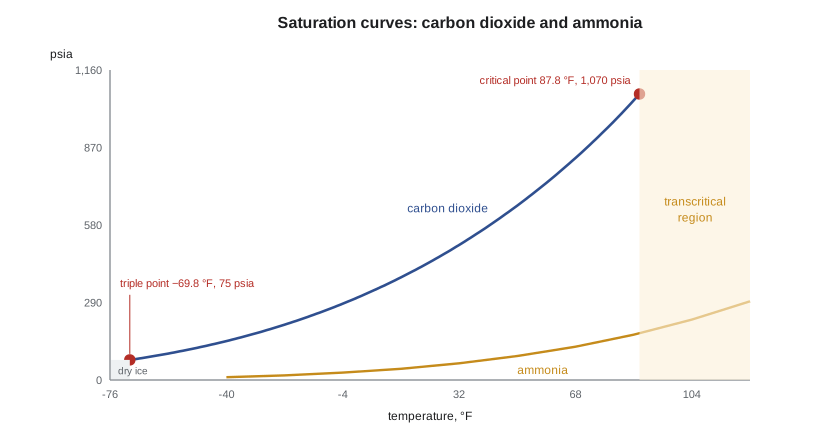
Carbon dioxide's saturation pressures are far higher than those of any common HFC. Its triple point, where solid, liquid and vapor coexist, is at about −69.8 °F and 60 psig: below that pressure, liquid carbon dioxide cannot exist, and it turns to solid dry ice and vapor. Its critical point is at about 87.8 °F and 1,055 psig. Between those two points it behaves like any other refrigerant, condensing and evaporating at a pressure set by temperature. Above the critical temperature there is no distinction between liquid and vapor, and heat is rejected from a dense, supercritical fluid whose temperature falls continuously as it cools. The script calculates the saturation pressure across the useful range from a standard property equation.
# Carbon dioxide: saturation pressure, standstill pressure and room concentration (approximate)
import math
Tc, pc = 304.13, 73.77           # K and bar, critical point
a = [(-7.0602087, 1.0), (1.9391218, 1.5), (-1.6463597, 2.0), (-3.2995634, 4.0)]
def psat_psig(tF):               # psig, Span and Wagner ancillary equation
    T = (tF - 32) / 1.8 + 273.15
    tau = 1 - T / Tc
    return pc * math.exp(Tc / T * sum(c * tau ** n for c, n in a)) * 14.504 - 14.7
for t in (-69.9, -22, 14, 32, 50, 68, 86):
    print(f"{t:6.1f} F  {psat_psig(t):6.0f} psig  (ammonia at the same temperature is far lower)")
print("above 87.8 F there is no liquid-vapor boundary: the gas cooler works in the transcritical region")
# a leak into a small machine room
room = 20 * 16 * 12              # ft3
for lb in (11, 44, 110):
    ft3 = lb / 44.01 * 392.0
    print(f"{lb:3d} lb into {room:,} ft3 -> {ft3 / room * 1e6:9,.0f} ppm")
print("limits: 5,000 ppm (OSHA 8-hour), 30,000 ppm (15-minute), 40,000 ppm IDLH")-69.9 F 60 psig (ammonia at the same temperature is far lower) -22.0 F 192 psig (ammonia at the same temperature is far lower) 14.0 F 369 psig (ammonia at the same temperature is far lower) 32.0 F 491 psig (ammonia at the same temperature is far lower) 50.0 F 638 psig (ammonia at the same temperature is far lower) 68.0 F 816 psig (ammonia at the same temperature is far lower) 86.0 F 1031 psig (ammonia at the same temperature is far lower) above 87.8 F there is no liquid-vapor boundary: the gas cooler works in the transcritical region 11 lb into 3,840 ft3 -> 25,515 ppm 44 lb into 3,840 ft3 -> 102,060 ppm 110 lb into 3,840 ft3 -> 255,150 ppm limits: 5,000 ppm (OSHA 8-hour), 30,000 ppm (15-minute), 40,000 ppm IDLH
The pressures range from about 190 psig at −22 °F, a typical low-temperature evaporator, through 370 psig at 14 °F and 490 psig at 32 °F, to over 1,000 psig at 86 °F, just below the critical point. For comparison, ammonia at 86 °F is about 155 psig. The high pressures have consequences for every part of a system. Components, piping and fittings must be rated for them, and in transcritical systems the high side typically has a design pressure of about 1,740 psig or more, the intermediate receiver about 870 psig and the suction lines 650 psig or so. Copper tube must be a high-strength alloy or of a heavier wall than usual, and fittings, valves and gauges must be marked for carbon dioxide service. Brazed joints and flare fittings that are fine on HFC systems may not be.
Standstill pressure
One consequence of the high pressures is the standstill problem. When a carbon dioxide system stops, for a power failure or a service shutdown, the refrigerant on the low side warms toward the temperature of its surroundings, and its pressure rises. In a supermarket machine room at 77 °F, the saturation pressure is about 930 psig, well above the design pressure of the low side and of the intermediate receiver. Systems therefore need a way to deal with standstill: a small standby condensing unit, often running on emergency power, that keeps the receiver cold; relief valves that vent carbon dioxide to keep the pressure within limits; or, in some systems, design pressures high enough to contain the refrigerant at ambient temperature. A technician who isolates a section of a carbon dioxide system for service must allow for the same rise: an isolated section of liquid can reach very high pressures in minutes as it warms.
Relief and dry ice
Pressure relief on carbon dioxide systems has its own hazard. If liquid carbon dioxide is released to the atmosphere through a valve or a broken line, it drops below the triple-point pressure and part of it turns instantly to solid dry ice snow, at about −109 °F, while the rest flashes to vapor. Dry ice can block a relief line or a vent, and it can collect in a relief valve's discharge pipe. Relief valves on carbon dioxide systems are therefore usually placed on vapor spaces, their discharge lines are kept short and sloped, and their outlets are protected. During service, liquid carbon dioxide must never be vented through a small valve or a hose, because the dry ice that forms can block the hose and then release suddenly, and because the cold can cause frostbite. When a system is emptied, the pressure is reduced through the vapor phase, staying above the triple point until the liquid is gone, as the manufacturer's procedure describes.
Charging also follows from the triple point. A system that has been evacuated must first be charged with vapor until its pressure is well above about 60 psig, so that liquid admitted later does not turn to dry ice in the evaporators and valves. Only then is liquid added, typically by weight, usually to the receiver.
Water in carbon dioxide systems
Moisture is a serious problem in carbon dioxide systems. Carbon dioxide holds very little water in solution, especially in the vapor phase, so small amounts of moisture can come out as free water or, at low temperatures, form ice and solid hydrates that block valves and filters. With water, carbon dioxide forms carbonic acid, which corrodes steel components and damages oils. Systems therefore use carbon dioxide of a refrigeration grade with very low moisture, larger filter-driers designed for carbon dioxide, moisture indicators on liquid lines and very thorough evacuation. Theo learned that the beverage-grade or welding-grade carbon dioxide used elsewhere is not suitable.
Health hazards
Carbon dioxide is non-flammable and has low toxicity at low concentrations; it is a normal part of air at about 0.04 %, or 400 ppm, and of the air we breathe out at about 4 %. But it is not harmless. At higher concentrations it affects breathing, the heart and the brain directly, not only by displacing oxygen: a few percent causes rapid breathing, headache and dizziness, around 10 % can cause unconsciousness within minutes, and higher concentrations can kill quickly. It has no smell at the concentrations that matter, so people do not notice it, and it is about 1.5 times as dense as air, so a release flows down stairs, into pits, basements and low rooms and collects there.
Exposure limits reflect that. OSHA's permissible exposure limit is 5,000 ppm as an 8-hour average, NIOSH recommends a short-term limit of 30,000 ppm over 15 minutes, and the IDLH is 40,000 ppm. The script at the start of the lesson shows how quickly those levels can be reached: 11 lb of carbon dioxide released into a small machine room of 3,840 ft³ gives about 25,500 ppm, close to the short-term limit, and 44 lb gives over 100,000 ppm, about 10 %, a level that can cause collapse. A supermarket system can hold several hundred kilograms, so a large leak in an enclosed space is a real danger.
Carbon dioxide systems therefore need detection wherever a leak could build up a dangerous concentration: machine rooms, walk-in coolers and freezers, and other enclosed or low spaces. The detectors, usually non-dispersive infrared, are placed low, because carbon dioxide sinks, and they trigger alarms and ventilation at concentrations set by the code and the design. Codes also limit how much refrigerant can leak into an occupied space, using a refrigerant concentration limit for carbon dioxide that the designer must check for each room the system serves. Dry ice and cold liquid can cause severe frostbite, so the protective equipment for carbon dioxide work includes insulated gloves and face protection.
Rules for carbon dioxide systems
Carbon dioxide systems are covered by the same safety codes as other refrigeration systems: the mechanical code, through ASHRAE 15, with the pressure vessels and piping under the state's boiler and pressure vessel rules. Because carbon dioxide is in safety group A1, the requirements are simpler than for ammonia in some respects, but the high pressures and the asphyxiation hazard bring their own requirements for pressure ratings, relief, machinery rooms and detection. Carbon dioxide is not covered by the process safety and emergency planning thresholds that apply to ammonia. Technicians need training specific to carbon dioxide, and many manufacturers require it for warranty work; industry groups and manufacturers in the United States offer such training.
| Property | Carbon dioxide (R-744) | Consequence |
|---|---|---|
| Triple point | −69.8 °F, 60 psig | Liquid cannot exist below it; dry ice forms |
| Critical point | 87.8 °F, 1,055 psig | Transcritical operation in warm weather |
| Pressure at 32 °F | About 490 psig | Components rated for high pressure |
| Density of gas | About 1.5 times air | Collects in low spaces; detectors placed low |
| Smell | None | Leaks go unnoticed without detection |
| Water | Very low solubility; forms carbonic acid | Very dry refrigerant, large driers, thorough evacuation |
Tools for carbon dioxide work
Working on carbon dioxide systems needs its own tools. Manifold gauges and hoses must be rated for carbon dioxide's pressures, typically to at least 1,740 to 2,300 psig, with burst ratings well above that. Recovery and charging equipment, scales, vacuum pumps and leak detectors must be suitable, and electronic leak detectors for carbon dioxide work on different principles from HFC detectors. Personal carbon dioxide monitors are worn in machine rooms and walk-ins. Cylinders of carbon dioxide are much heavier and at higher pressure than HFC cylinders, and some contain a dip tube for liquid; technicians must know which they have before connecting. Nadia gave Theo a list of the tools Northfield would need for Harvest Lane 2, and Dana approved the purchase the same week.
Common mistakes
MistakeUsing HFC gauges, hoses and fittings on a carbon dioxide system.
InsteadUse tools and components rated and marked for carbon dioxide pressures.
MistakeAdmitting liquid carbon dioxide to an evacuated system.
InsteadCharge vapor first until the pressure is well above the triple point.
MistakeVenting liquid carbon dioxide through a hose.
InsteadDry ice can block the hose and release suddenly; reduce pressure through the vapor phase.
MistakeIsolating a section of liquid and leaving it to warm.
InsteadPressure rises very quickly; relieve or drain it before isolation.
MistakeTreating carbon dioxide as harmless because it is non-toxic at low levels.
InsteadHigh concentrations can cause collapse; detect low and ventilate.
Summary and key terms
- Carbon dioxide works at very high pressures, about 490 psig at 32 °F, and its critical point is only 88 °F.
- Below the triple point, 60 psig, liquid turns to dry ice; this affects charging, relief and venting.
- Standstill pressure rises toward the ambient saturation pressure, so systems need standby cooling, relief or high design pressures.
- Moisture forms ice, hydrates and carbonic acid; very dry refrigerant and large driers are required.
- Carbon dioxide has no smell, is heavier than air and can cause collapse at high concentrations; detectors are placed low.
- OSHA's PEL is 5,000 ppm; NIOSH's short-term limit is 30,000 ppm; the IDLH is 40,000 ppm.
- R-744
- The refrigerant designation of carbon dioxide.
- Triple point
- The temperature and pressure at which solid, liquid and vapor coexist.
- Critical point
- The temperature and pressure above which liquid and vapor cannot be distinguished.
- Transcritical
- Operation in which heat is rejected above the critical point and evaporation occurs below it.
- Standstill pressure
- The pressure a stopped system reaches as its refrigerant warms to ambient temperature.
- Dry ice
- Solid carbon dioxide, formed when liquid carbon dioxide drops below the triple-point pressure.
Practice problems
Work each problem on paper first, then reveal the answer to check.
What is the saturation pressure of carbon dioxide at 14 °F, from the script?
Show answer
About 370 psig.
Why are carbon dioxide detectors placed low?
Show answer
Carbon dioxide is about 1.5 times as dense as air and collects in low spaces.
20 lb of carbon dioxide leaks into a room of 7,000 ft³. About what concentration results if it mixes evenly?
Show answer
20 ÷ 44.01 × 392 = 178 ft³, about 25,000 ppm.
Why must an evacuated carbon dioxide system be charged with vapor first?
Show answer
So that liquid admitted later stays above the triple point and does not form dry ice.
Lesson quiz · 5 questions
Score 60% or more to complete this lesson.
Create a free account to save your progress, take quizzes and earn a certificate.