
RAC-420 · Lesson 11 of 12 · 17 min
Ammonia-CO₂ cascades and secondary systems
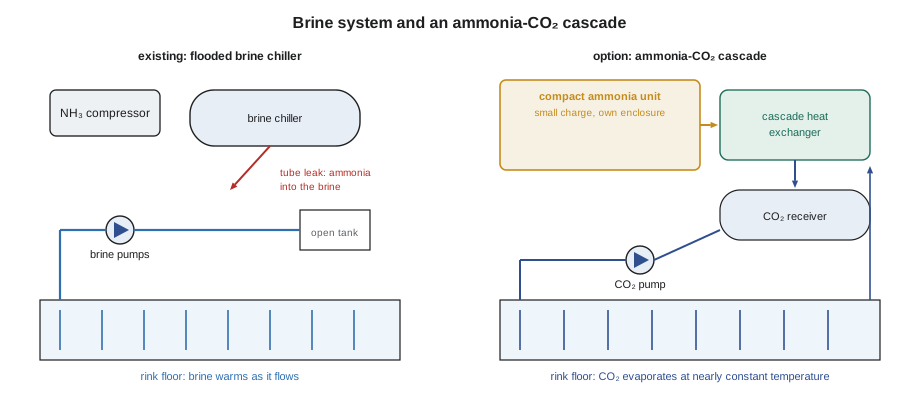
In September, Pat Morrison gave Ingrid and Theo the keys to Hillcrest Arena's plant room and a box of records going back to 1986. The plant was simple: two reciprocating ammonia compressors, a vertical oil separator, a receiver, a flooded shell-and-tube chiller in which ammonia boiled around tubes carrying calcium chloride brine, two large brine pumps, an open-topped brine expansion tank and a header that fed some thirty miles of steel pipe in the concrete floor under the ice. The ammonia never left the plant room. The brine carried the cooling to the ice. "That's the whole idea of a secondary system," Ingrid said. "Keep the dangerous refrigerant small and in one place, and send something harmless to the load." This lesson describes secondary systems, how they can fail, and the cascade systems that combine ammonia and carbon dioxide.
Secondary fluids
In a secondary, or indirect, system, the refrigeration plant cools a heat transfer fluid, and the fluid is pumped to the load. Common secondary fluids are calcium chloride brine, used in many older rinks because it is cheap and works at low temperatures; glycol solutions, propylene or ethylene glycol in water, used in newer rinks, warehouses and process plants; and, in some systems, carbon dioxide itself, which can be pumped as a volatile secondary fluid that evaporates in the load and condenses back in the plant. The benefits are a small, contained refrigerant charge and simple load piping. The costs are the extra temperature difference at the heat exchanger, which makes the plant work at a lower evaporating temperature, and the energy to pump the fluid.
A rink floor needs a lot of fluid. The script compares the brine flow needed for Hillcrest's peak load with the flow of carbon dioxide that would do the same job by evaporating in the floor pipes.
# The arena: rink floor brine flow versus pumped CO2, and a cascade's temperatures (approximate)
load = 100 * 12000.0                  # Btu/h peak rink load (100 tons)
cp_brine, sg_brine, dT = 0.69, 1.25, 4.5     # calcium chloride brine, Btu/lb F, specific gravity, F
gpm_b = load / (500 * sg_brine * cp_brine * dT)
print(f"brine: {gpm_b:.0f} gpm at a {dT} F rise")
hfg_co2, rho_co2, n = 111.0, 61.4, 2.0      # CO2 at about 14 F (Btu/lb, lb/ft3), overfeed rate 2:1
lb_min = load / hfg_co2 / 60 * n
gpm_c = lb_min / rho_co2 * 7.48
print(f"pumped CO2: {lb_min:.0f} lb/min = {gpm_c:.0f} gpm ({gpm_b / gpm_c:.0f} times less volume)")
pump_eff = 0.6
for name, gpm, psi in [("brine", gpm_b, 36), ("CO2", gpm_c, 22)]:
    hp = gpm * psi * 2.31 / 3960 / pump_eff
    print(f"{name:6s} pump power about {hp * 0.746:4.1f} kW at {psi} psi")
# an ammonia-CO2 cascade: CO2 condenses on the ammonia evaporator
print("cascade: CO2 evaporates 10 F and condenses 19 F; the ammonia must evaporate colder still")
t_co2_cond, approach = 19.0, 9.0
print(f"ammonia evaporates about {t_co2_cond - approach:.0f} F so that the CO2 can condense at {t_co2_cond:.0f} F")brine: 618 gpm at a 4.5 F rise pumped CO2: 360 lb/min = 44 gpm (14 times less volume) brine pump power about 16.1 kW at 36 psi CO2 pump power about 0.7 kW at 22 psi cascade: CO2 evaporates 10 F and condenses 19 F; the ammonia must evaporate colder still ammonia evaporates about 10 F so that the CO2 can condense at 19 F
At the rink's peak load of about 100 tons, the brine, warming by 4.5 °F through the floor, had to circulate at about 620 gpm. Pumped carbon dioxide, evaporating in the floor with a 2:1 overfeed, would need only about 44 gpm, fourteen times less volume, and its pump would use well under 1 kW instead of about 16 kW. Carbon dioxide's latent heat does the work that brine's temperature rise does, and the floor's temperature is more even, because the carbon dioxide evaporates at a nearly constant temperature along each pipe instead of warming as brine does. That is why new and rebuilt rinks increasingly use carbon dioxide in the floor.
When the barrier fails
A secondary system is only as safe as the barrier between the refrigerant and the secondary fluid. In a shell-and-tube chiller, that barrier is the wall of each tube. Tubes corrode, especially in brine, which is corrosive to steel if its chemistry is not maintained, and they can be damaged by freezing if the brine flow stops while the ammonia keeps boiling. When a tube leaks, ammonia at the chiller's pressure, which is higher than the brine's, flows into the brine. The brine carries it out of the plant room, through the floor and into the brine expansion tank, which in many older arenas is open to the room. Ammonia in brine is therefore a sign of a failing chiller, and it can also turn the brine side, which nobody thinks of as hazardous, into a route for ammonia to reach places it was never expected to be.
The incident at Fernie Memorial Arena in British Columbia, on October 17, 2017, is the most important recent example in Canada. Three workers died in an ammonia release from the arena's refrigeration plant, and 95 residents of 55 nearby homes were evacuated. Investigations by the province's safety regulator, Technical Safety BC, and its workers' compensation board, WorkSafeBC, found that the arena's chiller was about 30 years old, beyond its expected life, that tests earlier in 2017 had repeatedly found ammonia in the brine, that recommendations to replace the curling chiller had been made years before, and that the city's emergency procedures had not been reviewed or practiced for years, so the workers present were not familiar with them when the alarms sounded. Technical Safety BC's report made 18 recommendations to improve the safety of ice rink refrigeration systems. The lessons are clear and general: ammonia in brine is an urgent warning, not a maintenance item; equipment past its life needs a plan; and emergency procedures must be current and practiced.
At Hillcrest, the records showed that the brine had been tested for ammonia twice a year, with simple test strips and occasionally by a laboratory, and that all the results had been negative except one, in 2019, which had been retested negative a week later and not followed up. Ingrid had the brine tested by a laboratory the same week, which found no ammonia, and set up a monthly test with the arena's operators, with an instruction to shut the plant down, isolate the chiller and call Northfield on any positive result. She also had an ammonia detector added at the brine expansion tank, and recommended replacing the open tank with a closed one vented outdoors.
Ammonia and carbon dioxide cascades
A cascade system uses two separate refrigeration circuits linked by a heat exchanger. In an ammonia-carbon dioxide cascade, the low-temperature circuit uses carbon dioxide, and the high-temperature circuit uses ammonia. The carbon dioxide evaporates at the load, in a rink floor or freezer coils, and is condensed in the cascade heat exchanger by the ammonia, which evaporates on the other side. The ammonia circuit then compresses its vapor and condenses it outdoors. The carbon dioxide side may be pumped, as a volatile secondary fluid with no compressor, or compressed, with carbon dioxide compressors raising it to the cascade's condensing pressure, which is common in low-temperature freezers.
The cascade exchanger needs a temperature difference to work, so the ammonia must evaporate a few degrees below the temperature at which the carbon dioxide condenses. If the carbon dioxide evaporates at about 10 °F in the floor and condenses at 19 °F, the ammonia must evaporate at about 10 °F, as the script showed. That is a small penalty compared with brine, which needs a larger temperature difference in the chiller and another in the floor.
Cascades have several safety and practical advantages. The ammonia charge is small and confined to a compact plant, often a packaged unit outdoors or in a separate enclosure, far from the public. The carbon dioxide in the occupied areas is non-flammable and low in toxicity. Carbon dioxide's small pipes and high capacity suit large freezer warehouses and rinks. The disadvantages are the extra heat exchanger, the cost, and the need for technicians who know both refrigerants. Carbon dioxide on the low side still works at high pressures, and its standstill pressure must be managed, as lesson 9 explained. If the cascade exchanger leaks, ammonia and carbon dioxide can react to form ammonium carbamate, a white solid that can block passages, so the exchanger's design and monitoring matter.
Other low-charge options for rinks
Rinks have several other choices, which the capstone will compare for Hillcrest:
- A packaged low-charge ammonia chiller with glycol or brine. The ammonia stays in a factory-built unit with a hundred pounds or so or less, often outdoors, and the rest of the system remains a secondary loop. The floor piping can usually be kept if it is in good condition.
- A direct transcritical carbon dioxide system. Carbon dioxide compressors serve the floor directly, with no ammonia at all, and reject heat at high temperatures that can heat the arena, its showers, the resurfacer water and the snow melt pit. In cold climates, the heat recovery can be very valuable.
- HFC or HFO systems with secondary loops, which are increasingly constrained by the HFC phasedown and their own costs.
For each option, the condition of the floor matters a great deal. A floor with corroded steel pipes or a failing slab may need replacing anyway, which opens the way to a carbon dioxide floor with smaller, higher-pressure pipes. At Hillcrest, a pressure test and a thermal scan of the floor found the steel piping in fair condition but with two repaired leaks and some thinning near the header, so a new floor would be needed within about ten years whatever the refrigeration choice.
Operating secondary systems well
Whatever the system, the secondary side needs care. Brine and glycol chemistry is tested and adjusted: concentration, for freeze protection, and inhibitors and pH, for corrosion. Strainers are cleaned, air is vented, expansion tanks are kept at the right level and pumps are maintained. Flow and temperatures are logged, and a rising temperature difference at the chiller, or a rising chiller approach, can show fouling or loss of flow before the ice suffers. And the brine or glycol is tested regularly for refrigerant, because the secondary fluid is the first place a chiller leak shows itself.
| System | Ammonia charge | Fluid in the floor | Main advantages | Main concerns |
|---|---|---|---|---|
| Existing flooded brine chiller | About 800 lb | Calcium chloride brine | Known, simple | Old chiller; ammonia in brine; open tank |
| Packaged low-charge ammonia + glycol | About 55 lb | Glycol | Small charge outdoors; floor reused | Pumping energy; new controls |
| Ammonia-CO₂ cascade | Small, in a compact unit | Pumped CO₂ | Efficient floor; little pumping | Two refrigerants; high pressure; cost |
| Direct transcritical CO₂ | None | CO₂ | No ammonia; heat recovery | High pressure; new floor; skills |
Glycol in warehouses and food plants
Secondary systems are not only for rinks. Many food plants and warehouses use glycol loops to cool processing rooms, docks and offices, so that ammonia stays in the engine room. Glycol systems need the concentration checked, because water added during maintenance dilutes it and lowers its freeze protection, and an evaporator or heat exchanger that freezes can split. Glycol also needs inhibitors to protect steel, and its condition is checked by testing pH, inhibitor level and the color and clarity of the fluid. At Grand Valley, a small glycol loop cooled the offices and the battery-charging room, and Theo added its concentration and inhibitor checks to the operators' monthly rounds after finding the loop diluted to the edge of its freeze protection.
Common mistakes
MistakeTreating ammonia in the brine as a minor maintenance item.
InsteadIt means the barrier has failed; shut down, isolate and investigate at once.
MistakeTesting the brine once and assuming a single negative result is the end of it.
InsteadTest regularly and follow every positive or doubtful result to a conclusion.
MistakeLetting brine flow stop while the chiller is still refrigerating.
InsteadInterlock the compressors with brine flow; frozen tubes split.
MistakeForgetting the standstill pressure on the CO₂ side of a cascade.
InsteadManage it with standby cooling or relief, as for any CO₂ system.
MistakeChoosing a refrigeration option without assessing the floor.
InsteadThe floor's condition can decide the best option.
Summary and key terms
- Secondary systems keep the refrigerant in a small plant and pump a safer fluid, brine, glycol or CO₂, to the load.
- Pumped CO₂ needs far less volume and pumping power than brine because it evaporates in the floor.
- A chiller tube leak puts ammonia into the secondary fluid; ammonia in brine is an urgent warning.
- Fernie (2017) showed the consequences of old equipment, ignored test results and unpracticed emergency procedures.
- Ammonia-CO₂ cascades confine a small ammonia charge and use CO₂ in occupied areas.
- Rink options include packaged low-charge ammonia with glycol, cascades and direct transcritical CO₂; the floor's condition matters.
- Secondary system
- A system in which the refrigeration plant cools a fluid that is pumped to the load.
- Brine
- A salt solution, such as calcium chloride in water, used as a secondary fluid.
- Cascade system
- Two refrigeration circuits linked by a heat exchanger in which one condenses the other.
- Cascade heat exchanger
- The exchanger in which the high-temperature circuit evaporates and the low-temperature circuit condenses.
- Volatile secondary fluid
- A secondary fluid such as CO₂ that evaporates in the load and condenses in the plant.
- Ammonium carbamate
- A white solid that forms when ammonia and carbon dioxide mix, and can block passages.
Practice problems
Work each problem on paper first, then reveal the answer to check.
A rink load is 85 tons and brine warms by 4.5 °F with cp 0.69 and specific gravity 1.25. What brine flow is needed?
Show answer
1,020,000 ÷ (500 × 1.25 × 0.69 × 4.5) = about 525 gpm.
The same load is carried by CO₂ with hfg 111 Btu/lb at a 2:1 overfeed. What mass flow is pumped?
Show answer
1,020,000 ÷ 111 ÷ 60 × 2 = about 306 lb/min.
Why is ammonia in the brine an urgent warning?
Show answer
It means a chiller tube has failed and ammonia can travel with the brine out of the plant room.
Name one advantage and one concern of a direct transcritical CO₂ rink system.
Show answer
Advantage: no ammonia and high-temperature heat recovery. Concern: high pressures, new floor or skills.
Lesson quiz · 5 questions
Score 60% or more to complete this lesson.
Create a free account to save your progress, take quizzes and earn a certificate.