
RAC-420 · Lesson 6 of 12 · 17 min
Machinery rooms, detection and ventilation
At seven on a Tuesday morning in April, Grand Valley's ammonia detector in the engine room went into its low alarm. The emergency exhaust fans started, the horn and strobes outside the doors came on, and the operator on shift, following the plant's procedure, did not go in. He checked the detector readings on the panel in the control room, which showed 40 ppm near compressor HS-2 and falling, called the chief operator and Ingrid's group, and kept the doors closed. When Ingrid arrived with Theo, the reading was down to about 10 ppm. Wearing full-face respirators and personal monitors, with the operator watching from the door, they found a weeping packing nut on a suction valve, which an operator had opened the night before to bring HS-2 back into service. This lesson describes the room that made that small event easy to manage: the machinery room, its detectors, its ventilation and its emergency controls.
Why machinery rooms
Codes require refrigeration machinery above certain sizes, and ammonia machinery in particular, to be in a dedicated machinery room, unless it is listed for outdoor or unenclosed installation. The room concentrates the equipment where leaks are most likely, keeps it away from occupied areas, and provides the ventilation, detection, controls and access that make a release manageable. In the United States, the mechanical code, usually through ASHRAE 15 and IIAR 2, sets the machinery room requirements for ammonia. The requirements below are typical, but the code edition in force must always be checked.
- Construction. The room is enclosed with walls, floor and ceiling of a specified fire resistance, tight to the rest of the building so that ammonia cannot leak into it. Doors are self-closing and tight-fitting, open outward, and lead directly outdoors or to a corridor, with at least one door leading directly outdoors in many cases.
- No open flames or hot surfaces above set limits, unless the room is designed for them and the combustion air is ducted from outdoors. Fuel-burning equipment is generally not allowed in an ammonia machinery room.
- Electrical equipment. Codes require ammonia machinery rooms either to have emergency ventilation that keeps concentrations well below the flammable range, with equipment not rated for hazardous locations shut down at a high concentration, or to meet hazardous location requirements.
- Signs at each door identify the room, the refrigerant and its safety group, and the presence of detection and emergency controls.
- Access. The room is kept for refrigeration machinery and related equipment, not used for storage, and access is restricted to authorized and trained people.
Ammonia detection
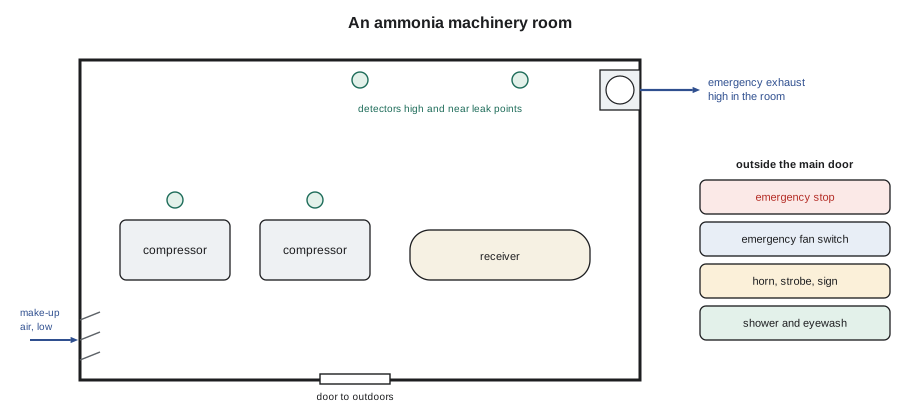
Fixed ammonia detectors monitor the machinery room continuously, with sensors placed where ammonia is likely to collect or pass: near the compressors and other leak points, and high in the room, because warm ammonia vapor rises, with others where a cold release could flow. The common technologies are electrochemical cells, which are accurate at low concentrations, and semiconductor or catalytic sensors for higher ranges. Detectors need regular bump tests with a test gas and calibration on the manufacturer's schedule, and electrochemical cells wear out after a few years.
The detection system works in stages, and the codes set or guide each one. Typically:
- A low-level alarm, at a concentration around the occupational exposure limit, sounds alarms inside and outside the room, signals the plant's monitoring system and starts the emergency ventilation.
- A higher-level alarm, set at a concentration that some codes specify, may start additional ventilation or alert outside responders.
- At a much higher concentration, a fraction of the lower flammable limit, often around 25 % of it, about 40,000 ppm, equipment not rated for hazardous locations is de-energized, while the emergency ventilation keeps running on circuits designed for that condition.
Alarms outside each entrance, a horn and strobe, tell people not to enter, and the alarms must be audible and visible over the room's noise. Detection is also installed in other places ammonia could reach: air handling units with ammonia coils, ammonia evaporators in occupied spaces, and, at the arena, the brine system, as lesson 11 describes. Detectors do not fix leaks, but they turn a hidden problem into an event that people can manage.
Ventilation
Machinery rooms need two kinds of mechanical ventilation. Normal ventilation removes the heat from motors and equipment and keeps the room at a reasonable temperature, and may also provide a small continuous exhaust. Emergency ventilation is sized to dilute and remove ammonia during a release, starts automatically on detection, and can be started manually from outside the room. It draws from where ammonia collects, usually high in the room for ammonia, with make-up air entering low, and discharges outdoors away from intakes and people.
Codes set the emergency ventilation rate in different ways. ASHRAE 15 gives a rate based on the refrigerant charge, in the form Q = 100√G, where Q is in cubic feet per minute and G is the mass of refrigerant in pounds in the largest system. IIAR 2 bases the emergency ventilation of ammonia machinery rooms on the room itself, with a minimum number of air changes per hour, about 30, and other criteria. The script compares the two approaches for Grand Valley's engine room and estimates how long a release takes to clear, treating the room as perfectly mixed.
# Machinery room emergency ventilation and how fast a release clears (well-mixed, illustrative)
import math
G = 20940                                  # lb of ammonia in the largest system
q_formula = 100 * math.sqrt(G)             # cfm, the ASHRAE 15 style formula Q = 100 sqrt(G)
room = 80 * 46 * 23                        # ft3, Grand Valley engine room
q_ach = room * 30 / 60                     # cfm at 30 air changes an hour
print(f"Q = 100 sqrt(G) -> {q_formula:,.0f} cfm; 30 air changes an hour -> {q_ach:,.0f} cfm")
release = 44.0                             # lb released before isolation
c0 = release / 17.03 * 392.0 / room * 1e6
print(f"{release:.0f} lb mixed into {room:,} ft3 -> {c0:,.0f} ppm")
for name, q in [("formula rate", q_formula), ("30 air changes", q_ach)]:
    tau = room / q                         # min, time constant of the room
    for target in (300, 25):
        t = tau * math.log(c0 / target)
        print(f"  {name:15s}: down to {target:3d} ppm after about {t:4.1f} min")
print("A real room clears unevenly: measure before anyone re-enters without breathing apparatus.")Q = 100 sqrt(G) -> 14,471 cfm; 30 air changes an hour -> 42,320 cfm 44 lb mixed into 84,640 ft3 -> 11,966 ppm formula rate : down to 300 ppm after about 21.6 min formula rate : down to 25 ppm after about 36.1 min 30 air changes : down to 300 ppm after about 7.4 min 30 air changes : down to 25 ppm after about 12.3 min A real room clears unevenly: measure before anyone re-enters without breathing apparatus.
For Grand Valley's 20,900 lb charge, the charge-based formula gives about 14,500 cfm; 30 air changes an hour in the 84,600 ft³ room gives about 42,300 cfm, nearly three times as much. A 44 lb release, mixed evenly, would give about 12,000 ppm. At the formula rate, a perfectly mixed room would take about 22 minutes to fall below 300 ppm and 36 minutes below 25 ppm; at 30 air changes an hour, about 7 and 12 minutes. Grand Valley's room had been upgraded to the higher rate when the plant was expanded. Real rooms do not mix perfectly; corners and pits clear slowly, and concentrations near a continuing leak stay high. That is why the rule after any alarm is that nobody enters without the protection the readings call for, and the readings must come from an instrument, not from the clock.
Emergency fans and their controls must be reliable. They are tested regularly, by simulating a detector alarm and confirming that the fans start, the dampers open and the alarms sound. Their power supply is arranged so that the fans keep running when other equipment in the room is shut down, and their motors and starters are suitable for the conditions they may run in. Make-up air openings must stay clear: a stack of pallets in front of a louver can starve the fans.
Emergency controls outside the room
Outside the main door of an ammonia machinery room, codes require a set of controls and information that people can use without entering:
- An emergency shutdown switch, often a red mushroom-head button, that stops the refrigeration compressors, pumps and other equipment in the room, and in many plants closes emergency isolation valves.
- An emergency ventilation switch that starts the emergency fans, with a separate control or key to stop them, so they cannot be switched off by mistake.
- The detector status and alarms.
- Emergency shower and eyewash, as lesson 2 described.
- Emergency information: the plant's emergency contacts, a simplified flow diagram and the location of the main isolation valves, often in a weatherproof box.
Some plants also have emergency isolation valves, King valves on receivers and main liquid lines, that can be closed remotely or automatically on a large release, and IIAR standards and many process safety programs call for them. The shutdown sequence matters: stopping the compressors stops pumping ammonia through the system, but a large charge in vessels remains, so the plant's emergency procedures say which valves to close, by whom and with what protection.
What happened at Grand Valley
The April alarm went the way a well-designed system should. The detectors found the leak at a low concentration; the alarms warned people; the emergency fans started; the operator did not enter; the readings on the panel showed the concentration falling; and the people who did enter were trained, protected, monitored and stood by. The cause, a packing nut not retightened after a valve was operated, was a small human error, and the fix was to add a packing check to the plant's procedure for returning a compressor to service. Hannah recorded it as a near miss, investigated it and shared the findings with the operators, which lesson 7 explains is a required part of a process safety program.
Ingrid used the event to teach Theo the order of thinking she wanted every time. First, people: is anyone hurt or at risk, and is everyone out who should be? Second, information: what are the readings, where, and are they rising or falling? Third, protection: what equipment does that concentration call for? Fourth, isolation: can the leak be stopped from outside, or with the least exposure? And only then, repair.
| Element | Purpose | Typical test |
|---|---|---|
| Fixed ammonia detectors | Find leaks and trigger alarms and ventilation | Bump test and calibration on schedule |
| Alarms at each door | Keep people out during a release | Function test with detector simulation |
| Emergency ventilation | Dilute and remove ammonia | Start on alarm and from the outside switch; check airflow |
| Emergency shutdown switch | Stop machinery from outside | Function test with the plant shut down |
| Emergency shower and eyewash | Flush exposed people | Weekly activation, with a log |
Testing the systems
At Grand Valley the detectors, alarms and emergency ventilation were tested every quarter, with the plant's operators and Ingrid's group working together. Each detector was exposed to a test gas until it alarmed, and the operator in the control room confirmed the reading, the alarm and the start of the emergency fans. The emergency shutdown switch was tested during a planned shutdown, because it stopped the whole engine room. The make-up air louvers were checked for blockage, and the fan belts and motors were inspected. Every result was recorded, and a detector that failed its bump test was replaced the same day from spares. Theo found that the tests took less time than the paperwork, and that the paperwork was what the inspectors asked to see.
Common mistakes
MistakeGoing into the machinery room to see why the ammonia alarm is sounding.
InsteadStay out; read the panel, call for help and enter only with the protection the readings call for.
MistakeSwitching off the emergency fans because they are noisy.
InsteadLeave them running until the readings show the room is clear; stopping them needs a deliberate control.
MistakeStacking materials in front of make-up air louvers.
InsteadKeep make-up openings clear so the fans can move their design air.
MistakeLetting detector calibration slide because there are no leaks.
InsteadDetectors that are not tested may not alarm when they are needed.
MistakeTrusting the time since a release instead of a reading.
InsteadMeasure the concentration before entry; rooms clear unevenly.
Summary and key terms
- Ammonia machinery is housed in dedicated machinery rooms with specified construction, doors, electrical arrangements, signs and restricted access.
- Fixed detectors near leak points and high in the room trigger staged alarms, emergency ventilation and, at high concentrations, shutdown of non-rated equipment.
- ASHRAE 15 sizes emergency ventilation by charge, Q = 100√G (cfm, lb); IIAR 2 uses room air changes, about 30 an hour.
- Controls outside the door let people shut down machinery and run ventilation without entering.
- Rooms do not clear evenly: entry after an alarm depends on readings and protection, not time.
- Detectors, alarms, fans and showers are tested and logged on a schedule.
- Machinery room
- A room built to code to house refrigeration machinery, with ventilation, detection and controls.
- Emergency ventilation
- Ventilation sized to remove refrigerant during a release, started automatically by detection.
- Bump test
- A quick check that a gas detector responds to a test gas.
- Emergency shutdown switch
- A switch outside the machinery room that stops the refrigeration equipment.
- King valve
- The main liquid outlet valve of a receiver, often used for emergency isolation.
- Near miss
- An event that could have caused harm but did not, which is investigated to prevent recurrence.
Practice problems
Work each problem on paper first, then reveal the answer to check.
A machinery room serves a system with 3,600 lb of ammonia. What emergency ventilation does Q = 100√G give?
Show answer
100 × 60 = 6,000 cfm.
A room of 40,000 ft³ is ventilated at 30 air changes an hour. What is its time constant?
Show answer
40,000 ÷ 20,000 cfm = 2 minutes.
Why are ammonia detectors placed high in a machinery room?
Show answer
Warm ammonia vapor is lighter than air and rises.
What should the first person to hear a machinery room ammonia alarm do?
Show answer
Stay out, check readings remotely, raise the alarm and follow the emergency procedure.
Lesson quiz · 5 questions
Score 60% or more to complete this lesson.
Create a free account to save your progress, take quizzes and earn a certificate.