
RAC-420 · Lesson 2 of 12 · 18 min
Ammonia properties and health hazards
Before Theo was allowed into Grand Valley's engine room unescorted, Ingrid sat him down with the plant's safety data sheet for anhydrous ammonia, a personal monitor and a bottle of household ammonia cleaner. She unscrewed the cap and held it at arm's length. "That's maybe a few percent ammonia in water," she said. "You can smell it from here, at a few parts per million in the air. The stuff in the receiver is pure, and it boils at −28 °F. If it gets out, it doesn't drip. It flashes into a cloud." This lesson describes what ammonia is, how it behaves when it escapes, what it does to the body and how exposure is measured and limited.
Physical properties
Anhydrous ammonia, NH₃, is ammonia without water. At atmospheric pressure it boils at about −28 °F, so in any refrigeration system at normal temperatures it is stored as a liquid under its own vapor pressure: about 15.7 psig at 0 °F, 47.6 psig at 32 °F and 181 psig at 95 °F. These pressures are similar to those of R-22, so ammonia systems are not high-pressure systems in the sense that carbon dioxide systems are. Liquid ammonia is light, about 40 lb/ft³ at 32 °F, roughly two-thirds the density of water.
Ammonia vapor has a molecular mass of about 17, compared with about 29 for air, so pure ammonia gas at room temperature is lighter than air and rises. That is helpful indoors, because ventilation can draw it out at the ceiling. But a release from a liquid line does not behave like pure warm gas. When liquid ammonia escapes, part of it flashes to vapor instantly, cooling the rest to its boiling point, and the remainder forms a fog of fine liquid droplets and cold vapor mixed with moist air. That cold, droplet-laden cloud can be heavier than air and can hug the ground, flow into low areas and drift outdoors for a long distance before it warms and rises. Emergency plans must assume both behaviors.
Ammonia is very soluble in water. That is why it is so irritating: it dissolves into the moisture of the eyes, nose, throat, lungs and skin and forms ammonium hydroxide, an alkali that damages tissue. It is also why water is used to knock down vapor in some emergencies and why a small leak can sometimes be found by the white fumes it forms with the moisture in the air. Water in a refrigeration system is a different matter: ammonia tolerates some water without the acid problems that fluorocarbon systems suffer, but water in the circuit raises the evaporating temperature for a given pressure and reduces capacity, so it must be monitored and removed.
Ammonia attacks copper, zinc and their alloys, including brass and bronze, especially when moisture is present. For that reason ammonia systems are built of carbon steel, stainless steel and aluminum, with steel valves and compatible gaskets, and copper or brass gauges, tools or fittings must never be used on them. Ammonia is compatible with mineral and synthetic oils that are not soluble in it, which leads to the oil management practices in lessons 4 and 8.
Flammability
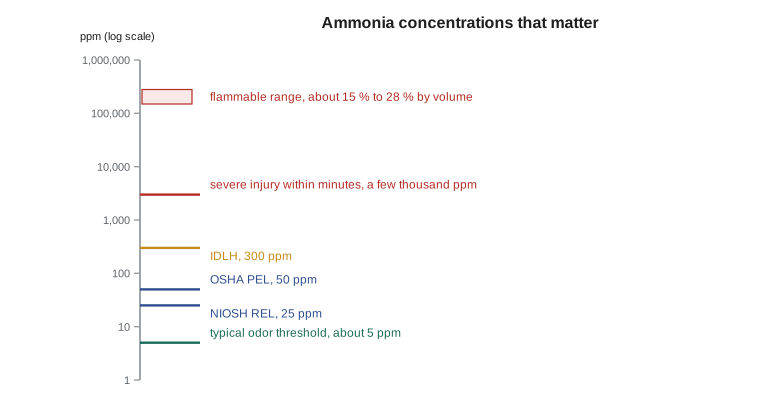
Ammonia is flammable, but only within a narrow range and with difficulty. Its lower flammable limit is about 15 % by volume in air and its upper limit about 28 %. Below 15 % there is too little fuel to burn; above 28 % there is too little oxygen. It is hard to ignite, burns slowly and gives off little heat, which is why ASHRAE 34 places it in class 2L, lower flammability. But 15 % is 150,000 parts per million, a concentration that occurs only close to a large release or in an enclosed space, such as a machinery room after a major leak, and there it can ignite from an open flame, an electric arc or a hot surface. Machinery room rules on electrical equipment, emergency ventilation and shutdown, in lesson 6, are written with that in mind. In practice, the toxic hazard of ammonia is far more often the one that hurts people.
Health effects
Ammonia's effects depend on concentration and time. At low concentrations it irritates the eyes, nose and throat; most people can smell it at a few parts per million, and the smell becomes very unpleasant well before it is dangerous, which is one of ammonia's most important safety features. Higher concentrations cause coughing, tears, burning of the throat and chest, and difficulty breathing. At several hundred parts per million exposure becomes immediately dangerous to life or health: escape is still possible, but injury is likely. At concentrations of a few thousand parts per million, ammonia can cause severe injury to the airways and lungs within minutes, and higher concentrations can kill.
Liquid ammonia on skin or in the eyes causes chemical burns and, because it boils so cold, freezing injury at the same time. Eye contact is particularly serious: the alkali penetrates quickly and can cause permanent damage. That is why first aid for ammonia exposure is immediate and prolonged flushing with water, at an emergency shower or eyewash, for at least 15 minutes and usually longer, while someone calls for medical help. Contaminated clothing is removed, because it holds ammonia against the skin. Anyone who has breathed significant ammonia needs medical assessment, because lung injury can develop over hours.
One more effect matters for safe work: people get used to the smell. After some minutes in a low concentration, the nose becomes less sensitive, and a worker can stop noticing a level that would alarm someone arriving fresh. And people differ: some smell ammonia at 1 or 2 ppm, others not until 20 or more. The smell is a warning, not a measurement. Everyone working on ammonia systems carries a personal monitor, and fixed detectors guard machinery rooms and other areas.
Exposure limits
Exposure limits express how much ammonia a worker may breathe. OSHA's permissible exposure limit for ammonia is 50 ppm as an 8-hour time-weighted average. NIOSH recommends a lower limit of 25 ppm over a 10-hour day with a short-term limit of 35 ppm over 15 minutes, and ACGIH's values are the same as NIOSH's, so many employers and the IIAR standards work to the lower figures. The level considered immediately dangerous to life or health, the IDLH, is 300 ppm. Emergency planners also use guideline values for the public, such as the ERPG and AEGL series, which set concentrations for one-hour exposures at which people would experience discomfort, serious effects or life-threatening effects.
Concentrations of gases in air are expressed in parts per million by volume or in milligrams per cubic meter. For ammonia at room temperature, 1 ppm is about 0.70 mg/m³. A useful way to understand the numbers is to work out what a given release does to a room, assuming it mixes evenly, as the script does for Hillcrest Arena's plant room.
# Ammonia in a room: from pounds released to parts per million (well-mixed, 77 F, 1 atm)
M = 17.03                  # lb per lb-mol, ammonia
Vm = 392.0                 # ft3 per lb-mol of gas at 77 F and 14.7 psia
levels = [(5, "typical odor threshold (varies widely)"), (25, "NIOSH 10-hour exposure limit (REL)"),
          (50, "OSHA permissible exposure limit (PEL)"), (300, "immediately dangerous to life or health (IDLH)"),
          (150000, "lower flammable limit, about 15 % by volume")]
room = 50 * 33 * 20        # ft3, the arena plant room (illustrative)
for lb in (0.1, 4.4, 100):
    gas_ft3 = lb / M * Vm
    ppm = gas_ft3 / room * 1e6
    worst = max([lv for lv in levels if ppm >= lv[0]], default=None)
    note = worst[1] if worst else "below the odor threshold"
    print(f"{lb:6.1f} lb released into {room:,} ft3 -> {ppm:9,.0f} ppm  (above: {note})")
print("Well-mixed averages hide much higher concentrations near the leak and in pockets.")0.1 lb released into 33,000 ft3 -> 70 ppm (above: OSHA permissible exposure limit (PEL)) 4.4 lb released into 33,000 ft3 -> 3,069 ppm (above: immediately dangerous to life or health (IDLH)) 100.0 lb released into 33,000 ft3 -> 69,752 ppm (above: immediately dangerous to life or health (IDLH)) Well-mixed averages hide much higher concentrations near the leak and in pockets.
Even a tenth of a pound of ammonia, a few seconds of vapor from a loose packing nut, mixed evenly through the 33,000 ft³ plant room, gives about 70 ppm, above OSHA's limit. A little over 4 lb, about half a gallon of liquid, gives over 3,000 ppm, ten times the IDLH. And 100 lb, a modest liquid release, gives about 7 % by volume, half the lower flammable limit as an average and certainly above it near the leak. Real releases do not mix evenly: near the source, in pockets and in the path of a cloud, concentrations are far higher. The calculation explains why a plant room is never entered during a release without self-contained breathing apparatus, and why the size of the room's ventilation, in lesson 6, matters so much.
Personal protective equipment
The protective equipment for ammonia work depends on the task and the possible exposure, and the plant's procedures set it out. For routine rounds in a machinery room with working detection, operators wear safety glasses and carry a personal monitor and an escape respirator. For tasks that open the system, such as draining oil or changing a gauge, procedures typically require a full-face respirator with ammonia cartridges, chemical-resistant gloves and protective clothing, with a second person standing by. Cartridge respirators protect only at low concentrations, up to the limit the manufacturer and the respiratory protection program specify, and only where there is enough oxygen; they must never be used to enter an area of unknown or high concentration.
Entering a release, or any area above the IDLH or of unknown concentration, requires self-contained breathing apparatus, SCBA, and, for liquid or high vapor concentrations, a fully encapsulating chemical protective suit. Only trained and equipped responders do that, under an incident command system, as lesson 12 describes. Every respirator user must be medically cleared, trained and fit-tested under the employer's respiratory protection program, as OSHA's respiratory protection standard, 29 CFR 1910.134, requires, and beards or anything else that breaks the face seal are not allowed with tight-fitting respirators.
Emergency showers and eyewash stations are required near ammonia machinery and wherever liquid could contact workers. They must be tested regularly, kept clear and placed so that a person can reach them within seconds, typically outside the machinery room door, so that a person can escape the room and reach water at the same time. At Grand Valley, Theo's first job on his own was the weekly shower and eyewash test, with a log.
| Concentration | What it means | What to do |
|---|---|---|
| Smell, no reading on monitor | Small leak somewhere | Find it with the monitor; report it |
| Up to 25 ppm | Below the working limit | Find and fix the source; watch the trend |
| 25 to 300 ppm | Above the working limit; irritation | Leave unless properly protected; follow the procedure |
| Above 300 ppm | Above IDLH | Evacuate; responders only, with SCBA |
| Visible cloud or fog | Liquid release; very high concentration | Evacuate, raise the alarm, activate the emergency plan |
Ammonia and the people nearby
Ammonia's hazards reach beyond the plant. A large outdoor release can drift over neighboring properties, roads and schools, and the guideline values used for the public are lower than those for trained workers, because the public includes children, older people and people with lung conditions, and because they may not recognize the smell or know what to do. That is why plants above the threshold quantities must plan for the public, as lesson 7 explains, and why even small plants such as arenas, which are often next to schools and homes, need emergency procedures that include warning neighbors and coordinating with the fire department. At Hillcrest Arena, the plant room's outside wall faced a playground, which Theo noted on his first visit and which shaped the capstone.
Workers' own health matters too. Repeated exposure to low concentrations is unpleasant and can irritate the airways, and anyone with asthma or another lung condition should discuss ammonia work with a physician. Personal monitors with logging can show a worker's exposure over a shift, and plants that log exposures can find tasks, such as oil draining or filter changes, that need better controls.
Common mistakes
MistakeRelying on smell to judge how much ammonia is present.
InsteadUse a calibrated personal monitor; smell varies and fades with exposure.
MistakeAssuming a release will rise and clear because ammonia is lighter than air.
InsteadLiquid releases form cold, heavy clouds that can hug the ground.
MistakeUsing a cartridge respirator to go into a leak to close a valve.
InsteadCartridges are for low, known concentrations; leaks of unknown size need SCBA and trained responders.
MistakeBrushing off a splash because it feels cold rather than hot.
InsteadFlush with water at once for at least 15 minutes and get medical help.
MistakeUsing brass fittings or a copper gauge on an ammonia line.
InsteadUse steel and approved materials only.
Summary and key terms
- Ammonia boils at about −28 °F; its pressures are moderate, like R-22's.
- Pure ammonia vapor is lighter than air, but liquid releases form cold, heavy clouds.
- Ammonia is very soluble in water and forms an alkali that damages eyes, airways, lungs and skin.
- It is flammable only between about 15 % and 28 % by volume and hard to ignite, but enclosed releases can reach that range.
- OSHA's PEL is 50 ppm; NIOSH and ACGIH use 25 ppm with a 35 ppm short-term limit; the IDLH is 300 ppm.
- Smell is a warning, not a measurement; protective equipment and respirators are chosen by task, and releases require SCBA.
- Anhydrous ammonia
- Ammonia without water, used as the refrigerant R-717.
- IDLH
- Immediately dangerous to life or health: the concentration above which escape without injury is doubtful.
- Time-weighted average (TWA)
- An exposure limit averaged over a working day.
- Short-term exposure limit (STEL)
- An exposure limit averaged over 15 minutes.
- SCBA
- Self-contained breathing apparatus, which supplies air from a cylinder carried by the user.
- Lower flammable limit
- The lowest concentration in air at which a gas can burn; about 15 % for ammonia.
Practice problems
Work each problem on paper first, then reveal the answer to check.
Convert 50 ppm of ammonia to mg/m³.
Show answer
About 35 mg/m³.
How many pounds of ammonia, mixed evenly in a 20,000 ft³ room, give 300 ppm?
Show answer
300 ppm of 20,000 ft³ is 6 ft³ of gas, about 0.26 lb.
Why is the emergency eyewash placed outside the machinery room door?
Show answer
So a person can escape the room and reach water at the same time.
Why must a cartridge respirator never be used to enter a release?
Show answer
It protects only at low, known concentrations with enough oxygen.
Lesson quiz · 5 questions
Score 60% or more to complete this lesson.
Create a free account to save your progress, take quizzes and earn a certificate.