
PSYC-105 · Lesson 8 of 12 · 20 min
Social cognition and attitudes
▶ Video coming soon A video version of this lesson is on the way.
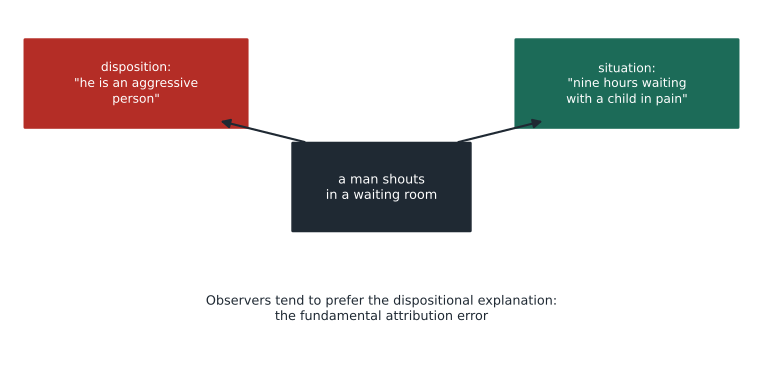
Fatima tells the class about a patient's family member who shouted at a nurse in the emergency department. Her first thought was that he was a rude, aggressive person. Later she learned he had been waiting nine hours with a child in pain and had just been told the wait would be longer. 'I felt terrible for judging him,' she says. Navarro writes three words on the board: person, situation, judgment. 'You have just described one of the most replicated findings in social psychology. This lesson is about how we make sense of other people, and how our attitudes form and change.'
Social psychology is the scientific study of how people think about, influence and relate to one another. This lesson focuses on social cognition, the way we perceive and interpret the social world, and on attitudes and persuasion. Lesson 9 turns to social influence and group behavior.
Explaining behavior: attributions
When we see someone act, we automatically explain why. Fritz Heider proposed in the 1950s that people act as naive scientists, attributing behavior either to the person's disposition, such as personality or ability, or to the situation. Did the student fail the test because she is lazy, or because the test was unfair and her family was in crisis?
People tend to overestimate the role of dispositions and underestimate the role of situations when explaining others' behavior, a tendency Lee Ross named the fundamental attribution error in 1977. In a classic 1967 study by Edward Jones and Victor Harris, participants read essays either supporting or opposing Fidel Castro's government in Cuba. Even when they were told that the writers had been assigned which side to argue, they judged that the writers held the views they expressed. Fatima's first judgment of the shouting man is the same error.
We are kinder to ourselves. In the actor-observer bias, people explain their own behavior more situationally than they explain others' behavior: I snapped because I was exhausted; you snapped because you are short-tempered. In the self-serving bias, people attribute their successes to themselves and their failures to circumstances: I got an A because I worked hard, and a C because the questions were tricky.
Attribution tendencies vary across cultures. In studies by Michael Morris and Kaiping Peng in the 1990s, English-language newspapers in the United States explained murders more in terms of the killer's personality, while Chinese-language newspapers explained the same crimes more in terms of situations and relationships. Research comparing people from more individualist and more collectivist cultures suggests that the fundamental attribution error is weaker, though not absent, in collectivist cultures, where the self is defined more by relationships and roles.
Attributions have consequences. Whether people attribute poverty or unemployment to individual effort or to circumstances predicts their views on social policy. Whether a teacher attributes a child's struggles to low ability or to a difficult home situation affects how the teacher responds. Navarro suggests a habit: before judging, ask what situation could make a reasonable person act this way.
First impressions and expectations
People form impressions of others astonishingly quickly. In studies by Janine Willis and Alexander Todorov, judgments of trustworthiness and competence made after seeing a face for one tenth of a second correlated well with judgments made without time limits. Fast judgments are not necessarily accurate, however, and they are shaped by stereotypes and by features such as attractiveness. The halo effect is the tendency for a positive impression in one area, such as appearance, to spread to unrelated judgments, such as intelligence or kindness.
Expectations can create their own confirmation. In a self-fulfilling prophecy, a belief leads to behavior that makes the belief come true. In a 1968 study, Robert Rosenthal and Lenore Jacobson told teachers that certain randomly chosen students were about to 'bloom' intellectually, and reported that those students later showed larger IQ gains. The study was criticized for its methods, and later research found that teacher expectation effects are real but usually small, larger for some students, such as those from stigmatized groups, and they mostly fade over time. In a 1977 study by Mark Snyder and colleagues, men who believed they were talking on the phone with an attractive woman behaved more warmly, and the women, who did not know what the men believed, responded more warmly in turn.
Attitudes
An attitude is an evaluation of a person, object or idea, which can be positive, negative or mixed. Attitudes are often described as having three components: affective, how we feel; behavioral, how we tend to act; and cognitive, what we believe, sometimes remembered as the ABCs of attitudes.
Do attitudes predict behavior? In a famous 1934 study, Richard LaPiere traveled across the United States with a young Chinese couple at a time of widespread prejudice against Chinese people; they were refused service at only one of more than 250 establishments, yet when LaPiere later wrote asking whether the businesses would serve Chinese guests, most of those that replied said no. Later research showed that attitudes predict behavior better when they are strong, specific to the behavior, held with certainty and accessible, and when outside pressures are weak. A general attitude toward the environment predicts a specific behavior, such as recycling a particular bottle, poorly; an attitude toward recycling itself predicts it better.
Behavior also shapes attitudes. In the foot-in-the-door technique, people who agree to a small request become more likely to agree to a larger one later. In a 1966 study by Jonathan Freedman and Scott Fraser, homeowners who first agreed to put a small sign in their window supporting safe driving were much more likely to agree later to a large, ugly sign on their lawn. Playing a role can also change attitudes: people who take on a job or uniform often come to adopt the attitudes that go with it.
Cognitive dissonance
Leon Festinger proposed in 1957 that people feel discomfort, which he called cognitive dissonance, when they hold inconsistent thoughts or when their behavior conflicts with their attitudes. To reduce dissonance, people often change their attitudes to fit what they have done.
In a classic 1959 experiment by Festinger and James Carlsmith, students performed a mind-numbingly boring task, turning pegs on a board for an hour. Then they were asked to tell the next participant that the task had been enjoyable. Some were paid 1 US dollar to tell the lie; others were paid 20 US dollars, a large sum at the time. Afterward, students paid 1 dollar rated the task as more enjoyable than those paid 20. The students paid 20 dollars had a sufficient external justification for lying; those paid 1 dollar did not, so they reduced dissonance by deciding the task had not been so bad.
Dissonance helps explain why people justify difficult choices: after choosing between two similar options, people tend to rate the chosen one more highly. It also explains effort justification: people who undergo a difficult initiation to join a group tend to value the group more. Dissonance effects are real but depend on conditions: they are strongest when people feel they chose freely, when the behavior has consequences and when it threatens their self-image. Some critics argue that self-perception, simply inferring our attitudes from our behavior, explains many of the same results, as Daryl Bem proposed.
Persuasion
Owen's channel depends on persuasion, and so does much of public life. Richard Petty and John Cacioppo's elaboration likelihood model describes two routes to persuasion. On the central route, people who are motivated and able think carefully about the arguments, and strong arguments persuade them while weak ones do not. On the peripheral route, people who are distracted, uninterested or rushed respond to cues such as the speaker's attractiveness, fame or confidence, the number of arguments or the reactions of others. Central-route attitude change tends to last longer and to predict behavior better.
Research has identified features of effective messages. Communicators who seem credible, expert and trustworthy are more persuasive, as are those who seem similar to the audience. Two-sided messages that acknowledge and rebut counterarguments tend to work better with knowledgeable audiences. Repetition increases familiarity and liking, the mere exposure effect, though too much repetition can backfire. Fear appeals can work when they are paired with clear, achievable steps people can take; without such steps, fear can produce denial.
Persuasion research also informs resistance to misinformation. Inoculation theory, proposed by William McGuire in the 1960s, holds that exposing people to weakened forms of a persuasive attack, along with a refutation, makes them more resistant to later attacks, much as a vaccine builds immunity. Recent research by Sander van der Linden and Jon Roozenbeek found that short games and videos that teach people common manipulation techniques, such as emotional language, false dichotomies and scapegoating, modestly improved their ability to recognize misinformation, though the effects fade without reinforcement.
Owen describes a dilemma: sponsors want short, flashy videos with confident claims, but he wants viewers to think. Navarro suggests that the elaboration likelihood model shows both can work, but that the effects of flashy peripheral cues are shorter-lived. Marcus offers to show how the share of a channel's viewers who watch long enough to hear an argument changes the reach of central-route messages.
# Illustrative: viewers who start a video, and the fraction still watching at each point
starts = 10_000
retention = {"10 seconds": 0.62, "1 minute": 0.41, "5 minutes": 0.18}
for point, fraction in retention.items():
print(f"still watching at {point}: {round(starts * fraction):,}")still watching at 10 seconds: 6,200 still watching at 1 minute: 4,100 still watching at 5 minutes: 1,800
In this made-up example, only 1,800 of 10,000 viewers are still watching at five minutes. If the strongest arguments come at minute five, most viewers meet only the peripheral cues at the start. The practical lesson, Navarro says, is to put the key argument early and clearly, not to give up on arguments.
Stereotypes, prejudice and discrimination
A stereotype is a generalized belief about a group; prejudice is a negative attitude toward a group and its members; discrimination is negative behavior toward them. Stereotypes arise partly from normal categorization: grouping people, like objects, simplifies a complex world. But categories lead us to exaggerate differences between groups and similarities within them. The outgroup homogeneity effect is the tendency to see members of other groups as more alike than members of one's own group.
Prejudice can be explicit, consciously held and expressed, or implicit, operating automatically and sometimes contrary to a person's stated beliefs. The Implicit Association Test, developed by Anthony Greenwald and colleagues in 1998, measures how quickly people pair concepts, such as faces of different groups with positive or negative words. It has been taken by millions of people online. Research shows that it captures real associations at the level of groups, but its reliability for individuals is low, and meta-analyses find that it predicts individual behavior only weakly. Interventions that change implicit scores often do not change behavior.
Prejudice has many roots. Social identity theory, developed by Henri Tajfel and John Turner in the 1970s, holds that people derive part of their self-esteem from the groups they belong to, so they are motivated to see their ingroups favorably. In minimal group experiments, even people divided into groups on trivial grounds, such as preferring one painter's work to another's, favored their own group in allocating rewards. Competition for resources, fear, frustration and socialization also contribute.
What reduces prejudice? Gordon Allport's contact hypothesis, proposed in 1954, holds that contact between groups reduces prejudice under certain conditions: equal status, common goals, cooperation and support from authorities. A 2006 meta-analysis by Thomas Pettigrew and Linda Tropp of more than 500 studies found that contact reliably reduced prejudice, even when not all of Allport's conditions were met. Cooperative learning methods, such as Elliot Aronson's jigsaw classroom, in which each student holds a piece of information the group needs, promote cooperation among diverse students. Researchers and educators in the United States have similarly examined how teaching accurate history and building cross-group friendships can reduce prejudice.
Worked problem
Spotting attribution errors
Identify the bias in each statement: (a) 'I failed because the professor wrote unfair questions, but Marcus failed because he doesn't study.' (b) 'The new manager is strict because she's a cold person,' said by an employee who doesn't know the company is in financial trouble. (c) 'My team won because we're skilled; we lost last week because of bad refereeing.'
Show solution
- (a) Own failure explained by the situation and another's by disposition: the actor-observer bias.
- (b) Behavior explained by personality while ignoring situational pressures: the fundamental attribution error.
- (c) Success credited to the self and failure to circumstances: the self-serving bias.
- In each case, ask what situational or dispositional factors are being ignored.
Answer: Actor-observer bias, fundamental attribution error and self-serving bias, respectively.
Common mistakes
MistakePeople who express a view must hold it.
InsteadSituational pressures, such as being assigned a side, can produce expressed views people do not hold.
MistakeAttitudes always predict behavior.
InsteadThey predict behavior best when strong, specific and accessible and when outside pressures are weak.
MistakeBeing paid more for doing something always makes people like it more.
InsteadSmall incentives can produce more attitude change through dissonance, because there is less external justification.
MistakeThe Implicit Association Test diagnoses an individual's prejudice.
InsteadIt captures group-level associations but has low reliability and weak prediction for individuals.
Summary and key terms
- People explain behavior with dispositional or situational attributions and tend to overweight dispositions in others: the fundamental attribution error.
- The actor-observer and self-serving biases favor ourselves; attribution patterns vary across cultures.
- First impressions form rapidly, are shaped by halo effects and can become self-fulfilling prophecies, usually with small effects.
- Attitudes have affective, behavioral and cognitive components and predict behavior under specific conditions; behavior also shapes attitudes.
- Cognitive dissonance leads people to change attitudes to fit their actions when external justification is low.
- The elaboration likelihood model distinguishes central and peripheral routes to persuasion; inoculation builds resistance to misinformation.
- Stereotypes, prejudice and discrimination stem from categorization and group identity; intergroup contact under good conditions reduces prejudice.
- Fundamental attribution error
- Overestimating dispositional and underestimating situational causes of others' behavior.
- Self-fulfilling prophecy
- A belief that leads to behavior that makes the belief come true.
- Attitude
- An evaluation of a person, object or idea.
- Cognitive dissonance
- Discomfort from inconsistent thoughts or from behavior that conflicts with attitudes.
- Elaboration likelihood model
- A model of persuasion with a central route based on arguments and a peripheral route based on cues.
- Contact hypothesis
- The idea that contact between groups under favorable conditions reduces prejudice.
Practice problems
Work each problem on paper first, then reveal the answer to check.
What did the Jones and Harris essay study show?
Show answer
People attributed essay positions to the writers' true beliefs even when they knew the positions were assigned.
Why did students paid 1 dollar rate the boring task more favorably?
Show answer
They lacked external justification for lying, so they reduced dissonance by changing their attitude.
In the code, how many viewers are still watching at one minute?
Show answer
4,100.
Name the conditions Allport proposed for contact to reduce prejudice.
Show answer
Equal status, common goals, cooperation and support from authorities.
Lesson quiz · 5 questions
Score 60% or more to complete this lesson.
Create a free account to save your progress, take quizzes and earn a certificate.