
PSYC-105 · Lesson 3 of 12 · 20 min
Childhood: social and emotional development
▶ Video coming soon A video version of this lesson is on the way.
Fatima arrives with a story from her placement at a hospital pediatric ward. A toddler being admitted clung to his father and screamed when a nurse reached for him, then, a few minutes later, crawled happily around the playroom as long as his father stayed in the doorway. When the father stepped out to make a phone call, the boy stopped playing and stared at the door until he came back. 'He was using his dad like a home base,' Fatima says. Navarro nods. 'That is almost word for word how attachment researchers describe it.'
Social and emotional development concerns how children form relationships, understand and regulate their feelings, develop a sense of who they are and learn to get along with others. This lesson covers attachment, parenting, peers, gender development and the effects of adversity and resilience.
Attachment: more than food
Attachment is the strong emotional bond between a child and a caregiver, shown by seeking closeness and distress at separation. Early in the twentieth century, many psychologists assumed that infants became attached to their mothers because mothers fed them, a learned association between the caregiver and the satisfaction of hunger. Two lines of research overturned this idea.
In the late 1950s, Harry Harlow raised infant rhesus monkeys with two artificial 'mothers': one made of bare wire that held a bottle of milk and one covered in soft cloth that provided no food. The infants fed from the wire mother but spent most of their time clinging to the cloth one, and when frightened they ran to the cloth mother for comfort. Harlow concluded that contact comfort, not food, was central to attachment. His studies are now regarded as cruel; monkeys raised in isolation showed lasting social and emotional damage. They contributed to the stricter rules for animal research that now apply.
At about the same time, the British psychiatrist John Bowlby, drawing on evolutionary theory and observations of children separated from their families, argued that infants are biologically predisposed to form attachments that keep them close to protective adults. From repeated experiences with caregivers, children build an internal working model, a set of expectations about whether others will be available and responsive and whether they themselves are worthy of care.
The strange situation
Mary Ainsworth, who worked with Bowlby and observed mothers and infants in Uganda and Baltimore, developed a laboratory procedure in the 1960s and 1970s to assess attachment in children of about twelve to eighteen months. In the strange situation, a child and caregiver enter an unfamiliar playroom; a stranger enters; the caregiver leaves briefly and returns; and the child's behavior, especially at reunion, is observed.
Ainsworth described three patterns, and later researchers added a fourth. Securely attached infants explore the room using the caregiver as a secure base, may be upset when the caregiver leaves, and greet and are comforted by the caregiver on return. Insecure-avoidant infants seem indifferent to separation and avoid the caregiver at reunion. Insecure-resistant, also called ambivalent, infants are very distressed by separation and both seek and resist contact at reunion, staying hard to soothe. Disorganized infants, identified by Mary Main and Judith Solomon, show confused or contradictory behavior, such as approaching the caregiver with their face turned away; this pattern is more common where caregivers are frightening or frightened, including in cases of maltreatment.
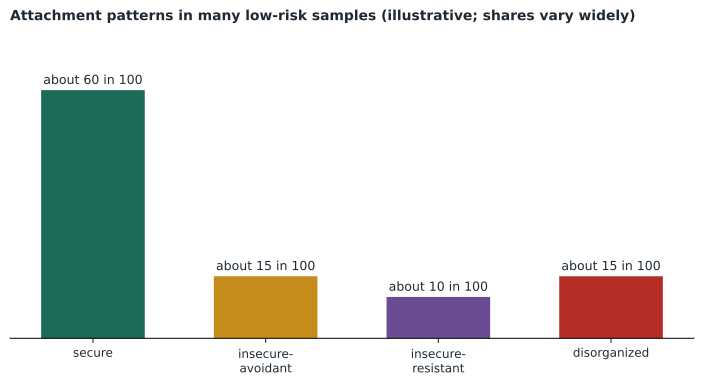
In many low-risk samples, a majority of infants, often around 60 out of 100, are classified as secure. The shares vary across cultures. In some studies in Germany, where independence was encouraged, more infants were classified as avoidant; in some studies in Japan, where infants were rarely left with strangers, more were classified as resistant. Critics argue that the procedure measures something slightly different in each culture: a brief separation is much more unusual, and so more stressful, for some children than for others.
What predicts secure attachment? Ainsworth found that caregivers of secure infants tended to be sensitive and responsive, noticing the baby's signals and responding promptly and appropriately. Meta-analyses confirm a link between sensitivity and security, though it is moderate, and temperament and family circumstances also play a part. Interventions that help parents read and respond to their babies' cues can increase secure attachment. Importantly, attachment is not only to mothers: infants form attachments to fathers, grandparents, siblings and child care providers, and multiple secure relationships are common and beneficial.
Does early attachment matter later? Securely attached infants tend, on average, to become children with somewhat better social skills and emotional regulation. But the links are modest, and attachment patterns can change when circumstances change, for better or worse. Navarro is careful to stress that attachment theory is often overstated in popular parenting advice. Babies do not need constant contact or a perfect parent; they need caregivers who are, in the phrase of the pediatrician Donald Winnicott, 'good enough'.
Child care and parenting
Parents often worry about whether time in child care harms attachment. Large longitudinal studies, including the United States National Institute of Child Health and Human Development study that followed more than 1,300 children from 1991, found that the quality of parenting at home was a much stronger predictor of children's development than whether they attended child care. High-quality child care was associated with somewhat better language and cognitive skills. Long hours in group care were associated with slightly more behavior problems in some analyses, but the effects were small and depended on quality.
Diana Baumrind, beginning in the 1960s, described parenting styles along two dimensions: demandingness, meaning expectations and control, and responsiveness, meaning warmth and support. Authoritative parents are both demanding and responsive: they set clear rules, explain them and listen. Authoritarian parents are demanding but not responsive: 'because I said so'. Permissive parents are responsive but set few limits. Uninvolved, or neglectful, parents are neither. Later researchers added the fourth style to Baumrind's original three.
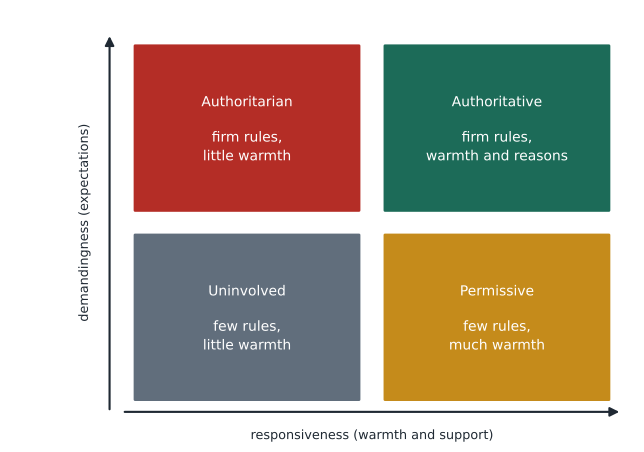
In many studies, especially of middle-class families in North America, children of authoritative parents tend to have higher self-esteem, better school performance and better social skills. But these are correlations. Children's temperaments shape parenting as well as the reverse: an easy-going child may make warm, reasoned discipline easier. Twin studies show that children share genes with their parents, which complicates interpretation. And the effects of a style can vary by culture and context; in some communities and in dangerous neighborhoods, stricter parenting does not show the same negative associations.
Physical punishment is one area where the evidence is unusually consistent. Meta-analyses of many studies find that spanking is associated with more aggression, more behavior problems and poorer mental health in children, and not with better long-term behavior. Spanking remains legal for parents in all 50 states, though the American Academy of Pediatrics recommends against it, and a growing number of states ban corporal punishment in schools.
Peers, play and the self
Play is the work of childhood. Through pretend play, children practice roles, rules and perspective-taking; through rough-and-tumble play, they learn to read signals and control strength. Mildred Parten's observations in the 1930s described a progression from playing alone to parallel play, side by side without interacting, to cooperative play with shared goals, though children continue to use all these forms.
As children enter school, peers become increasingly important. Popular children tend to be friendly, cooperative and good at reading social cues; rejected children are often either aggressive or withdrawn. Peer rejection predicts later difficulties, and friendships, even a single close one, protect children against the effects of bullying and loneliness. Bullying, repeated aggression against someone with less power, affects many children and is associated with anxiety, depression and school avoidance. School programs that involve the whole school, including bystanders, reduce bullying modestly.
Children's self-concept also develops. Toddlers begin to recognize themselves in a mirror at around eighteen months to two years, shown by touching a dot of rouge secretly placed on their nose. Young children describe themselves in concrete terms, 'I have a dog and I can run fast'; older children compare themselves with others and describe traits and abilities. Self-esteem tends to be high in early childhood and to become more realistic, and sometimes lower, as children make social comparisons.
Gender development
By about age two or three, most children can label themselves and others as boys or girls, and by five or six most understand that sex is generally stable over time. Children develop gender schemas, ideas about what boys and girls are like, and often follow gender stereotypes rigidly in the preschool years before becoming more flexible later in childhood.
Several processes contribute. Social learning theory emphasizes reinforcement and modeling by parents, peers and media; children are often rewarded for gender-typical behavior and teased for atypical behavior, especially boys. Cognitive approaches emphasize children's own active efforts to learn what their gender means and to conform to it. Biological factors such as prenatal hormones also play a role: girls exposed to unusually high levels of androgens before birth, because of a condition called congenital adrenal hyperplasia, tend to show more interest in toys typically preferred by boys. Most researchers see gender development as arising from biological, cognitive and social influences together.
Gender identity, a person's internal sense of their own gender, usually matches the sex recorded at birth but not always. Transgender people have a gender identity different from that sex, and some people identify outside the categories of man and woman. Research on transgender and gender-diverse young people consistently finds higher rates of anxiety and depression, linked in large part to stigma, rejection and harassment, and finds that family acceptance and supportive environments are associated with better mental health. Questions about medical care for transgender adolescents are the subject of active debate among clinicians and policymakers, with reviews in several countries reaching different conclusions about the strength of the evidence.
Adversity and resilience
Some children grow up amid serious adversity. In the Adverse Childhood Experiences study, begun in the 1990s by the Kaiser Permanente health organization and the Centers for Disease Control and Prevention, adults reported whether, as children, they had experienced abuse, neglect, domestic violence, parental substance use, mental illness, incarceration or separation. People who reported more such experiences had, on average, higher rates of later physical and mental health problems. The ACE score is a useful population-level tool, but it is not a precise predictor for individuals; many people with high scores do well.
Resilience is the capacity to adapt well in the face of adversity. The developmental psychologist Ann Masten has called it 'ordinary magic', because it usually comes not from rare qualities but from common protective factors: at least one warm, stable relationship with an adult; problem-solving and self-regulation skills; a sense of competence; and supportive schools and communities. Emmy Werner's study of nearly 700 children born in 1955 on the Hawaiian island of Kauai followed them for decades. About a third were considered at high risk, and roughly one in three of those children grew into competent, caring adults by age 18, with many more recovering later in adulthood.
Ruth asks what this means for parents who make mistakes. Navarro answers that no child needs a flawless childhood. What matters most is the overall pattern: warmth, reasonable structure, and repair after conflict. 'Kids don't remember the night you lost your temper as much as they remember whether you came back and made it right.'
Worked problem
Classifying a reunion
In a strange situation session, a 14-month-old plays with toys while her father is present, cries when he leaves, and when he returns she runs to him, is quickly comforted and goes back to playing. A second child barely reacts to her mother leaving and turns away when she returns. Classify each.
Show solution
- Look first at exploration: the first child uses her father as a base and explores.
- Look at reunion: she seeks contact and is comforted quickly. This is the pattern of secure attachment.
- The second child shows little distress and avoids the caregiver at reunion. This is the insecure-avoidant pattern.
- Remember that one session is a snapshot; patterns can change, and cultural expectations affect behavior.
Answer: The first child shows secure attachment and the second insecure-avoidant attachment.
Common mistakes
MistakeInfants become attached to whoever feeds them.
InsteadHarlow's and Bowlby's work showed that comfort and responsiveness, not food, are central.
MistakeChildren can only be securely attached to their mother.
InsteadChildren form attachments to several caregivers, and multiple secure attachments are common.
MistakeAuthoritative parenting has been proven to cause better outcomes.
InsteadThe evidence is mostly correlational; children's temperament and shared genes also shape the associations.
MistakeA high ACE score means a person will have poor health.
InsteadACE scores describe population risk; many individuals with high scores do well, especially with protective relationships.
Summary and key terms
- Attachment is an emotional bond that keeps infants close to caregivers; contact comfort and responsiveness, not food, are central.
- The strange situation classifies infants as secure, insecure-avoidant, insecure-resistant or disorganized; shares vary across cultures.
- Sensitive caregiving predicts secure attachment moderately; children form multiple attachments, and patterns can change.
- Baumrind's parenting styles are defined by demandingness and responsiveness; authoritative parenting is associated with good outcomes, but causation is uncertain.
- Physical punishment is consistently associated with worse child outcomes.
- Play, peers, friendships and self-concept develop through childhood; bullying causes lasting harm.
- Gender development reflects biological, cognitive and social influences; resilience usually comes from ordinary protective factors.
- Attachment
- An emotional bond with a caregiver shown by seeking closeness and distress at separation.
- Secure base
- A caregiver whose presence lets a child explore with confidence.
- Internal working model
- A child's expectations about relationships, built from experience with caregivers.
- Authoritative parenting
- A style high in both demandingness and responsiveness.
- Gender schema
- A mental framework for what being a boy, girl or other gender means.
- Resilience
- Adapting well in the face of adversity.
Practice problems
Work each problem on paper first, then reveal the answer to check.
How did Harlow's monkeys challenge the idea that attachment comes from feeding?
Show answer
They fed from the wire mother but clung to and sought comfort from the cloth mother.
Why might more Japanese infants be classified as resistant in some studies?
Show answer
Brief separations from the mother were unusual for them, so the procedure was more stressful.
Name the parenting style that sets clear rules, explains them and is warm.
Show answer
Authoritative.
What did Masten mean by calling resilience 'ordinary magic'?
Show answer
That it usually arises from common protective factors such as caring relationships and skills, not rare traits.
Lesson quiz · 5 questions
Score 60% or more to complete this lesson.
Create a free account to save your progress, take quizzes and earn a certificate.