
PSYC-105 · Lesson 11 of 12 · 21 min
Anxiety, mood, psychotic and other disorders
▶ Video coming soon A video version of this lesson is on the way.
Navarro reminds the class that reading about disorders can be unsettling. 'Medical students famously start to believe they have every disease they study,' she says. 'You will recognize yourself in some of these descriptions, because they describe experiences that everyone has to a degree. A disorder is a matter of intensity, persistence and impairment. If anything today resonates in a way that worries you, the counseling office is open, and I'll put the crisis numbers on the last slide.' This lesson surveys the major groups of disorders, what they look like and what is known about their causes.
Anxiety disorders
Anxiety is a normal, often useful response to threat. Anxiety disorders involve fear or anxiety that is excessive or persistent, out of proportion to the actual danger and accompanied by avoidance that interferes with life. They are the most common category of psychological disorders.
Generalized anxiety disorder involves persistent, excessive and hard-to-control worry about many things, such as work, health and family, for at least six months, with symptoms such as restlessness, fatigue, poor concentration, irritability, muscle tension and disturbed sleep. Panic disorder involves recurrent, unexpected panic attacks, sudden surges of intense fear with symptoms such as a pounding heart, shortness of breath, dizziness and a feeling of losing control or dying, followed by persistent worry about further attacks or changes in behavior to avoid them. Many people who have a panic attack go to an emergency department believing they are having a heart attack.
Specific phobias are intense, irrational fears of particular objects or situations, such as spiders, heights, flying or injections, leading to avoidance. Social anxiety disorder involves intense fear of situations in which one might be scrutinized or embarrassed, such as speaking in class, eating in public or meeting new people. Agoraphobia involves fear and avoidance of situations where escape might be difficult or help unavailable, such as crowds, public transit or open spaces.
Obsessive-compulsive disorder, now classified separately, involves obsessions, intrusive, unwanted thoughts, images or urges that cause anxiety, such as fears of contamination or of having harmed someone, and compulsions, repetitive behaviors or mental acts, such as handwashing, checking or counting, performed to reduce the anxiety. People with the disorder often recognize that their obsessions are excessive but feel unable to stop. Casual use of 'OCD' to mean liking things tidy trivializes a condition that can consume hours each day.
Posttraumatic stress disorder can develop after exposure to actual or threatened death, serious injury or sexual violence, whether experienced directly, witnessed or learned about happening to someone close, or through repeated exposure to details at work, as for first responders. Symptoms include intrusive memories, flashbacks and nightmares; avoidance of reminders; negative changes in thoughts and mood; and heightened arousal, such as hypervigilance and being easily startled, lasting more than a month. Most people exposed to trauma do not develop the disorder; social support after the event is one of the strongest protective factors.
How anxiety is maintained
Learning explains a great deal about anxiety, as the first course described. Fears can be acquired through classical conditioning, as when a person bitten by a dog becomes afraid of dogs, through observing others' fear and through frightening information. Avoidance is then reinforced, negatively, by the relief it brings, which prevents the person from learning that the feared situation is safe. This avoidance cycle is the target of exposure therapy.
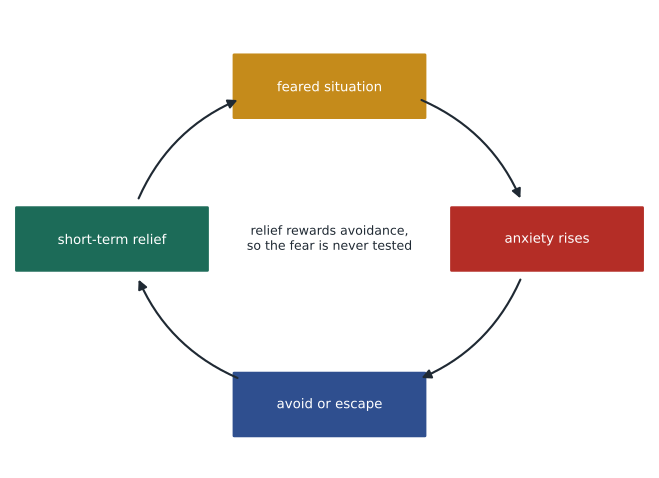
Cognition matters too. People with anxiety disorders tend to pay extra attention to threats, interpret ambiguous situations as dangerous and overestimate both the likelihood and the cost of bad outcomes. Biology plays a part: anxiety disorders run in families, twin studies show moderate heritability, and the amygdala and related circuits are highly reactive in many people with anxiety. Evolution may explain why people develop phobias of snakes, heights and spiders far more readily than of cars or electrical outlets, a pattern called preparedness, consistent with the taste-aversion findings of the first course.
Depressive disorders
Major depressive disorder involves at least two weeks of depressed mood or loss of interest or pleasure in nearly all activities, together with other symptoms: changes in appetite or weight, sleeping too much or too little, slowed movement or agitation, fatigue, feelings of worthlessness or excessive guilt, difficulty concentrating and recurrent thoughts of death. Depression is not ordinary sadness. It is persistent, it affects the body and thinking as well as mood, and it impairs functioning. Persistent depressive disorder involves a milder but chronic depressed mood lasting at least two years.
Depression is one of the leading causes of disability worldwide. Many people experience a single episode, but for many others it recurs. Episodes often follow stressful events, especially losses and humiliations, but people differ in vulnerability. Biological factors include genes, with heritability estimated at about 40 out of 100 parts of the variation in twin studies, and differences in stress-hormone systems and brain circuits involved in reward and emotion regulation. The popular idea that depression is caused simply by a 'chemical imbalance' of serotonin is an oversimplification; a 2022 review by Joanna Moncrieff and colleagues found no consistent evidence of low serotonin in depression, though antidepressants that act on serotonin help many people, for reasons that are still being studied.
Psychological factors include negative thinking patterns. Aaron Beck described a cognitive triad of negative views of the self, the world and the future, and the explanatory style described in lesson 6, explaining bad events as permanent, pervasive and personal, predicts depression. Rumination, especially common in women, prolongs and deepens depressed mood. Social factors include poverty, isolation, relationship conflict and discrimination. The cycle often reinforces itself: depressed mood leads to withdrawal, which reduces positive experiences and support, which deepens depression.
Bipolar disorders
Bipolar I disorder involves at least one manic episode, a distinct period of abnormally elevated, expansive or irritable mood and increased energy lasting at least a week, with symptoms such as inflated self-esteem, greatly reduced need for sleep, racing thoughts, rapid speech, distractibility and risky behavior, such as spending sprees. Most people with bipolar I also experience depressive episodes. Bipolar II disorder involves depressive episodes and at least one hypomanic episode, a milder form of mania that does not cause severe impairment.
Bipolar disorders are among the most heritable of psychological disorders. They usually begin in late adolescence or early adulthood and tend to recur. With treatment, usually medication such as lithium or other mood stabilizers combined with psychotherapy and attention to sleep and stress, many people live stable, productive lives. Ruth says her brother tracks his sleep carefully, because missing sleep has preceded his episodes. Navarro confirms that disrupted sleep is a well-known trigger and that regular routines are part of many treatment plans.
Suicide: understanding risk and helping
Navarro addresses suicide directly and carefully. Suicide is a leading cause of death among young people in both Canada and the United States. Most people who die by suicide have a mental health condition, often depression, though not always diagnosed, and suicidal thoughts usually arise when a person feels intense pain, hopelessness and the sense of being a burden or not belonging. Suicide is preventable, and most people who have suicidal thoughts do not die by suicide; many recover fully with support and treatment.
Signs that someone may be at risk include talking about wanting to die or being a burden, withdrawing from others, giving away possessions, saying goodbye, sudden calm after a period of depression, and increased use of alcohol or drugs. Asking someone directly whether they are thinking about suicide does not plant the idea; research shows it is more likely to bring relief and open a conversation. Listening without judgment, staying with the person and helping them connect with professional support can save a life.
Navarro shows the last slide early. In both the United States, anyone in distress can call or text 988 to reach the 988 Suicide and Crisis Lifeline, available nationwide since July 2022, 24 hours a day. In an emergency, call 9-1-1. She adds that the college counseling office offers free appointments to students.
Schizophrenia and psychotic disorders
Psychosis is a loss of contact with reality, involving hallucinations, delusions or severely disorganized thinking. Schizophrenia is a disorder in which psychotic symptoms and impaired functioning persist for at least six months. It affects somewhat less than 1 person in 100 over a lifetime and usually begins in late adolescence or early adulthood, slightly earlier on average in men.
Symptoms are grouped into categories. Positive symptoms are experiences added to normal functioning: hallucinations, most often hearing voices; delusions, fixed false beliefs, such as being persecuted or controlled by outside forces; and disorganized speech and behavior. Negative symptoms are losses of normal functioning: reduced emotional expression, little speech, lack of motivation and withdrawal. Cognitive symptoms include problems with attention, working memory and planning. Negative and cognitive symptoms often affect daily functioning more than positive symptoms and respond less to medication.
Schizophrenia is not 'split personality'. That common confusion mixes it up with dissociative identity disorder, a separate and much rarer condition. People with schizophrenia are also far more likely to be harmed than to harm others.
The causes involve genetic and environmental factors. Heritability is high, around 80 out of 100 parts of the variation in twin studies, but no single gene is responsible; many variants each contribute a small amount. Prenatal factors, such as maternal infection or malnutrition, complications at birth, heavy cannabis use in adolescence and growing up in cities or as a member of a marginalized minority group are associated with increased risk. The brains of people with schizophrenia show, on average, enlarged ventricles and reduced gray matter, and excess dopamine activity in certain pathways is linked to positive symptoms, which is why antipsychotic medications that block dopamine receptors can reduce hallucinations and delusions. Early intervention programs for first-episode psychosis, which combine medication, therapy, family support and help with school or work, improve outcomes.
Other groups of disorders
Eating disorders, introduced in lesson 5, include anorexia nervosa, involving restriction of food intake, intense fear of gaining weight and a distorted body image; bulimia nervosa, involving recurrent binge eating followed by behaviors such as vomiting to prevent weight gain; and binge-eating disorder, involving recurrent binges without such compensatory behaviors. They occur in people of all genders, body sizes and backgrounds. Family-based treatment for adolescents and cognitive behavioral therapy for adults are among the treatments with the best evidence.
Neurodevelopmental disorders begin in childhood. Attention-deficit/hyperactivity disorder involves persistent inattention, hyperactivity and impulsivity that interfere with functioning in more than one setting. Autism spectrum disorder involves differences in social communication and interaction and restricted, repetitive patterns of behavior and interests, ranging widely in support needs. Many autistic people prefer identity-first language, 'autistic person', and Navarro notes that preferences about language differ among communities and individuals and are worth asking about.
Personality disorders involve enduring, inflexible patterns of inner experience and behavior that deviate from cultural expectations and cause distress or impairment. Borderline personality disorder involves instability in relationships, self-image and emotions, intense fear of abandonment and impulsive, sometimes self-harming behavior; dialectical behavior therapy, discussed in lesson 12, was developed for it. Antisocial personality disorder involves a persistent disregard for and violation of the rights of others beginning in adolescence. Dissociative disorders involve disruptions of memory, identity or awareness, and substance use disorders involve continued use of a substance despite significant problems, as described in the first course's lesson on consciousness.
Marcus asks how researchers know how common disorders are, and Navarro explains lifetime and twelve-month prevalence. He writes a short program converting numbers from a hypothetical survey into rates per 100.
# Hypothetical survey of 2,500 adults: counts meeting criteria in the past 12 months
survey = 2_500
counts = {"any anxiety disorder": 300, "major depression": 190, "bipolar disorder": 25}
for name, n in counts.items():
print(f"{name}: {n / survey * 100:.1f} per 100")any anxiety disorder: 12.0 per 100 major depression: 7.6 per 100 bipolar disorder: 1.0 per 100
In this invented survey, anxiety disorders are the most common at 12 per 100, followed by major depression at 7.6 and bipolar disorder at 1.0. Real national surveys give broadly similar orders of magnitude, though the exact figures depend on the methods and the population.
Worked problem
Distinguishing disorders
Identify the most likely category for each description, keeping in mind that only a professional can diagnose: (a) Repeated sudden attacks of intense fear with a pounding heart, followed by constant worry about another attack. (b) A week of very little sleep, racing thoughts and extravagant spending, unlike the person's usual self. (c) Months of hearing voices others do not hear, believing neighbors are sending messages through the television, and withdrawing from school.
Show solution
- Look for the core feature in each description.
- (a) Unexpected panic attacks with persistent worry about more: consistent with panic disorder.
- (b) A distinct period of elevated energy, reduced need for sleep and risky behavior: consistent with a manic episode, as in bipolar I disorder.
- (c) Hallucinations, delusions and declining functioning lasting months: consistent with schizophrenia or another psychotic disorder.
- In each case, recommend assessment by a professional, since medical conditions and substances can cause similar symptoms.
Answer: Panic disorder, a manic episode suggesting bipolar disorder, and a psychotic disorder such as schizophrenia, each requiring professional assessment.
Common mistakes
MistakeSchizophrenia means having a split personality.
InsteadSchizophrenia involves psychosis and impaired functioning; dissociative identity disorder is a different, rare condition.
MistakeDepression is just a chemical imbalance of serotonin.
InsteadDepression involves many interacting biological, psychological and social factors; evidence for a simple serotonin deficit is weak.
MistakeAsking someone if they are thinking about suicide can put the idea in their head.
InsteadAsking directly does not increase risk and often brings relief and opens the door to help.
MistakeLiking things neat means having OCD.
InsteadOCD involves distressing obsessions and time-consuming compulsions that impair functioning.
Summary and key terms
- Anxiety disorders involve excessive, persistent fear or worry with avoidance; they include generalized anxiety, panic, phobias, social anxiety and agoraphobia.
- Obsessive-compulsive disorder involves obsessions and compulsions; posttraumatic stress disorder follows trauma and includes intrusions, avoidance and hyperarousal.
- Anxiety is maintained by conditioning, reinforced avoidance, threat-focused thinking and biological vulnerability.
- Major depressive disorder involves at least two weeks of low mood or loss of pleasure with other symptoms; its causes are biological, psychological and social.
- Bipolar disorders involve manic or hypomanic episodes, are highly heritable and are often well managed with treatment.
- Suicide is preventable; asking directly and connecting people with help, including 988, saves lives.
- Schizophrenia involves positive, negative and cognitive symptoms with high heritability and environmental risk factors; other groups include eating, neurodevelopmental, personality, dissociative and substance use disorders.
- Panic attack
- A sudden surge of intense fear with strong physical symptoms.
- Obsession
- An intrusive, unwanted thought, image or urge that causes anxiety.
- Major depressive disorder
- At least two weeks of depressed mood or loss of pleasure with other symptoms causing impairment.
- Manic episode
- A distinct period of elevated or irritable mood and increased energy lasting at least a week.
- Delusion
- A fixed false belief held despite clear contrary evidence.
- Negative symptoms
- Losses of normal functioning in schizophrenia, such as reduced expression and motivation.
Practice problems
Work each problem on paper first, then reveal the answer to check.
Why does avoidance maintain a phobia?
Show answer
The relief it brings reinforces avoidance and prevents the person from learning that the situation is safe.
What distinguishes bipolar II from bipolar I disorder?
Show answer
Bipolar II involves hypomanic rather than full manic episodes, along with depressive episodes.
Give one positive and one negative symptom of schizophrenia.
Show answer
Positive: hallucinations or delusions. Negative: reduced emotional expression or lack of motivation.
In the survey code, how many per 100 had major depression?
Show answer
7.6.
Lesson quiz · 5 questions
Score 60% or more to complete this lesson.
Create a free account to save your progress, take quizzes and earn a certificate.