
PSYC-105 · Lesson 6 of 12 · 20 min
Stress, health and coping
▶ Video coming soon A video version of this lesson is on the way.
It is the week before midterms, and Navarro begins by asking the class to rate their stress from 1 to 10. Most hands go up at 7 or 8. Fatima, who is juggling clinical placements, a part-time job and family obligations, says 9. Ruth, who has a sick parent, says she stopped counting. 'Good,' says Navarro, and the class laughs. 'Not good that you're stressed. Good that we have real data. This lesson is about what stress does to the body and mind, why some people seem to handle it better than others, and which ways of coping actually help.'
What stress is
Stress is the process by which we perceive and respond to events, called stressors, that we appraise as threatening or challenging. The definition contains an important idea: stress depends not only on events but on how we interpret them. Richard Lazarus described two steps. In primary appraisal, we ask whether an event is relevant to us and whether it is a threat, a loss or a challenge. In secondary appraisal, we ask whether we have the resources to cope. A difficult exam may be a threat to a student who doubts she has prepared, and a challenge to one who feels ready.
Stressors come in several forms. Catastrophes are large-scale, unpredictable events such as wildfires, floods, wars and pandemics. Significant life changes include the death of a loved one, divorce, moving or losing a job. Daily hassles are the minor irritations of everyday life: traffic, lost keys, crowded buses and slow internet. Research suggests that daily hassles, because they accumulate, can affect health and mood as much as major events. Chronic stressors, such as poverty, caregiving for a family member with dementia, discrimination or an unsafe neighborhood, persist for months or years and are particularly harmful.
In 1967, Thomas Holmes and Richard Rahe published the Social Readjustment Rating Scale, which assigned points to life events, from 100 for the death of a spouse to 11 for a minor violation of the law. Higher totals over a year were associated with more illness. The scale was influential but has limitations: it counts positive events such as marriage as stressors, it ignores how people appraise events, and it was developed with samples that do not represent everyone's life circumstances.
The stress response
In the 1920s, Walter Cannon described the fight-or-flight response, a rapid, coordinated reaction to threat. The sympathetic nervous system increases heart rate, blood pressure and breathing, diverts blood to the muscles and releases stored glucose for energy. The adrenal glands release adrenaline and noradrenaline. This response is highly adaptive when we must escape or fight a physical danger, and much less so when the threat is an email from a manager.
A slower system works alongside it. The hypothalamus signals the pituitary gland, which signals the adrenal glands to release cortisol, a hormone that mobilizes energy and dampens inflammation. This chain is called the hypothalamic-pituitary-adrenal axis, or HPA axis. Cortisol is helpful in the short term, but sustained high levels can suppress immune function, disrupt sleep, contribute to weight gain around the abdomen and affect memory.
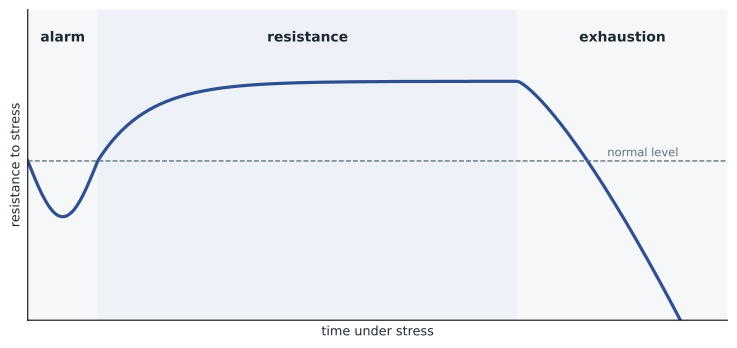
The Canadian researcher Hans Selye, working at McGill University and the Université de Montréal from the 1930s onward, proposed that the body responds to many kinds of prolonged stressors in the same general way, which he called the general adaptation syndrome. It has three phases. In the alarm phase, the body mobilizes resources. In the resistance phase, it stays aroused and copes, with stress hormones elevated. If the stressor continues long enough, the body enters exhaustion, when resources are depleted and vulnerability to illness increases.
Not everyone responds to stress with fight or flight. Shelley Taylor proposed in 2000 that people, and women in particular, often respond with tend-and-befriend: caring for others and seeking social support. The hormone oxytocin, involved in social bonding, may play a role. Fatima notices that after a hard clinical shift she calls her sister rather than going for a run, and Navarro points out that both are reasonable responses.
Stress and illness
Psychoneuroimmunology studies how psychological factors, the nervous system and the immune system interact. A classic series of studies by Sheldon Cohen and colleagues in the 1990s exposed healthy volunteers to a cold virus through nose drops and kept them in quarantine. People who reported more stress in the previous year were more likely to develop colds, and in later studies chronic stressors lasting a month or more, such as conflict with a partner or unemployment, were especially strong predictors. Social ties had the opposite effect: people with more diverse social networks were less likely to get sick.
Janice Kiecolt-Glaser and colleagues found that small standardized wounds healed more slowly in caregivers of relatives with dementia than in matched people who were not caregivers, and more slowly in dental students during exams than during vacations. Stress has also been linked to the progression of some illnesses, though the effects of psychology on serious diseases such as cancer are much smaller than popular accounts suggest; there is no good evidence that a positive attitude cures cancer, and the idea can make patients feel they are to blame.
The clearest link is with heart disease. In the 1950s, cardiologists Meyer Friedman and Ray Rosenman described a Type A pattern of competitive, hurried, hostile behavior that seemed to predict heart attacks. Later research found that the key ingredient was hostility and anger, not ambition or speed. Chronic stress, depression and social isolation are also associated with higher cardiovascular risk. Some of the link is behavioral, since stressed people may sleep less, exercise less, smoke more and eat differently, and some is physiological.
Stress is not distributed equally. People with lower incomes, those facing discrimination and those in insecure housing or work experience more chronic stressors and fewer resources for coping. The concept of allostatic load, developed by Bruce McEwen, describes the cumulative wear and tear on the body from repeated or chronic stress. Researchers have linked higher allostatic load to many of the health gaps between social groups, which is one reason health psychologists argue that reducing stress requires social change as well as individual coping.
Coping
Coping is the effort to manage stress. Lazarus and Susan Folkman distinguished two broad kinds. Problem-focused coping tries to change the stressor itself, by making a plan, seeking information or taking action. Emotion-focused coping tries to manage the emotional response, by reframing the situation, seeking comfort or distracting oneself. Problem-focused coping tends to work best when the situation is controllable, such as a heavy workload that can be scheduled; emotion-focused coping tends to work best when it is not, such as waiting for a medical test result.
Some strategies are generally helpful and some generally harmful. Avoidance, such as denying the problem, drinking or using drugs to numb feelings, tends to bring short-term relief and long-term costs. Rumination, repeatedly dwelling on problems and their causes without moving toward solutions, predicts depression and anxiety. Reappraisal, rethinking the meaning of a situation, is associated with better emotional outcomes; for example, interpreting a racing heart before an exam as the body getting ready rather than as a sign of failure.
Perceived control and optimism
Perceived control is a powerful buffer. In a famous 1976 study by Ellen Langer and Judith Rodin, nursing home residents who were given choices about their environment and the responsibility of caring for a plant became more active and alert than residents whose care was decided for them, and a follow-up reported fewer deaths in the choice group. The mortality finding was based on small numbers and should be treated cautiously, but many later studies confirm that a sense of control improves well-being.
When people repeatedly experience events they cannot control, they may stop trying even when control becomes possible. Martin Seligman called this learned helplessness after experiments in the 1960s in which dogs exposed to inescapable shocks later failed to escape avoidable ones. The animal studies are now viewed as ethically troubling, and later neuroscience research by Steven Maier and Seligman suggested that passivity may be the default response to prolonged threat and that what is learned is control. In people, explanatory style matters: those who explain bad events as permanent, pervasive and personal are more vulnerable to depression.
Optimism, the expectation of good outcomes, is associated with better coping and health, though some of the link reflects the fact that healthy people find it easier to be optimistic. Self-efficacy, Albert Bandura's term for belief in one's ability to succeed at a particular task, predicts persistence and performance across many domains.
Social support and other buffers
Social support is one of the most robust protective factors in health psychology. People with close relationships tend to live longer; a 2010 meta-analysis by Julianne Holt-Lunstad and colleagues, combining 148 studies, found that people with stronger social relationships had roughly 1.5 times the odds of survival over the study periods, an effect comparable to that of quitting smoking, although such comparisons are approximate. Support can be emotional, practical or informational. Perceived support, the belief that help would be available if needed, often matters more than help actually received.
Exercise is another reliable buffer. Regular aerobic exercise reduces stress hormones, improves sleep and mood and, in clinical trials, reduces symptoms of mild to moderate depression. Mindfulness-based programs, which train attention to the present moment without judgment, show modest benefits for stress, anxiety and depression in randomized trials, though many studies are small and the benefits are similar to those of other active treatments. Relaxation training and adequate sleep also help.
Marcus offers to score the class's stress ratings with a small program that also compares people with and without someone to talk to. The numbers are invented for the demonstration.
# Illustrative class data: stress rating (1-10) and whether the student has someone to talk to
ratings = [(8, True), (9, False), (7, True), (6, True), (9, False), (8, False), (5, True), (7, True)]
with_support = [s for s, has in ratings if has]
without = [s for s, has in ratings if not has]
print("with support:", round(sum(with_support) / len(with_support), 1))
print("without support:", round(sum(without) / len(without), 1))with support: 6.6 without support: 8.7
In this tiny invented sample, students with support report lower average stress, 6.6 against 8.7. Navarro reminds the class of the first course: eight people prove nothing, and the data are correlational. Stressed people may withdraw from others, or a third factor such as a heavy workload may lower both support and well-being. Large longitudinal and experimental studies are what support the conclusion.
Health behaviors and change
Much of health psychology concerns behavior: smoking, drinking, eating, exercising, sleeping and following medical advice. Knowing what is healthy is rarely enough. Successful behavior change programs set specific, achievable goals; use self-monitoring, such as tracking steps or drinks; plan for obstacles with 'if-then' implementation intentions, such as 'if I feel like smoking after dinner, I will go for a walk'; and arrange the environment to make the healthy choice easier. Peter Gollwitzer's research found that forming implementation intentions improves goal attainment, with moderate effects across many studies.
Public health policy also shapes behavior. Taxes, smoke-free laws and warning labels in the United States are examples of population-level approaches that work alongside individual coping. Navarro returns to the point about allostatic load: individuals can learn to cope, but the biggest gains in health often come from changing the conditions people live in.
Worked problem
Choosing a coping strategy
Ruth's father is in hospital with a serious illness. She cannot change his diagnosis, but she can arrange her work schedule and organize family visits. Which kinds of coping fit which parts of her situation?
Show solution
- Separate the controllable from the uncontrollable parts.
- Controllable: her schedule and the visiting plan call for problem-focused coping, such as making a shared calendar with her siblings.
- Uncontrollable: the illness itself calls for emotion-focused coping, such as seeking support, reappraising what she can offer him and allowing herself to grieve.
- Avoid strategies with long-term costs, such as drinking to sleep or ruminating late at night.
Answer: Use problem-focused coping for the schedule and visits and emotion-focused coping for the illness, while avoiding avoidance and rumination.
Common mistakes
MistakeStress is caused by events alone.
InsteadStress depends on how events are appraised and on the resources people believe they have.
MistakeOnly major life events affect health.
InsteadDaily hassles and chronic stressors also have strong effects.
MistakeBeing Type A, ambitious and busy, causes heart disease.
InsteadThe harmful ingredient appears to be hostility and anger.
MistakeA positive attitude can cure cancer.
InsteadThere is no good evidence for this, and the idea can lead patients to blame themselves.
Summary and key terms
- Stress is the process of appraising and responding to stressors; primary and secondary appraisal shape whether an event feels threatening.
- Stressors include catastrophes, life changes, daily hassles and chronic conditions such as poverty and caregiving.
- The fight-or-flight response and the HPA axis mobilize the body; Selye's general adaptation syndrome has alarm, resistance and exhaustion phases.
- Chronic stress weakens immune function, slows healing and raises cardiovascular risk; hostility is the harmful part of Type A.
- Problem-focused coping suits controllable stressors and emotion-focused coping suits uncontrollable ones; avoidance and rumination tend to backfire.
- Perceived control, optimism, self-efficacy, social support, exercise and sleep protect health.
- Behavior change works best with specific goals, monitoring, implementation intentions and supportive environments and policies.
- Stressor
- An event or condition appraised as threatening or challenging.
- HPA axis
- The hypothalamic-pituitary-adrenal system that releases cortisol in response to stress.
- General adaptation syndrome
- Selye's three-phase pattern of alarm, resistance and exhaustion.
- Problem-focused coping
- Efforts to change or remove a stressor.
- Learned helplessness
- Passivity after repeated experiences of uncontrollable events.
- Allostatic load
- Cumulative wear and tear on the body from chronic stress.
Practice problems
Work each problem on paper first, then reveal the answer to check.
Why might two students feel very different levels of stress about the same exam?
Show answer
They appraise it differently, as a threat or a challenge, and judge their coping resources differently.
What did Cohen's cold-virus studies show?
Show answer
People with more stress, especially chronic stress, were more likely to develop colds, and more diverse social networks protected them.
Name the three phases of Selye's general adaptation syndrome.
Show answer
Alarm, resistance and exhaustion.
In the code, why can't the class conclude that support reduces stress?
Show answer
The sample is tiny and correlational; stress may reduce support, or a third factor may affect both.
Lesson quiz · 5 questions
Score 60% or more to complete this lesson.
Create a free account to save your progress, take quizzes and earn a certificate.