
PSYC-105 · Lesson 10 of 12 · 19 min
Understanding psychological disorders
▶ Video coming soon A video version of this lesson is on the way.
Navarro opens the class with a request. 'For the next three weeks we will talk about psychological disorders. Some of you have lived with one, or love someone who does. Statistically, that is most of this room. So we will use language that puts people first, a person with schizophrenia, not a schizophrenic, and we will remember that every diagnosis describes a struggle a real person is having, not who they are.' Ruth says quietly that her brother has bipolar disorder, and that she wishes more people understood it. Navarro thanks her and begins with a question that is harder than it looks: what makes something a disorder?
Defining a psychological disorder
A psychological disorder is a syndrome marked by clinically significant disturbance in a person's thinking, emotion regulation or behavior. The wording comes from the American Psychiatric Association's definition, and each part matters. Unusual behavior alone is not a disorder: being a vegetarian, a genius or a hermit is statistically rare but not a problem in itself. Most definitions add that the disturbance usually causes significant distress or impairs functioning in work, school, relationships or self-care.
Clinicians sometimes summarize the criteria as the four Ds: deviance from cultural norms, distress, dysfunction and, in some formulations, danger to self or others. Each is imperfect on its own. A person in a manic episode may feel wonderful, not distressed, while making ruinous decisions. Cultural norms change: homosexuality was listed as a mental disorder by the American Psychiatric Association until 1973, a classification now recognized as reflecting prejudice rather than science. And grief after a death can involve intense distress and impaired functioning without being a disorder.
Culture shapes how distress is expressed and understood. Some syndromes are described mainly in particular cultures, and the diagnostic manuals now include guidance on cultural concepts of distress. In some cultures, emotional distress is more often expressed through physical complaints, such as fatigue or pain, than through talk of sadness. Clinicians are taught to ask how a person and their community understand the problem.
From demons to diagnoses
Explanations of disordered behavior have changed over history. In many times and places, they were spiritual: possession, curses or moral failing, sometimes treated with cruel methods. In the late eighteenth century, reformers such as Philippe Pinel in France unchained patients in Paris asylums and promoted moral treatment, emphasizing dignity and humane care. In North America, Dorothea Dix campaigned in the mid-nineteenth century for state-run hospitals.
The medical model, which treats psychological disorders as illnesses that can be diagnosed, treated and often cured, gained ground in the nineteenth century, helped by the discovery that a form of severe mental decline, general paresis, was caused by syphilis infection of the brain. The medical model brought diagnosis and treatment into health care, but it also, in the twentieth century, supported mass institutionalization. In the United States, state hospitals held more than half a million people at their peak in the mid-1950s.
Deinstitutionalization, beginning in the 1950s and 1960s, moved many people out of hospitals as new medications appeared and as reformers documented abuses. Its goals were humane, but community services were often not funded adequately, and many people with serious mental illness ended up homeless or in jails. Navarro notes that the debate about how to provide good, accessible community care continues today.
The biopsychosocial approach
Most clinicians and researchers now take a biopsychosocial approach, which holds that disorders arise from the interaction of biological, psychological and social-cultural factors. Biological factors include genes, brain structure and function, and neurotransmitter systems. Psychological factors include learned fears, patterns of thinking, stress and trauma. Social-cultural factors include poverty, discrimination, family relationships and cultural expectations.
The diathesis-stress model describes one way these factors combine. A diathesis is a predisposition, often genetic but sometimes psychological, such as a pessimistic explanatory style. A stressor is an event or condition that triggers the disorder. People with a strong diathesis may develop a disorder after mild stress; people with a weak diathesis may not develop it even after severe stress. The model explains why identical twins, who share all their genes, often do not share disorders: if one twin has schizophrenia, the other develops it in roughly 40 to 50 out of 100 cases in many studies, far more than in the general population but far from always.
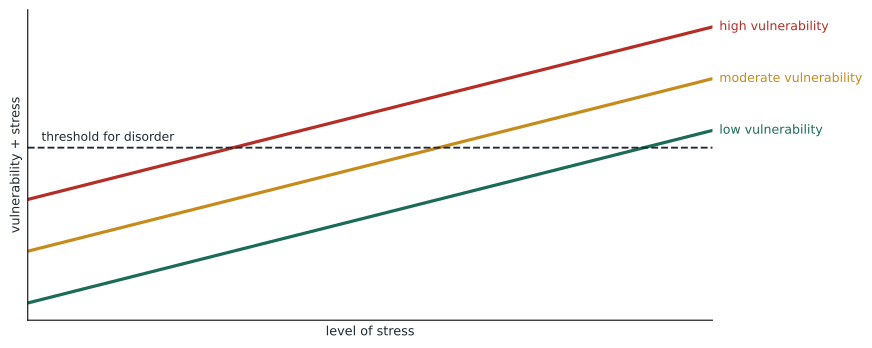
Marcus turns the model into a short program, with made-up numbers, to show that the same stressor can push one person over a threshold and not another.
# Illustrative diathesis-stress model: disorder occurs when vulnerability + stress exceeds a threshold
threshold = 10
people = {"high vulnerability": 7, "moderate vulnerability": 4, "low vulnerability": 1}
for stress in (2, 5, 8):
    crossed = [name for name, v in people.items() if v + stress > threshold]
print(f"stress {stress}: over threshold -> {crossed or 'nobody'}")stress 2: over threshold -> nobody stress 5: over threshold -> ['high vulnerability'] stress 8: over threshold -> ['high vulnerability', 'moderate vulnerability']
With stress at 2, nobody crosses the threshold; at 5, only the most vulnerable person does; at 8, two of the three do. Navarro stresses that real vulnerability and stress interact in more complex ways, and that protective factors, such as social support, raise the threshold for everyone.
Classifying disorders: DSM and ICD
Two classification systems are used worldwide. The Diagnostic and Statistical Manual of Mental Disorders, published by the American Psychiatric Association, is now in its fifth edition, revised in 2022 as DSM-5-TR. The International Classification of Diseases, published by the World Health Organization, covers all diseases; its eleventh edition, ICD-11, came into effect in 2022. In the United States, the DSM is the main reference for diagnosis, while health insurers and government agencies use a clinical modification of the ICD for billing codes. The two systems are broadly similar, and their developers have worked to align them.
The DSM describes each disorder with explicit criteria: a list of symptoms, how many must be present, how long they must last and what must be ruled out. For example, a major depressive episode requires at least five of nine listed symptoms, including either depressed mood or loss of interest or pleasure, nearly every day for at least two weeks, causing significant distress or impairment. Explicit criteria improved reliability, the agreement between clinicians, compared with earlier, vaguer descriptions.
Diagnosis has real benefits: it guides treatment, helps people understand their experiences, enables communication between professionals and research on causes and treatments, and often determines access to services and insurance coverage. It also has limitations. Critics argue that categories impose sharp boundaries on problems that vary continuously; that many people meet criteria for several disorders at once, called comorbidity, which suggests the categories overlap; and that each new edition has broadened some definitions, risking the medicalization of ordinary distress. An alternative research framework, the Hierarchical Taxonomy of Psychopathology, or HiTOP, describes psychopathology as dimensions, such as internalizing and externalizing problems, rather than categories.
| Approach | Main idea | Strength | Limitation |
|---|---|---|---|
| Categorical (DSM, ICD) | Disorders are present or absent based on criteria | Clear decisions for treatment and services | Arbitrary cut-offs; much comorbidity |
| Dimensional (HiTOP) | Problems vary along continuous dimensions | Fits how symptoms actually vary | Less practical for yes-or-no decisions |
Labels and stigma
In 1973, David Rosenhan published 'On being sane in insane places', reporting that he and seven other healthy people had gained admission to psychiatric hospitals by claiming to hear voices saying words like 'empty' and 'thud', then behaved normally. They were kept for an average of 19 days and most were discharged with a diagnosis of schizophrenia 'in remission'. The study was enormously influential and contributed to changes in diagnosis. But in 2019, the journalist Susannah Cahalan reported that she could find records for only some of the pseudopatients, that Rosenhan's own medical records appear to differ from what he reported, and that the study may have been partly misrepresented. Like the Stanford prison experiment, it is now treated as a cautionary tale.
The concern Rosenhan raised, that labels shape how others see us, remains valid. Stigma, negative attitudes and discrimination toward people with mental illness, is widespread. People with serious mental illness are often portrayed as violent, yet most are never violent, and they are far more likely to be victims of violence than perpetrators. Stigma discourages people from seeking help, and self-stigma, internalizing negative stereotypes, can be as harmful as public stigma. Contact with people who have lived experience of mental illness is one of the most effective ways to reduce stigma, consistent with the contact hypothesis from lesson 8. Campaigns by groups such as the National Alliance on Mental Illness use this approach.
How common are disorders?
Psychological disorders are common. In the United States, the National Institute of Mental Health estimates from national surveys that more than one in five adults lives with a mental illness in a given year. Many disorders begin early: about half of all lifetime cases begin by the mid-teens and three quarters by the mid-twenties, according to large international surveys led by Ronald Kessler.
Rates vary with social conditions. Poverty is associated with higher rates of many disorders, through both social causation, the stress of poverty increasing risk, and social selection, disorders making it harder to work and earn. Discrimination and trauma also raise risk. Some disorders differ by gender: depression and anxiety are diagnosed about twice as often in women as in men, while substance use disorders and antisocial personality disorder are diagnosed more often in men, differences that reflect biology, socialization and patterns of help-seeking and diagnosis.
Mental health and the law
Diagnosis also has legal significance. In the United States, state civil commitment laws allow involuntary hospitalization only under specific conditions, generally that the person has a mental illness and is a danger to themselves or others or is unable to care for themselves, with rights to a court hearing. In criminal law, a defendant can be found not guilty by reason of insanity, but this is rare and requires that the disorder prevented the person from understanding the nature of the act or that it was wrong.
Navarro ends by returning to Ruth's brother. Bipolar disorder, she says, is a condition many people manage successfully with treatment, and people with it are artists, scientists, parents and nurses. The next lesson describes the major disorders; the last describes how they are treated.
Worked problem
Applying the definition of a disorder
Decide whether each case is likely to meet the general definition of a disorder: (a) A man spends every weekend birdwatching alone and is content. (b) A student has felt sad nearly every day for a month, has lost interest in friends, sleeps 12 hours a day and is failing courses. (c) A woman cries often in the weeks after her mother's death but continues to work and care for her family.
Show solution
- Ask about clinically significant disturbance, distress and impaired functioning, and consider cultural and situational context.
- (a) Unusual perhaps, but no distress or impairment: not a disorder.
- (b) Persistent low mood, loss of interest, sleep change and impaired functioning for more than two weeks: this pattern may meet criteria for depression and should be assessed by a professional.
- (c) Intense distress that is an expected response to loss, with functioning maintained: ordinary grief, not a disorder.
Answer: Only case (b) suggests a possible disorder, and a professional assessment is needed to diagnose it.
Common mistakes
MistakeAny unusual behavior is a psychological disorder.
InsteadA disorder involves clinically significant disturbance, usually with distress or impairment, not mere rarity.
MistakePeople with mental illness are usually violent.
InsteadMost are never violent and are more likely to be victims than perpetrators.
MistakeA diagnosis describes who a person is.
InsteadA diagnosis describes a condition a person has; person-first language reflects this.
MistakeRosenhan's study proved that psychiatric diagnosis is meaningless.
InsteadThe study's accuracy has been seriously questioned; modern criteria are more reliable, though limitations remain.
Summary and key terms
- A psychological disorder involves clinically significant disturbance in thinking, emotion regulation or behavior, usually with distress or impairment.
- Definitions depend partly on culture, which also shapes how distress is expressed.
- Explanations moved from spiritual to medical models; institutionalization and deinstitutionalization both carried costs.
- The biopsychosocial approach and the diathesis-stress model explain disorders as interacting vulnerabilities and stressors.
- The DSM-5-TR and ICD-11 classify disorders with explicit criteria; dimensional approaches such as HiTOP address comorbidity and arbitrary cut-offs.
- Labels can bring stigma; contact with people with lived experience reduces it. Rosenhan's study is now doubted.
- Disorders are common, often begin early, vary with social conditions and carry legal significance in involuntary treatment and criminal responsibility.
- Psychological disorder
- A syndrome of clinically significant disturbance in thinking, emotion regulation or behavior.
- Biopsychosocial approach
- Explaining disorders through interacting biological, psychological and social-cultural factors.
- Diathesis-stress model
- The idea that a predisposition combines with stress to produce a disorder.
- Comorbidity
- The presence of more than one disorder in the same person.
- DSM-5-TR
- The current edition of the American Psychiatric Association's diagnostic manual, revised in 2022.
- Stigma
- Negative attitudes and discrimination toward people with a characteristic such as mental illness.
Practice problems
Work each problem on paper first, then reveal the answer to check.
Why is statistical rarity not enough to define a disorder?
Show answer
Many rare traits, such as exceptional talent, cause no distress or impairment.
In the code, who crosses the threshold when stress is 5?
Show answer
Only the person with high vulnerability, because 7 plus 5 is 12, above 10.
What is comorbidity, and why does it challenge categorical diagnosis?
Show answer
Having more than one disorder at once; frequent comorbidity suggests the categories overlap.
What is one effective way to reduce stigma?
Show answer
Contact with people who have lived experience of mental illness.
Lesson quiz · 5 questions
Score 60% or more to complete this lesson.
Create a free account to save your progress, take quizzes and earn a certificate.