
PSYC-105 · Lesson 7 of 12 · 20 min
Personality: theories and assessment
▶ Video coming soon A video version of this lesson is on the way.
Before class, Owen posts a link to an online quiz that sorts people into sixteen personality types, and half the class takes it. Marcus is pleased to be an 'architect'. Fatima is annoyed that she came out differently on a second try. Navarro is delighted. 'Today you get to find out which personality tests psychologists trust,' she says, 'and why the one you just took is not on the list.' Personality is a person's characteristic pattern of thinking, feeling and acting across situations and time. This lesson surveys the major approaches to understanding it and the methods used to measure it.
Freud and the psychodynamic approach
Sigmund Freud, a Viennese physician working from the 1890s until his death in 1939, developed the first comprehensive theory of personality, psychoanalysis. Treating patients with symptoms that had no clear physical cause, he became convinced that much of mental life is unconscious, hidden from awareness but powerfully influencing thoughts, feelings and actions. He sought access to the unconscious through free association, in which patients said whatever came to mind, and through the interpretation of dreams, slips of the tongue and symptoms.
Freud described personality as the interaction of three systems. The id, present from birth, operates on the pleasure principle, seeking immediate gratification of basic drives. The ego, which develops as children encounter reality, operates on the reality principle, finding realistic ways to satisfy the id. The superego, the internalized moral standards of parents and society, judges and constrains. Conflict among them produces anxiety, which the ego reduces with defense mechanisms, unconscious strategies that distort reality.
| Defense mechanism | What it does | Example |
|---|---|---|
| Repression | Pushes threatening thoughts out of awareness | Having no memory of a frightening event |
| Denial | Refuses to accept a painful reality | Insisting a serious illness is nothing |
| Projection | Attributes one's own unacceptable feelings to others | Accusing a partner of jealousy when one is jealous |
| Displacement | Redirects feelings toward a safer target | Yelling at a sibling after being criticized at work |
| Rationalization | Offers acceptable reasons for behavior | Saying "I didn't want that job anyway" |
| Reaction formation | Expresses the opposite of a hidden feeling | Being excessively polite to someone one dislikes |
Freud also proposed that personality forms through psychosexual stages in childhood, oral, anal, phallic, latency and genital, each focused on a different area of pleasure, and that unresolved conflicts lead to fixation. These ideas have little empirical support. Critics have argued that Freud's theory explains everything after the fact but predicts little, that it was based on a small number of patients, and that many of its specific claims, such as the Oedipus complex, have not held up. Research on memory, described in the first course, has also shown that repressed memories 'recovered' in therapy can be false.
Yet Freud's influence is enormous, and some of his broad ideas survive in modified form. Modern research confirms that much mental processing is unconscious, though the unconscious of cognitive science is less a cauldron of hidden desires than a vast system of automatic processing. People do use something like defense mechanisms to protect self-esteem. Later psychodynamic theorists, including Alfred Adler, Karen Horney and Carl Jung, emphasized social relationships, culture and the drive for competence more than sexuality, and modern psychodynamic therapy has some research support, as lesson 12 describes.
Humanistic theories
In the 1950s and 1960s, humanistic psychologists rejected both psychoanalysis, as too pessimistic, and behaviorism, as too mechanical. They emphasized people's capacity for growth and free choice. Abraham Maslow, whose hierarchy appeared in lesson 5, studied people he considered self-actualizing, such as Abraham Lincoln and Eleanor Roosevelt, and described them as accepting, spontaneous and focused on problems beyond themselves, though his method of choosing subjects was highly subjective.
Carl Rogers proposed that people naturally move toward growth when their environment provides genuineness, acceptance and empathy. Central to his theory is the self-concept, our thoughts and feelings about who we are. When people receive unconditional positive regard, acceptance regardless of their behavior, they can develop a self-concept that fits their experience. When love is conditional, people may deny parts of themselves to win approval. Rogers's ideas shaped counseling, teaching and parenting, and his emphasis on empathy and a warm therapeutic relationship is supported by research on what makes therapy effective. Humanistic theories have been criticized for vague concepts that are hard to test and for underestimating people's capacity for harm.
Trait theories
Trait theories describe personality in terms of stable characteristics that can be measured. In the 1930s, Gordon Allport and Henry Odbert combed an English dictionary and found about 18,000 words describing people. Later researchers used factor analysis, a statistical technique that identifies clusters of items that tend to go together, to reduce this list to a small number of basic dimensions. Hans Eysenck proposed two or three, including extraversion and emotional stability; Raymond Cattell proposed sixteen.
The most widely accepted model today is the Big Five, or five-factor model, developed by researchers including Paul Costa and Robert McCrae. The five factors, remembered with the acronym OCEAN, are openness to experience, conscientiousness, extraversion, agreeableness and neuroticism, which some researchers call emotional stability when it is scored in the other direction. Each is a continuum, not a type: most people fall near the middle on most dimensions.
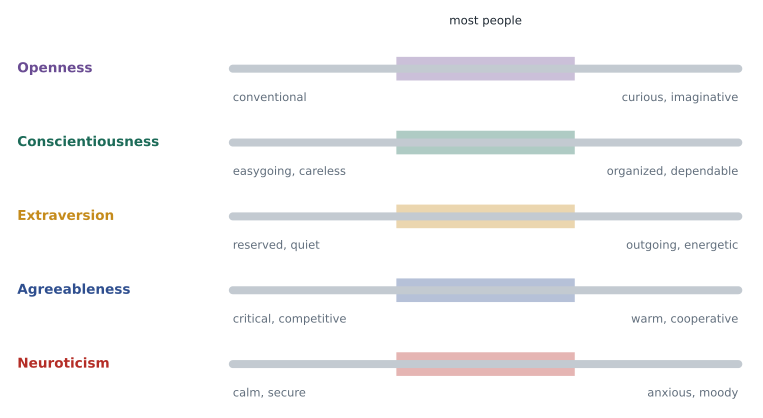
The Big Five have proven remarkably useful. They emerge in many languages and cultures, although some studies in non-industrialized societies find a less clear structure. They are moderately heritable, with twin studies suggesting that roughly 40 out of 100 parts of the variation reflect genetic differences. They change in predictable ways with age: on average, people become more conscientious and agreeable and less neurotic from adolescence into middle age, a pattern called the maturity principle. And they predict real outcomes. Conscientiousness predicts school and job performance and even longevity; neuroticism predicts anxiety, depression and lower relationship satisfaction; agreeableness predicts helping and cooperation.
A sixth factor, honesty-humility, is added in the HEXACO model developed by Kibeom Lee of the University of Calgary and Michael Ashton of Brock University in Ontario. It captures sincerity, fairness and modesty and predicts ethical and unethical behavior better than the Big Five alone. Marcus scores a short Big Five questionnaire the class has completed, showing how reverse-keyed items work.
# Ratings from 1 (disagree) to 5 (agree). Reverse-keyed items are scored as 6 minus the rating.
items = [("I am the life of the party", 4, False),
         ("I don't talk a lot", 2, True),
         ("I feel comfortable around people", 5, False),
         ("I keep in the background", 1, True)]
scores = [6 - r if reverse else r for _, r, reverse in items]
print("item scores:", scores)
print("extraversion average:", sum(scores) / len(scores))item scores: [4, 4, 5, 5] extraversion average: 4.5
Reverse-keyed items, such as 'I don't talk a lot', are worded in the opposite direction so that someone who agrees with everything does not score high on every trait. After reversing, this person's extraversion average is 4.5 out of 5. Well-designed scales use several items per trait, because each single item is a noisy measure.
The person-situation debate
In 1968, Walter Mischel challenged trait theory by arguing that people's behavior is far less consistent across situations than trait theories implied. A child who is honest at home may cheat at school; correlations between behavior in one situation and another were often only about 0.3. If traits were so weak, should psychologists focus on situations instead?
The debate that followed produced a resolution. Traits are poor at predicting a single behavior in a single situation, but good at predicting average behavior across many situations, just as a basketball player's skill is better judged over a season than in one game. Personality also shows up in consistent patterns of if-then responses, such as 'if criticized, then defensive', which Mischel later called behavioral signatures. Situations matter too: in strong situations, such as a funeral, nearly everyone behaves alike, while in weak situations, such as a party, personality shows more.
Social-cognitive and biological approaches
The social-cognitive perspective, associated with Albert Bandura, views behavior as the result of reciprocal determinism: personal factors such as beliefs and expectations, behavior and environment all influence one another. A sociable person chooses parties, which reinforce sociability; an anxious person avoids challenges, which leaves anxieties untested. Julian Rotter's concept of locus of control describes whether people believe outcomes depend on their own actions, an internal locus, or on luck and others, an external locus; an internal locus is associated with better achievement and health.
Biological approaches look at genes, the brain and evolution. Twin and adoption studies show that genes contribute substantially to personality differences, and that the shared family environment contributes surprisingly little: adopted siblings raised together are hardly more alike in personality than strangers. Researchers have searched for specific genes, but personality, like most traits, is influenced by thousands of genetic variants, each with a tiny effect. Brain research links extraversion to sensitivity to reward and neuroticism to sensitivity to threat, though these findings are still developing.
Assessing personality
Personality inventories are questionnaires on which people report their feelings and behaviors. The Minnesota Multiphasic Personality Inventory, first published in 1943 and now in its third edition, the MMPI-3, released in 2020, is the most widely researched clinical inventory. Its original items were chosen empirically: items that distinguished patients with particular diagnoses from other people were kept, whether or not their content seemed relevant. It includes validity scales that detect people who answer carelessly, try to look good or exaggerate problems.
Projective tests present ambiguous stimuli and assume that people project their inner feelings onto them. In the Rorschach inkblot test, introduced in 1921, people describe what they see in a series of inkblots; in the Thematic Apperception Test, they tell stories about ambiguous pictures. Projective tests are still used by some clinicians, but research shows weak reliability and validity for many of their uses. A newer scoring system for the Rorschach has better support for a few specific purposes, such as detecting disordered thinking, but most psychologists regard projective tests as unsuitable for most clinical decisions.
Navarro then explains the class's online quiz. Popular type tests, many of them loosely based on the Myers-Briggs Type Indicator, sort people into categories even though traits are continuous, so a person near the middle of a scale can flip types from one day to the next, as Fatima did. Research finds that the Myers-Briggs has weak test-retest reliability for its types and adds little prediction beyond the Big Five; its publisher states that it should not be used for hiring decisions. People also tend to accept vague, flattering descriptions as accurate, the Barnum effect, named for the showman P. T. Barnum. In a 1948 demonstration, Bertram Forer gave students the same generic 'personality profile' and they rated it as highly accurate for themselves.
Good personality measures share the properties of good measures in general, described in the first course: reliability, giving consistent results, and validity, measuring what they claim to measure and predicting relevant outcomes. They are also normed, with scores compared to a large reference group.
Culture and the self
Cultures differ in how they define the self. In more individualist cultures, common in North America, Western Europe and Australia, people tend to define themselves by personal attributes and goals and value independence. In more collectivist cultures, common in many parts of Asia, Africa and Latin America, people tend to define themselves through relationships and group memberships and value harmony. These are broad tendencies with enormous variation within any country, and cultures change over time. Hazel Markus and Shinobu Kitayama described the difference as independent versus interdependent self-construals, and it affects what people find motivating, how they express emotions and even how they explain behavior, as lesson 8 describes.
Worked problem
Interpreting a Big Five profile
A job applicant scores high on conscientiousness, average on extraversion, high on agreeableness, low on neuroticism and average on openness. What can and cannot be concluded?
Show solution
- High conscientiousness modestly predicts good job performance across many jobs.
- Low neuroticism suggests emotional stability under stress, and high agreeableness suggests cooperation.
- Average scores on extraversion and openness are typical and say little either way.
- No profile predicts any one person's behavior with certainty; correlations with job performance are modest, so interviews, work samples and references also matter.
- Self-reports can be faked in high-stakes settings, so results should be interpreted cautiously.
Answer: The profile suggests a dependable, cooperative and steady applicant, but it supports modest predictions rather than certainties.
Common mistakes
MistakePersonality types like those in online quizzes are scientifically established categories.
InsteadTraits are continuous; type tests have weak reliability and add little beyond the Big Five.
MistakeFreud's psychosexual stages are well supported by research.
InsteadThey have little empirical support, although the importance of unconscious processing is confirmed.
MistakeBecause behavior varies across situations, personality traits don't exist.
InsteadTraits predict average behavior across many situations well, even if single behaviors vary.
MistakePersonality is fixed by adulthood.
InsteadTraits are fairly stable but change on average with age, typically toward greater maturity.
Summary and key terms
- Personality is a characteristic pattern of thinking, feeling and acting.
- Freud's psychoanalysis described id, ego, superego and defense mechanisms; his specific claims lack support, but unconscious processing is real.
- Humanistic theorists Maslow and Rogers emphasized growth, the self-concept and unconditional positive regard.
- The Big Five, openness, conscientiousness, extraversion, agreeableness and neuroticism, are continuous, moderately heritable and predictive.
- The person-situation debate concluded that traits predict behavior across many situations, and situations matter as well.
- Social-cognitive approaches emphasize reciprocal determinism and locus of control; biological approaches find genes matter and shared family environment matters little.
- Inventories like the MMPI-3 are well researched; projective tests and type quizzes have weak support; cultures differ in self-construal.
- Defense mechanism
- An unconscious strategy that protects against anxiety by distorting reality.
- Unconditional positive regard
- Acceptance of a person regardless of their behavior.
- Big Five
- Five broad personality dimensions: openness, conscientiousness, extraversion, agreeableness and neuroticism.
- Reciprocal determinism
- The mutual influence of personal factors, behavior and environment.
- Projective test
- A test using ambiguous stimuli to reveal inner feelings, with weak support for most uses.
- Barnum effect
- The tendency to accept vague, general descriptions as accurate for oneself.
Practice problems
Work each problem on paper first, then reveal the answer to check.
Why did Fatima get a different type on a second try?
Show answer
Type tests split continuous traits into categories, so a person near the middle can fall on either side on different days.
Which Big Five trait best predicts job performance across jobs?
Show answer
Conscientiousness.
In the code, what is the score for 'I keep in the background' rated 1?
Show answer
5, because reverse-keyed items are scored as 6 minus the rating.
How did the person-situation debate resolve?
Show answer
Traits predict average behavior across situations well; single behaviors depend strongly on the situation.
Lesson quiz · 5 questions
Score 60% or more to complete this lesson.
Create a free account to save your progress, take quizzes and earn a certificate.