
PHYS-481 · Lesson 9 of 12 · 23 min
The Sun and the solar wind
The Sun drives everything in this course twice over. Its light, at a steady 1361 W/m\(^2\), powers the weather and the climate. Its plasma, flowing outward as the solar wind at hundreds of kilometers per second, shapes the Earth's magnetosphere and, when disturbed, causes geomagnetic storms. This lesson treats the Sun as the source of space weather. PHYS-430 covers the solar interior and stellar physics; here we need only its outer layers: the photosphere that emits sunlight, the chromosphere and corona above it, and the magnetic activity that heats the corona and produces sunspots, flares and coronal mass ejections. The center of the lesson is Eugene Parker's 1958 argument that a hot corona cannot be in static equilibrium and must expand supersonically into space, and the spiral the solar magnetic field takes as the Sun rotates beneath the outflowing wind.
The Sun's outer layers
The photosphere is the layer from which visible light escapes, at an effective temperature of 5772 K. The program below recovers that temperature from the solar luminosity, \(3.83\times10^{26}\) W, and radius, and recovers the solar constant from the luminosity and the Earth's distance. Above the photosphere the temperature first falls to about 4000 K, then rises through the chromosphere, a few thousand kilometers thick, and jumps across a thin transition region to more than a million kelvin in the corona. The corona is visible to the eye only during a total solar eclipse, as a white halo of sunlight scattered by its free electrons, because its density is about a millionth of the photosphere's. It emits strongly in extreme ultraviolet and X-rays, and these are the photons that create the ionosphere, as lesson 7 described.
Why the corona is so hot is still being researched. The energy comes from the turbulent motions of the photosphere, which tangle and twist the magnetic field lines rooted in it. That energy is carried upward by magnetic waves and released by small-scale reconnection of the field, in events called nanoflares, but the relative importance of the two mechanisms is not settled. NASA's Parker Solar Probe, launched in 2018 and named for Eugene Parker, the first spacecraft named after a living person, has flown within about 6.1 million km of the photosphere, closer than any spacecraft before, to sample the region where the corona is heated and the wind accelerated.
Solar activity and the solar cycle
The Sun's magnetic activity follows a cycle of about 11 years. Its most visible sign is the number of sunspots, dark regions where strong magnetic fields of about 0.3 T suppress convection and the surface is about 1500 K cooler than its surroundings. The cycle was found by Heinrich Schwabe in 1843 from 17 years of sunspot counts. At each minimum the overall magnetic polarity of the Sun reverses, so the full magnetic cycle is about 22 years. Cycle 25 began in December 2019, and the Royal Observatory of Belgium's sunspot index service determined that it reached its maximum in October 2024, with a smoothed monthly sunspot number of about 161, higher than most predictions had expected. Activity remains high for a year or two after the maximum, and some of the largest storms of a cycle come in its declining phase.
Solar flares are sudden releases of magnetic energy in active regions, lasting minutes to hours, that brighten the Sun across the spectrum, especially in X-rays. They are classified by their peak X-ray flux near the Earth as C, M or X class, each ten times the previous. The X-rays arrive in about eight minutes and immediately increase the ionization of the D region on the sunlit hemisphere, causing the radio blackouts of lesson 8. Flares often accompany coronal mass ejections, eruptions that expel \(10^{12}\) to \(10^{13}\) kg of magnetized plasma into space at speeds from a few hundred to more than 2000 km/s. When an ejection is aimed at the Earth, it arrives one to four days later and causes the largest geomagnetic storms.
Parker's solar wind
Before 1958 most scientists pictured the corona as a static atmosphere held by the Sun's gravity, perhaps with occasional streams of particles. Parker showed that this is impossible. For an isothermal corona at temperature \(T\), hydrostatic balance with gravity falling as \(1/r^2\) gives a pressure that tends to a finite value at infinite distance, many orders of magnitude larger than the pressure of the interstellar medium. The corona cannot be confined; it must flow. Parker then solved for a steady, spherically symmetric outflow. Mass conservation gives \(\rho v r^2 = \text{constant}\), and the momentum equation for an isothermal gas with sound speed \(c_s = \sqrt{2k_BT/m_p}\), the factor 2 accounting for electrons and protons sharing the pressure, is
The right side vanishes at the critical radius \(r_c = GM_\odot/(2c_s^2)\). For the solution to pass smoothly from slow flow near the Sun to fast flow far away, the left side must also vanish there, which requires \(v = c_s\) at \(r_c\). This transonic solution, like the flow through the throat of a rocket nozzle, is the only one that starts subsonic at the base of the corona and reaches zero pressure at infinity. Integrating gives Parker's equation
The program below computes the sound speed and critical radius for a corona at one million kelvin, solves Parker's equation by bisection on the supersonic branch, and then works out the Parker spiral, the density and ram pressure of the wind, and the travel times of coronal mass ejections.
import math
G = 6.674e-11; Msun = 1.989e30; Rsun = 6.957e8; AU = 1.496e11
k = 1.380649e-23; mp = 1.67262192e-27
Lsun = 3.828e26; sigma = 5.670374419e-8
print(f"solar constant L/(4 pi AU^2) = {Lsun / (4 * math.pi * AU**2):.0f} W/m^2")
print(f"effective temperature = {(Lsun / (4 * math.pi * Rsun**2 * sigma)) ** 0.25:.0f} K")

# Parker's isothermal wind: sound speed and critical radius
T = 1.0e6
cs = math.sqrt(2 * k * T / mp)       # electrons and protons share the pressure
rc = G * Msun / (2 * cs**2)
print(f"coronal temperature {T:.0e} K: sound speed {cs / 1e3:.0f} km/s, critical point {rc / Rsun:.1f} solar radii")

# Solve Parker's equation  (v/cs)^2 - ln (v/cs)^2 = 4 ln(r/rc) + 4 rc/r - 3  on the supersonic branch
def parker_v(r):
    rhs = 4 * math.log(r / rc) + 4 * rc / r - 3
    lo, hi = 1.0, 100.0                       # u = (v/cs)^2 above 1
    for _ in range(200):
        mid = (lo + hi) / 2
        if mid - math.log(mid) < rhs: lo = mid
        else: hi = mid
    return cs * math.sqrt(lo)
for r_au in (0.1, 0.5, 1.0, 5.2, 30.0):
    print(f"  r = {r_au:5.1f} AU: wind speed {parker_v(r_au * AU) / 1e3:5.0f} km/s")

# Density falls as 1/r^2 and the interplanetary field winds into the Parker spiral
Omega = 2 * math.pi / (25.38 * 86400)   # sidereal rotation at the solar equator
for v in (300e3, 400e3, 700e3):
    psi = math.degrees(math.atan(Omega * AU / v))
    print(f"wind {v / 1e3:.0f} km/s: spiral angle at 1 AU = {psi:.1f} deg, travel time {AU / v / 86400:.2f} days")

n1 = 5e6   # per m^3 at 1 AU
for r_au in (0.3, 1.0, 5.2):
    n = n1 / r_au**2
    print(f"density at {r_au} AU: {n / 1e6:.1f} per cm^3, ram pressure at 400 km/s {n * mp * 4e5**2 * 1e9:.2f} nPa")

# Coronal mass ejection arrival times
for v in (500e3, 1000e3, 2000e3, 2380e3):
    print(f"CME at {v / 1e3:.0f} km/s reaches Earth in {AU / v / 3600:.1f} h")
print(f"mass loss in the wind: {4 * math.pi * AU**2 * n1 * mp * 4e5:.2e} kg/s")solar constant L/(4 pi AU^2) = 1361 W/m^2 effective temperature = 5772 K coronal temperature 1e+06 K: sound speed 128 km/s, critical point 5.8 solar radii r = 0.1 AU: wind speed 285 km/s r = 0.5 AU: wind speed 433 km/s r = 1.0 AU: wind speed 485 km/s r = 5.2 AU: wind speed 591 km/s r = 30.0 AU: wind speed 685 km/s wind 300 km/s: spiral angle at 1 AU = 55.0 deg, travel time 5.77 days wind 400 km/s: spiral angle at 1 AU = 47.0 deg, travel time 4.33 days wind 700 km/s: spiral angle at 1 AU = 31.5 deg, travel time 2.47 days density at 0.3 AU: 55.6 per cm^3, ram pressure at 400 km/s 14.87 nPa density at 1.0 AU: 5.0 per cm^3, ram pressure at 400 km/s 1.34 nPa density at 5.2 AU: 0.2 per cm^3, ram pressure at 400 km/s 0.05 nPa CME at 500 km/s reaches Earth in 83.1 h CME at 1000 km/s reaches Earth in 41.6 h CME at 2000 km/s reaches Earth in 20.8 h CME at 2380 km/s reaches Earth in 17.5 h mass loss in the wind: 9.41e+08 kg/s
For a corona at \(10^6\) K, the sound speed is 128 km/s and the flow becomes supersonic at 5.8 solar radii. By the Earth's orbit the wind has accelerated to about 485 km/s, close to the measured average of 400 to 450 km/s, and it continues to accelerate slowly at larger distances. This simple isothermal model, with no adjustable parameters other than the coronal temperature, predicted the solar wind's speed before any spacecraft had measured it. The Soviet Luna 1 and Luna 2 probes in 1959 and NASA's Mariner 2, on its way to Venus in 1962, confirmed a continuous supersonic wind.
The real wind comes in two kinds. The slow wind, at 300 to 500 km/s, comes from near the boundaries of closed magnetic regions and is dense and variable. The fast wind, at 700 to 800 km/s, flows from coronal holes, dark regions in X-ray images where the magnetic field is open to space, and is steady and thin. As the Sun rotates every 27 days as seen from the Earth, fast streams overtake slow wind ahead of them and form compressed corotating interaction regions, which cause moderate geomagnetic storms that recur every 27 days, especially in the declining phase of the cycle.
The Parker spiral
The solar wind is a very good electrical conductor, so the solar magnetic field is frozen into it: the plasma carries the field lines outward. Each parcel of wind moves radially, but its foot point on the Sun rotates with angular velocity \(\Omega_\odot\). A field line connecting successive parcels emitted from the same foot point therefore traces an Archimedean spiral, at an angle \(\psi\) to the radial direction given by
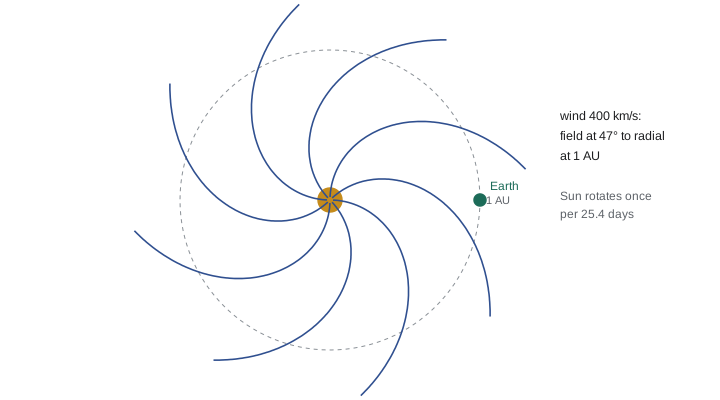
For a 400 km/s wind at 1 AU, \(\psi \approx 47°\), as the program finds and as spacecraft measure. Fast wind makes a more open spiral, slow wind a tighter one. The spiral has practical consequences: energetic particles accelerated in a flare travel along field lines, so flares on the western half of the Sun as seen from the Earth, which are magnetically connected to us along the spiral, are much more likely to send solar energetic particles to the Earth within tens of minutes than flares on the eastern half.
The interplanetary magnetic field and why its direction matters
Near the Earth the interplanetary magnetic field is about 5 nT, roughly a ten-thousandth of the Earth's surface field. Its direction is what matters most for space weather. The component along the Earth's rotation axis, called \(B_z\) in the geocentric solar magnetospheric coordinates used by space physicists, controls how efficiently the solar wind transfers energy into the magnetosphere. When \(B_z\) points south, opposite to the Earth's field at the dayside magnetopause, the two fields can reconnect, opening the magnetosphere to the solar wind, as lesson 11 explains. A coronal mass ejection often carries a magnetic cloud in which the field rotates smoothly over a day; if it holds a strong southward field for many hours, the result is an intense storm. The strongest storms combine high speed, high density and a strong, sustained southward field.
Travel times and warning
The slow wind takes four to five days to reach the Earth; fast streams take about two and a half days. A coronal mass ejection at 1000 km/s arrives in about 42 hours, and the fastest ones, at more than 2000 km/s, in under a day. The Carrington storm of 1859 began about 17.6 hours after the flare, implying an average speed of about 2400 km/s. Coronagraphs on the SOHO spacecraft, launched in 1995, and on the newer GOES-19 weather satellite, which carries the first operational coronagraph, image ejections as they leave the Sun, giving one to three days of warning of their arrival, though not of their magnetic orientation. That is measured only when the ejection passes spacecraft at the Lagrange point L1, 1.5 million km upstream, giving 15 to 60 minutes' notice, as lesson 12 calculates.
Worked problem
When will the storm arrive?
A coronagraph shows an Earth-directed ejection leaving the Sun at 1400 km/s. Ignoring deceleration, when does it arrive? In reality fast ejections slow down by drag against the slower ambient wind. If its average speed over the trip is 1100 km/s, how much later does it arrive?
Show solution
- Constant speed: \(t = 1.496\times10^{11}/1.4\times10^6 = 1.07\times10^5\) s, about 29.7 hours.
- Average 1100 km/s: \(t = 1.496\times10^{11}/1.1\times10^6 = 1.36\times10^5\) s, about 37.8 hours.
- The difference is about 8 hours.
- This is why forecasters model the ejection's deceleration; arrival-time errors of about 10 hours are typical even with modern models.
Answer: About 30 hours at constant speed, about 38 hours with realistic slowing.
Common mistakes
MistakeThinking the solar wind is blown off by radiation pressure.
InsteadIt is a thermal outflow of the hot corona; sunlight's pressure on the plasma is negligible.
MistakeAssuming the wind starts fast and slows down.
InsteadIt accelerates through the sonic point near a few solar radii and keeps speeding up slowly.
MistakeExpecting the interplanetary field to point radially away from the Sun.
InsteadThe Sun's rotation winds it into a spiral at about 45° at the Earth.
MistakeTreating every large flare as a storm warning.
InsteadStorms come from Earth-directed ejections with southward magnetic fields; many flares produce no storm.
MistakeSaying sunspots are cool and therefore make the Sun dimmer overall.
InsteadBright faculae around active regions more than compensate; the Sun is about 0.1 % brighter at solar maximum.
Summary and key terms
- The photosphere radiates at 5772 K; the corona above it is heated to more than \(10^6\) K by magnetic processes still under study.
- Solar activity follows an 11-year cycle; cycle 25 peaked in October 2024 with a smoothed sunspot number near 161.
- Parker showed a hot corona must expand; the transonic wind passes the sound speed at \(r_c = GM_\odot/2c_s^2\) and reaches about 400 to 500 km/s at the Earth.
- The frozen-in field forms the Parker spiral, about 47° from radial at 1 AU for a 400 km/s wind.
- Coronal mass ejections travel to the Earth in one to four days; their magnetic orientation is known only about an hour ahead.
- corona
- The Sun's outer atmosphere, hotter than a million kelvin and very tenuous.
- solar wind
- The supersonic outflow of coronal plasma, about 400 km/s slow wind and 750 km/s fast wind at the Earth.
- Parker spiral
- The Archimedean spiral of the interplanetary magnetic field produced by solar rotation and radial outflow.
- coronal mass ejection
- An eruption of magnetized plasma from the corona into interplanetary space.
- coronal hole
- A region of open magnetic field, dark in X-rays, that is the source of fast solar wind.
- solar cycle
- The roughly 11-year variation in solar magnetic activity and sunspot number.
Practice problems
Work each problem on paper first, then reveal the answer to check.
Find the critical radius for a corona at \(1.5\times10^6\) K.
Show answer
\(c_s = 128\sqrt{1.5} = 157\) km/s; \(r_c = 1.33\times10^{20}/(2\times2.46\times10^{10}) = 2.7\times10^9\) m, about 3.9 solar radii.
What is the spiral angle at Mars (1.52 AU) for a 400 km/s wind?
Show answer
\(\tan\psi = 1.52\times1.07 = 1.63\), \(\psi \approx 58°\).
Estimate the solar wind density at Jupiter (5.2 AU) if it is 5 per cm\(^3\) at 1 AU.
Show answer
\(5/5.2^2 \approx 0.18\) per cm\(^3\).
How much mass does the Sun lose over 4.6 billion years at \(10^9\) kg/s?
Show answer
\(10^9\times1.45\times10^{17} \approx 1.5\times10^{26}\) kg, under 0.01 % of its mass.
Why are western-hemisphere flares more likely to send particles to the Earth?
Show answer
The Parker spiral connects the Earth magnetically to the Sun's western hemisphere, and particles travel along field lines.
A fast stream at 750 km/s follows slow wind at 350 km/s from a source 30° of solar longitude behind it. Roughly where do they meet?
Show answer
Within about 1 AU: in about 2.3 days the Sun rotates 30°; the fast wind gains on the slow, forming a compression region near the Earth's orbit.
Lesson quiz · 5 questions
Score 60% or more to complete this lesson.
Create a free account to save your progress, take quizzes and earn a certificate.