
PHYS-481 · Lesson 6 of 12 · 22 min
Climate physics: energy balance, feedbacks and sensitivity
How much will the Earth warm if the carbon dioxide in the air doubles? This number, the equilibrium climate sensitivity, is the single most important quantity in climate physics, and estimating it is a problem in the physics of energy balance. Lesson 5 explained how greenhouse gases raise the effective emission height. This lesson turns that idea into a quantitative framework: the global energy budget, radiative forcing, the Planck response, the feedbacks from water vapor, the lapse rate, snow and ice, and clouds, and the time the climate takes to respond because of the heat capacity of the oceans. The numbers in this lesson come from current measurements and from the assessments of the Intergovernmental Panel on Climate Change, and every calculation is a few lines of Python.
The global energy budget
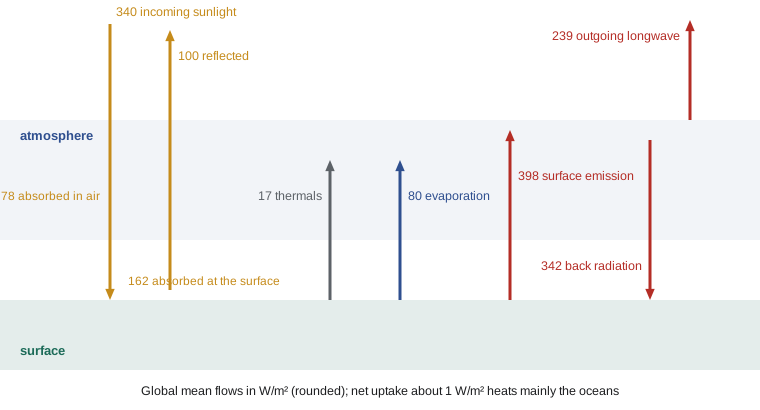
Averaged over the globe and the year, the top of the atmosphere receives about 340 W/m\(^2\) of sunlight, one quarter of the solar constant of 1361 W/m\(^2\), because the Earth intercepts sunlight over its cross-section \(\pi R^2\) but spreads it over its surface \(4\pi R^2\). About 100 W/m\(^2\) is reflected by clouds, aerosols and the surface, giving a planetary albedo of about 0.29. The remaining 240 W/m\(^2\) is absorbed, about a third in the atmosphere and two thirds at the surface. To balance it, the planet emits about 239 W/m\(^2\) of infrared to space. The surface, at 288 K, emits about 398 W/m\(^2\), far more than the planet as a whole, and it can do so because the atmosphere sends about 342 W/m\(^2\) of infrared back down. The surface also loses about 80 W/m\(^2\) through evaporation and 17 W/m\(^2\) through rising warm air. These values, from Trenberth, Fasullo and colleagues and the satellite energy budget measured by NASA's CERES instruments, are uncertain by a few watts per square meter in the individual surface terms, but the top-of-atmosphere net flux is measured more precisely through changes in ocean heat content.
That net flux is not zero. The Earth currently absorbs about 1 W/m\(^2\) more than it emits, averaged over the 2010s and increasing since. More than 90 % of this excess goes into the oceans, which have been warming measurably down to 2000 m since the Argo network of profiling floats began full coverage in the mid-2000s. The imbalance is the most direct evidence that the climate is not in equilibrium: it is still catching up with the greenhouse gases already added.
Radiative forcing
A radiative forcing \(F\) is a change in the net downward flux at the top of the atmosphere caused by an external change, measured before the surface temperature has responded. For carbon dioxide the forcing grows logarithmically with concentration, because the absorption is spread over the wings of the band, which widen slowly. A widely used fit, from Myhre and colleagues in 1998, is
with \(C_0 = 280\) ppm the pre-industrial concentration. Doubling gives \(F_{2\times} = 5.35\ln 2 = 3.7\) W/m\(^2\); the 2021 assessment, with improved line-by-line calculations including stratospheric adjustment, gives 3.9 W/m\(^2\). The logarithm means each doubling has the same effect: going from 280 to 560 ppm matters as much as going from 560 to 1120 ppm. Methane, nitrous oxide and halocarbons add further forcing; aerosols from pollution subtract some by reflecting sunlight and brightening clouds.
The concentration is measured precisely. At Mauna Loa, where Keeling's record began in 1958 at about 315 ppm, the monthly mean reached a record 431.1 ppm in April 2026 according to NOAA, and the growth rate in recent years has been about 2.5 ppm per year. The concentration oscillates each year by about 6 ppm at Mauna Loa, falling in the northern summer as forests take up carbon and rising in winter; at northern stations such as Alert, Nunavut, the swing is larger.
The Planck response
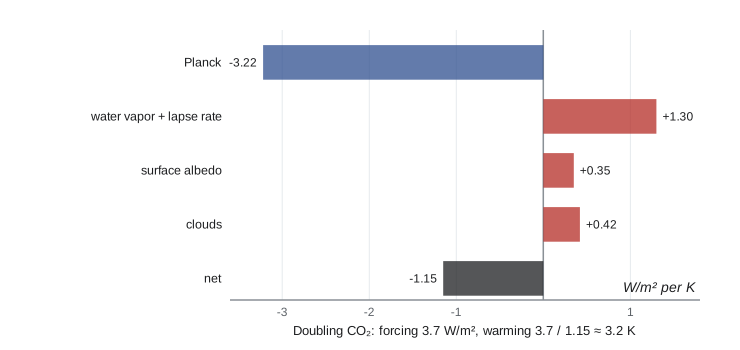
If nothing changed but the temperature, a warmer planet would radiate more and restore balance. Differentiating \(\sigma T_e^4\) gives the blackbody estimate of this Planck response, \(\lambda_P = 4\sigma T_e^3 \approx 3.8\) W m\(^{-2}\) K\(^{-1}\). The real atmosphere radiates from a range of levels at different temperatures, and the assessed value is about 3.2 W m\(^{-2}\) K\(^{-1}\). With the Planck response alone, doubled carbon dioxide would warm the planet by \(F_{2\times}/\lambda_P = 3.7/3.22 \approx 1.15\) K. This is a robust floor.
Feedbacks
Feedbacks change the energy balance in proportion to the warming. Writing the net flux imbalance as \(N = F + \lambda T\), with \(\lambda\) the sum of the Planck response, which is negative because it restores balance, and the feedback parameters, the equilibrium warming is \(\Delta T = -F/\lambda\). The main feedbacks are:
Water vapor. Warmer air holds more water vapor, about 7 % more per kelvin by Clausius–Clapeyron, and relative humidity is observed and modeled to stay roughly constant. Water vapor is a strong greenhouse gas, so the warming is amplified. The water vapor feedback is the largest positive feedback, about +1.8 W m\(^{-2}\) K\(^{-1}\).
Lapse rate. In the tropics, warming follows the moist adiabat, which warms the upper troposphere more than the surface. The planet then radiates more effectively from aloft, a negative feedback of about \(-0.5\) W m\(^{-2}\) K\(^{-1}\). Because both depend on moist thermodynamics, the water vapor and lapse rate feedbacks are usually combined, giving about +1.3 W m\(^{-2}\) K\(^{-1}\) with small uncertainty.
Surface albedo. Warming melts snow and sea ice, exposing darker ground and ocean that absorb more sunlight, a positive feedback of about +0.35 W m\(^{-2}\) K\(^{-1}\). It is concentrated at high latitudes and is one reason the Arctic, including Canada's North, has warmed two to four times faster than the global average.
Clouds. Changes in cloud amount, height and brightness can push either way. The 2021 assessment concluded that the net cloud feedback is positive, about +0.42 W m\(^{-2}\) K\(^{-1}\), mainly because high clouds rise as the troposphere deepens, keeping their tops cold, and because low clouds over the subtropical oceans thin. Clouds remain the largest source of uncertainty.
The program below computes the forcing for several concentrations, adds up the feedbacks, finds the equilibrium sensitivity and its dependence on the cloud feedback, and integrates a one-box model of the ocean mixed layer to show how long the response takes.
import math
sigma = 5.670374419e-8; Te = 255.0
C0 = 280.0
def forcing(C): return 5.35 * math.log(C / C0)
for C in (315.0, 370.0, 420.0, 431.0, 560.0):
    print(f"CO2 {C:5.0f} ppm: forcing {forcing(C):5.2f} W/m^2")
F2x = forcing(560.0)

# Feedback parameters (W/m^2 per K); negative values restore, positive amplify
print(f"blackbody estimate of the Planck response -4 sigma Te^3 = {-4 * sigma * Te**3:.2f}")
planck_fb = -3.22       # assessed value, including the real vertical structure
feedbacks = {"Planck": planck_fb, "water vapor plus lapse rate": 1.30, "surface albedo": 0.35,
             "clouds": 0.42}
total = sum(feedbacks.values())
for name, val in feedbacks.items():
    print(f"  {name:28s} {val:+.2f}")
print(f"  {'net feedback':28s} {total:+.2f}")
print(f"no-feedback warming for doubled CO2: {F2x / -planck_fb:.2f} K")
ECS = F2x / -total
print(f"equilibrium climate sensitivity with feedbacks: {ECS:.2f} K")
print(f"gain over the Planck-only response: {ECS / (F2x / -planck_fb):.2f}")

# Uncertainty: vary the cloud feedback over a range
for cl in (0.0, 0.42, 0.8):
    lam = planck_fb + 1.30 + 0.35 + cl
    print(f"cloud feedback {cl:+.2f}: sensitivity {F2x / -lam:.2f} K")

# Time response: one-box model C dT/dt = F - lambda T with a 100 m ocean mixed layer
rho_w, c_w, depth = 1025.0, 3990.0, 100.0
Cbox = rho_w * c_w * depth * 0.7          # 70 of every 100 m^2 of the surface are ocean
lam = -total
tau = Cbox / lam
print(f"heat capacity {Cbox:.3e} J/m^2/K, response time C/lambda = {tau / 3.156e7:.1f} years")
T, dt, yr = 0.0, 0.05, 3.156e7
F = F2x
for step in range(int(40 / dt) + 1):
    t = step * dt
    if abs(t - round(t)) < 1e-9 and int(round(t)) in (1, 5, 10, 20, 40):
        print(f"  year {int(round(t)):2d} after a sudden doubling: {T:.2f} K (equilibrium {F / lam:.2f} K)")
    T += dt * yr * (F - lam * T) / Cbox
# Present-day CO2 alone at equilibrium
print(f"equilibrium warming for 431 ppm CO2 alone: {forcing(431.0) / lam:.2f} K")CO2 315 ppm: forcing 0.63 W/m^2 CO2 370 ppm: forcing 1.49 W/m^2 CO2 420 ppm: forcing 2.17 W/m^2 CO2 431 ppm: forcing 2.31 W/m^2 CO2 560 ppm: forcing 3.71 W/m^2 blackbody estimate of the Planck response -4 sigma Te^3 = -3.76 Planck -3.22 water vapor plus lapse rate +1.30 surface albedo +0.35 clouds +0.42 net feedback -1.15 no-feedback warming for doubled CO2: 1.15 K equilibrium climate sensitivity with feedbacks: 3.22 K gain over the Planck-only response: 2.80 cloud feedback +0.00: sensitivity 2.36 K cloud feedback +0.42: sensitivity 3.22 K cloud feedback +0.80: sensitivity 4.82 K heat capacity 2.863e+08 J/m^2/K, response time C/lambda = 7.9 years year 1 after a sudden doubling: 0.39 K (equilibrium 3.22 K) year 5 after a sudden doubling: 1.52 K (equilibrium 3.22 K) year 10 after a sudden doubling: 2.32 K (equilibrium 3.22 K) year 20 after a sudden doubling: 2.97 K (equilibrium 3.22 K) year 40 after a sudden doubling: 3.20 K (equilibrium 3.22 K) equilibrium warming for 431 ppm CO2 alone: 2.01 K
With these values, doubled carbon dioxide gives an equilibrium warming of about 3.2 K, an amplification of 2.8 over the Planck-only response. The 2021 assessment gave a best estimate of 3 K with a likely range of 2.5 to 4 K and a very likely range of 2 to 5 K, combining process understanding, the observed warming and evidence from past climates such as the last glacial maximum. The program shows why the upper end is hard to rule out: the sensitivity is \(-F/\lambda\), and as the feedbacks bring \(\lambda\) closer to zero, small changes in the cloud feedback make large changes in the warming. Raising the cloud feedback from 0.42 to 0.80 W m\(^{-2}\) K\(^{-1}\) increases the sensitivity from 3.2 to 4.8 K, while removing it lowers the sensitivity only to 2.4 K. The distribution of possible sensitivities therefore has a long tail toward high values.
Time scales
The climate does not respond instantly. In the one-box model, \(C\,dT/dt = F + \lambda T\), the temperature relaxes toward equilibrium with time constant \(\tau = C/|\lambda|\). A 100 m ocean mixed layer covering 70 % of the surface has a heat capacity of about \(2.9\times10^8\) J m\(^{-2}\) K\(^{-1}\), giving \(\tau \approx 8\) years. But the deep ocean, with fifty times the heat capacity, slowly takes up heat and delays the final approach to equilibrium by centuries. For this reason climate scientists also use the transient climate response, the warming at the time of doubling when carbon dioxide rises by 1 % per year; its assessed best estimate is 1.8 K, about 60 % of the equilibrium value.
The carbon dioxide forcing alone, at 431 ppm, would eventually give about 2.0 K of warming. The observed warming is less, about 1.3 to 1.4 K above the 1850 to 1900 average for the mid-2020s, because the deep ocean has not caught up and because aerosol cooling offsets part of the forcing from all greenhouse gases. The World Meteorological Organization confirmed 2024 as the warmest year on record, about 1.55 °C above the pre-industrial level, boosted by a strong El Niño, and 2025 ranked as the second or third warmest. A single year above 1.5 °C does not mean the Paris Agreement threshold has been passed, since that refers to a 20-year average, but the long-term trend is approaching it.
Evidence from the past
Climate sensitivity can also be estimated from past climates. During the last glacial maximum, about 20 000 years ago, carbon dioxide was about 190 ppm, ice sheets more than 3 km thick covered most of Canada and the northern United States, and the global mean temperature was about 5 to 7 K lower than pre-industrial. Dividing the temperature change by the total forcing from carbon dioxide, ice sheets, dust and vegetation gives sensitivities consistent with the modern estimate. The Laurentide Ice Sheet's retreat also shaped the landscape of the Prairies and the Great Lakes, and the vast glacial Lake Agassiz, whose bed underlies Winnipeg and the Red River valley, drained as it melted.
Worked problem
Equilibrium warming from current carbon dioxide
Using the forcing formula and the feedback parameter \(\lambda = -1.15\) W m\(^{-2}\) K\(^{-1}\), find the eventual warming if carbon dioxide stayed at 431 ppm and nothing else changed.
Show solution
- Forcing: \(F = 5.35\ln(431/280) = 5.35\times0.4313 = 2.31\) W/m\(^2\).
- Equilibrium warming: \(\Delta T = F/1.15 = 2.0\) K.
- With a mixed-layer time constant of about 8 years, most of this would appear within a few decades, but the deep ocean would add the last part slowly.
Answer: About 2.0 K above pre-industrial, from carbon dioxide alone.
Common mistakes
MistakeTreating radiative forcing as proportional to concentration.
InsteadCarbon dioxide forcing grows with the logarithm of concentration.
MistakeCounting water vapor as a forcing.
InsteadIts amount is set by temperature, so it acts as a feedback, not an independent driver.
MistakeExpecting the planet to reach equilibrium immediately.
InsteadThe ocean's heat capacity delays the response by years to centuries.
MistakeReading a single year above 1.5 °C as crossing the Paris threshold.
InsteadThat threshold refers to a multi-decade average.
MistakeAssuming large uncertainty means a symmetric range.
InsteadBecause sensitivity is \(-F/\lambda\), uncertainty in feedbacks gives a long tail toward high values.
Summary and key terms
- Of 340 W/m\(^2\) of incoming sunlight, about 240 is absorbed; the Earth currently absorbs about 1 W/m\(^2\) more than it emits.
- Carbon dioxide forcing is about \(5.35\ln(C/C_0)\) W/m\(^2\), 3.7 to 3.9 W/m\(^2\) per doubling; the concentration reached 431 ppm in April 2026.
- The Planck response alone gives about 1.2 K per doubling; water vapor, albedo and cloud feedbacks amplify it to about 3 K.
- Equilibrium climate sensitivity is likely 2.5 to 4 K, with clouds the largest uncertainty.
- Ocean heat capacity delays the response; 2024 was the warmest year on record at about 1.55 °C above pre-industrial.
- radiative forcing
- A change in the net downward flux at the top of the atmosphere caused by an external change, before the surface responds.
- feedback parameter
- The change in net flux per kelvin of surface warming due to a given process.
- equilibrium climate sensitivity
- The eventual global warming for a doubling of carbon dioxide.
- transient climate response
- The warming at the time of doubling when carbon dioxide rises 1 % per year.
- Planck response
- The increase in outgoing radiation with temperature, about -3.2 W m^-2 K^-1.
- energy imbalance
- The difference between absorbed sunlight and emitted infrared at the top of the atmosphere.
Practice problems
Work each problem on paper first, then reveal the answer to check.
What forcing corresponds to 350 ppm?
Show answer
\(5.35\ln(350/280) = 1.19\) W/m\(^2\).
If the net feedback were \(-2.0\) W m\(^{-2}\) K\(^{-1}\), what would the sensitivity be?
Show answer
\(3.71/2.0 \approx 1.9\) K.
Why does the water vapor feedback scale with the Clausius–Clapeyron rate?
Show answer
At roughly constant relative humidity, vapor content follows the saturation vapor pressure, which rises about 7 % per kelvin.
Compute the mixed-layer time constant for a 50 m layer with \(\lambda = -1.15\).
Show answer
\(C = 1025\times3990\times50\times0.7 = 1.43\times10^8\); \(\tau = C/1.15 \approx 1.25\times10^8\) s, about 4 years.
Why is the albedo feedback strongest in the Arctic?
Show answer
Snow and sea ice are present there, and their loss replaces a bright surface with dark ground or ocean.
An energy imbalance of 1 W/m\(^2\) persists for 10 years. If it all went into the top 2000 m of ocean, how much would that layer warm?
Show answer
Energy: \(1\times3.156\times10^8\) J/m\(^2\) of Earth surface; ocean column heat capacity \(1025\times3990\times2000\times0.7 \approx 5.7\times10^9\) J m\(^{-2}\) K\(^{-1}\); warming about 0.055 K.
Lesson quiz · 5 questions
Score 60% or more to complete this lesson.
Create a free account to save your progress, take quizzes and earn a certificate.