
PHYS-420 · Lesson 9 of 12 · 22 min
Detectors and accelerators
▶ Video coming soon A video version of this lesson is on the way.
Every result in nuclear and particle physics depends on two kinds of machine: accelerators, which give particles the energy to probe small distances or create new particles, and detectors, which record what happens. This lesson explains how charged particles and photons lose energy in matter, which is the basis of all detection; surveys the main detector types and what each measures; and develops the physics of the cyclotron, the synchrotron and the collider, with examples from TRIUMF, Fermilab and CERN.
How charged particles lose energy
A fast charged particle passing through matter loses energy mainly by ionizing and exciting atoms. Each collision with an electron takes a little energy, and the particle slows gradually along a nearly straight path. The mean energy loss per unit path, the stopping power, is given by the Bethe formula (1930):
where \(z\) is the particle's charge number, \(\beta = v/c\), \(Z/A\) and \(\rho\) describe the material, and \(I\) is its mean excitation energy, about \(10Z\) eV. The \(1/\beta^2\) factor dominates: slow particles lose energy fastest. As a particle slows, its rate of loss rises sharply near the end of its range, giving the Bragg peak that proton therapy uses. At \(\beta\gamma \approx 3\) the loss reaches a broad minimum, about 2 MeV per g/cm² in most materials; particles near this minimum are called minimum-ionizing, which describes most cosmic-ray muons and most particles in collider detectors. Because \(dE/dx\) depends on \(\beta\), measuring it together with momentum identifies the particle's mass.
Electrons are different. Being light, they are deflected strongly and, above a critical energy (tens of MeV in most materials), they lose energy mainly by bremsstrahlung, radiating photons as they are deflected by nuclei. High-energy photons in turn create electron-positron pairs. The two processes alternate, building an electromagnetic shower whose depth grows only logarithmically with energy, in units of the material's radiation length (0.56 cm in lead, 36 cm in water).
How photons interact
Photons do not lose energy gradually; they are absorbed or scattered in single events. Three processes dominate, depending on energy. The photoelectric effect, in which the photon is absorbed and an atomic electron ejected, dominates below a few hundred keV and grows rapidly with \(Z\). Compton scattering from electrons dominates around 1 MeV. Pair production, \(\gamma \to e^+e^-\) in the field of a nucleus, needs at least \(2m_ec^2 = 1.022\) MeV and dominates above about 10 MeV. A beam of photons is attenuated exponentially, \(I = I_0e^{-\mu x}\), which is why gamma shielding uses dense, high-\(Z\) materials such as lead.
Gas, scintillation and semiconductor detectors
Gas detectors collect the ionization a particle leaves in a gas. In an ionization chamber the charge is collected without amplification; in a proportional counter, a high field near a thin wire multiplies it by a fixed factor, giving a signal proportional to the energy deposited; in a Geiger–Müller tube, the multiplication saturates into a full discharge, giving a large signal for any particle but no energy information. Georges Charpak's multiwire proportional chamber of 1968, with hundreds of wires each acting as its own counter, made electronic tracking possible and won the 1992 Nobel Prize. Modern time projection chambers record the ionization along a track in three dimensions.
Scintillators emit a flash of light when a particle deposits energy; the light is converted to an electrical pulse by a photomultiplier tube or a silicon photomultiplier. Inorganic crystals such as sodium iodide doped with thallium, or bismuth germanate in PET scanners, are dense and bright, good for gamma rays. Plastic scintillators are fast, cheap and easily shaped, good for timing and triggering. The resolution of a scintillator is limited by photoelectron statistics: with \(N\) photoelectrons, the relative standard deviation is about \(1/\sqrt N\). The program finds a full width at half maximum of about 3 parts in 100 at 662 keV for a good sodium iodide crystal.
Semiconductor detectors collect the electron-hole pairs created in a reverse-biased diode. Because creating a pair in germanium takes only 2.9 eV, against about 30 eV per ion pair in a gas and more than 100 eV per photoelectron in a scintillator, many more charge carriers are produced and the resolution is far better: about 2 keV at 1.33 MeV for high-purity germanium, the standard for gamma-ray spectroscopy. Silicon strip and pixel detectors, with features of tens of micrometers, track charged particles near the collision point in collider experiments and locate the decays of short-lived particles such as those containing bottom quarks.
Cherenkov detectors and calorimeters
A charged particle moving faster than light does in a medium, \(v > c/n\), emits Cherenkov radiation, the optical analog of a sonic boom, discovered by Pavel Cherenkov in 1934. The light is emitted on a cone of half-angle \(\cos\theta = 1/(n\beta)\). The threshold \(\beta > 1/n\) depends on mass, which makes Cherenkov detectors useful for identifying particles. The program computes thresholds in water: 0.26 MeV kinetic energy for an electron but 55 MeV for a muon and 485 MeV for a proton, and a maximum angle of 41°. Super-Kamiokande in Japan, a 50,000-metric ton tank of water lined with 11,000 photomultipliers, sees the rings of Cherenkov light from neutrino interactions; a sharp ring means a muon, a fuzzy one an electron shower. The blue glow in the water of a research reactor pool is Cherenkov light from fast electrons.
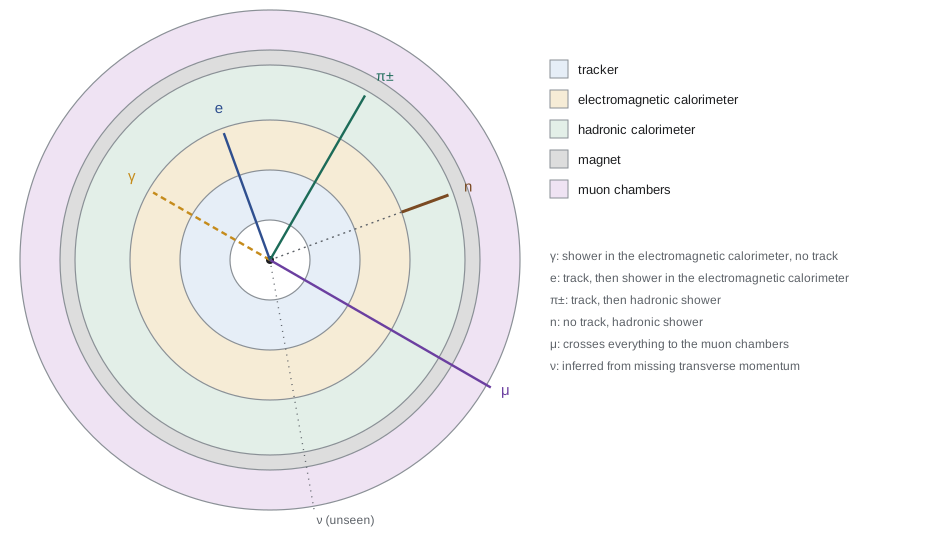
Calorimeters measure energy by stopping a particle completely and measuring all the energy it deposits. Electromagnetic calorimeters contain the showers of electrons and photons; hadronic calorimeters, much deeper, absorb the showers of strongly interacting particles. Unlike tracking, whose momentum resolution worsens at high momentum, a calorimeter's relative resolution improves as \(1/\sqrt E\), because the number of shower particles grows with energy. A modern collider detector such as ATLAS or CMS at CERN wraps these layers around the collision point like an onion: silicon trackers in a magnetic field innermost, then electromagnetic and hadronic calorimeters, then muon chambers outside everything, since only muons and neutrinos penetrate that far.
The cyclotron
Ernest Lawrence's cyclotron (1931) accelerates ions in a spiral. In a uniform magnetic field \(B\), a particle of charge \(q\) and mass \(m\) circles with angular frequency \(\omega = qB/m\), independent of its speed, as long as it is non-relativistic. Two hollow D-shaped electrodes with an alternating voltage at this frequency give the particle a kick each half turn; it gains energy, moves to a larger orbit, but stays in step. The orbit radius at momentum \(p\) is \(r = p/qB\). The program finds a cyclotron frequency of 7 MHz for protons in a 0.46 T field. At relativistic energies the frequency falls as \(1/\gamma\), so high-energy cyclotrons shape the field to rise with radius, keeping the orbit time constant: the isochronous cyclotron.
TRIUMF's main cyclotron in Vancouver, completed in 1974, is the largest cyclotron in the world, 18 m across. It accelerates negative hydrogen ions, which are extracted by passing them through a thin foil that strips both electrons and reverses their curvature, so beams of different energies, up to 520 MeV, can be taken out at different radii simultaneously. The program checks the size: 520 MeV protons have momentum 1,116 MeV/c and orbit at about 8 m in a field of a few tenths of a tesla. Small medical cyclotrons, a meter or two across, produce fluorine-18 and other isotopes in hospitals worldwide.
Synchrotrons and colliders
To reach higher energies, a synchrotron keeps particles on a ring of fixed radius by raising the magnetic field in step with their momentum, using radio-frequency cavities to accelerate them each turn. For a particle of unit charge,
so the energy is limited by the ring size and the strength of the bending magnets. The Large Hadron Collider at CERN, in a 27 km tunnel, uses superconducting niobium-titanium dipoles at 8.33 T, cooled to 1.9 K, to hold protons of 7 TeV, as the program confirms. Electrons are limited differently: a charge on a circle radiates synchrotron radiation, with power proportional to \(\gamma^4/\rho^2\), which is enormous for light particles. That radiation is the product of light sources such as the Advanced Photon Source near Chicago, studied in PHYS-382.
What matters for creating new particles is the energy available in the center-of-mass frame, \(\sqrt s\). For a beam of energy \(E\) on a fixed target of mass \(m\), \(\sqrt s \approx \sqrt{2Emc^2}\), which grows only as the square root of the beam energy. Two beams of energy \(E\) colliding head on give \(\sqrt s = 2E\). This is why the highest-energy machines are colliders: the LHC's 13.6 TeV collisions would need a fixed-target beam of about \(10^{8}\) TeV to match. The price is a low collision rate, since beams are far less dense than solid targets, so colliders squeeze bunches to micrometer sizes and measure their performance by luminosity, the rate per unit cross-section.
# Detectors and accelerators: Cherenkov light, photon statistics and the cyclotron and synchrotron conditions
import math
me, mmu, mpi, mp = 0.51100, 105.658, 139.570, 938.272   # MeV
print("Cherenkov threshold kinetic energy and maximum angle in water (n = 1.33)")
n = 1.33
for name, m in (("electron", me), ("muon", mmu), ("pion", mpi), ("proton", mp)):
    gamma = 1 / math.sqrt(1 - 1 / n ** 2)
    print(f"  {name:8s} threshold T = {(gamma - 1) * m:8.2f} MeV")
print(f"  angle for beta -> 1: {math.degrees(math.acos(1 / n)):.1f} degrees")
print()
print("scintillator energy resolution limited by photoelectron statistics (sigma/E = 1/sqrt(N))")
for E_keV, yield_per_keV in ((662, 8.0), (1332, 8.0), (662, 1.0)):
    N = E_keV * yield_per_keV
    print(f"  {E_keV:5d} keV, {yield_per_keV:.0f} photoelectrons per keV: FWHM {2.355 / math.sqrt(N) * 100:.1f} parts per 100")
print()
# cyclotron: f = q B / (2 pi m) for a non-relativistic ion; H- ions extracted at 520 MeV need an isochronous field
q, mpkg = 1.602e-19, 1.6726e-27
for B in (0.3, 0.46, 1.5):
    print(f"  proton cyclotron frequency at B = {B:.2f} T: {q * B / (2 * math.pi * mpkg) / 1e6:6.2f} MHz")
T = 520.0
p = math.sqrt((T + mp) ** 2 - mp ** 2)            # MeV/c
for B in (0.46, 0.56):
    print(f"  520 MeV protons (p = {p:.0f} MeV/c) in B = {B} T orbit at radius {p / (299.79 * B):.2f} m")
print()
# synchrotron: p [GeV/c] = 0.2998 B [T] rho [m]
for name, B, rho in (("LHC dipoles", 8.33, 2804.0), ("Tevatron", 4.2, 754.0)):
print(f" {name:12s} B = {B} T, bending radius {rho:.0f} m -> p = {0.2998 * B * rho / 1000:.2f} TeV/c")Cherenkov threshold kinetic energy and maximum angle in water (n = 1.33)
electron threshold T = 0.26 MeV
muon threshold T = 54.60 MeV
pion threshold T = 72.12 MeV
proton threshold T = 484.86 MeV
angle for beta -> 1: 41.2 degrees
scintillator energy resolution limited by photoelectron statistics (sigma/E = 1/sqrt(N))
662 keV, 8 photoelectrons per keV: FWHM 3.2 parts per 100
1332 keV, 8 photoelectrons per keV: FWHM 2.3 parts per 100
662 keV, 1 photoelectrons per keV: FWHM 9.2 parts per 100
proton cyclotron frequency at B = 0.30 T: 4.57 MHz
proton cyclotron frequency at B = 0.46 T: 7.01 MHz
proton cyclotron frequency at B = 1.50 T: 22.87 MHz
520 MeV protons (p = 1116 MeV/c) in B = 0.46 T orbit at radius 8.10 m
520 MeV protons (p = 1116 MeV/c) in B = 0.56 T orbit at radius 6.65 m
LHC dipoles B = 8.33 T, bending radius 2804 m -> p = 7.00 TeV/c
Tevatron B = 4.2 T, bending radius 754 m -> p = 0.95 TeV/cLinear accelerators and large facilities
Linear accelerators avoid synchrotron radiation by accelerating particles in a straight line through a series of radio-frequency cavities. The two-mile linac at SLAC accelerated the electrons of the 1968 deep inelastic scattering experiments that revealed quarks. Linacs also drive spallation neutron sources and free-electron lasers, and compact electron linacs of a few MeV deliver most radiation therapy in hospitals. In the United States, the Electron-Ion Collider is being built at Brookhaven National Laboratory, reusing the tunnel and ion rings of the Relativistic Heavy Ion Collider, which ended its 25-year run in February 2026; it will collide polarized electrons with protons and ions to map how quarks and gluons make up nucleon spin and mass. The collider is expected to begin experiments in the 2030s.
Worked problem
Why build a collider?
Compare the center-of-mass energy available from a 7 TeV proton beam striking a stationary proton with that from two 7 TeV beams colliding head on.
Show solution
- Fixed target: \(s = 2m_p^2c^4 + 2E m_pc^2 \approx 2 \times 7000 \times 0.938\ \text{GeV}^2 = 1.31 \times 10^{4}\ \text{GeV}^2\).
- So \(\sqrt s = 115\) GeV.
- Collider: \(\sqrt s = 2 \times 7\) TeV = 14 TeV.
- The collider gives 120 times more energy for creating new particles.
Answer: 115 GeV on a fixed target against 14 TeV in a collider. Beam on target wastes most of its energy in moving the products forward.
Common mistakes
MistakeAssuming the cyclotron frequency stays fixed at all energies.
InsteadIt falls as \(1/\gamma\); high-energy cyclotrons need a field that rises with radius.
MistakeExpecting energy loss to be greatest for the fastest particles.
InsteadBethe's formula has \(1/\beta^2\): slow particles lose energy fastest, giving the Bragg peak.
MistakeThinking Cherenkov light means a particle exceeds \(c\).
InsteadIt exceeds \(c/n\), the speed of light in the medium, never \(c\) itself.
MistakeExpecting calorimeter resolution to worsen at high energy like tracking.
InsteadCalorimeter resolution improves as \(1/\sqrt E\) because showers contain more particles.
MistakeComparing accelerator energies by beam energy alone.
InsteadWhat matters for new particles is \(\sqrt s\); fixed-target \(\sqrt s\) grows only as \(\sqrt E\).
Summary and key terms
- Charged particles lose energy by ionization (Bethe formula, \(\propto 1/\beta^2\)); electrons and photons above tens of MeV form showers.
- Photons interact by the photoelectric effect, Compton scattering and pair production, depending on energy.
- Gas, scintillation and semiconductor detectors collect ionization or light; germanium gives keV energy resolution; Cherenkov light identifies particles by velocity.
- Cyclotrons use \(\omega = qB/m\); TRIUMF's 520 MeV cyclotron is the world's largest.
- Synchrotrons use \(p = 0.3B\rho\); colliders give \(\sqrt s = 2E\) instead of \(\sqrt{2Emc^2}\).
- Stopping power
- Energy lost per unit path length, \(-dE/dx\).
- Minimum-ionizing particle
- Particle near the broad minimum of \(dE/dx\), at \(\beta\gamma \approx 3\).
- Cherenkov radiation
- Light emitted when a charged particle moves faster than light in the medium.
- Calorimeter
- Detector that measures energy by absorbing a particle's shower.
- Luminosity
- Collision rate per unit cross-section in a collider.
Practice problems
Work each problem on paper first, then reveal the answer to check.
At what kinetic energy does an electron start to emit Cherenkov light in water?
Show answer
0.26 MeV, as the program shows.
What is the cyclotron frequency of deuterons in a 1.5 T field?
Show answer
About half the proton value: 11.4 MHz.
A ring has 2 T magnets and a 100 m bending radius. What proton momentum can it hold?
Show answer
\(0.2998 \times 2 \times 100 = 60\) GeV/c.
Why do germanium detectors resolve gamma lines better than sodium iodide?
Show answer
Each pair costs only 2.9 eV, so many more carriers are produced and statistical fluctuations are smaller.
Which particles reach the outer muon chambers of a collider detector?
Show answer
Muons (and neutrinos, which leave no signal).
Find \(\sqrt s\) for 100 GeV electrons on a stationary electron.
Show answer
\(\sqrt{2 \times 100 \times 0.000511} = 0.32\) GeV.
Lesson quiz · 5 questions
Score 60% or more to complete this lesson.
Create a free account to save your progress, take quizzes and earn a certificate.