
PHYS-420 · Lesson 10 of 12 · 22 min
Particles and symmetries: leptons, hadrons and conservation laws
▶ Video coming soon A video version of this lesson is on the way.
By the early 1960s physicists had found hundreds of "elementary" particles, far too many for all of them to be fundamental. Enrico Fermi reportedly told a student that if he could remember all their names he would have become a botanist. The way out of this zoo came from classifying particles by their interactions and by the quantities they conserve, and from noticing patterns in those quantities. This lesson sets out the classification, the conservation laws that decide which processes can happen, and the symmetry patterns that led to the quark model of the next lesson.
Leptons and hadrons
Particles divide first by whether they feel the strong interaction. Leptons do not. There are six: the electron, the muon and the tau, each with charge \(-1\), and three neutral neutrinos, \(\nu_e\), \(\nu_\mu\) and \(\nu_\tau\), one paired with each. The muon, found in cosmic rays by Carl Anderson and Seth Neddermeyer in 1936, is a heavy copy of the electron, 207 times its mass, that decays in 2.2 µs; I. I. Rabi's famous question about it was "who ordered that?". The tau, found by Martin Perl at SLAC in 1975, is heavier still, 1.78 GeV. Each charged lepton has an antiparticle of opposite charge, and each neutrino an antineutrino. As far as we can tell, all leptons are point-like.
Hadrons, from the Greek for "thick" or "strong", feel the strong interaction. They divide into baryons, with half-integer spin, such as the proton, neutron and the heavier \(\Lambda\), \(\Sigma\), \(\Xi\) and \(\Omega\); and mesons, with integer spin, such as the pion, kaon, \(\eta\) and \(\rho\). Hadrons have finite size, about 1 fm, and most are very short lived. The proton, as far as we know, is stable: experiments such as Super-Kamiokande set its lifetime above about \(10^{34}\) years, far longer than the age of the universe.
Conservation laws
Some quantities are conserved in every interaction. Electric charge, energy, momentum and angular momentum are the familiar ones. Two more are suggested by what never happens. The proton is lighter than the neutron, the pion and the positron, so many decays such as \(p \to e^+ + \pi^0\) would be allowed by energy and charge. They are never seen. We explain this by assigning a baryon number \(B = +1\) to every baryon, \(-1\) to every antibaryon and 0 to everything else, and postulating that \(B\) is conserved. The proton, the lightest baryon, then has nothing to decay into. Similarly, the decay \(\mu^- \to e^- + \gamma\) is never seen, though energetically allowed: experiments such as MEG at the Paul Scherrer Institute have shown it happens in fewer than about 1 in \(10^{13}\) muon decays. This leads to separate electron, muon and tau lepton numbers, each conserved: \(L_e = +1\) for \(e^-\) and \(\nu_e\), \(-1\) for \(e^+\) and \(\bar\nu_e\), and so on.
Lepton numbers explain why there are two neutrinos in muon decay, \(\mu^- \to e^- + \bar\nu_e + \nu_\mu\): one carries off the muon number and the other balances the electron number. In 1962 Leon Lederman, Melvin Schwartz and Jack Steinberger showed at Brookhaven that neutrinos from pion decay, \(\pi^+ \to \mu^+ + \nu_\mu\), produce only muons and never electrons when they interact, proving that \(\nu_\mu\) and \(\nu_e\) are distinct (Nobel Prize 1988). Neutrino oscillations, in lesson 12, do violate the separate lepton numbers slowly, but the total lepton number is still conserved in every process observed so far.
Strangeness
In cosmic-ray tracks of the late 1940s, physicists found new particles, now called kaons and hyperons, with a strange property. They were produced copiously, in strong interactions, but decayed slowly, in about \(10^{-10}\) s, which is characteristic of weak decays. And they were always produced in pairs. Murray Gell-Mann and Kazuhiko Nishijima explained this in 1953 with a new quantum number, strangeness \(S\), conserved by the strong and electromagnetic interactions but not by the weak one. In \(\pi^- + p \to K^0 + \Lambda\), the kaon has \(S = +1\) and the lambda \(S = -1\), so strangeness is conserved; the lambda then decays weakly, \(\Lambda \to p + \pi^-\), changing \(S\) by 1, which is why it lives so long. The program checks these and other reactions against all the conservation laws at once.
# Conservation laws: check charge, baryon number, lepton numbers and strangeness in candidate reactions
P = {  # charge Q, baryon number B, electron/muon lepton numbers Le, Lmu, strangeness S, mass (MeV)
 "p": (1, 1, 0, 0, 0, 938.3), "pbar": (-1, -1, 0, 0, 0, 938.3), "n": (0, 1, 0, 0, 0, 939.6),
 "e-": (-1, 0, 1, 0, 0, 0.511), "e+": (1, 0, -1, 0, 0, 0.511), "nu_e": (0, 0, 1, 0, 0, 0), "nubar_e": (0, 0, -1, 0, 0, 0),
 "mu-": (-1, 0, 0, 1, 0, 105.7), "mu+": (1, 0, 0, -1, 0, 105.7), "nu_mu": (0, 0, 0, 1, 0, 0), "nubar_mu": (0, 0, 0, -1, 0, 0),
 "pi+": (1, 0, 0, 0, 0, 139.6), "pi-": (-1, 0, 0, 0, 0, 139.6), "pi0": (0, 0, 0, 0, 0, 135.0),
 "K+": (1, 0, 0, 0, 1, 493.7), "K-": (-1, 0, 0, 0, -1, 493.7), "K0": (0, 0, 0, 0, 1, 497.6),
 "Lambda": (0, 1, 0, 0, -1, 1115.7), "Sigma+": (1, 1, 0, 0, -1, 1189.4), "gamma": (0, 0, 0, 0, 0, 0)}
names = ["charge", "baryon number", "electron number", "muon number", "strangeness"]
def check(lhs, rhs, decay=False):
    L = [sum(P[x][i] for x in lhs) for i in range(5)]; R = [sum(P[x][i] for x in rhs) for i in range(5)]
    broken = [names[i] for i in range(5) if L[i] != R[i]]
    mass_ok = (not decay) or P[lhs[0]][5] >= sum(P[x][5] for x in rhs)
    if not mass_ok: return "forbidden: not enough mass energy"
    if not broken: return "allowed"
    if broken == ["strangeness"] and abs(L[4] - R[4]) == 1: return "allowed only as a weak process (strangeness changes by 1)"
    return "forbidden: violates " + ", ".join(broken)
cases = [(["n"], ["p", "e-", "nubar_e"], True), (["n"], ["p", "e-", "nu_e"], True), (["p"], ["e+", "pi0"], True),
         (["mu-"], ["e-", "nubar_e", "nu_mu"], True), (["mu-"], ["e-", "gamma"], True), (["pi+"], ["mu+", "nu_mu"], True),
         (["pi-", "p"], ["K0", "Lambda"], False), (["pi-", "p"], ["K-", "Sigma+"], False), (["Lambda"], ["p", "pi-"], True),
         (["p", "p"], ["p", "p", "p", "pbar"], False), (["nubar_e", "p"], ["n", "e+"], False), (["p"], ["n", "e+", "nu_e"], True)]
for lhs, rhs, dec in cases:
    print(f"  {' + '.join(lhs):10s} -> {' + '.join(rhs):22s} {check(lhs, rhs, dec)}")
print()
# threshold for antiproton production on a fixed proton target: E_beam = 7 m_p (total), T = 6 m_p
mp = 938.3
print(f"p + p -> p + p + p + pbar threshold beam kinetic energy: {6 * mp / 1000:.2f} GeV")n -> p + e- + nubar_e allowed n -> p + e- + nu_e forbidden: violates electron number p -> e+ + pi0 forbidden: violates baryon number, electron number mu- -> e- + nubar_e + nu_mu allowed mu- -> e- + gamma forbidden: violates electron number, muon number pi+ -> mu+ + nu_mu allowed pi- + p -> K0 + Lambda allowed pi- + p -> K- + Sigma+ forbidden: violates strangeness Lambda -> p + pi- allowed only as a weak process (strangeness changes by 1) p + p -> p + p + p + pbar allowed nubar_e + p -> n + e+ allowed p -> n + e+ + nu_e forbidden: not enough mass energy p + p -> p + p + p + pbar threshold beam kinetic energy: 5.63 GeV
The last line of the program recovers a famous number. Producing an antiproton requires baryon number conservation, so the cheapest reaction is \(p + p \to p + p + p + \bar p\). The threshold formula of lesson 6, with \(Q = -2m_pc^2\), gives a beam kinetic energy of \(6m_pc^2 = 5.6\) GeV. The Bevatron at Berkeley was built with exactly this energy in mind, and in 1955 Owen Chamberlain and Emilio Segrè used it to discover the antiproton (Nobel Prize 1959).
Which interaction is at work?
Different interactions respect different conservation laws, and this lets us identify which force drives a process from what it conserves and how long it takes:
So the \(\Delta^{++}\), which decays to \(p + \pi^+\) in \(5 \times 10^{-24}\) s, decays strongly; the \(\pi^0\), which decays to two photons in \(8.5 \times 10^{-17}\) s, decays electromagnetically; and the charged pion, which decays to a muon and neutrino in 26 ns, decays weakly. Noether's theorem, from PHYS-344, connects each conservation law to a symmetry: energy to time translation, momentum to space translation, and charge to a gauge symmetry of the electromagnetic field. The approximate conservation laws such as isospin and strangeness reflect approximate symmetries among the quarks.
Antiparticles and discrete symmetries
Every particle has an antiparticle with the same mass and lifetime and opposite charges: electric charge, baryon number, lepton number and strangeness. Paul Dirac predicted the positron from his relativistic equation in 1928, and Carl Anderson found it in cosmic rays in 1932. A few neutral particles, such as the photon and the \(\pi^0\), are their own antiparticles. Three discrete symmetries act on particles: charge conjugation C, which swaps particles and antiparticles; parity P, the mirror reflection; and time reversal T. Lesson 5 showed that the weak interaction violates P, and it violates C as well: a left-handed neutrino turns under C into a left-handed antineutrino, which does not exist. The combination CP survives almost perfectly, but James Cronin and Val Fitch found in 1964 that neutral kaons violate it slightly. A general theorem of relativistic quantum field theory guarantees that the combination CPT is exact, which is why particle and antiparticle masses must be equal, a prediction tested to parts in \(10^{18}\) with neutral kaons and to parts in \(10^{12}\) with antihydrogen at CERN.
Isospin and the pion-nucleon resonances
We met isospin in lesson 2 as the symmetry between proton and neutron. It applies to all hadrons: particles of nearly equal mass but different charge form isospin multiplets, like the states of a spin. The pions \(\pi^+\), \(\pi^0\), \(\pi^-\) form an isospin triplet, \(I = 1\); the nucleon is a doublet, \(I = \tfrac12\). Isospin is conserved by the strong interaction, and the rules for adding angular momentum from PHYS-373, with the same Clebsch–Gordan coefficients, predict relations among strong cross-sections. A pion and a nucleon combine to total isospin \(\tfrac32\) or \(\tfrac12\). The \(\Delta(1232)\) resonance, discovered by Fermi's group in 1952 in pion-proton scattering, has \(I = \tfrac32\), so it comes in four charge states, \(\Delta^{++}\), \(\Delta^+\), \(\Delta^0\) and \(\Delta^-\). At the resonance peak, isospin predicts that the cross-section for \(\pi^+p\) is three times that for \(\pi^-p\), as measured.
The eightfold way
In 1961 Gell-Mann and, independently, Yuval Ne'eman noticed that when hadrons with the same spin and parity are plotted by strangeness against the third component of isospin, they form regular patterns. The eight lightest spin-\(\tfrac12\) baryons, the nucleons, the \(\Lambda\), the three \(\Sigma\) and two \(\Xi\), form a hexagon with two particles at the center: an octet. The eight lightest mesons form a similar octet, plus a singlet. The spin-\(\tfrac32\) baryons, the four \(\Delta\), three \(\Sigma^*\) and two \(\Xi^*\), formed a triangle with one place empty at the bottom.
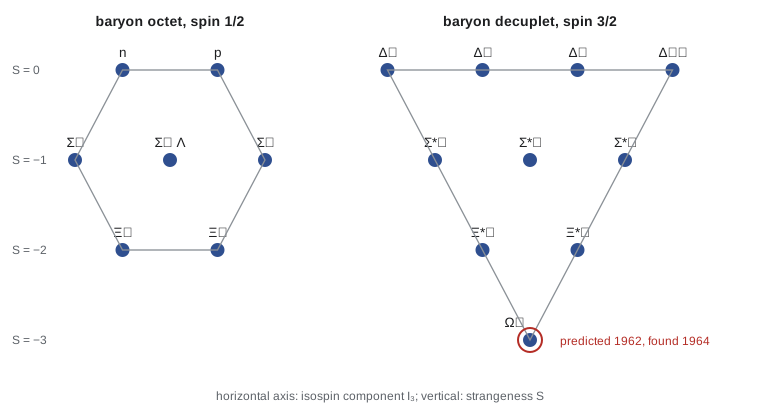
The pattern is that of the symmetry group SU(3), and it made a prediction. The masses in the decuplet increase by about 150 MeV with each unit of strangeness: \(\Delta\) at 1232, \(\Sigma^*\) at 1385, \(\Xi^*\) at 1533 MeV. The missing particle should therefore have strangeness \(-3\), charge \(-1\), and mass near 1680 MeV, and because nothing lighter with strangeness \(-3\) existed, it would have to decay weakly, leaving a measurable track. Gell-Mann named it the \(\Omega^-\). In 1964 a bubble-chamber photograph at Brookhaven showed exactly such a particle, at 1672 MeV. The prediction of the omega-minus did for the eightfold way what the prediction of gallium and germanium did for Mendeleev's periodic table: it showed that the pattern reflected real structure, which the quark model would explain.
Worked problem
Allowed or not?
Decide whether each process is allowed, and if so by which interaction: (a) \(K^+ \to \pi^+ + \pi^0\); (b) \(\pi^- + p \to K^+ + \Sigma^-\); (c) \(n \to p + e^-\).
Show solution
- (a) Charge, baryon and lepton numbers balance. Strangeness changes from +1 to 0, so only the weak interaction can do it: it occurs, with a lifetime of 12 ns.
- (b) Charge: \(-1 + 1 = +1 - 1\). Baryon number: 1 = 1. Strangeness: \(0 = +1 - 1\). All conserved, so it is allowed as a strong reaction (above threshold).
- (c) Charge and baryon number balance, but electron number goes from 0 to 1, and angular momentum cannot balance with two spin-\(\tfrac12\) products from a spin-\(\tfrac12\) parent.
- So (c) is forbidden; the real decay includes \(\bar\nu_e\).
Answer: (a) allowed weak decay; (b) allowed strong production of strange particles in a pair; (c) forbidden without the antineutrino.
Common mistakes
MistakeAssuming any process allowed by energy and charge must happen.
InsteadBaryon and lepton numbers, strangeness and angular momentum may forbid it.
MistakeThinking strangeness is conserved in all decays.
InsteadWeak interactions change it by one unit, which is why strange particles live about \(10^{-10}\) s.
MistakeCounting the neutrinos in muon decay as one particle.
InsteadTwo are needed, one carrying muon number and one balancing electron number.
MistakeTreating isospin as an ordinary spin in space.
InsteadIt is an internal symmetry; it uses the same mathematics but has nothing to do with rotation.
MistakeApplying the light-mass threshold approximation to antiproton production.
Instead\(|Q| = 2m_pc^2\) is not small; the exact formula gives \(6m_pc^2\).
Summary and key terms
- Leptons (\(e\), \(\mu\), \(\tau\) and three neutrinos) do not feel the strong force; hadrons divide into baryons and mesons.
- Baryon number and the separate lepton numbers are conserved in every process observed (apart from slow neutrino oscillation).
- Strangeness is conserved by strong and electromagnetic interactions but not the weak one, explaining associated production and long lifetimes.
- Conservation laws and lifetimes identify the interaction at work; isospin multiplets and SU(3) octets and decuplets organize hadrons.
- The predicted \(\Omega^-\), found in 1964, confirmed the eightfold way.
- Lepton
- Spin-\(\tfrac12\) particle that does not feel the strong force.
- Baryon number
- +1 for baryons, −1 for antibaryons, conserved in all known interactions.
- Strangeness
- Quantum number conserved by strong and electromagnetic interactions only.
- Isospin multiplet
- Hadrons of nearly equal mass differing only in charge.
- Eightfold way
- SU(3) classification of hadrons into octets, decuplets and singlets.
Practice problems
Work each problem on paper first, then reveal the answer to check.
Is \(\Lambda \to n + \pi^0\) allowed?
Show answer
Yes, weakly: strangeness changes from −1 to 0, everything else conserved.
What forbids \(\pi^- + p \to K^- + \Sigma^+\)?
Show answer
Strangeness goes from 0 to −2, as the program reports.
Why must the \(\Omega^-\) decay weakly?
Show answer
No lighter combination of hadrons has strangeness −3, so a strangeness-conserving decay is impossible.
Classify \(\eta \to \gamma\gamma\) (lifetime \(5 \times 10^{-19}\) s).
Show answer
Electromagnetic.
Write the decay of the \(\mu^+\) with correct neutrinos.
Show answer
\(\mu^+ \to e^+ + \nu_e + \bar\nu_\mu\).
Predict the ratio \(\sigma(\pi^+p)/\sigma(\pi^-p)\) at the \(\Delta\) peak.
Show answer
3, from Clebsch–Gordan coefficients for isospin \(\tfrac32\).
Lesson quiz · 5 questions
Score 60% or more to complete this lesson.
Create a free account to save your progress, take quizzes and earn a certificate.