
PHYS-420 · Lesson 6 of 12 · 22 min
Nuclear reactions: kinematics, Q-values and cross-sections
▶ Video coming soon A video version of this lesson is on the way.
In a nuclear reaction, a projectile strikes a target nucleus and something new emerges. Reactions are how we make radioactive isotopes for medicine, how the Sun and stars produce energy and elements, how reactors work, and how most of what we know about nuclear structure was learned. This lesson sets out the bookkeeping of reactions: conservation laws, Q-values and thresholds; the cross-section, which measures how likely a reaction is; and the two great mechanisms by which reactions happen, the slow formation of a compound nucleus and the fast direct reaction. It ends with resonances, the sharp peaks in cross-sections that reveal the quantum states of nuclei.
Notation and conservation laws
A reaction in which projectile \(a\) strikes target \(X\) to produce residual nucleus \(Y\) and outgoing particle \(b\) is written \(a + X \to Y + b\), or compactly \(X(a, b)Y\). Rutherford's 1919 reaction, the first artificial transmutation, is \({}^{14}\mathrm N(\alpha, p){}^{17}\mathrm O\). Every reaction conserves electric charge, the number of nucleons (baryon number), energy including rest energy, linear momentum, angular momentum and, because the strong and electromagnetic forces do, parity. These laws decide which reactions are possible; the dynamics decides how often they happen.
The Q-value
The energy released is the difference between initial and final rest energies:
A reaction with \(Q > 0\) is exothermic: rest energy turns into kinetic energy of the products. One with \(Q < 0\) is endothermic and needs kinetic energy to proceed. As with decays, Q can be computed from atomic masses as long as electrons are balanced on both sides. The program computes Q-values from nuclear masses for five reactions. Deuterium-tritium fusion, \(d + t \to {}^4\mathrm{He} + n\), releases 17.59 MeV, the reaction that fusion power plants aim to use; Rutherford's reaction absorbs 1.19 MeV; and \({}^7\mathrm{Li}(p, n){}^7\mathrm{Be}\), used as a neutron source at accelerators, absorbs 1.65 MeV.
Thresholds
An endothermic reaction does not start at \(T_a = -Q\), because momentum conservation means the products cannot all be at rest: some of the beam's energy must go into moving the center of mass. The minimum, the threshold, is easiest to find with the invariant mass. The quantity \(s = (E_{\text{tot}})^2 - (p_{\text{tot}}c)^2\) is the same in every frame. At threshold, the products are created at rest in the center-of-mass frame, so \(\sqrt s = (m_Y + m_b)c^2\). In the laboratory, with \(X\) at rest and \(a\) of total energy \(E_a\),
which solves to the exact relativistic threshold kinetic energy
The approximation holds when \(|Q| \ll mc^2\), as in nuclear physics. For \({}^7\mathrm{Li}(p, n)\), \(T_{\text{th}} \approx 1.646 \times 8/7 = 1.88\) MeV, matching the program. The same formula, with very different numbers, gives the threshold for creating antiprotons, which we use in lesson 10: there \(|Q|\) is twice the proton mass, and the light-mass approximation fails badly.
Cross-sections
How likely is a reaction? Picture a beam of \(I\) particles per second striking a thin target with \(n\) nuclei per unit volume and thickness \(t\). The reaction rate \(R\) is proportional to \(I\) and to the number of target nuclei per unit area, \(nt\). The constant of proportionality has the dimensions of area and is called the cross-section:
The cross-section is the effective area that each nucleus presents to the beam for that reaction. Its natural unit is the barn, \(10^{-28}\ \text{m}^2 = 100\ \text{fm}^2\), roughly the geometric area of a medium nucleus; the name comes from the Manhattan Project physicists' joke that a uranium nucleus was "as big as a barn". Cross-sections range over many orders of magnitude, from thousands of barns for slow-neutron capture on some isotopes to femtobarns (\(10^{-15}\) b) for producing Higgs bosons. The differential cross-section \(d\sigma/d\Omega\) gives the angular distribution of the outgoing particles, and the total cross-section is its integral over all angles.
For a beam passing through a thick target, the beam is depleted as it goes: \(dI/dx = -n\sigma_{\text{tot}}I\), so \(I(x) = I_0e^{-n\sigma_{\text{tot}}x}\), and the mean free path between collisions is \(\ell = 1/n\sigma_{\text{tot}}\). This is the same law that governs the attenuation of gamma rays in shielding and of neutrons in a reactor moderator.
Neutron reactions and the 1/v law
Neutrons carry no charge, so they feel no Coulomb barrier and can react with any nucleus at any energy. Enrico Fermi's group in Rome discovered in 1934 that neutrons slowed by passing through paraffin wax or water were far more effective at inducing radioactivity than fast ones. The explanation is that for absorption at low energy, the cross-section varies as \(1/v\), the reciprocal of the neutron speed: a slow neutron spends more time near the nucleus. Thermal neutrons, in equilibrium with matter at room temperature, have a most probable speed of 2,200 m/s and an energy of 0.025 eV, and cross-sections are tabulated at this speed. Boron-10 has a thermal absorption cross-section of 3,840 barns and cadmium-113 about 20,000 barns, which is why both are used to absorb neutrons in reactor control and in radiation shielding.
The compound nucleus
Niels Bohr proposed in 1936 that many reactions proceed in two stages. The projectile is absorbed and its energy is quickly shared among all the nucleons, forming a compound nucleus in a highly excited state. The compound nucleus lives long on the nuclear time scale, \(10^{-16}\) s or longer against a crossing time of \(10^{-22}\) s, and forgets how it was formed. It then decays, by emitting a neutron, proton, alpha particle or gamma ray, with probabilities that depend only on its energy and angular momentum. This independence hypothesis was confirmed by forming the same compound nucleus, zinc-64, from \(p + {}^{63}\mathrm{Cu}\) and \(\alpha + {}^{60}\mathrm{Ni}\) and finding the same ratios of decay channels. Compound-nucleus reactions give outgoing particles nearly isotropically, with energy spectra like evaporation from a hot drop.
Direct reactions
At higher projectile energies, above about 20 MeV, many reactions are over in the time the projectile takes to cross the nucleus, \(10^{-22}\) s. In a direct reaction the projectile interacts with one nucleon or a few at the surface. In a stripping reaction such as \((d, p)\), the deuteron's neutron is transferred into a single-particle orbit of the target while the proton flies on. The angular distribution peaks forward, at an angle that depends on the orbital angular momentum \(\ell\) transferred, so \((d, p)\) reactions measure the shell-model orbits of lesson 3. Knockout and pickup reactions do the same for occupied orbits. Most of the experimental support for the shell model came from these reactions.
Resonances and the Breit–Wigner formula
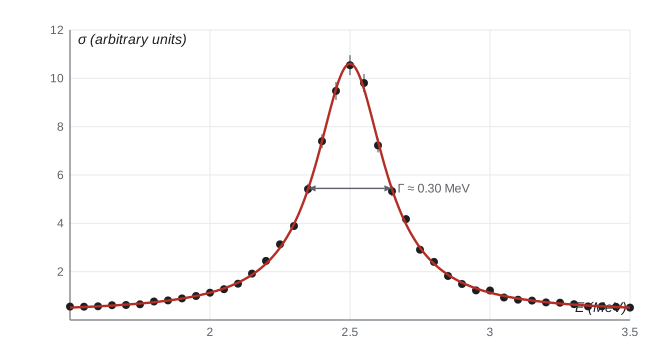
When the beam energy matches a quasi-bound state of the compound nucleus, the cross-section rises in a sharp peak. A state with a lifetime \(\tau\) has, by the energy-time uncertainty relation, an energy spread \(\Gamma = \hbar/\tau\). Its time dependence \(e^{-iE_0t/\hbar}e^{-\Gamma t/2\hbar}\) has a Fourier transform whose squared modulus is a Lorentzian, and the resulting cross-section for an incoming channel \(a\) and outgoing channel \(b\) is the Breit–Wigner formula of 1936:
where \(k\) is the incoming wave number, \(\Gamma_a\) and \(\Gamma_b\) are the partial widths for decay into each channel, \(\Gamma = \sum\Gamma_i\) is the total width, and \(g\) is a statistical factor for the spins. The full width at half maximum is \(\Gamma\), and the peak is bounded by the unitarity limit \(4\pi g/k^2\), the same maximum we met for a single partial wave in PHYS-373. The program fits a Breit–Wigner shape with a flat background to simulated data with 4 parts in 100 of noise and recovers the resonance energy and width: a width of 0.30 MeV corresponds to a lifetime of \(2.2 \times 10^{-21}\) s.
# Reactions: Q-values, thresholds and fitting a Breit-Wigner resonance
import math, random
u = 931.494
M = {"p": 1.007276, "n": 1.008665, "d": 2.013553, "t": 3.015501, "He-3": 3.014932, "He-4": 4.001506,
     "Li-7": 7.014358, "Be-7": 7.014736, "C-12": 11.996709, "N-14": 13.999234, "O-17": 16.994743}
# nuclear (not atomic) masses in u
def Q(a, X, Y, b): return (M[a] + M[X] - M[Y] - M[b]) * u
print("reaction                 Q (MeV)   threshold (MeV, lab kinetic energy of the beam)")
for a, X, Y, b in (("p", "Li-7", "Be-7", "n"), ("d", "t", "He-4", "n"), ("d", "He-3", "He-4", "p"),
                   ("He-4", "N-14", "O-17", "p"), ("n", "He-3", "t", "p")):
    q = Q(a, X, Y, b)
    if q >= 0: th = "exothermic, no threshold"
    else:
        ma, mX, mY, mb = (M[k] * u for k in (a, X, Y, b))
        th = f"{-q * (mY + mb + ma + mX) / (2 * mX):.3f}"   # exact relativistic threshold for a beam on a fixed target
    print(f"  {a} + {X:5s} -> {Y:5s} + {b:3s}  {q:8.3f}   {th}")
print()
# Breit-Wigner: sigma(E) = sigma0 (G/2)^2 / ((E - E0)^2 + (G/2)^2); fit synthetic data by least squares on a grid
rnd = random.Random(420)
E0t, Gt, s0t = 2.50, 0.30, 10.0
data = []
for k in range(41):
    E = 1.5 + 0.05 * k
    s = s0t * (Gt / 2) ** 2 / ((E - E0t) ** 2 + (Gt / 2) ** 2) + 0.3
    data.append((E, s * (1 + rnd.gauss(0, 0.04))))
def chi2(E0, G):
    f = [(G / 2) ** 2 / ((E - E0) ** 2 + (G / 2) ** 2) for E, _ in data]
    # best sigma0 and flat background for these E0, G by linear least squares
    n = len(f); sf = sum(f); sff = sum(x * x for x in f); sy = sum(y for _, y in data); sfy = sum(x * y for x, (_, y) in zip(f, data))
    det = sff * n - sf * sf
    a = (sfy * n - sf * sy) / det; b = (sff * sy - sf * sfy) / det
    return sum((y - a * x - b) ** 2 for x, (_, y) in zip(f, data)), a, b
best = min(((chi2(2.3 + 0.002 * i, 0.15 + 0.002 * j), 2.3 + 0.002 * i, 0.15 + 0.002 * j) for i in range(201) for j in range(151)))
(c, s0, bg), E0, G = best
print(f"Breit-Wigner fit: E0 = {E0:.3f} MeV (true {E0t}), Gamma = {G:.3f} MeV (true {Gt}), peak {s0:.2f} (true {s0t}), background {bg:.2f}")
print(f"lifetime of the state tau = hbar / Gamma = {6.582e-22 / G:.2e} s")reaction Q (MeV) threshold (MeV, lab kinetic energy of the beam) p + Li-7 -> Be-7 + n -1.646 1.883 d + t -> He-4 + n 17.589 exothermic, no threshold d + He-3 -> He-4 + p 18.353 exothermic, no threshold He-4 + N-14 -> O-17 + p -1.191 1.532 n + He-3 -> t + p 0.764 exothermic, no threshold Breit-Wigner fit: E0 = 2.500 MeV (true 2.5), Gamma = 0.298 MeV (true 0.3), peak 10.31 (true 10.0), background 0.29 lifetime of the state tau = hbar / Gamma = 2.21e-21 s
Resonances appear throughout physics: the 3.68 MeV and 4.44 MeV levels of carbon-12, the giant dipole resonance in which all the protons oscillate against all the neutrons, the \(\Delta(1232)\) resonance of pion-nucleon scattering that we meet in lesson 10, and the \(Z\) boson at 91.2 GeV. A famous nuclear example is the 7.65 MeV state of carbon-12, predicted by Fred Hoyle in 1953 from the observed cosmic abundance of carbon. Without it, the triple-alpha reaction that makes carbon in stars would be far too slow; William Fowler's group at Caltech found it where Hoyle said it would be.
Worked problem
Producing fluorine-18 for PET
Fluorine-18 for PET scans is made by bombarding oxygen-18 water with protons: \({}^{18}\mathrm O(p, n){}^{18}\mathrm F\). Atomic masses: \({}^{18}\mathrm O\) 17.999160 u, \({}^{18}\mathrm F\) 18.000938 u, \({}^1\mathrm H\) 1.007825 u, \(n\) 1.008665 u. Find Q and the threshold.
Show solution
- Electrons balance: \({}^1\mathrm H + {}^{18}\mathrm O\) has 9 electrons, as does \({}^{18}\mathrm F\), and the neutron has none.
- \(Q = (1.007825 + 17.999160 - 18.000938 - 1.008665) \times 931.494 = -0.002618 \times 931.494 = -2.438\) MeV.
- Threshold: \(T_{\text{th}} \approx 2.438\,(1 + 1.008/17.99) = 2.438 \times 1.056 = 2.575\) MeV.
- Medical cyclotrons use protons of 11 to 18 MeV, well above threshold, where the cross-section is near its peak of about half a barn.
Answer: \(Q = -2.44\) MeV and the threshold is about 2.57 MeV, easily reached by the small cyclotrons in hospitals.
Common mistakes
MistakeTaking the threshold of an endothermic reaction to be \(-Q\).
InsteadMomentum conservation requires extra energy: \(T_{\text{th}} \approx -Q(1 + m_a/m_X)\).
MistakeTreating the cross-section as the geometric size of the nucleus.
InsteadIt is an effective area for a particular reaction and can be far larger or smaller than \(\pi R^2\).
MistakeExpecting neutron cross-sections to fall at low energy like charged-particle ones.
InsteadNeutrons see no Coulomb barrier; absorption grows as \(1/v\) at low energy.
MistakeReading the width of a resonance as an experimental error.
Instead\(\Gamma = \hbar/\tau\) is a physical property of the state.
MistakeForgetting to balance electrons when using atomic masses in Q-values.
InsteadCheck that the same number of electrons appears on both sides, or use nuclear masses.
Summary and key terms
- \(Q = (m_a + m_X - m_Y - m_b)c^2\); exothermic if positive.
- Threshold from invariant mass: \(T_{\text{th}} = -Q(m_a + m_X + m_Y + m_b)/2m_X\).
- \(R = \sigma Int\); the barn is \(10^{-28}\) m²; thick targets attenuate as \(e^{-n\sigma x}\).
- Compound-nucleus reactions are slow and forget their entrance channel; direct reactions are fast and probe single-particle orbits.
- Resonances follow the Breit–Wigner form with width \(\Gamma = \hbar/\tau\); slow-neutron absorption follows the \(1/v\) law.
- Q-value
- Energy released in a reaction or decay.
- Cross-section
- Effective target area for a reaction, measured in barns.
- Threshold energy
- Minimum beam kinetic energy for an endothermic reaction.
- Compound nucleus
- Long-lived excited intermediate state that shares the projectile's energy.
- Breit–Wigner formula
- Lorentzian cross-section near a resonance of width \(\Gamma\).
Practice problems
Work each problem on paper first, then reveal the answer to check.
A beam of \(10^{12}\) protons per second hits a target of \(10^{20}\) nuclei per cm². The cross-section is 50 mb. Find the reaction rate.
Show answer
\(R = 50 \times 10^{-27}\ \text{cm}^2 \times 10^{12} \times 10^{20} = 5 \times 10^{6}\) per second.
Find the threshold for \({}^{14}\mathrm N(\alpha, p){}^{17}\mathrm O\) using the program's Q.
Show answer
\(1.191(1 + 4/14) = 1.53\) MeV.
What is the mean free path of thermal neutrons in boron-10 (density \(1.3 \times 10^{23}\ \text{cm}^{-3}\), \(\sigma = 3840\) b)?
Show answer
\(\ell = 1/(1.3 \times 10^{23} \times 3.84 \times 10^{-21}) = 2.0 \times 10^{-3}\) cm, 20 µm.
A resonance has a width of 10 eV. What is its lifetime?
Show answer
\(6.58 \times 10^{-16}/10 = 6.6 \times 10^{-17}\) s.
Why do \((d, p)\) reactions measure orbital angular momentum?
Show answer
The transferred neutron's \(\ell\) determines the angle of the forward peak in the proton angular distribution.
If a cross-section follows \(1/v\) and is 100 b at 0.025 eV, what is it at 1 eV?
Show answer
\(\sigma \propto E^{-1/2}\): \(100\sqrt{0.025} = 15.8\) b.
Lesson quiz · 5 questions
Score 60% or more to complete this lesson.
Create a free account to save your progress, take quizzes and earn a certificate.