
PHYS-420 · Lesson 5 of 12 · 23 min
Beta decay, neutrinos and the weak interaction
▶ Video coming soon A video version of this lesson is on the way.
Beta decay is the most common form of radioactivity and the most puzzling. In it a neutron inside a nucleus becomes a proton, or a proton becomes a neutron, and an electron or a positron is created and emitted. Nothing in the electromagnetic or strong forces can change the identity of a nucleon or create an electron. Beta decay is the work of a third interaction, the weak force, and its study led to two of the great discoveries of twentieth-century physics: the neutrino, a particle so elusive that it took 26 years to detect after it was proposed, and the violation of mirror symmetry by the laws of nature.
Three kinds of beta decay
There are three closely related processes, each moving a nucleus along an isobar toward the valley of stability:
In \(\beta^-\) decay, a neutron-rich nucleus such as carbon-14 or cobalt-60 converts a neutron to a proton. In \(\beta^+\) decay, a proton-rich nucleus such as fluorine-18 converts a proton to a neutron and emits a positron; this cannot happen for a free proton, which is lighter than a neutron, but can happen inside a nucleus when the binding energies allow. In electron capture, the nucleus absorbs one of its own atomic electrons, usually from the K shell, and emits only a neutrino. In terms of atomic masses, the Q-values are \(Q_{\beta^-} = [M(Z) - M(Z + 1)]c^2\), \(Q_{\text{EC}} = [M(Z) - M(Z - 1)]c^2\) and \(Q_{\beta^+} = Q_{\text{EC}} - 2m_ec^2\), so positron emission needs at least 1.022 MeV more than electron capture. The free neutron itself decays with a half-life of about 10 minutes (a mean life of 878 to 888 seconds, depending on the method, a discrepancy still being studied) and \(Q = 0.782\) MeV.
The continuous spectrum and Pauli's neutrino
If beta decay produced only a daughter nucleus and an electron, the electron would have a single energy, as alpha particles do. Instead, as James Chadwick showed in 1914, electrons emerge with a continuous spectrum from zero up to the Q-value. Energy seemed not to be conserved; Niels Bohr was prepared to give up exact conservation. Spin was a problem too: in the decay of a nucleus with integer spin to one with integer spin, emitting a single spin-\(\tfrac12\) electron cannot conserve angular momentum. In 1930 Wolfgang Pauli proposed, in a letter to colleagues he addressed as "dear radioactive ladies and gentlemen", that an unseen, light, neutral spin-\(\tfrac12\) particle carries off the missing energy and angular momentum. Enrico Fermi named it the neutrino, the little neutral one.
The neutrino interacts so weakly that a typical one from a reactor would pass through light-years of lead without stopping. Clyde Cowan and Frederick Reines finally detected reactor antineutrinos in 1956 at the Savannah River reactor in South Carolina, using inverse beta decay, \(\bar\nu_e + p \to n + e^+\): the positron annihilates at once, and the neutron is captured a few microseconds later, giving a delayed coincidence that distinguished the rare events from background. Reines shared the 1995 Nobel Prize.
Fermi's theory
Fermi published the first theory of beta decay in 1934, modeled on the quantum theory of radiation: just as an excited atom creates a photon, a nucleus creates an electron-neutrino pair. Using Fermi's golden rule from PHYS-373, the decay rate into final states with electron momentum between \(p\) and \(p + dp\) is
where \(dN/dE_0\) counts the final states per unit energy. The electron and neutrino share the energy \(Q\) (the nuclear recoil carries negligible energy but balances momentum), so the phase space for an electron of momentum \(p\) and total energy \(E\), with the neutrino taking \(Q - T\), is proportional to \(p^2\,dp\,(Q - T)^2\). For allowed transitions, in which the leptons carry no orbital angular momentum, the matrix element is nearly independent of energy, and the spectrum is
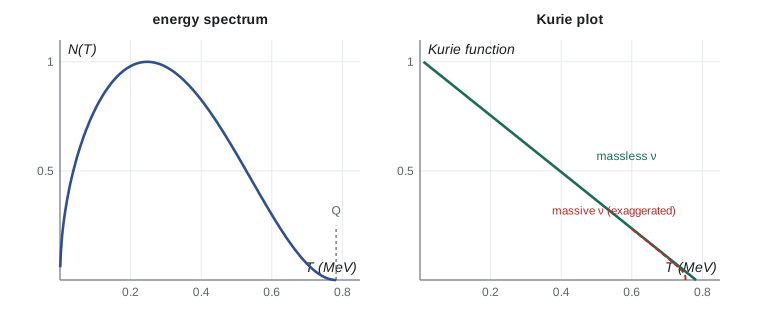
where we used \(p\,dp = E\,dE/c^2\) and \(F(Z', T)\), the Fermi function, corrects for the Coulomb attraction (for electrons) or repulsion (for positrons) of the daughter nucleus. The program computes this shape for the free neutron, ignoring the small Coulomb factor: the electrons have a most probable kinetic energy of 0.25 MeV and a mean of 0.30 MeV, about two-fifths of Q, with the neutrino carrying the rest on average.
The Kurie plot
Rearranging the spectrum gives a straight line. Define the Kurie function \(K(T) = \sqrt{N(T)/(pEF)}\). For an allowed transition with massless neutrinos, \(K \propto (Q - T)\), a straight line that meets the axis at the endpoint \(T = Q\). This Kurie plot, introduced by Franz Kurie in 1936, tests whether a transition is allowed and measures the endpoint precisely. The program fits it to simulated data with one part in 100 of random scatter and recovers Q to about 1 keV.
# Beta decay: the allowed spectrum shape, the Kurie plot and the tritium endpoint
import math, random
me = 0.51100      # MeV
def spectrum(T, Q, mnu=0.0):
    """Allowed shape without the Coulomb (Fermi) factor: N(T) ~ p E (Q - T) sqrt((Q - T)^2 - mnu^2)."""
    if T <= 0 or T >= Q - mnu: return 0.0
    E = T + me; p = math.sqrt(E * E - me * me); x = Q - T
    return p * E * x * math.sqrt(x * x - mnu * mnu)
Q = 0.7823        # neutron decay Q-value (MeV)
n = 2000; h = Q / n
w = [spectrum((i + 0.5) * h, Q) for i in range(n)]
mean = sum((i + 0.5) * h * wi for i, wi in enumerate(w)) / sum(w)
peak = (max(range(n), key=lambda i: w[i]) + 0.5) * h
print(f"neutron beta decay, Q = {Q} MeV: most probable electron energy {peak:.3f} MeV, mean {mean:.3f} MeV ({mean / Q:.2f} of Q)")
print()
# Kurie plot: K(T) = sqrt(N / (p E)) is a straight line in T that meets the axis at Q
rnd = random.Random(420)
pts = []
for T in [0.05 * k for k in range(1, 15)]:
    N = spectrum(T, Q) * (1 + rnd.gauss(0, 0.01))
    E = T + me; p = math.sqrt(E * E - me * me)
    pts.append((T, math.sqrt(N / (p * E))))
mx = sum(t for t, _ in pts) / len(pts); my = sum(k for _, k in pts) / len(pts)
slope = sum((t - mx) * (k - my) for t, k in pts) / sum((t - mx) ** 2 for t, _ in pts)
icept = my - slope * mx
print(f"Kurie plot fit with 1 part in 100 noise: endpoint = {-icept / slope:.4f} MeV (true {Q})")
print()
# tritium: endpoint 18.59 keV; a neutrino mass m removes the last part of the spectrum
Qt = 0.018591
tot = sum(spectrum((i + 0.5) * Qt / 6000, Qt) for i in range(6000)) * Qt / 6000
base = None
for m_eV in (0.0, 0.45, 1.0, 2.0):
    m = m_eV * 1e-6
    a = Qt - 2e-6                         # the last 2 eV below the endpoint
    k = 4000; hh = (Qt - a) / k
    last = sum(spectrum(a + (i + 0.5) * hh, Qt, m) for i in range(k)) * hh / tot
    base = base or last
    print(f"  m_nu = {m_eV:4.2f} eV: fraction of decays in the last 2 eV = {last:.2e}  ({last / base:.2f} of the massless value)")
print()
# Sargent's rule: decay rate grows roughly as Q^5 for allowed transitions at high Q
for q in (1, 2, 4, 8):
print(f" Q x {q}: relative rate ~ {q ** 5:6d}")neutron beta decay, Q = 0.7823 MeV: most probable electron energy 0.247 MeV, mean 0.303 MeV (0.39 of Q) Kurie plot fit with 1 part in 100 noise: endpoint = 0.7812 MeV (true 0.7823) m_nu = 0.00 eV: fraction of decays in the last 2 eV = 2.81e-12 (1.00 of the massless value) m_nu = 0.45 eV: fraction of decays in the last 2 eV = 2.60e-12 (0.93 of the massless value) m_nu = 1.00 eV: fraction of decays in the last 2 eV = 1.82e-12 (0.65 of the massless value) m_nu = 2.00 eV: fraction of decays in the last 2 eV = 0.00e+00 (0.00 of the massless value) Q x 1: relative rate ~ 1 Q x 2: relative rate ~ 32 Q x 4: relative rate ~ 1024 Q x 8: relative rate ~ 32768
Weighing the neutrino
If the neutrino has mass \(m_\nu\), the spectrum near the endpoint changes to \(pE(Q - T)\sqrt{(Q - T)^2 - m_\nu^2c^4}\): the line curves down and ends \(m_\nu c^2\) below Q. The effect is confined to the last few electronvolts, where only a tiny fraction of decays occur, as the program shows: about 3 decays in \(10^{12}\) fall in the last 2 eV of the tritium spectrum, and a mass of 1 eV removes a third of them. Tritium is used because its endpoint, 18.6 keV, is very low, which makes that fraction as large as possible. The KATRIN experiment in Karlsruhe, a spectrometer 24 m long and 10 m across, reported in 2025 from 259 days of data that the electron antineutrino mass is less than 0.45 eV at 90 parts in 100 confidence. Neutrinos are at least a million times lighter than electrons, but, as we will see in lesson 12, they are not massless.
Sargent's rule and comparative half-lives
Integrating the spectrum over all energies gives the total rate. For \(Q \gg m_ec^2\) the integral grows as \(Q^5\): doubling the energy release makes an allowed decay about 32 times faster. This is Sargent's rule, found empirically in 1933 by B. W. Sargent, a Canadian physicist working at the Cavendish Laboratory in Cambridge, who later spent his career at Queen's University in Kingston. To compare the intrinsic strengths of different transitions, nuclear physicists remove the phase-space factor by quoting the comparative half-life \(ft_{1/2}\), where \(f\) is the integrated phase space. Allowed transitions have \(\log ft\) between about 3 and 6; forbidden ones, in which the leptons must carry orbital angular momentum, have larger values, 6 to 20 or more. Superallowed transitions between \(0^+\) states with the same isospin all have nearly the same \(ft\), about 3,070 s, which tests the universality of the weak interaction to a few parts in \(10^4\).
Selection rules
In allowed decays the electron and neutrino carry no orbital angular momentum, so the parity of the nucleus does not change. Their spins can couple to \(S = 0\) or \(S = 1\). Fermi transitions have \(S = 0\) and \(\Delta J = 0\); Gamow–Teller transitions, proposed by George Gamow and Edward Teller in 1936, have \(S = 1\) and \(\Delta J = 0, \pm1\) (but not \(0 \to 0\)). Neutron decay, \(\tfrac12^+ \to \tfrac12^+\), is a mixture of both. Forbidden transitions require the leptons to carry orbital angular momentum \(\ell \ge 1\), which costs a factor of roughly \((pR/\hbar)^2 \sim 10^{-3}\) to \(10^{-4}\) in rate for each unit, much as in gamma decay.
Parity violation
In 1956 Tsung-Dao Lee and Chen-Ning Yang noticed that no experiment had tested whether the weak interaction respects parity, the symmetry between a process and its mirror image. Chien-Shiung Wu tested it within months, with colleagues at the US National Bureau of Standards: she cooled cobalt-60 to 0.01 K in a magnetic field to align the nuclear spins and found that the electrons were emitted preferentially opposite to the spin direction. In a mirror the spin direction reverses but the electron momentum does not, so the mirror-image experiment would give the opposite result. Nature distinguishes left from right. Lee and Yang received the 1957 Nobel Prize, a year after their proposal. Later experiments showed that neutrinos are always left-handed, with spin opposite to their momentum, and antineutrinos right-handed. The modern theory, the V − A form of the weak interaction, builds this in: only left-handed particles take part in charged weak interactions.
The weak interaction today
Fermi's theory treated the weak interaction as acting at a point, with strength \(G_F = 1.166 \times 10^{-5}\ \text{GeV}^{-2}(\hbar c)^3\). We now know it is carried by the massive \(W^\pm\) and \(Z^0\) bosons, of about 80 and 91 GeV. At energies far below these masses, the exchange looks like a point interaction with \(G_F/\sqrt2 = g^2/8M_W^2\), which is why the weak interaction appears weak: not because its coupling \(g\) is small, but because the carriers are heavy and the force is short ranged. At the quark level, \(\beta^-\) decay is \(d \to u + W^-\), followed by \(W^- \to e^- + \bar\nu_e\). We return to this picture in lessons 10 to 12.
Worked problem
Is positron emission possible?
Copper-64 (atomic mass 63.929764 u) can decay to nickel-64 (63.927966 u) or to zinc-64 (63.929142 u). Which modes are energetically allowed?
Show solution
- To zinc (\(Z\) up by 1), \(\beta^-\): \(Q = (63.929764 - 63.929142) \times 931.494 = 0.579\) MeV, allowed.
- To nickel (\(Z\) down by 1), electron capture: \(Q_{\text{EC}} = (63.929764 - 63.927966) \times 931.494 = 1.675\) MeV, allowed.
- Positron emission to nickel: \(Q_{\beta^+} = 1.675 - 1.022 = 0.653\) MeV, also allowed.
- All three modes compete; measured branchings are about 39, 43 and 18 in 100 for \(\beta^-\), EC and \(\beta^+\).
Answer: All three: \(\beta^-\) to zinc-64 and both electron capture and \(\beta^+\) to nickel-64. Copper-64 is used in PET imaging because of its positron branch.
Common mistakes
MistakeUsing \(Q_{\beta^+} = [M(Z) - M(Z - 1)]c^2\) with atomic masses.
InsteadSubtract \(2m_ec^2\): the atom loses an electron and a positron is created.
MistakeExpecting a single electron energy in beta decay.
InsteadThree bodies share the energy, so the spectrum is continuous up to Q.
MistakeThinking free protons undergo \(\beta^+\) decay.
InsteadThe proton is lighter than the neutron; \(\beta^+\) occurs only inside nuclei where binding energies supply the difference.
MistakeReading the Kurie plot's curvature near the endpoint as a sign of forbidden decay without checking resolution.
InsteadDetector resolution also bends the endpoint; it must be modeled before inferring a neutrino mass.
MistakeCalling the weak interaction weak because its coupling constant is small.
InsteadIts coupling is comparable to electromagnetism; it appears weak because the W and Z are heavy.
Summary and key terms
- \(\beta^-\), \(\beta^+\) and electron capture change \(Z\) by one at fixed \(A\); \(Q_{\beta^+} = Q_{\text{EC}} - 2m_ec^2\).
- The continuous spectrum led Pauli to propose the neutrino (1930); Cowan and Reines detected it in 1956.
- Fermi's theory gives \(N(T) \propto FpE(Q - T)^2\); the Kurie plot is linear and ends at Q for massless neutrinos.
- Total rate grows as \(Q^5\) (Sargent's rule); \(\log ft\) classifies allowed and forbidden transitions; KATRIN sets \(m_\nu < 0.45\) eV.
- Wu's 1957 experiment showed parity violation; the weak force is carried by heavy W and Z bosons.
- Electron capture
- Absorption of an atomic electron by a proton in the nucleus.
- Kurie plot
- \(\sqrt{N/pEF}\) against T, a straight line for allowed decays.
- Fermi transition
- Allowed decay with lepton spins coupled to zero and \(\Delta J = 0\).
- Gamow–Teller transition
- Allowed decay with lepton spins coupled to one.
- Parity violation
- Failure of mirror symmetry, a property of the weak interaction.
Practice problems
Work each problem on paper first, then reveal the answer to check.
Using the program, what is the mean electron energy in neutron decay?
Show answer
0.303 MeV, 0.39 of Q.
Fluorine-18 has \(Q_{\text{EC}} = 1.656\) MeV. What is the maximum positron kinetic energy?
Show answer
\(1.656 - 1.022 = 0.634\) MeV.
By Sargent's rule, how much faster is an allowed decay with Q = 3 MeV than one with Q = 1 MeV?
Show answer
About \(3^5 = 243\) times.
Classify \(1^+ \to 0^+\) beta decay.
Show answer
Allowed Gamow–Teller: no parity change and \(\Delta J = 1\).
Why does tritium suit neutrino-mass experiments?
Show answer
Its very low endpoint (18.6 keV) puts a relatively large fraction of decays near the endpoint, and its atomic physics is simple.
In Wu's experiment, what would parity conservation have predicted?
Show answer
Equal numbers of electrons along and against the nuclear spin.
Lesson quiz · 5 questions
Score 60% or more to complete this lesson.
Create a free account to save your progress, take quizzes and earn a certificate.