
PHYS-420 · Lesson 7 of 12 · 26 min
Fission and fusion as energy sources
▶ Video coming soon A video version of this lesson is on the way.
The curve of binding energy per nucleon, which peaks near iron, means that energy can be released in two opposite ways: by splitting a heavy nucleus into two medium ones, fission, or by joining two light nuclei into a heavier one, fusion. Fission has powered electricity grids since the 1950s; fusion powers the Sun and is the long-sought goal of controlled fusion research. This lesson explains the physics of both as energy sources: where the energy comes from, how a fission chain reaction is kept steady and safe in a power reactor, what happens to spent fuel, and what conditions a fusion plasma must reach to produce more energy than it consumes.
Where fission energy comes from
A heavy nucleus such as uranium-236 sits on the falling side of the binding-energy curve, at about 7.6 MeV per nucleon. Two fragments of mass about 95 and 140 lie near 8.5 MeV per nucleon. The difference, about 0.9 MeV for each of 236 nucleons, is roughly 200 MeV per fission. The semi-empirical mass formula of lesson 3 shows which terms are responsible: splitting increases the surface energy, because two small drops have more surface than one large drop, but it reduces the Coulomb energy by much more, because the protons are no longer all crowded together. The program applies the formula to a typical split and finds about 170 MeV, close to the measured total of about 200 MeV once the formula's limitations and the energy later released by the radioactive fragments are accounted for.
Most of the energy appears at once as the kinetic energy of the two fragments, which fly apart pushed by their mutual Coulomb repulsion: about 170 MeV. The rest is carried by prompt neutrons (about 5 MeV), prompt gamma rays (7 MeV), and the beta and gamma decay of the radioactive fragments over the following seconds to years (about 20 MeV, of which neutrinos carry away 10 MeV that cannot be recovered). The fragments stop in the fuel within micrometers, so their energy becomes heat right where it is produced.
Why heavy nuclei fission
If fission releases energy, why doesn't uranium fission on its own? A spherical drop must first deform before it can split, and in the liquid-drop picture deformation raises the surface energy faster than it lowers the Coulomb energy, until the drop has stretched into a neck. The result is a fission barrier of about 6 MeV for uranium and plutonium isotopes. Spontaneous fission by tunneling through this barrier is very slow for uranium-238, with a partial half-life of about \(10^{16}\) years. Niels Bohr and John Wheeler worked out this picture in 1939, months after the discovery. The ratio of Coulomb to surface energy, the fissility parameter \(Z^2/A\), measures how close a nucleus is to being unstable against any deformation; at about \(Z^2/A \approx 50\) the barrier would vanish entirely.
Absorbing a neutron forms a compound nucleus with excitation energy equal to the neutron's binding energy plus its kinetic energy. For uranium-235, adding a neutron makes even-even uranium-236, and the pairing energy of lesson 3 makes the neutron's binding energy, 6.5 MeV, larger than the barrier: even a slow thermal neutron causes fission. For uranium-238, adding a neutron makes odd uranium-239 with a binding energy of only 4.8 MeV, below its barrier, so fission needs neutrons of more than about 1 MeV. This is why uranium-235, only 0.72 parts in 100 of natural uranium, is the fissile isotope that power reactors depend on.
Fission products
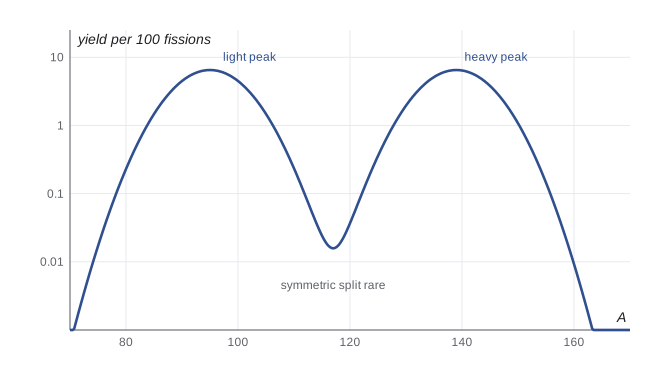
Fission rarely splits a nucleus evenly. The mass distribution of fragments from thermal fission of uranium-235 has two humps, centered near \(A \approx 95\) and \(A \approx 139\), with a deep valley at symmetric division. The heavy peak stays near \(A = 139\) for all fissioning nuclei, a sign of the stabilizing influence of the doubly magic tin-132 shell closure inside the heavy fragment. Because the fragments inherit the neutron-rich ratio of uranium, they lie far from the valley of stability and undergo chains of beta decay. Among them are the isotopes that matter for medicine (molybdenum-99), for safety (iodine-131, with an 8-day half-life) and for long-term waste (cesium-137 and strontium-90, about 30 years each).
The chain reaction in a power reactor
Each fission of uranium-235 also releases on average 2.4 neutrons, which can cause further fissions. If, on average, exactly one neutron from each fission goes on to cause another, the reaction is self-sustaining at constant power: the effective multiplication factor is \(k_{\text{eff}} = 1\) and the reactor is said to be critical. If \(k_{\text{eff}} < 1\), the reaction dies away. A power reactor is designed and operated to stay at \(k_{\text{eff}} = 1\), with control rods of neutron-absorbing material such as cadmium or boron that operators adjust to compensate as fuel is consumed. Enrico Fermi's group achieved the first controlled chain reaction in Chicago on 2 December 1942; Canada's ZEEP at Chalk River, the first reactor outside the United States, went critical in September 1945.
Neutrons from fission are fast, about 2 MeV, while the fission cross-section of uranium-235 is hundreds of times larger for slow neutrons. Thermal reactors therefore contain a moderator, a light material that slows neutrons by elastic collisions. A neutron loses the most energy colliding with a nucleus of similar mass, so hydrogen in water is very effective, but hydrogen also absorbs neutrons. Heavy water, \(\mathrm D_2\mathrm O\), slows neutrons almost as well and absorbs far fewer. This is the key to the Canadian CANDU design: with a heavy-water moderator, enough neutrons survive that natural uranium, unenriched, can sustain a chain reaction. Light-water reactors, the most common type worldwide and the type used in the United States, need fuel enriched to a few parts in 100 of uranium-235 to make up for the neutrons lost to hydrogen.
Delayed neutrons make reactors controllable
If all neutrons were prompt, emitted within \(10^{-14}\) s of fission, a reactor's power would respond to changes in \(k_{\text{eff}}\) within milliseconds, far too fast for mechanical control. But about 65 neutrons in every 10,000 from uranium-235 fission are delayed: they are emitted by certain fission fragments after beta decays with half-lives from a fraction of a second to about a minute. The delayed fraction \(\beta = 0.0065\) sets the time scale. As long as the excess reactivity \(\rho = (k_{\text{eff}} - 1)/k_{\text{eff}}\) stays below \(\beta\), the chain depends on the delayed neutrons, and the power grows with a period of tens of seconds rather than milliseconds, as the program shows. Reactors are designed so that \(\rho\) stays far below \(\beta\) in all normal and abnormal operation, and they have strong negative feedbacks: in most designs, rising temperature reduces \(k_{\text{eff}}\) automatically, through Doppler broadening of uranium-238 absorption resonances and changes in moderator density.
Safety and spent fuel
Shutting down a reactor stops the chain reaction within seconds, but the radioactive fission products keep producing heat: about 7 parts in 100 of full power immediately after shutdown, falling to about 1 part in 100 after a few hours. This decay heat must be removed for days. Loss of cooling after shutdown, not the chain reaction itself, caused the core damage at Three Mile Island (1979) and Fukushima Daiichi (2011); the Chernobyl accident (1986) followed from a design with a positive power feedback operated in an unstable regime. Modern designs remove decay heat by passive means, such as natural circulation, that need no pumps or power.
Spent fuel holds the fission products and the heavier actinides formed by neutron capture. After a few hundred years the fission products have largely decayed, but actinides such as plutonium-239 (24,000 years) keep the fuel radioactive for many thousands of years. The internationally preferred solution is a deep geological repository. Finland's Onkalo repository, in granite at Olkiluoto, is the first in the world licensed to operate, while the United States still stores its spent fuel at reactor sites and in interim facilities.
Nuclear fuel is extraordinarily concentrated. The program compares energy per kilogram: fully fissioned uranium-235 gives about \(8 \times 10^{13}\) J/kg, three million times coal. Natural uranium in a CANDU reactor, of which only a small fraction is actually fissioned, still yields about \(6 \times 10^{11}\) J/kg, some 25,000 times coal. New designs continue to appear: small modular reactors of about 300 MW are being developed in the United States, and the first of four BWRX-300 units is under construction at Darlington, Ontario, licensed in April 2025.
Fusion
Fusing light nuclei releases energy because \(B/A\) rises steeply from hydrogen to helium. The easiest reaction is deuterium-tritium fusion,
The energy is shared in inverse proportion to mass, so the neutron takes four-fifths. Per kilogram of fuel this is four times more than fission. Deuterium is abundant in seawater; tritium, with a 12.3-year half-life, must be bred from lithium by the fusion neutrons themselves, \(n + {}^6\mathrm{Li} \to {}^4\mathrm{He} + t\). Commercial tritium today comes mostly from CANDU reactors in Canada, as a by-product in their heavy water.
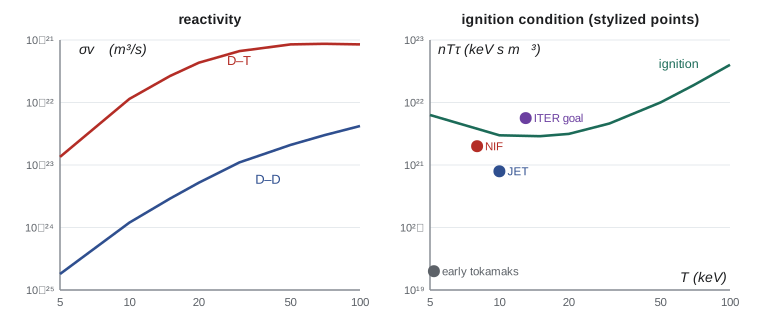
The obstacle is the Coulomb barrier, about 0.4 MeV for deuterium and tritium. Fusion happens at much lower temperatures by tunneling, as in alpha decay but in reverse: the reaction rate is the product of the falling Maxwell–Boltzmann distribution of PHYS-361 and the rising tunneling probability, which peaks at the Gamow peak. The rate per unit volume is \(n_Dn_T\langle\sigma v\rangle\), where the reactivity \(\langle\sigma v\rangle\), the cross-section averaged over the thermal distribution, peaks near 65 keV (about 750 million K). At 10 to 20 keV, where practical machines operate, it is already within a factor of a few of its peak.
The Lawson criterion
A plasma at temperature \(T\) loses energy, by radiation and transport, in a characteristic energy confinement time \(\tau_E\). For the plasma to sustain itself by its own fusion heating, ignition, the alpha particles, which stay in the plasma, must replace those losses. With equal densities \(n/2\) of deuterium and tritium, total thermal energy density \(3nT\) (electrons and ions), and alpha heating \((n^2/4)\langle\sigma v\rangle E_\alpha\), ignition requires
The right-hand side has a minimum near 15 keV, about \(3 \times 10^{21}\ \text{keV s m}^{-3}\), as the program finds from approximate tabulated reactivities. John Lawson stated a version of this condition in 1955, and the triple product \(nT\tau_E\) is the standard measure of progress. Two quite different strategies aim to reach it. Magnetic confinement, mainly in the doughnut-shaped tokamak, holds a dilute plasma (\(n \sim 10^{20}\ \text{m}^{-3}\)) for seconds. Inertial confinement compresses a tiny fuel capsule to enormous density for less than a nanosecond.
# Nuclear energy for power: fission and fusion energy budgets, reactor control and the Lawson criterion
import math
aV, aS, aC, aA, aP = 15.75, 17.8, 0.711, 23.7, 11.18
def B(Z, A):
    N = A - Z
    pair = 0.0 if A % 2 else (aP / math.sqrt(A) if Z % 2 == 0 else -aP / math.sqrt(A))
    return aV * A - aS * A ** (2 / 3) - aC * Z * (Z - 1) / A ** (1 / 3) - aA * (N - Z) ** 2 / A + pair
# U-235 + n -> compound U-236 -> two fragments + 2 neutrons (a typical asymmetric split)
q_semf = B(56, 144) + B(36, 90) - B(92, 236)
print(f"SEMF estimate for U-236 -> Ba-144 + Kr-90 + 2n: {q_semf:.0f} MeV released")
coul = 1.44 * 56 * 36 / (1.2 * (144 ** (1 / 3) + 90 ** (1 / 3)) + 2.0)
print(f"Coulomb energy of the two touching fragments: about {coul:.0f} MeV (most of the release appears as fragment kinetic energy)")
print()
NA, MeV = 6.022e23, 1.602e-13
E_fis = 200 * MeV * NA / 0.235                 # J per kg of U-235 fully fissioned
E_dt = 17.59 * MeV * NA / 0.005                # J per kg of D-T fuel (one reaction per 5 g/mol)
print("energy released per kilogram of fuel")
for name, e in (("U-235 fully fissioned", E_fis), ("natural uranium in a CANDU (about 7 MWd per kg)", 7 * 86400e6),
                ("deuterium-tritium fusion", E_dt), ("coal (about 24 MJ per kg)", 24e6), ("natural gas (about 50 MJ per kg)", 50e6)):
    print(f"  {name:48s} {e:9.2e} J   ({e / 24e6:9.0f} times coal)")
print()
# a power reactor runs at k_eff = 1; delayed neutrons (beta = 0.0065 for U-235) make the time scale slow
beta, ell, lam_d = 0.0065, 1e-3, 0.08          # beta, prompt generation time (s, heavy water), mean delayed-precursor decay constant (1/s)
print("reactor period for a small excess reactivity rho = k_eff - 1 (one delayed group)")
for rho in (0.0005, 0.001, 0.002):
    T = (beta - rho) / (lam_d * rho)
    print(f"  rho = {rho:.4f}: power e-folds every {T:6.1f} s; without delayed neutrons it would be {ell / rho:.2f} s")
print()
# D-T fusion: reactivity <sigma v> (approximate tabulated values, m^3/s) and the ignition triple product
table = [(5, 1.35e-23), (10, 1.14e-22), (15, 2.65e-22), (20, 4.33e-22), (30, 6.65e-22), (50, 8.5e-22), (70, 8.7e-22), (100, 8.5e-22)]
E_alpha = 3.52e3                                # keV carried by the alpha particle, which stays and heats the plasma
print("T (keV)   <sigma v> (m^3/s)   ignition n T tau (keV s / m^3)")
best = None
for T, sv in table:
    ntt = 12 * T * T / (E_alpha * sv)
    best = min(best or (ntt, T), (ntt, T))
    print(f"  {T:4d}      {sv:9.2e}         {ntt:9.2e}")
print(f"minimum near T = {best[1]} keV, n T tau ~ {best[0]:.1e} keV s/m^3 (about 3 x 10^21 is the usual quoted target)")SEMF estimate for U-236 -> Ba-144 + Kr-90 + 2n: 166 MeV released
Coulomb energy of the two touching fragments: about 212 MeV (most of the release appears as fragment kinetic energy)
energy released per kilogram of fuel
U-235 fully fissioned 8.21e+13 J ( 3421009 times coal)
natural uranium in a CANDU (about 7 MWd per kg) 6.05e+11 J ( 25200 times coal)
deuterium-tritium fusion 3.39e+14 J ( 14141252 times coal)
coal (about 24 MJ per kg) 2.40e+07 J ( 1 times coal)
natural gas (about 50 MJ per kg) 5.00e+07 J ( 2 times coal)
reactor period for a small excess reactivity rho = k_eff - 1 (one delayed group)
rho = 0.0005: power e-folds every 150.0 s; without delayed neutrons it would be 2.00 s
rho = 0.0010: power e-folds every 68.7 s; without delayed neutrons it would be 1.00 s
rho = 0.0020: power e-folds every 28.1 s; without delayed neutrons it would be 0.50 s
T (keV) <sigma v> (m^3/s) ignition n T tau (keV s / m^3)
5 1.35e-23 6.31e+21
10 1.14e-22 2.99e+21
15 2.65e-22 2.89e+21
20 4.33e-22 3.15e+21
30 6.65e-22 4.61e+21
50 8.50e-22 1.00e+22
70 8.70e-22 1.92e+22
100 8.50e-22 4.01e+22
minimum near T = 15 keV, n T tau ~ 2.9e+21 keV s/m^3 (about 3 x 10^21 is the usual quoted target)Both approaches have made large advances. The JET tokamak in England produced 59 MJ of fusion energy in a 5-second pulse in 2021 and 69 MJ in its final campaign in 2023. ITER, a tokamak being assembled in southern France by 33 nations, is designed for a fusion power ten times its heating power. Its 2024 baseline schedule plans the start of research operations with deuterium in 2034 and deuterium-tritium operation in 2039, about a decade later than earlier plans. In inertial confinement, the National Ignition Facility at Livermore achieved scientific breakeven on 5 December 2022, producing 3.15 MJ of fusion energy from 2.05 MJ of laser light on target, though the lasers themselves drew far more energy from the grid. A working power plant needs much more: a high gain, a tritium-breeding blanket, materials that survive intense neutron bombardment, and reliable continuous operation.
Worked problem
Fuel for a year
A 1 GW electric power station runs at 33 parts in 100 efficiency for a year. How much fuel does it consume if it burns coal (24 MJ/kg), uranium-235 by fission (\(8.2 \times 10^{13}\) J/kg), or D-T fuel by fusion (\(3.4 \times 10^{14}\) J/kg)?
Show solution
- Thermal energy needed: \(3\ \text{GW} \times 3.15 \times 10^{7}\ \text{s} = 9.5 \times 10^{16}\) J.
- Coal: \(9.5 \times 10^{16}/2.4 \times 10^{7} = 4.0 \times 10^{9}\) kg, four million metric tons, about 40,000 railway cars.
- Uranium-235 fissioned: \(9.5 \times 10^{16}/8.2 \times 10^{13} = 1.2 \times 10^{3}\) kg, about 1.2 metric tons (held in roughly 150 metric tons of natural uranium fuel in a CANDU).
- D-T fuel: \(9.5 \times 10^{16}/3.4 \times 10^{14} = 280\) kg.
Answer: Four million metric tons of coal against about a metric ton of uranium-235 or a few hundred kilograms of deuterium and tritium, the million-fold advantage of nuclear over chemical energy.
Common mistakes
MistakeThinking uranium-238 fissions readily with slow neutrons.
InsteadIts neutron binding energy is below its fission barrier; only fast neutrons above about 1 MeV fission it.
MistakeBelieving that shutting down a reactor stops all heat production.
InsteadDecay heat continues at several parts in 100 of full power at first and must be removed for days.
MistakeExpecting fusion to need temperatures at which particles exceed the Coulomb barrier classically.
InsteadTunneling at the Gamow peak lets fusion proceed at 10 to 20 keV, far below the 400 keV barrier.
MistakeEquating NIF's scientific breakeven with a power plant's energy balance.
InsteadIt compared fusion energy with laser energy on target, not with the electricity used to drive the lasers.
MistakeAssuming reactor control relies only on mechanical speed.
InsteadDelayed neutrons stretch the time scale to tens of seconds as long as reactivity stays below \(\beta\).
Summary and key terms
- Fission of heavy nuclei releases about 200 MeV, mostly as fragment kinetic energy, because the Coulomb energy falls more than the surface energy rises.
- U-235 fissions with thermal neutrons because pairing makes the neutron's binding exceed the barrier; fragments form a double-humped mass distribution.
- Power reactors run at \(k_{\text{eff}} = 1\); moderators slow neutrons; delayed neutrons (\(\beta = 0.0065\)) and negative feedback make control safe; CANDU uses heavy water and natural uranium.
- Decay heat and long-lived actinides shape reactor safety and the need for deep geological repositories.
- D-T fusion releases 17.6 MeV; ignition needs \(nT\tau_E \gtrsim 3 \times 10^{21}\) keV s m⁻³ near 15 keV, pursued by tokamaks such as ITER and by inertial confinement at NIF.
- Effective multiplication factor
- Average number of fissions caused by the neutrons from one fission.
- Moderator
- Light material that slows fission neutrons to thermal energies.
- Delayed neutrons
- Neutrons emitted by fission fragments after beta decay, which slow reactor dynamics.
- Decay heat
- Heat from radioactive fission products after shutdown.
- Lawson criterion
- Minimum triple product \(nT\tau_E\) for a self-sustaining fusion plasma.
Practice problems
Work each problem on paper first, then reveal the answer to check.
How many fissions per second produce 1 W of heat?
Show answer
\(1/(200 \times 1.6 \times 10^{-13}) = 3.1 \times 10^{10}\) per second.
Why is heavy water a better moderator than light water for natural uranium?
Show answer
It slows neutrons almost as well but absorbs far fewer, leaving enough to sustain the chain reaction without enrichment.
Using the program, what is the reactor period for \(\rho = 0.001\)?
Show answer
About 69 s, against about 1 s if there were no delayed neutrons.
What fraction of the D-T fusion energy is carried by the neutron, and why?
Show answer
\(14.1/17.6 = 0.80\); momentum balance gives the lighter particle the larger share.
A tokamak plasma has \(n = 10^{20}\ \text{m}^{-3}\) and \(T = 15\) keV. What confinement time does ignition require?
Show answer
\(\tau_E = 2.9 \times 10^{21}/(10^{20} \times 15) \approx 1.9\) s.
Why does the heavy fission fragment peak stay near \(A = 139\) for different fissioning nuclei?
Show answer
Shell effects near the doubly magic tin-132 stabilize the heavy fragment.
Lesson quiz · 5 questions
Score 60% or more to complete this lesson.
Create a free account to save your progress, take quizzes and earn a certificate.