
PHYS-420 · Lesson 11 of 12 · 23 min
Quarks, color and the strong interaction
▶ Video coming soon A video version of this lesson is on the way.
The patterns of the eightfold way demanded an explanation, and in 1964 Murray Gell-Mann and George Zweig independently supplied one: hadrons are made of smaller constituents, which Gell-Mann called quarks, after a line in James Joyce's Finnegans Wake. At first many physicists, including Gell-Mann himself, treated quarks as a bookkeeping device, because no experiment had ever seen a particle with fractional charge. Within a decade, electron scattering had found them inside the proton, a new quantum number called color had explained how they combine, and a complete theory of the strong interaction, quantum chromodynamics, had been written down. This lesson tells that story and explains the strange properties of the force between quarks.
The quark model
In the original model there are three quarks, now called flavors: up (\(u\)), down (\(d\)) and strange (\(s\)). They have spin \(\tfrac12\) and baryon number \(\tfrac13\), and fractional charges: \(+\tfrac23e\) for the up quark and \(-\tfrac13e\) for the down and strange quarks. The strange quark carries strangeness \(-1\). Baryons are made of three quarks and mesons of a quark and an antiquark:
All of the quantum numbers follow. The proton's charge is \(\tfrac23 + \tfrac23 - \tfrac13 = 1\); the neutron's is \(\tfrac23 - \tfrac13 - \tfrac13 = 0\). The isospin doublet \((u, d)\) explains why the proton and neutron, and the three pions, behave as multiplets. The SU(3) patterns of the eightfold way are what you get by combining three objects that come in three flavors: a quark and an antiquark give \(3 \times 3 = 9\) combinations, an octet and a singlet, and three quarks give 27, which split into a decuplet, two octets and a singlet. The program counts these combinations and computes hadron charges from their quark content. The mass differences in the decuplet, about 150 MeV per unit of strangeness, reflect the strange quark's greater effective mass.
The problem of the omega-minus, and color
The quark model had a serious difficulty. The \(\Delta^{++}\) is \(uuu\) and the \(\Omega^-\) is \(sss\), each with spin \(\tfrac32\), so all three quark spins point the same way. In the ground state, with no orbital angular momentum, the wave function is symmetric in space, spin and flavor. But quarks are fermions, and by the Pauli principle of PHYS-373 their total wave function must be antisymmetric under exchange. In 1964 and 1965 Oscar Greenberg, and Moo-Young Han with Yoichiro Nambu, resolved this by giving each quark a new three-valued quantum number, now called color: each quark comes in red, green or blue, with nothing to do with ordinary colors. The color part of a baryon's wave function is antisymmetric, \(\epsilon_{ijk}q_iq_jq_k\), which makes the total antisymmetric.
Color does more than rescue the Pauli principle. All observed hadrons are color singlets, neutral in color: three quarks of different colors, or a quark and an antiquark of a color and its anticolor. This rule explains why we see \(qqq\) and \(q\bar q\) but not \(qq\) or single quarks. And it can be measured. In electron-positron annihilation, the ratio
counts the quark types light enough to be produced, each weighted by its charge squared, times the number of colors \(N_c\). Below the charm threshold, with \(u\), \(d\) and \(s\), \(R = N_c(\tfrac49 + \tfrac19 + \tfrac19) = \tfrac23N_c\). Experiments find \(R \approx 2\), so \(N_c = 3\). Above the charm and bottom thresholds \(R\) steps up to \(\tfrac{10}{3}\) and \(\tfrac{11}{3}\), as the program shows, with small corrections from gluon emission. Without color the steps would be three times smaller, which the data rule out.
Seeing quarks: deep inelastic scattering
How can we see particles that never come out? In 1968, a SLAC–MIT team led by Jerome Friedman, Henry Kendall and Richard Taylor scattered electrons of up to 20 GeV from protons. At large momentum transfer, the cross-section for inelastic scattering, in which the proton broke up, was far larger than expected and almost independent of the momentum transfer at fixed values of a single variable, the Bjorken scaling variable \(x\). Richard Feynman interpreted this scaling with his parton model: the electron scatters elastically from point-like constituents, partons, each carrying a fraction \(x\) of the proton's momentum. Just as Rutherford's large-angle alpha scattering revealed the nucleus, the large-angle electron scattering revealed point-like partons inside the proton. The partons were identified with quarks, which won Friedman, Kendall and Taylor the 1990 Nobel Prize.
The experiments held another surprise. Adding up the momentum carried by all the quarks gave only about half the proton's momentum. The rest is carried by electrically neutral partons, the gluons, which the electron cannot see. A proton is not simply three quarks: it is three valence quarks plus a sea of gluons and quark-antiquark pairs, constantly fluctuating. Even the proton's mass is mostly not the mass of its quarks, which add up to about 9 MeV; nearly all of its 938 MeV is the energy of the quarks' motion and of the gluon field, \(E = mc^2\) at work inside every atom.
Heavy quarks
In November 1974 two groups, led by Burton Richter at SLAC and Samuel Ting at Brookhaven, independently discovered a narrow resonance at 3.1 GeV, named the \(J/\psi\). Its width, only 93 keV, was astonishingly small for a hadron of that mass. It is a bound state of a new, fourth quark, charm, and its antiquark, \(c\bar c\), and it is narrow because it is just below the threshold for decaying into two charmed mesons. This "November revolution" convinced most physicists that quarks were real, and Richter and Ting shared the 1976 Nobel Prize. A fifth quark, bottom, appeared in the \(\Upsilon\) (upsilon) at 9.5 GeV at Fermilab in 1977, and the sixth, top, at Fermilab's Tevatron in 1995, with a mass of 173 GeV, as heavy as a gold atom. The top quark decays in about \(5 \times 10^{-25}\) s, before it can form hadrons at all.
Quantum chromodynamics
The theory of the strong interaction, quantum chromodynamics or QCD, was developed in the early 1970s. It is built like quantum electrodynamics, but with color charge in place of electric charge and with eight massless gluons in place of the photon. The crucial difference is that gluons themselves carry color, so they interact with one another, which photons do not. A quark emits and absorbs gluons, and gluons emit and absorb gluons. This self-interaction gives QCD two remarkable properties.
The first is asymptotic freedom, discovered in 1973 by David Gross and Frank Wilczek and by David Politzer (Nobel Prize 2004). In any quantum field theory the effective strength of an interaction depends on the distance or energy scale at which it is measured, because the vacuum around a charge is filled with virtual pairs. In QED, virtual electron-positron pairs screen a charge, so the effective coupling grows at short distances. In QCD, the gluons' own color produces an antiscreening that wins, so the coupling \(\alpha_s\) decreases at short distances. At one loop,
where \(n_f\) is the number of quark flavors light enough to matter at scale \(Q\). As long as \(n_f \le 16\), \(\beta_0 > 0\) and the coupling falls with energy. The program starts from the measured value \(\alpha_s = 0.118\) at the \(Z\) mass and finds 0.29 at 2 GeV and 0.07 at 13 TeV. At high energies quarks behave almost as free particles, which is why Feynman's partons looked free in deep inelastic scattering, and why calculations of collider processes in powers of \(\alpha_s\) work.
# Quarks and QCD: hadron quantum numbers, multiplet counting, the R ratio and the running strong coupling
from fractions import Fraction as F
import math
q = {"u": F(2, 3), "d": F(-1, 3), "s": F(-1, 3), "c": F(2, 3), "b": F(-1, 3), "t": F(2, 3)}
def charge(content):
    tot = F(0)
    for ch in content.split():
        tot += -q[ch[0]] if ch.endswith("bar") else q[ch]
    return tot
for name, content in (("proton", "u u d"), ("neutron", "u d d"), ("Delta++", "u u u"), ("Lambda", "u d s"),
                      ("Omega-", "s s s"), ("pi+", "u dbar"), ("K+", "u sbar"), ("J/psi", "c cbar"), ("B+", "u bbar")):
    print(f"  {name:8s} {content:8s} charge {str(charge(content)):>3s}")
print()
# SU(3) counting for u, d, s: 3 x 3bar = 9 = 8 + 1 states; 3 x 3 x 3 = 27 = 10 + 8 + 8 + 1
import itertools
fl = "uds"
mesons = [(a, b) for a in fl for b in fl]
sym = set(tuple(sorted(c)) for c in itertools.product(fl, repeat=3))
print(f"quark-antiquark combinations of u, d and s: {len(mesons)} (an octet and a singlet)")
print(f"fully symmetric three-quark states: {len(sym)} (the decuplet); total 3^3 = {3 ** 3}")
print()
# R = sigma(e+ e- -> hadrons) / sigma(e+ e- -> mu+ mu-) = N_c * sum of quark charges squared
def R(kinds, Nc=3): return Nc * sum(q[f] ** 2 for f in kinds)
for label, fls in (("below charm (u d s)", "uds"), ("above charm (u d s c)", "udsc"), ("above bottom (u d s c b)", "udscb")):
    print(f"  {label:26s} R = {str(R(fls)):5s} = {float(R(fls)):.3f}   (would be {float(R(fls, 1)):.3f} with N_c = 1)")
print()
# one-loop running: 1/alpha_s(Q) = 1/alpha_s(MZ) + b0/(2 pi) ln(Q/MZ), b0 = 11 - 2 nf/3
aZ, MZ = 0.118, 91.19
for Q in (2.0, 5.0, 10.0, 91.19, 1000.0, 13000.0):
    nf = 3 if Q < 1.3 else 4 if Q < 4.2 else 5 if Q < 173 else 6
    b0 = 11 - 2 * nf / 3
    inv = 1 / aZ + b0 / (2 * math.pi) * math.log(Q / MZ)
print(f" alpha_s({Q:7.1f} GeV) ~ {1 / inv:.3f}")proton u u d charge 1 neutron u d d charge 0 Delta++ u u u charge 2 Lambda u d s charge 0 Omega- s s s charge -1 pi+ u dbar charge 1 K+ u sbar charge 1 J/psi c cbar charge 0 B+ u bbar charge 1 quark-antiquark combinations of u, d and s: 9 (an octet and a singlet) fully symmetric three-quark states: 10 (the decuplet); total 3^3 = 27 below charm (u d s) R = 2 = 2.000 (would be 0.667 with N_c = 1) above charm (u d s c) R = 10/3 = 3.333 (would be 1.111 with N_c = 1) above bottom (u d s c b) R = 11/3 = 3.667 (would be 1.222 with N_c = 1) alpha_s( 2.0 GeV) ~ 0.293 alpha_s( 5.0 GeV) ~ 0.203 alpha_s( 10.0 GeV) ~ 0.173 alpha_s( 91.2 GeV) ~ 0.118 alpha_s( 1000.0 GeV) ~ 0.090 alpha_s(13000.0 GeV) ~ 0.071
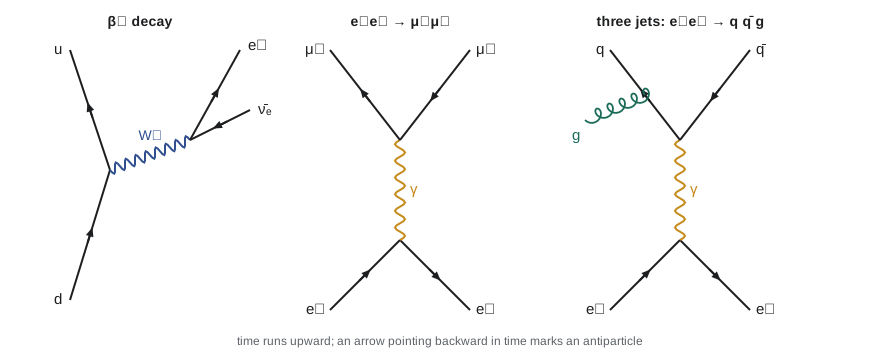
The second property is confinement. At large distances the coupling grows, and the gluon field between a quark and an antiquark is squeezed into a narrow tube with a constant energy per unit length, about 1 GeV/fm. Pulling the pair apart costs energy in proportion to their separation, so it would take infinite energy to isolate a quark. Long before that, the energy in the tube is enough to create a new quark-antiquark pair, and the tube breaks into two shorter ones, each with a quark at each end. In high-energy collisions this process repeats many times, so a quark knocked out of a proton emerges as a narrow spray of hadrons, a jet. Three-jet events at the PETRA collider in Hamburg in 1979, in which a quark had radiated a hard gluon, were the first direct evidence for gluons. Confinement has never been proved mathematically from QCD; doing so is one of the Clay Millennium Prize problems. But numerical lattice QCD calculations on supercomputers show it, and reproduce the masses of the proton and other hadrons to within a few parts in 100.
Exotic hadrons and the quark-gluon plasma
QCD allows other color-neutral combinations, and some have been found. Since 2003, many tetraquark candidates (\(qq\bar q\bar q\)) have been seen, and in 2015 the LHCb experiment at CERN found pentaquarks containing \(uudc\bar c\). At very high temperatures, above about \(2 \times 10^{12}\) K, hadrons are expected to dissolve into a plasma of free quarks and gluons, the state of the universe in its first microseconds. Collisions of heavy nuclei at the Relativistic Heavy Ion Collider at Brookhaven, which ran from 2000 to February 2026, and at the LHC have created it. To the surprise of many, it behaves not as a gas but as a nearly perfect liquid, with the lowest ratio of viscosity to entropy density of any known substance.
Worked problem
Quark content and charge
The \(\Sigma^+\) has strangeness \(-1\), baryon number 1 and charge +1. Find its quark content, and that of the \(K^0\) (strangeness +1, charge 0).
Show solution
- Baryon number 1 means three quarks; strangeness \(-1\) means one strange quark.
- The other two must give charge \(+1 - (-\tfrac13) = +\tfrac43\): two up quarks. So \(\Sigma^+ = uus\).
- The \(K^0\) is a meson with strangeness +1, so it contains \(\bar s\) (charge \(+\tfrac13\)).
- The other quark must have charge \(-\tfrac13\) and no strangeness: a down quark. So \(K^0 = d\bar s\).
Answer: \(\Sigma^+ = uus\) and \(K^0 = d\bar s\).
Common mistakes
MistakeThinking quark color is related to visible color.
InsteadIt is a three-valued charge of the strong interaction, named by analogy only.
MistakeAdding quark masses to get the proton mass.
InsteadThe light quark masses total about 9 MeV; most of the 938 MeV is field and kinetic energy.
MistakeExpecting the strong coupling to grow at high energy, as in QED.
InsteadGluon self-interaction makes \(\alpha_s\) fall with energy: asymptotic freedom.
MistakeBelieving free quarks could be isolated with enough energy.
InsteadThe color field breaks into new quark-antiquark pairs, producing jets of hadrons instead.
MistakeForgetting the factor \(N_c\) in the R ratio.
InsteadEach quark type is produced in three colors; the data require \(N_c = 3\).
Summary and key terms
- Baryons are \(qqq\) and mesons \(q\bar q\); \(u\), \(d\), \(s\) quarks explain the eightfold way; quark charges are \(+\tfrac23\) and \(-\tfrac13\).
- Color rescues the Pauli principle for \(\Delta^{++}\) and \(\Omega^-\); hadrons are color singlets; \(R = N_c\sum Q_q^2\) shows \(N_c = 3\).
- Deep inelastic scattering (1968) revealed point-like partons; gluons carry about half the proton's momentum.
- Charm (1974), bottom (1977) and top (1995) complete six quark flavors.
- QCD has eight self-interacting gluons, asymptotic freedom (\(\alpha_s\) falls with energy) and confinement, which produces jets.
- Quark
- Spin-\(\tfrac12\) constituent of hadrons with fractional charge.
- Strong charge
- The three-valued charge of the strong interaction, called color.
- Gluon
- Massless carrier of the strong force, itself color-charged.
- Asymptotic freedom
- Decrease of the strong coupling at high energy or short distance.
- Confinement
- The impossibility of isolating color-charged particles.
Practice problems
Work each problem on paper first, then reveal the answer to check.
What is the quark content of the \(\Xi^0\) (strangeness −2)?
Show answer
\(uss\).
Find R just above the bottom-quark threshold.
Show answer
\(3(\tfrac49 + \tfrac19 + \tfrac19 + \tfrac49 + \tfrac19) = \tfrac{11}{3}\).
Using the program, estimate \(\alpha_s\) at 1 TeV.
Show answer
About 0.09.
Why is the \(J/\psi\) so narrow?
Show answer
It lies below the threshold for decay into two charmed mesons, so it must annihilate, which is suppressed.
How much energy is stored in a 1.5 fm flux tube?
Show answer
About 1.5 GeV, enough to create several light quark pairs.
What would \(\beta_0\) be with 17 flavors?
Show answer
\(11 - 34/3 = -\tfrac13\): the theory would lose asymptotic freedom.
Lesson quiz · 5 questions
Score 60% or more to complete this lesson.
Create a free account to save your progress, take quizzes and earn a certificate.