
PHYS-382 · Lesson 6 of 12 · 22 min
Electromagnetic waves in vacuum: plane waves, energy and pressure
In empty space, with no charges or currents anywhere, Maxwell's equations still have nonzero solutions. The fields sustain each other: a changing magnetic field makes a circulating electric field, whose change makes a circulating magnetic field, and the pattern travels. This lesson derives the wave equation from Maxwell's equations, finds the plane-wave solutions and shows that they are transverse, with \(\mathbf{E}\) and \(\mathbf{B}\) perpendicular to each other and to the direction of travel and in a fixed ratio \(c\). It then computes the energy and momentum the waves carry, applies them to sunlight and to solar sails, and describes polarization. PHYS-230 introduced electromagnetic waves descriptively; here everything follows from the four equations.
The wave equation
In vacuum with \(\rho = 0\) and \(\mathbf{J} = \mathbf{0}\), the equations are \(\nabla\cdot\mathbf{E} = 0\), \(\nabla\cdot\mathbf{B} = 0\), \(\nabla\times\mathbf{E} = -\partial\mathbf{B}/\partial t\) and \(\nabla\times\mathbf{B} = \mu_0\varepsilon_0\,\partial\mathbf{E}/\partial t\). Take the curl of Faraday's law and use the identity \(\nabla\times(\nabla\times\mathbf{E}) = \nabla(\nabla\cdot\mathbf{E}) - \nabla^2\mathbf{E}\). The first term vanishes by Gauss's law, and the right side becomes \(-\partial(\nabla\times\mathbf{B})/\partial t = -\mu_0\varepsilon_0\,\partial^2\mathbf{E}/\partial t^2\). The same steps applied to the Ampère–Maxwell law give the equation for \(\mathbf{B}\):
Each Cartesian component of each field obeys the three-dimensional wave equation with speed
In 1862 Maxwell computed this speed from Wilhelm Weber and Rudolf Kohlrausch's measurement of the ratio of electromagnetic to electrostatic units and found it agreed with Hippolyte Fizeau's measurement of the speed of light within the accuracy of both. He wrote that light consists in transverse undulations of the same medium which is the cause of electric and magnetic phenomena. Today the logic runs the other way: since 1983 the meter has been defined by fixing \(c\) exactly, and since 2019 \(\mu_0\) and \(\varepsilon_0\) are measured quantities linked by \(\mu_0\varepsilon_0 = 1/c^2\).
The wave equation is necessary but not sufficient. Maxwell's equations are first order and couple the fields, so not every pair of solutions of the two wave equations is allowed. Substituting a candidate back into the original equations imposes extra conditions, and these are what make light transverse.
Monochromatic plane waves
The simplest solutions depend on position only through one coordinate along the direction of travel. A monochromatic plane wave traveling in the direction of the unit vector \(\hat{\mathbf{k}}\) is most conveniently written in complex form,
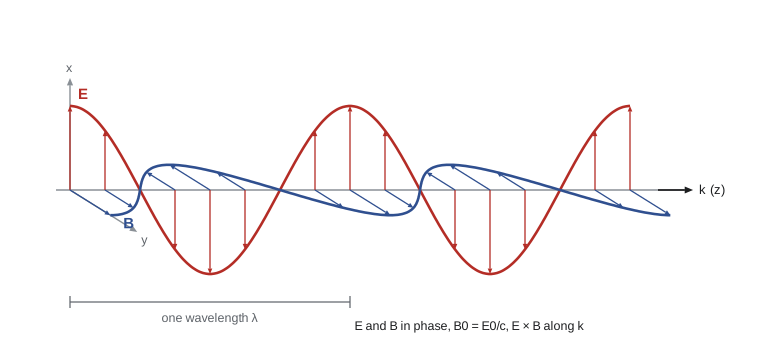
with the physical field given by the real part. The wave vector \(\mathbf{k} = k\hat{\mathbf{k}}\) has magnitude \(k = 2\pi/\lambda\), and the wave equation requires \(\omega = ck\). For such fields every derivative becomes multiplication: \(\nabla \to i\mathbf{k}\) and \(\partial/\partial t \to -i\omega\). The divergence equations give \(\mathbf{k}\cdot\tilde{\mathbf{E}}_0 = 0\) and \(\mathbf{k}\cdot\tilde{\mathbf{B}}_0 = 0\): both fields are perpendicular to the direction of travel. Faraday's law gives
So \(\mathbf{B}\) is perpendicular to \(\mathbf{E}\), in phase with it, and smaller by the factor \(c\): \(B_0 = E_0/c\). The three vectors \(\mathbf{E}\), \(\mathbf{B}\) and \(\mathbf{k}\) form a right-handed set, so that \(\mathbf{E}\times\mathbf{B}\) points along the direction of travel. In SI units the magnetic field of light looks tiny, a few microtesla for sunlight, but its force on a moving charge, \(qvB\), is smaller than the electric force \(qE\) only by the factor \(v/c\). The figure shows a snapshot.
Energy and momentum of a plane wave
For the real field \(\mathbf{E} = E_0\cos(kz - \omega t)\,\hat{\mathbf{x}}\), the magnetic energy density \(B^2/2\mu_0 = E^2/(2\mu_0c^2) = \tfrac{1}{2}\varepsilon_0E^2\) equals the electric one, so the total is \(u = \varepsilon_0E_0^2\cos^2(kz - \omega t)\). The Poynting vector is \(\mathbf{S} = cu\,\hat{\mathbf{z}}\): energy moves with the wave at speed \(c\). Averaged over a cycle, \(\cos^2\) gives \(\tfrac{1}{2}\), so
where \(I\) is the intensity, \(\mathbf{g}\) the momentum density, and \(Z_0 = \sqrt{\mu_0/\varepsilon_0} = \mu_0c \approx 376.7\ \Omega\) is the impedance of free space, the ratio \(E/H\) in a plane wave. When the wave strikes a surface that absorbs it completely, it delivers momentum per unit area per unit time \(I/c\), which is the radiation pressure. A perfect mirror receives twice that. For light striking at angle \(\theta\) from the normal, the pressure on an absorber is \(I\cos^2\theta/c\), one cosine because the beam spreads over a larger area and another because only the normal component of momentum pushes.
Sunlight, solar sails and laser pointers
Just above the atmosphere sunlight has an intensity of about 1361 W/m\(^2\), the total solar irradiance. The program finds the corresponding field amplitudes, about 1000 V/m and 3.4 \(\mu\)T, and a pressure of about 4.5 \(\mu\)Pa on an absorber: roughly the weight of a grain of sand spread over a square meter, a ten-billionth of atmospheric pressure. Tiny as it is, this pressure is free and never runs out. In 2010 the Japanese space agency JAXA flew IKAROS, the first spacecraft to use a solar sail as its main propulsion. Its square sail of thin polyimide film, about 14 m on a side, was coated with aluminum and carried thin-film solar cells. The program estimates the force for an ideal flat mirror and for more realistic reflectivities; the thrust actually measured in flight was about 1 mN, below the ideal because the sail was not perfectly flat or reflective and did not always face the Sun squarely. Radiation pressure also shapes comet tails, which point away from the Sun, and must be included in navigating any spacecraft precisely.
import math
eps0 = 8.8541878188e-12; mu0 = 1.25663706212e-6; c = 2.99792458e8
Z0 = math.sqrt(mu0 / eps0)
print(f"impedance of free space Z0 = {Z0:.2f} ohm")

# 1. Sunlight above the atmosphere: intensity 1361 W/m^2
I = 1361.0
E0 = math.sqrt(2 * I / (c * eps0)); B0 = E0 / c
u = I / c
print(f"sunlight: E0 = {E0:.1f} V/m, B0 = {B0 * 1e6:.3f} uT, mean energy density {u * 1e6:.3f} uJ/m^3")
print(f"pressure on an absorber {I / c * 1e6:.3f} uPa, on a perfect mirror {2 * I / c * 1e6:.3f} uPa")

# 2. The IKAROS solar sail (2010): about 196 m^2 of reflective film near 1 AU
area = 196.0
F_ideal = 2 * I / c * area
print(f"ideal mirror sail force = {F_ideal * 1e3:.2f} mN")
for refl in (0.9, 0.8):
    # a fraction refl is reflected, the rest absorbed; light hits face-on
    F = (1 + refl) * I / c * area
    print(f"with reflectivity {refl:.1f}: {F * 1e3:.2f} mN")

# 3. A 5 mW laser pointer focused to a 1 mm diameter spot
P, dspot = 5e-3, 1e-3
Ilas = P / (math.pi * (dspot / 2) ** 2)
print(f"laser pointer: intensity {Ilas:.0f} W/m^2 ({Ilas / I:.1f} suns), E0 = {math.sqrt(2 * Ilas * Z0):.0f} V/m")

# 4. Polarization: add two perpendicular components with a phase difference and
#    trace the tip of E over one cycle (axis ratio and sense of rotation).
for name, Ex, Ey, phase in [("linear 45 deg", 1, 1, 0.0), ("circular", 1, 1, math.pi / 2), ("elliptical", 1, 0.5, math.pi / 3)]:
    pts = [(Ex * math.cos(t), Ey * math.cos(t - phase)) for t in [2 * math.pi * j / 360 for j in range(360)]]
    r = [math.hypot(x, y) for x, y in pts]
    cross = pts[0][0] * pts[1][1] - pts[0][1] * pts[1][0]
    sense = "none" if abs(cross) < 1e-12 else ("counterclockwise" if cross > 0 else "clockwise")
print(f"{name:14s}: max |E| {max(r):.3f}, min |E| {min(r):.3f}, rotation seen facing the source: {sense}")impedance of free space Z0 = 376.73 ohm sunlight: E0 = 1012.6 V/m, B0 = 3.378 uT, mean energy density 4.540 uJ/m^3 pressure on an absorber 4.540 uPa, on a perfect mirror 9.080 uPa ideal mirror sail force = 1.78 mN with reflectivity 0.9: 1.69 mN with reflectivity 0.8: 1.60 mN laser pointer: intensity 6366 W/m^2 (4.7 suns), E0 = 2190 V/m linear 45 deg : max |E| 1.414, min |E| 0.000, rotation seen facing the source: none circular : max |E| 1.000, min |E| 1.000, rotation seen facing the source: counterclockwise elliptical : max |E| 1.037, min |E| 0.418, rotation seen facing the source: counterclockwise
The laser pointer concentrates 5 mW into a 1 mm spot, nearly five times the intensity of direct sunlight, which is why looking into one is dangerous: the eye focuses the beam to a spot far smaller still. Its field of about 2 kV/m is nonetheless small compared with the field of about 3 MV/m at which air breaks down. Pulsed lasers focused to micrometer spots can exceed atomic fields, about \(5 \times 10^{11}\) V/m, which opens the nonlinear optics that PHYS-460 discusses.
The electromagnetic spectrum
Nothing in the derivation fixes the frequency. The same equations describe power-line fields at 60 Hz with wavelengths of 5000 km, radio and television from kilohertz to gigahertz, microwaves, infrared, the narrow visible band from about 400 to 700 nm, ultraviolet, X-rays and gamma rays with wavelengths smaller than an atomic nucleus. All travel at \(c\) in vacuum. What differs is how they interact with matter, because that depends on how the wavelength and the photon energy \(hf\) compare with the sizes and energy levels of atoms, molecules and electrons in solids. That is why glass is transparent to visible light but not to ultraviolet, why the atmosphere passes visible light and radio but blocks most X-rays, and why lessons 7 and 8 must describe materials by a permittivity that depends on frequency.
Polarization
The direction of \(\tilde{\mathbf{E}}_0\) is the polarization. For a wave traveling along \(z\), the most general amplitude is \(\tilde{\mathbf{E}}_0 = E_x\hat{\mathbf{x}} + E_ye^{i\delta}\hat{\mathbf{y}}\) with real \(E_x\), \(E_y\) and a relative phase \(\delta\). If \(\delta = 0\) or \(\pi\), the field oscillates along a fixed line: linear polarization. If \(E_x = E_y\) and \(\delta = \pm\pi/2\), the tip of \(\mathbf{E}\) traces a circle once per cycle: circular polarization. Every other case is elliptical. The program traces the tip of \(\mathbf{E}\) over one cycle for three cases and reports the largest and smallest magnitudes and the sense of rotation for an observer facing the oncoming wave.
Circular polarization carries angular momentum: a circularly polarized beam of power \(P\) and angular frequency \(\omega\) delivers torque \(P/\omega\) to an absorber, which Richard Beth measured in 1936 by transferring the spin of light to a quartz wave plate. In quantum terms each photon carries angular momentum \(\pm\hbar\) along its direction of motion, and energy \(\hbar\omega\), so the ratio of angular momentum to energy is \(1/\omega\) in both pictures. Unpolarized light, such as sunlight, is a rapid random mixture of polarizations; reflection, scattering and passage through polarizing filters can select particular components, as lesson 7 shows.
Worked problem
Fields of a radio station
A radio station radiates 50 kW uniformly over a hemisphere. Find the intensity and the electric and magnetic field amplitudes 10 km away.
Show solution
- Hemisphere area: \(2\pi r^2 = 2\pi \times 10^8 = 6.28 \times 10^8\) m\(^2\), so \(I = 5 \times 10^4/6.28 \times 10^8 = 7.96 \times 10^{-5}\) W/m\(^2\).
- \(E_0 = \sqrt{2Z_0I} = \sqrt{2 \times 376.7 \times 7.96 \times 10^{-5}} = 0.245\) V/m.
- \(B_0 = E_0/c = 8.2 \times 10^{-10}\) T.
- A receiving antenna about a meter long therefore sees an induced EMF of order a tenth of a volt, ample for a radio.
Answer: About 80 \(\mu\)W/m\(^2\), with \(E_0 \approx 0.25\) V/m and \(B_0 \approx 0.8\) nT.
Common mistakes
MistakeTreating every solution of the wave equation as a valid electromagnetic wave.
InsteadMaxwell's first-order equations also require transversality and \(\mathbf{B}_0 = \hat{\mathbf{k}}\times\mathbf{E}_0/c\).
MistakeConcluding that the magnetic part of light is negligible because \(B_0 = E_0/c\) is small.
InsteadIt carries exactly half the energy; the magnetic force is smaller only by \(v/c\).
MistakeForgetting the factor \(\tfrac{1}{2}\) in the time-averaged intensity.
Instead\(\langle\cos^2\rangle = \tfrac{1}{2}\), so \(I = \tfrac{1}{2}c\varepsilon_0E_0^2\).
MistakeUsing \(I/c\) for the pressure on a mirror.
InsteadReflection doubles it to \(2I/c\) at normal incidence.
MistakeCalling unpolarized light a fixed mixture of two linear polarizations.
InsteadIt is a randomly varying polarization; its time averages behave like an incoherent mixture.
Summary and key terms
- In vacuum each field component obeys the wave equation with speed \(c = 1/\sqrt{\mu_0\varepsilon_0}\).
- Plane waves are transverse: \(\mathbf{E}\), \(\mathbf{B}\) and \(\mathbf{k}\) form a right-handed set, with \(B_0 = E_0/c\) and the fields in phase.
- Electric and magnetic energy densities are equal; \(I = \tfrac{1}{2}c\varepsilon_0E_0^2 = E_0^2/2Z_0\) with \(Z_0 \approx 377\ \Omega\).
- Radiation pressure is \(I/c\) on an absorber and \(2I/c\) on a mirror; sunlight gives about 4.5 \(\mu\)Pa at Earth.
- Polarization can be linear, circular or elliptical; circularly polarized light carries angular momentum \(P/\omega\) per second.
- plane wave
- A wave whose fields are uniform over every plane perpendicular to its direction of travel.
- wave vector
- The vector k pointing along the direction of travel, with magnitude 2 pi / lambda.
- transverse wave
- A wave whose fields are perpendicular to its direction of travel.
- intensity
- The time-averaged power per unit area carried by a wave, the average of the Poynting vector.
- impedance of free space
- Z0 = sqrt(mu0/eps0), about 377 ohms, the ratio E/H in a plane wave.
- polarization
- The direction and pattern traced by the electric field of a wave over a cycle.
Practice problems
Work each problem on paper first, then reveal the answer to check.
Show that \(\mathbf{E} = E_0\sin(kx + \omega t)\,\hat{\mathbf{z}}\) is a wave traveling in the \(-x\) direction, and find \(\mathbf{B}\).
Show answer
It depends on \(x + ct\). With \(\hat{\mathbf{k}} = -\hat{\mathbf{x}}\), \(\mathbf{B} = \hat{\mathbf{k}}\times\mathbf{E}/c = (E_0/c)\sin(kx + \omega t)\,\hat{\mathbf{y}}\).
A 1 mW laser beam has a diameter of 2 mm. Find its intensity and electric field amplitude.
Show answer
\(I = 10^{-3}/(\pi \times 10^{-6}) = 318\) W/m\(^2\); \(E_0 = \sqrt{2Z_0I} = 490\) V/m.
What area of perfectly reflecting sail would give a 1000 kg spacecraft an acceleration of \(1\) mm/s\(^2\) near Earth's orbit?
Show answer
Force needed 1 N; pressure \(2I/c = 9.08\ \mu\)Pa, so the area is \(1.1 \times 10^5\) m\(^2\), a square about 330 m on a side.
Find the radiation pressure of sunlight on an absorbing panel tilted 60° from facing the Sun.
Show answer
\(p = I\cos^2\theta/c = 4.54 \times 0.25 = 1.1\ \mu\)Pa.
A circularly polarized 2 W beam at 633 nm is fully absorbed. Find the torque on the absorber.
Show answer
\(\omega = 2\pi c/\lambda = 2.98 \times 10^{15}\) rad/s, so \(\tau = P/\omega = 6.7 \times 10^{-16}\) N m.
Express the intensity of a plane wave in terms of its magnetic field amplitude.
Show answer
\(I = cB_0^2/(2\mu_0)\).
Lesson quiz · 5 questions
Score 60% or more to complete this lesson.
Create a free account to save your progress, take quizzes and earn a certificate.