
PHYS-382 · Lesson 11 of 12 · 23 min
Radiation: dipole radiation, the Larmor formula and antennas
Accelerating charges radiate: they send energy away to infinity in fields that fall off only as \(1/r\), so that the power crossing a large sphere does not shrink as the sphere grows. This lesson uses the retarded potentials to find the fields of an oscillating electric dipole, the simplest radiating system, and derives its radiation pattern and total power. It then obtains the Larmor formula for the power radiated by any accelerated point charge, applies it to the classical atom, which it famously dooms, and to synchrotron light sources, and ends with antennas: radiation resistance, the half-wave dipole and directivity. Heinrich Hertz's experiments of 1887 and 1888, with spark-gap transmitters and loop receivers, were the first deliberate production and detection of such radiation.
What counts as radiation
A static charge has a field that falls as \(1/r^2\), so its energy flux through a sphere of radius \(r\), proportional to \(r^2E^2\), vanishes as \(r \to \infty\). A field that carries energy to infinity must contain parts falling as \(1/r\), so that \(r^2|\mathbf{S}|\) tends to a finite limit. The retarded potentials of lesson 10 contain such parts: differentiating a retarded source \(\rho(\mathbf{r}', t - \mathscr{r}/c)\) with respect to position produces a term proportional to \(\dot{\rho}/c\), which falls one power of \(\mathscr{r}\) more slowly than the static term. Radiation is therefore tied to time derivatives of the sources, and for a point charge, as shown below, to its acceleration.
The oscillating electric dipole
Take two small spheres at \(z = \pm d/2\) joined by a wire, with charge sloshing between them so that the dipole moment is \(\mathbf{p}(t) = p_0\cos\omega t\,\hat{\mathbf{z}}\), \(p_0 = q_0d\). The current in the wire is \(I(t) = -q_0\omega\sin\omega t\). We make three approximations, all satisfied in the radiation zone of a small antenna: the dipole is small, \(d \ll r\); it is small compared with the wavelength, \(d \ll \lambda = 2\pi c/\omega\); and we look far away, \(r \gg \lambda\). Under them the retarded potentials give, to leading order in \(1/r\),
Computing \(\mathbf{E} = -\nabla V - \partial\mathbf{A}/\partial t\) and \(\mathbf{B} = \nabla\times\mathbf{A}\), and keeping only the \(1/r\) terms, gives the radiation fields
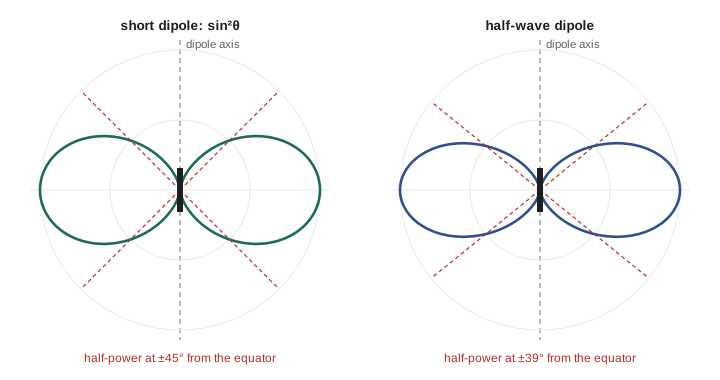
These are outgoing spherical waves. Locally they look like plane waves: \(\mathbf{E}\) and \(\mathbf{B}\) are perpendicular to each other and to the radial direction, in phase, with \(E = cB\). Their amplitude carries the factor \(\sin\theta\): nothing is radiated along the dipole's axis, and the radiation is strongest in the equatorial plane. The Poynting vector, averaged over a cycle, is
using \(\int_0^\pi\sin^3\theta\,d\theta = 4/3\). The flux through any large sphere is the same, so the energy really does escape. The \(\omega^4\) dependence is crucial. Molecules in the air are driven by sunlight to oscillate as small dipoles at the light's frequency and reradiate it in all directions; since blue light has nearly twice the frequency of red, it is scattered about \(2^4 = 16\) times more strongly, or about 6 times for wavelengths of 450 and 700 nm. This Rayleigh scattering is why the sky is blue and sunsets are red: looking toward the setting Sun, you see light from which the blue has been scattered away. The \(\sin^2\theta\) pattern also explains why skylight 90° from the Sun is strongly polarized.
The Larmor formula
For a single point charge \(q\) with acceleration \(\mathbf{a}\), moving slowly compared with light, the Liénard–Wiechert potentials of lesson 10 give a radiation field \(E_{\text{rad}} = \frac{\mu_0q}{4\pi}\frac{a\sin\theta}{r}\), where \(\theta\) is measured from the direction of the acceleration; this is the dipole result with \(\ddot{p} = qa\) in place of \(-p_0\omega^2\cos\omega t\). Integrating \(E_{\text{rad}}^2/(\mu_0c)\) over a sphere gives the total power radiated,
found by Joseph Larmor in 1897. A charge moving at constant velocity does not radiate; only acceleration does. Every source of electromagnetic radiation, from the electrons sloshing in a radio antenna to those jumping in an X-ray tube's target, can be traced to accelerating charges. At relativistic speeds the formula picks up powers of \(\gamma = 1/\sqrt{1 - v^2/c^2}\), as found by Liénard: for circular motion, where the acceleration is perpendicular to the velocity, the power is \(\gamma^4\) times the Larmor value, and the radiation is concentrated in a narrow forward cone of angle about \(1/\gamma\).
The Larmor formula sealed the fate of the classical model of the atom. An electron circling a proton at the Bohr radius has an acceleration of about \(9 \times 10^{22}\) m/s\(^2\) and would radiate about 50 nW. As it lost energy it would spiral inward, faster and faster, reaching the nucleus in about \(1.6 \times 10^{-11}\) s while emitting a continuous smear of frequencies. Real atoms are stable and emit sharp spectral lines, and the resolution came only with quantum mechanics: the ground state of hydrogen has no lower state to radiate into, as PHYS-271 explained.
Synchrotron radiation
The \(\gamma^4\) factor makes circular electron accelerators powerful light sources. In a storage ring, electrons with energies of a few GeV circle at nearly the speed of light, and every bending magnet makes them radiate a fan of intense, highly collimated light extending from the infrared to hard X-rays. The energy each electron loses per turn is \(U = e^2\gamma^4/(3\varepsilon_0\rho)\), where \(\rho\) is the bending radius; in practical units \(U \approx 88.5\ \text{keV}\times E^4/\rho\) with \(E\) in GeV and \(\rho\) in meters. Radio-frequency cavities replace this energy each turn. The Advanced Photon Source at Argonne National Laboratory near Chicago, rebuilt in 2023 and 2024 around a new, much brighter storage ring, operates at 6 GeV and serves thousands of researchers each year; Canada's national synchrotron, the Canadian Light Source in Saskatoon, runs at 2.9 GeV. The program estimates the energy loss per turn for both, taking round values for their bending radii. The steep dependence on energy is why the largest electron rings are so large, and why proton rings, with \(\gamma\) nearly 2000 times smaller at the same energy, radiate almost nothing.
Antennas and radiation resistance
An antenna fed with an oscillating current of amplitude \(I_0\) radiates power \(\langle P\rangle\), which the transmitter must supply. It is convenient to write \(\langle P\rangle = \tfrac{1}{2}I_0^2R_{\text{rad}}\), defining the radiation resistance \(R_{\text{rad}}\): the resistance that would dissipate the same average power. For a short antenna of length \(l\) carrying a uniform current, \(p_0\omega = I_0l\), and the dipole formula gives
Short antennas have tiny radiation resistance and are inefficient, because most of the supplied power is lost in the ordinary resistance of the wire. The common half-wave dipole, two rods each a quarter wavelength long fed at the middle, carries a current that falls sinusoidally to zero at the tips. Adding up the radiation from each element of current, with its own phase, gives a pattern \(\propto[\cos(\tfrac{\pi}{2}\cos\theta)/\sin\theta]^2\). Its radiation resistance, found by integrating that pattern numerically, is about 73 \(\Omega\), conveniently close to standard cable impedances. A receiving antenna works in reverse: the incoming wave's electric field drives currents along it, and by reciprocity the same pattern describes how well it receives from each direction.
The directivity \(D\) of an antenna is the ratio of its peak intensity to the intensity an isotropic radiator of the same total power would produce. For a short dipole \(D = 1.5\); for a half-wave dipole \(D \approx 1.64\). Arrays of many elements, phased so their fields add in one direction, achieve much larger directivity: the Yagi antennas on rooftops, the dishes of radio telescopes, and the phased arrays of modern radar and 5G base stations. Canada's CHIME radio telescope in British Columbia, built from fixed half-pipe reflectors with arrays of dipole receivers, maps the sky as the Earth turns and has detected thousands of fast radio bursts.
import math
c = 2.99792458e8; eps0 = 8.8541878188e-12; mu0 = 4e-7 * math.pi
e, me = 1.602176634e-19, 9.1093837e-31
Z0 = math.sqrt(mu0 / eps0)

# 1. Short (Hertzian) dipole: radiation resistance R = (2 pi/3) Z0 (l/lambda)^2
for l_over_lam in (0.01, 0.05, 0.1):
    print(f"short dipole l = {l_over_lam} wavelength: radiation resistance {2 * math.pi / 3 * Z0 * l_over_lam**2:.3f} ohm")

# 2. Half-wave dipole: integrate its far-field pattern to get the radiated power and resistance.
#    Intensity per unit solid angle is proportional to [cos(pi/2 cos th)/sin th]^2.
n = 20000; integ = 0.0
for i in range(n):
    th = math.pi * (i + 0.5) / n
    integ += (math.cos(math.pi / 2 * math.cos(th)) ** 2 / math.sin(th)) * (math.pi / n)
I0 = 1.0
P = Z0 * I0 * I0 / (4 * math.pi) * integ        # total power for current amplitude I0
R_half = 2 * P / I0 ** 2
D_half = 4 * math.pi * (Z0 * I0**2 / (8 * math.pi**2)) / P
print(f"half-wave dipole: pattern integral {integ:.4f}, radiation resistance {R_half:.1f} ohm, directivity {D_half:.3f}")
# half-power beamwidth: the angle from broadside where the intensity falls to one half
pattern = lambda th: (math.cos(math.pi / 2 * math.cos(th)) / math.sin(th)) ** 2
th = math.pi / 2
while pattern(th) > 0.5: th -= 1e-5
print(f"half-power beamwidth: short dipole 90 deg, half-wave dipole {2 * math.degrees(math.pi / 2 - th):.1f} deg")

# 3. Larmor formula P = q^2 a^2 / (6 pi eps0 c^3): the classical atom would spiral in.
a0 = 5.29177e-11
a_c = e * e / (4 * math.pi * eps0 * me * a0 * a0)
P_L = e * e * a_c * a_c / (6 * math.pi * eps0 * c ** 3)
t_collapse = a0 ** 3 / (4 * (e * e / (4 * math.pi * eps0 * me * c * c)) ** 2 * c)
print(f"electron in a Bohr orbit: acceleration {a_c:.3e} m/s^2, radiated power {P_L:.3e} W, "
      f"classical collapse time {t_collapse:.2e} s")

# 4. Synchrotron light sources: energy radiated per turn U = 88.5 keV x E[GeV]^4 / rho[m]
for name, E_GeV, rho in (("Canadian Light Source (2.9 GeV, bend radius taken as 7 m)", 2.9, 7.0),
                         ("Advanced Photon Source (6 GeV, bend radius taken as 40 m)", 6.0, 40.0)):
    gam = E_GeV * 1e9 * e / (me * c * c)
    U = e ** 2 * gam ** 4 / (3 * eps0 * rho) / e      # energy per turn in eV, from Larmor with gamma^4
    print(f"{name}: gamma = {gam:.0f}, energy lost per turn {U / 1e3:.0f} keV "
f"(formula 88.5 keV E^4/rho gives {88.5 * E_GeV**4 / rho:.0f} keV)")short dipole l = 0.01 wavelength: radiation resistance 0.079 ohm short dipole l = 0.05 wavelength: radiation resistance 1.973 ohm short dipole l = 0.1 wavelength: radiation resistance 7.890 ohm half-wave dipole: pattern integral 1.2188, radiation resistance 73.1 ohm, directivity 1.641 half-power beamwidth: short dipole 90 deg, half-wave dipole 78.1 deg electron in a Bohr orbit: acceleration 9.044e+22 m/s^2, radiated power 4.669e-08 W, classical collapse time 1.56e-11 s Canadian Light Source (2.9 GeV, bend radius taken as 7 m): gamma = 5675, energy lost per turn 894 keV (formula 88.5 keV E^4/rho gives 894 keV) Advanced Photon Source (6 GeV, bend radius taken as 40 m): gamma = 11742, energy lost per turn 2866 keV (formula 88.5 keV E^4/rho gives 2867 keV)
A dipole a hundredth of a wavelength long has a radiation resistance below a tenth of an ohm, which is why the short whip antennas of AM car radios receive but would make poor transmitters. The numerical integral of the half-wave pattern gives 73.1 \(\Omega\) and a directivity of 1.641, and a half-power beamwidth of 78°, narrower than the short dipole's 90°. The classical atom collapses in 16 picoseconds, the result that physicists around 1910 could not escape without quantum mechanics. Taking round bending radii of 7 m and 40 m, the two rings lose about 0.9 MeV and 2.9 MeV per electron per turn, and the exact expression and the practical formula agree.
Worked problem
Power from a radio antenna
A half-wave dipole for a 100 MHz FM broadcast is fed with a current of amplitude 2.0 A. Find its length, the power it radiates and the peak intensity 10 km away in the equatorial plane.
Show solution
- \(\lambda = c/f = 3.0\) m, so the antenna is 1.5 m long.
- \(\langle P\rangle = \tfrac{1}{2}I_0^2R_{\text{rad}} = 0.5 \times 4.0 \times 73 = 146\) W.
- An isotropic radiator would give \(146/(4\pi \times 10^8) = 1.16 \times 10^{-7}\) W/m\(^2\) at 10 km.
- The directivity 1.64 raises this to \(1.9 \times 10^{-7}\) W/m\(^2\) in the equatorial plane.
Answer: 1.5 m long, radiating about 146 W, with a peak intensity of about 0.19 \(\mu\)W/m\(^2\) at 10 km.
Common mistakes
MistakeThinking a charge moving at constant velocity radiates.
InsteadOnly acceleration produces the \(1/r\) radiation field; a uniformly moving charge carries its field along with it.
MistakeExpecting a dipole to radiate most strongly along its axis.
InsteadThe pattern is \(\sin^2\theta\): zero along the axis, maximum broadside.
MistakeTreating radiation resistance as a loss in the wire.
InsteadIt represents power carried away to infinity; ohmic losses are separate.
MistakeForgetting the \(\omega^4\) dependence of dipole radiation.
InsteadDoubling the frequency multiplies the radiated power by 16 for the same dipole moment.
MistakeUsing the nonrelativistic Larmor formula for a storage ring.
InsteadFor circular motion the power is enhanced by \(\gamma^4\), which can be \(10^{15}\) or more.
Summary and key terms
- Radiation fields fall as \(1/r\) and carry energy to infinity; they arise from time derivatives of the sources.
- An oscillating dipole radiates \(\langle P\rangle = \mu_0p_0^2\omega^4/12\pi c\) with pattern \(\sin^2\theta\); the \(\omega^4\) law explains the blue sky.
- The Larmor formula \(P = q^2a^2/6\pi\varepsilon_0c^3\) gives the power radiated by an accelerated charge; it predicts collapse of a classical atom.
- In storage rings the radiated power is enhanced by \(\gamma^4\); the energy lost per turn is \(88.5\ \text{keV}\,E^4/\rho\) for electrons.
- Antennas are described by radiation resistance and directivity: about \(790(l/\lambda)^2\ \Omega\) for a short dipole, 73 \(\Omega\) and 1.64 for a half-wave dipole.
- radiation zone
- The region far from a source, many wavelengths away, where the 1/r fields dominate.
- electric dipole radiation
- Radiation from an oscillating dipole moment, with power proportional to omega^4.
- Larmor formula
- The power q^2 a^2 / (6 pi eps0 c^3) radiated by an accelerated point charge.
- synchrotron radiation
- Radiation emitted by relativistic charges moving on curved paths.
- radiation resistance
- The resistance that would dissipate the same power an antenna radiates.
- directivity
- The ratio of an antenna's peak intensity to that of an isotropic radiator of the same power.
Practice problems
Work each problem on paper first, then reveal the answer to check.
By what factor does Rayleigh scattering of violet light (400 nm) exceed that of red light (700 nm)?
Show answer
\((700/400)^4 = 9.4\). The sky is not violet mainly because sunlight contains less violet and our eyes are less sensitive to it.
An electron in an X-ray tube is stopped from 30 keV in about \(10^{-18}\) s. Estimate the energy radiated, using the Larmor formula with constant deceleration.
Show answer
\(v = 1.0 \times 10^8\) m/s, so \(a = 10^{26}\) m/s\(^2\); \(P = e^2a^2/(6\pi\varepsilon_0c^3) = 5.7 \times 10^{-2}\) W for \(10^{-18}\) s gives \(6 \times 10^{-20}\) J, about 0.4 eV, a small fraction of 30 keV, so most of the energy goes into heat.
A short antenna 1.0 m long is used at 1 MHz. Find its radiation resistance and the current needed to radiate 1 kW.
Show answer
\(\lambda = 300\) m, \(R_{\text{rad}} = 790/90000 = 8.8\) m\(\Omega\); \(I_0 = \sqrt{2P/R} = 480\) A, impractical, which is why AM broadcast towers are tall.
Show that the dipole radiation intensity falls to half its maximum at 45° from the equatorial plane.
Show answer
\(\sin^2\theta = 1/2\) at \(\theta = 45°\) or \(135°\) from the axis, which are 45° from the equator.
Find the energy lost per turn by a 1 GeV electron in a ring of bending radius 3.3 m.
Show answer
\(U = 88.5 \times 1/3.3 = 27\) keV.
How does the power radiated by a dipole change if its frequency is tripled at fixed dipole amplitude?
Show answer
It grows by \(3^4 = 81\).
Lesson quiz · 5 questions
Score 60% or more to complete this lesson.
Create a free account to save your progress, take quizzes and earn a certificate.