
PHYS-382 · Lesson 5 of 12 · 23 min
Conservation laws: charge, energy and momentum
A conservation law in field theory has two parts: a density, saying how much of a quantity sits in each small volume, and a flux, saying how fast it flows across each surface. Charge is the first example, with the continuity equation. This lesson derives the same structure for energy and momentum directly from Maxwell's equations. The energy density of the fields is \(\tfrac{\varepsilon_0}{2}E^2 + \tfrac{1}{2\mu_0}B^2\), and energy flows with the Poynting vector \(\mathbf{S} = \mathbf{E}\times\mathbf{B}/\mu_0\). The momentum density is \(\varepsilon_0\mathbf{E}\times\mathbf{B}\), and momentum flows with the Maxwell stress tensor. These quantities are not bookkeeping devices. They tell you that the energy delivered to a light bulb travels through the space around the wires rather than inside them, that light pushes on what it strikes, and that the force between two charges can be calculated entirely from the fields on a surface between them.
Charge conservation
The continuity equation \(\partial\rho/\partial t + \nabla\cdot\mathbf{J} = 0\) is the model for every local conservation law. Integrated over a fixed volume \(V\) bounded by \(S\), it says \(dQ/dt = -\oint_S\mathbf{J}\cdot d\mathbf{a}\): the charge inside can change only by flowing out through the boundary. Charge cannot vanish at one point and reappear elsewhere, even if the total is unchanged, because that would require an instantaneous jump across space. Lesson 1 showed that the continuity equation is built into Maxwell's equations through the displacement current. Every other conservation law below will be found in the same form, a time derivative of a density plus the divergence of a flux, with a source term describing exchange with the charges.
Poynting's theorem
Consider the work that the fields do on the charges in a volume. In a time \(dt\), a charge \(q\) moving with velocity \(\mathbf{v}\) receives work \(\mathbf{F}\cdot\mathbf{v}\,dt = q\mathbf{E}\cdot\mathbf{v}\,dt\); the magnetic force does no work. For a continuous distribution, \(q\mathbf{v}\) becomes \(\mathbf{J}\,d\tau\), so the rate at which the fields do work on all the charges in \(V\) is
Use the Ampère–Maxwell law to eliminate \(\mathbf{J}\): \(\mathbf{E}\cdot\mathbf{J} = \frac{1}{\mu_0}\mathbf{E}\cdot(\nabla\times\mathbf{B}) - \varepsilon_0\mathbf{E}\cdot\partial\mathbf{E}/\partial t\). The product rule \(\nabla\cdot(\mathbf{E}\times\mathbf{B}) = \mathbf{B}\cdot(\nabla\times\mathbf{E}) - \mathbf{E}\cdot(\nabla\times\mathbf{B})\), together with Faraday's law, turns the first term into \(-\frac{1}{\mu_0}\mathbf{B}\cdot\partial\mathbf{B}/\partial t - \frac{1}{\mu_0}\nabla\cdot(\mathbf{E}\times\mathbf{B})\). Writing \(\mathbf{E}\cdot\partial\mathbf{E}/\partial t = \tfrac{1}{2}\partial(E^2)/\partial t\) and similarly for \(\mathbf{B}\), and applying the divergence theorem, gives Poynting's theorem:
The work done on the charges equals the decrease in the energy stored in the fields minus the energy that flows out through the surface. The energy density \(u = \tfrac{1}{2}(\varepsilon_0E^2 + B^2/\mu_0)\) combines the static results of PHYS-381 and lesson 3, and \(\mathbf{S}\), measured in watts per square meter, is the energy flux density. John Henry Poynting published the theorem in 1884, and Oliver Heaviside found it independently at about the same time. In local form, with \(u_{\text{mech}}\) the mechanical energy density of the charges,
the same shape as the continuity equation. One subtlety is that only the flux through closed surfaces is physically fixed; adding the curl of any vector field to \(\mathbf{S}\) would change the local flow without changing the theorem. The usual choice \(\mathbf{E}\times\mathbf{B}/\mu_0\) is the one that gives sensible results for radiation and that relativity singles out.
Where the energy in a circuit flows
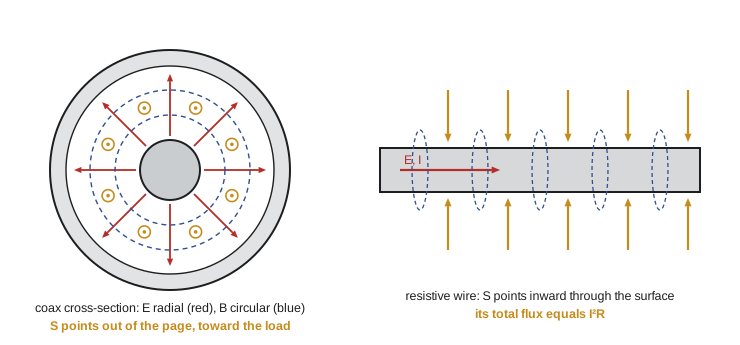
Poynting's theorem gives a surprising picture of how a battery powers a lamp. In a coaxial cable carrying current \(I\) at voltage \(V\), the electric field points radially between the inner and outer conductors and the magnetic field circles the axis. Their cross product points along the cable, toward the load. Integrating \(\mathbf{S}\) over the annulus between the conductors gives exactly \(VI\), the power delivered to the load. The energy flows in the insulating space between the conductors, not inside the copper. The conductors guide the energy; they do not carry it.
The same picture explains Joule heating. At the surface of a resistive wire, the electric field \(E = IR/L\) points along the wire and the magnetic field \(\mu_0I/2\pi a\) circles it. The Poynting vector therefore points radially inward, into the wire, and its flux through the surface is \(E \cdot \frac{\mu_0 I}{2\pi a}\cdot\frac{1}{\mu_0}\cdot 2\pi aL = IEL = I^2R\). The heat generated in a resistor enters it sideways from the surrounding field. The program checks both results.
Momentum and the Maxwell stress tensor
The fields also exchange momentum with charges. The total electromagnetic force on the charges in a volume is \(\mathbf{F} = \int(\rho\mathbf{E} + \mathbf{J}\times\mathbf{B})\,d\tau\). Eliminating \(\rho\) and \(\mathbf{J}\) with Gauss's law and the Ampère–Maxwell law, and using vector identities and Faraday's law, puts the force density in the form
where \(\overleftrightarrow{\mathbf{T}}\) is the Maxwell stress tensor, with components
Integrated over a volume, the total force on the charges inside is
Each component \(T_{ij}\) is the force per unit area in the \(i\) direction acting on a surface whose normal points in the \(j\) direction. The diagonal elements are pressures, or tensions when positive; the off-diagonal elements are shears. Faraday's lines of force behave like stretched rubber bands that also push sideways on each other: along the field the stress is a tension of \(\tfrac{1}{2}\varepsilon_0E^2\), across it a pressure of the same size. For static fields the second term vanishes, and the force on any collection of charges can be computed from the fields on a surface surrounding them, without knowing what is inside.
The second term identifies the momentum stored in the fields. Newton's third law and momentum conservation require
so the momentum density of the fields is \(\mathbf{S}/c^2\). Fields carrying energy flux carry momentum, and for light the momentum density is the energy density divided by \(c\). This is the origin of radiation pressure. A beam of power \(P\) that is completely absorbed delivers momentum at the rate \(P/c\) and therefore exerts force \(P/c\); a perfect mirror reverses the momentum and feels twice that. Pyotr Lebedev in Moscow and Ernest Nichols and Gordon Hull in the United States measured radiation pressure in 1900 and 1901, confirming Maxwell's prediction. There is also angular momentum density \(\mathbf{r}\times\mathbf{p}_{\text{em}}\), which lets circularly polarized light set small particles spinning.
Numerical checks
The program integrates the Poynting vector across the gap of a coaxial cable carrying 2 A at 100 V, computes the inward flux at the surface of a resistive copper wire, and then performs a classic check of the stress tensor: it computes the force between two equal charges by integrating \(T_{zz}\) over the plane midway between them. On that plane the field has no \(z\) component by symmetry, so \(T_{zz} = -\tfrac{1}{2}\varepsilon_0E^2\), and the integral, taken over rings out to 200 times the separation on a logarithmic grid, should reproduce Coulomb's law. Finally it gives the force of a 1 W light beam.
import math
eps0 = 8.8541878188e-12; mu0 = 4e-7 * math.pi; k = 1 / (4 * math.pi * eps0)

# 1. Coaxial cable carrying power V*I to a load: integrate S = E x B / mu0 over the gap
a, b, V, I = 0.5e-3, 1.75e-3, 100.0, 2.0
lam = 2 * math.pi * eps0 * V / math.log(b / a)        # line charge giving voltage V
n = 2000; P = 0.0
for i in range(n):
    s = a + (b - a) * (i + 0.5) / n
    E = lam / (2 * math.pi * eps0 * s); Bf = mu0 * I / (2 * math.pi * s)
    P += E * Bf / mu0 * 2 * math.pi * s * (b - a) / n
print(f"coax: power carried in the field = {P:.4f} W, V*I = {V * I:.4f} W")

# 2. Resistive wire: Poynting flux into the surface equals I^2 R
rho_cu, L, r, Iw = 1.68e-8, 1.0, 0.5e-3, 5.0
Rw = rho_cu * L / (math.pi * r * r)
Ez = Iw * Rw / L; Bs = mu0 * Iw / (2 * math.pi * r)
S_in = Ez * Bs / mu0
print(f"wire: S at surface = {S_in:.3f} W/m^2, times area {S_in * 2 * math.pi * r * L:.4f} W, I^2 R = {Iw**2 * Rw:.4f} W")

# 3. Force between two charges from the Maxwell stress tensor.
#    Charges q at (0,0,+d) and q at (0,0,-d). Integrate T_zz over the plane z = 0.
q, dd = 1e-9, 0.05
def Tzz(x, y):
    Ex = Ey = Ez = 0.0
    for zq in (dd, -dd):
        rx, ry, rz = x, y, -zq
        r3 = (rx * rx + ry * ry + rz * rz) ** 1.5
        Ex += k * q * rx / r3; Ey += k * q * ry / r3; Ez += k * q * rz / r3
    return eps0 * (Ez * Ez - 0.5 * (Ex * Ex + Ey * Ey + Ez * Ez))
# by symmetry use rings: dA = 2 pi s ds, with s up to 200 d on a logarithmic grid
F = 0.0; m = 4000; s_lo, s_hi = 1e-4 * dd, 200 * dd
for i in range(m):
    s1 = s_lo * (s_hi / s_lo) ** (i / m); s2 = s_lo * (s_hi / s_lo) ** ((i + 1) / m)
    sm = math.sqrt(s1 * s2)
    F += Tzz(sm, 0.0) * 2 * math.pi * sm * (s2 - s1)
print(f"stress-tensor force on the upper charge = {-F * 1e6:.4f} uN (repulsive, +z); "
      f"Coulomb k q^2/(2d)^2 = {k * q * q / (2 * dd) ** 2 * 1e6:.4f} uN")

# 4. Momentum carried by light: a 1 W laser beam fully absorbed, and fully reflected
Pl = 1.0; c = 2.99792458e8
print(f"1 W beam: force absorbed {Pl / c * 1e9:.3f} nN, reflected {2 * Pl / c * 1e9:.3f} nN")coax: power carried in the field = 200.0000 W, V*I = 200.0000 W wire: S at surface = 170.220 W/m^2, times area 0.5348 W, I^2 R = 0.5348 W stress-tensor force on the upper charge = 0.8987 uN (repulsive, +z); Coulomb k q^2/(2d)^2 = 0.8988 uN 1 W beam: force absorbed 3.336 nN, reflected 6.671 nN
The coaxial integral returns 200.0000 W, the power \(VI\). The inward Poynting flux at the wire surface equals \(I^2R\) to every printed digit. The stress-tensor force, 0.8987 \(\mu\)N, agrees with Coulomb's \(kq^2/(2d)^2\) to four figures; the small difference comes from cutting off the plane integral at a finite radius. The field has done the work of a Coulomb calculation without any reference to the charges themselves. And a 1 W beam pushes with 3.3 nN when absorbed, which is why radiation pressure is negligible in everyday life but measurable with sensitive torsion balances and important for spacecraft, as lesson 6 shows.
Worked problem
Energy flow in a charging capacitor
A parallel-plate capacitor with circular plates of radius \(a\) and spacing \(d\) is being charged, so the field between the plates grows. Show that the energy entering through the cylindrical edge of the gap equals the rate of increase of the stored electric energy.
Show solution
- Between the plates \(\mathbf{E}\) is axial and uniform. By the Ampère–Maxwell law the displacement current gives \(B\,2\pi a = \mu_0\varepsilon_0\pi a^2\,dE/dt\) at the edge, so \(B = \tfrac{1}{2}\mu_0\varepsilon_0 a\,dE/dt\), circling the axis.
- \(\mathbf{S} = \mathbf{E}\times\mathbf{B}/\mu_0\) points radially inward with magnitude \(\tfrac{1}{2}\varepsilon_0 aE\,dE/dt\).
- Flux through the edge, area \(2\pi a d\): \(P = \tfrac{1}{2}\varepsilon_0 aE\,\dot{E}\cdot 2\pi a d = \varepsilon_0 E\dot{E}\,\pi a^2 d\).
- The stored energy is \(U = \tfrac{1}{2}\varepsilon_0E^2\cdot\pi a^2d\), so \(dU/dt = \varepsilon_0E\dot{E}\,\pi a^2 d\), the same.
Answer: The energy enters the capacitor sideways through its edge, at exactly the rate the stored energy grows, as Poynting's theorem requires.
Common mistakes
MistakeThinking the energy in a circuit flows inside the wires.
InsteadIt flows through the surrounding space; the wires guide it and absorb what is lost as heat.
MistakeIncluding the magnetic force in the work done on charges.
Instead\(q\mathbf{v}\times\mathbf{B}\) is perpendicular to \(\mathbf{v}\) and does no work; only \(\mathbf{E}\cdot\mathbf{J}\) appears.
MistakeForgetting the factor 2 for a reflecting surface.
InsteadReflection reverses the momentum, so the force is \(2P/c\) rather than \(P/c\).
MistakeTreating the stress tensor as a vector.
Instead\(T_{ij}\) has two indices: force in direction \(i\) per unit area of a surface with normal in direction \(j\).
MistakeAssuming static fields carry no momentum.
InsteadWhenever \(\mathbf{E}\times\mathbf{B} \neq \mathbf{0}\), even for static fields, the fields carry momentum.
Summary and key terms
- Local conservation laws have the form \(\partial(\text{density})/\partial t + \nabla\cdot(\text{flux}) = \text{exchange with charges}\).
- Poynting's theorem: energy density \(\tfrac{1}{2}(\varepsilon_0E^2 + B^2/\mu_0)\), energy flux \(\mathbf{S} = \mathbf{E}\times\mathbf{B}/\mu_0\).
- In a coaxial cable the flux of \(\mathbf{S}\) between the conductors is \(VI\); a resistor receives \(I^2R\) through its surface.
- The Maxwell stress tensor gives the force on charges from the fields on a surrounding surface.
- Fields carry momentum density \(\mathbf{S}/c^2\); light exerts pressure \(I/c\) on absorbers and \(2I/c\) on mirrors.
- Poynting vector
- The energy flux density E x B / mu0 of an electromagnetic field, in W/m^2.
- Poynting's theorem
- The statement of energy conservation for fields and charges.
- Maxwell stress tensor
- The tensor T_ij giving the force per unit area transmitted by the fields.
- momentum density
- The momentum per unit volume eps0 E x B carried by the fields.
- radiation pressure
- The pressure exerted by light, equal to its intensity divided by c for an absorber.
- Joule heating
- Dissipation of energy at the rate J . E per unit volume in a conductor.
Practice problems
Work each problem on paper first, then reveal the answer to check.
A 1.0 m length of nichrome heating wire of radius 0.25 mm has resistance 22 \(\Omega\) and carries 1.5 A. Find the Poynting vector at its surface.
Show answer
\(P = I^2R = 49.5\) W over area \(2\pi aL = 1.57 \times 10^{-3}\) m\(^2\): \(S = 3.15 \times 10^4\) W/m\(^2\), pointing radially inward.
Find the energy density of a field with \(E = 3.0 \times 10^6\) V/m (near air breakdown).
Show answer
\(u = \tfrac{1}{2}\varepsilon_0E^2 = 0.5 \times 8.85 \times 10^{-12} \times 9 \times 10^{12} = 39.8\) J/m\(^3\).
Write \(T_{xx}\) and \(T_{xy}\) for a uniform field \(\mathbf{E} = E\hat{\mathbf{x}}\) with no magnetic field. Interpret them.
Show answer
\(T_{xx} = \tfrac{1}{2}\varepsilon_0E^2\) (a tension along the field), \(T_{yy} = T_{zz} = -\tfrac{1}{2}\varepsilon_0E^2\) (a pressure across it), \(T_{xy} = 0\).
Use the stress tensor to find the force per unit area on one plate of a parallel-plate capacitor with surface charge \(\sigma\).
Show answer
Enclose the plate; the field \(\sigma/\varepsilon_0\) is on one side only, and \(T_{zz} = \tfrac{1}{2}\varepsilon_0E^2 = \sigma^2/2\varepsilon_0\): an attraction toward the other plate, as in PHYS-381.
A 100 W light bulb radiates uniformly. Find the radiation pressure on a perfectly absorbing surface 2.0 m away, facing the bulb.
Show answer
\(I = 100/(4\pi \times 4) = 1.99\) W/m\(^2\), so \(p = I/c = 6.6 \times 10^{-9}\) Pa.
A static charge sits next to a bar magnet. Is there momentum in the fields? Angular momentum?
Show answer
Yes: \(\mathbf{E}\times\mathbf{B}\) is nonzero in general, so there is field momentum and angular momentum even though nothing moves; if the magnet is switched off, the system starts to rotate.
Lesson quiz · 5 questions
Score 60% or more to complete this lesson.
Create a free account to save your progress, take quizzes and earn a certificate.