
PHYS-344 · Lesson 6 of 12 · 26 min
Symmetry and conservation: Noether's theorem
Why is momentum conserved? Why angular momentum, and why energy? In PHYS-244 each conservation law was derived from Newton's laws for a particular kind of force. In 1918 Emmy Noether, working in Göttingen with David Hilbert and Felix Klein on problems arising from general relativity, proved a theorem that answers all three questions at once and explains where conservation laws come from: every continuous symmetry of the action produces a conserved quantity. Translation symmetry gives momentum, rotation symmetry gives angular momentum, and symmetry under shifts in time gives energy. The theorem has become one of the organizing principles of physics, from mechanics to particle physics.
Symmetries of a Lagrangian
A transformation of the coordinates is a symmetry if it leaves the Lagrangian unchanged (or, more generally, changes it only by a total time derivative, which does not affect the equations of motion). We are interested in continuous families of transformations that depend on a parameter \(\varepsilon\) and reduce to the identity at \(\varepsilon = 0\), such as translations by a distance \(\varepsilon\) or rotations by an angle \(\varepsilon\). For small \(\varepsilon\) such a transformation moves each coordinate by
where \(K_j\) describes the direction of the change. For a translation of a single particle along \(x\), \(K = (1, 0, 0)\); for a rotation about the \(z\) axis, \(\delta x = -\varepsilon y\), \(\delta y = \varepsilon x\), so \(K = (-y, x, 0)\).
The theorem
Suppose \(L\) is unchanged to first order: \(\delta L = \sum_j\big(\frac{\partial L}{\partial q_j}\varepsilon K_j + \frac{\partial L}{\partial\dot q_j}\varepsilon\dot K_j\big) = 0\). On a solution of Lagrange's equations replace \(\partial L/\partial q_j\) by \(\frac{d}{dt}\frac{\partial L}{\partial\dot q_j}\). The two terms combine into a single derivative by the product rule:
So the Noether charge
is constant along every solution. If the Lagrangian changes by a total derivative, \(\delta L = \varepsilon\,\frac{d\Lambda}{dt}\), the same argument gives the conserved quantity \(\sum_j p_jK_j - \Lambda\). The theorem converts a symmetry, a statement about what the Lagrangian does not depend on, into a conservation law, a statement about the motion.
The simplest case is a cyclic coordinate. If \(L\) does not depend on \(q_k\), shifting \(q_k\) by \(\varepsilon\) is a symmetry with \(K_k = 1\) and all other \(K_j = 0\), and the conserved quantity is \(p_k\). That is the case-1 first integral of lesson 2. Noether's theorem generalizes it to symmetries that are not simply the shift of one coordinate, which matters because the coordinates in which a symmetry becomes a shift are not always the ones we want to use.
Momentum, angular momentum and energy
Translation. For a system of particles with \(L = \sum_i\tfrac12 m_i\dot{\mathbf r}_i^2 - V\), where \(V\) depends only on differences \(\mathbf r_i - \mathbf r_k\), translating every particle by \(\varepsilon\hat{\mathbf n}\) leaves \(L\) unchanged. Then \(K_i = \hat{\mathbf n}\) for every particle, and \(Q = \sum_i m_i\dot{\mathbf r}_i\cdot\hat{\mathbf n}\), the component of total momentum along \(\hat{\mathbf n}\). Momentum is conserved because space is homogeneous: the laws do not care where the system is.
Rotation. If \(V\) depends only on distances, rotating every particle about an axis \(\hat{\mathbf n}\) by \(\varepsilon\) gives \(\delta\mathbf r_i = \varepsilon\,\hat{\mathbf n}\times\mathbf r_i\), and \(Q = \sum_i m_i\dot{\mathbf r}_i\cdot(\hat{\mathbf n}\times\mathbf r_i) = \hat{\mathbf n}\cdot\sum_i\mathbf r_i\times m_i\dot{\mathbf r}_i\), the component of total angular momentum along \(\hat{\mathbf n}\). Angular momentum is conserved because space is isotropic: the laws do not care which way the system faces.
Time translation. Time is not one of the coordinates, so this case needs a slightly different argument, which we have already met. If \(L\) has no explicit dependence on \(t\), then along a solution
so \(h = \sum_j p_j\dot q_j - L\) is conserved. When the kinetic energy is a quadratic form in the velocities, as it is whenever the coordinates are related to Cartesian ones without explicit time dependence, Euler's theorem on homogeneous functions gives \(\sum_j\dot q_j\,\partial T/\partial\dot q_j = 2T\), and \(h = 2T - (T - V) = T + V\), the energy. Energy is conserved because the laws do not change with time.
Partial symmetries
Most real systems have only some of these symmetries, and Noether's theorem tells you precisely which conservation laws survive. A projectile near the Earth's surface has \(V = mgz\): translations in \(x\) and \(y\) are symmetries, translations in \(z\) are not, so \(p_x\) and \(p_y\) are conserved but \(p_z\) is not. Rotations about the vertical are a symmetry, so \(L_z\) is conserved, but rotations about horizontal axes are not. A charged particle in a uniform magnetic field along \(z\) has a subtler set: in a suitable gauge the Lagrangian depends on \(x\) but changes only by a total derivative under a shift of \(x\), and the conserved quantity is a combination of momentum and position that fixes the center of the circular orbit.
A planet in the Sun's gravity, treated as a fixed center, has full rotational symmetry but not translational symmetry: angular momentum and energy are conserved, momentum is not. In the two-body problem, where both bodies move, translation symmetry returns and the total momentum is conserved; this is what lets PHYS-244 separate the center-of-mass motion.
A numerical experiment
The program below follows a particle moving in a plane under the isotropic oscillator potential \(V = \tfrac12 r^2\), which is symmetric under rotations and time shifts. It monitors the energy and the angular momentum \(L_z\). Then it breaks each symmetry in turn: an extra \(\varepsilon x^3\) term, which singles out the \(x\) direction, and a forcing term \(Ax\cos t\), which depends on time.
import math

def rk4(f, t, y, dt):
    k1 = f(t, y); k2 = f(t + dt / 2, [a + dt / 2 * b for a, b in zip(y, k1)])
    k3 = f(t + dt / 2, [a + dt / 2 * b for a, b in zip(y, k2)]); k4 = f(t + dt, [a + dt * b for a, b in zip(y, k3)])
    return [a + dt / 6 * (p + 2 * q + 2 * r + s) for a, p, q, r, s in zip(y, k1, k2, k3, k4)]

# A particle of unit mass moving in the plane under V = r^2/2 + eps * x^3 + A x cos(t).
#   eps = 0, A = 0: rotation symmetry and time symmetry -> L_z and E conserved
#   eps > 0:       rotation symmetry broken            -> L_z changes, E still conserved
#   A > 0:         time symmetry broken                -> E changes
def run(eps, A, T=30.0, dt=1e-3):
    def f(t, y):
        x, yy, vx, vy = y
        return [vx, vy, -x - 3 * eps * x * x - A * math.cos(t), -yy]
    def E(t, y):
        x, yy, vx, vy = y
        return 0.5 * (vx * vx + vy * vy) + 0.5 * (x * x + yy * yy) + eps * x ** 3 + A * x * math.cos(t)
    Lz = lambda y: y[0] * y[3] - y[1] * y[2]
    y = [1.0, 0.0, 0.0, 0.8]; t = 0.0
    E0, L0 = E(t, y), Lz(y); dE = dL = 0.0
    while t < T - 1e-9:
        y = rk4(f, t, y, dt); t += dt
        dE = max(dE, abs(E(t, y) - E0)); dL = max(dL, abs(Lz(y) - L0))
    return dE, dL
for eps, A, label in ((0.0, 0.0, "rotation and time symmetric"),
                      (0.1, 0.0, "x^3 term breaks rotation   "),
                      (0.0, 0.1, "forcing breaks time shifts ")):
    dE, dL = run(eps, A)
    print(f"{label}: largest change in E = {dE:.1e}, largest change in L_z = {dL:.1e}")

# Noether charge for a translation: two particles with an interaction depending only on x1 - x2
def two(y):
    x1, x2, v1, v2 = y
    F = -4 * (x1 - x2) ** 3                       # force on particle 1 from V = (x1 - x2)^4
    return [v1, v2, F / 1.0, -F / 3.0]            # masses 1 and 3
y = [0.0, 1.5, 2.0, -0.5]; P0 = 1.0 * y[2] + 3.0 * y[3]; worst = 0.0
for _ in range(20000):
    y = rk4(lambda t, s: two(s), 0, y, 1e-3)
    worst = max(worst, abs(1.0 * y[2] + 3.0 * y[3] - P0))
print(f"translation symmetry: total momentum {P0:.4f} kg m/s, largest change {worst:.1e}")rotation and time symmetric: largest change in E = 8.2e-15, largest change in L_z = 6.9e-15 x^3 term breaks rotation : largest change in E = 1.2e-14, largest change in L_z = 8.5e-01 forcing breaks time shifts : largest change in E = 1.1e+00, largest change in L_z = 4.0e-02 translation symmetry: total momentum 0.5000 kg m/s, largest change 1.6e-14
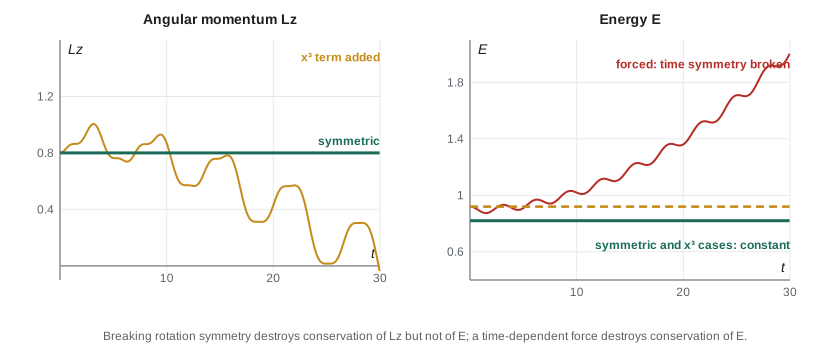
With both symmetries intact, energy and \(L_z\) are conserved to about \(10^{-14}\), limited only by rounding. Adding the \(x^3\) term destroys rotational symmetry: \(L_z\) wanders by 0.85, a large fraction of its starting value of 0.8, while the energy is still conserved to \(10^{-14}\), because the potential does not depend on time. Adding the time-dependent forcing destroys conservation of energy (it changes by 1.1, the forcing pumps energy in), and since the forcing also points along \(x\), it breaks rotational symmetry too and \(L_z\) drifts as well. Finally, two particles interacting through a potential that depends only on \(x_1 - x_2\) keep their total momentum fixed to \(10^{-14}\), even though each particle's own momentum swings back and forth.
Beyond mechanics
Noether's theorem extends directly to fields, where a continuous symmetry gives a conserved current and a local conservation law, such as \(\partial\rho/\partial t + \nabla\cdot\mathbf J = 0\) for electric charge. Charge conservation follows from a symmetry of the quantum description of charged particles under a change of phase. In particle physics, conservation of baryon number and of the various kinds of charge are understood the same way, and conversely the discovery of a conserved quantity is taken as a hint of a hidden symmetry.
Noether's theorem also clarifies the status of energy in general relativity. In an expanding universe there is no symmetry under shifts in time, and there is no general law of conservation of total energy: light from distant galaxies loses energy as it is redshifted, and that energy is not stored anywhere. This is not a paradox once one sees energy conservation as a consequence of a symmetry that the expanding universe does not have.
Emmy Noether was not allowed to hold a paid position at Göttingen for years because she was a woman; Hilbert famously objected that a university faculty was not a bathhouse. She received the right to lecture in 1919, became a central figure in modern algebra, and after being dismissed by the Nazi government in 1933 moved to Bryn Mawr College in Pennsylvania, where she died in 1935.
Worked problem
A bead on a rotating wire
A bead slides without friction on a straight wire that is forced to rotate in a horizontal plane at constant angular velocity \(\omega\) (as in lesson 5). Is the bead's angular momentum conserved? Is any quantity conserved?
Show solution
- With one coordinate \(r\), \(L = \tfrac12 m(\dot r^2 + \omega^2r^2)\), with no explicit \(t\).
- Angular momentum \(mr^2\omega\) changes as \(r\) changes; the wire exerts a torque, so it is not conserved. The rotation of the wire is imposed, not a symmetry of a closed system.
- Time-shift symmetry gives \(h = \dot r\,m\dot r - L = \tfrac12 m(\dot r^2 - \omega^2r^2)\), conserved.
- Released from rest at \(r_0\): \(h = -\tfrac12 m\omega^2r_0^2\), so \(\dot r^2 = \omega^2(r^2 - r_0^2)\), consistent with \(r = r_0\cosh\omega t\).
Answer: Angular momentum is not conserved, but the Jacobi integral \(\tfrac12 m(\dot r^2 - \omega^2r^2)\) is. It is not the kinetic energy, which grows, because the motor supplies work.
Worked problem
A particle on a cone
A particle slides without friction on the inside of a cone with its axis vertical and half-angle \(\alpha\), under gravity. Find two conserved quantities.
Show solution
- Use the distance \(r\) from the vertical axis and the azimuth \(\phi\). On the cone the height is \(z = r\cot\alpha\), so \(\dot z = \dot r\cot\alpha\).
- \(T = \tfrac12 m(\dot r^2/\sin^2\alpha + r^2\dot\phi^2)\), \(V = mgr\cot\alpha\).
- \(\phi\) is cyclic: rotation about the axis is a symmetry, so \(p_\phi = mr^2\dot\phi\) is conserved.
- No explicit \(t\) and a time-independent coordinate map: \(E = T + V\) is conserved.
Answer: The angular momentum about the axis, \(mr^2\dot\phi\), and the energy. With these two, the \(r\) motion reduces to a one-dimensional problem in an effective potential, exactly as for orbits in lesson 7.
Common mistakes
MistakeAssuming every conservation law in a problem must come from an obvious symmetry.
InsteadSome come from hidden symmetries; the Kepler problem's Laplace–Runge–Lenz vector reflects a four-dimensional rotation symmetry that is not visible in ordinary space.
MistakeIdentifying \(h = \sum p\dot q - L\) with the energy in every case.
InsteadIt equals \(T + V\) only when the kinetic energy is a homogeneous quadratic in the velocities.
MistakeExpecting conservation of a momentum component when the potential depends on that coordinate.
InsteadOnly directions in which the Lagrangian is unchanged give conserved momenta.
MistakeThinking a discrete symmetry such as a reflection gives a conservation law in classical mechanics.
InsteadNoether's theorem needs a continuous family of transformations; discrete symmetries give selection rules in quantum mechanics but no classical conserved quantity.
MistakeCalling energy conservation a law independent of symmetry.
InsteadIt is the Noether charge of time-shift symmetry and fails when that symmetry is absent.
Summary and key terms
- A continuous transformation \(q_j \to q_j + \varepsilon K_j(q)\) that leaves \(L\) unchanged gives a conserved Noether charge \(Q = \sum_j p_jK_j\).
- Homogeneity of space gives momentum conservation, isotropy gives angular momentum conservation, and time-shift symmetry gives conservation of \(h = \sum p_j\dot q_j - L\).
- When \(T\) is quadratic in the velocities, \(h\) is the energy \(T + V\).
- Systems with partial symmetry keep only the matching conserved quantities; the numerical test shows \(L_z\) and \(E\) failing exactly when their symmetries are broken.
- The theorem extends to fields as conserved currents, and explains why energy is not globally conserved in an expanding universe.
- Noether's theorem
- Every continuous symmetry of the action implies a conserved quantity.
- Noether charge
- The conserved quantity Σ p_j K_j associated with a symmetry.
- homogeneity of space
- The laws of physics are the same at every location; it gives momentum conservation.
- isotropy of space
- The laws of physics are the same in every direction; it gives angular momentum conservation.
- energy function
- The quantity h = Σ p_j q̇_j − L, conserved when L has no explicit time dependence.
- generator
- The vector K_j describing the direction in which a symmetry transformation moves the coordinates.
Practice problems
Work each problem on paper first, then reveal the answer to check.
A particle moves in the potential \(V = k(x^2 + y^2)\). Which components of momentum and angular momentum are conserved?
Show answer
No momentum components (V depends on x and y; z momentum is conserved if the particle can move in z). \(L_z\) is conserved, since V is unchanged by rotations about z.
A particle moves in \(V = V(x + y)\). Find a conserved momentum.
Show answer
Shifting \(x\) by \(\varepsilon\) and \(y\) by \(-\varepsilon\) leaves \(x + y\) unchanged, so \(p_x - p_y\) is conserved.
For \(L = \tfrac12 m\dot x^2 - \tfrac12 kx^2\cos^2(\omega t)\), is energy conserved?
Show answer
No: L depends explicitly on t, so h is not conserved; the spring is being changed.
Two particles interact through \(V(|\mathbf r_1 - \mathbf r_2|)\) and both feel uniform gravity. Which momentum components are conserved?
Show answer
The horizontal components of total momentum; gravity breaks vertical translation symmetry.
Show that for \(L = \tfrac12 m(\dot r^2 + r^2\dot\phi^2) - V(r)\), the Noether charge for \(\phi \to \phi + \varepsilon\) is \(mr^2\dot\phi\).
Show answer
\(K_\phi = 1\), \(K_r = 0\), so \(Q = p_\phi = \partial L/\partial\dot\phi = mr^2\dot\phi\).
In the program, why did the forced case also change \(L_z\)?
Show answer
The forcing \(Ax\cos t\) singles out the x direction, so it breaks rotational symmetry as well as time symmetry.
Lesson quiz · 5 questions
Score 60% or more to complete this lesson.
Create a free account to save your progress, take quizzes and earn a certificate.