
NUC-450 · Lesson 8 of 12 · 21 min
Generation IV reactors
With the fusion chapters in review, the options study turns to its second half. Rohan Desai, Meridian's reactor physicist, takes over as Hana's mentor for the advanced fission chapters. “Fusion asks the client to wait for physics,” he says. “Advanced fission asks them to wait for engineering and licensing. Some of these designs are being built right now.” He hands her the Generation IV International Forum roadmap and the NRC's list of advanced reactor applications, and asks for a chapter that explains what each technology is good for.
This lesson introduces the six reactor systems selected by the Generation IV International Forum, the goals they were chosen to meet, and the coolants, fuels and neutron spectra that distinguish them. It compares coolants quantitatively and surveys the designs that are closest to deployment in North America, with their licensing status in 2026.
Generations of reactors
Reactor designs are often grouped into generations. Generation I covers the early prototypes of the 1950s and 1960s, such as Shippingport in the United States and the Nuclear Power Demonstration reactor at Rolphton, Ontario. Generation II covers most of the reactors operating today, built from the late 1960s to the 1990s: pressurized and boiling water reactors and CANDU units. Generation III and III+ are evolutionary water-cooled designs with improved safety, more passive features and longer lives, such as the AP1000, the EPR and the BWRX-300 small modular reactor. Generation IV refers to designs that depart from water cooling to meet more ambitious goals.
The Generation IV International Forum, founded in 2001 by nine countries including Canada and the United States and now with more than a dozen members, set four goals in its 2002 technology roadmap: sustainability, through better use of uranium and less long-lived waste; economics, through lower life-cycle cost and financial risk; safety and reliability, through very low core damage probability and no need for off-site emergency response; and proliferation resistance and physical protection. It then chose six systems for collaborative research from about a hundred concepts.
| System | Spectrum | Coolant | Outlet temperature | Fuel cycle | Distinctive strength |
|---|---|---|---|---|---|
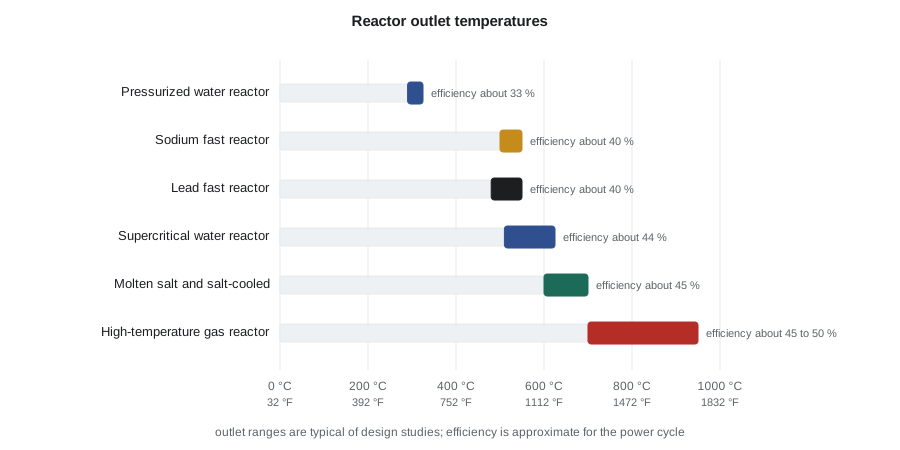
| Sodium-cooled fast reactor (SFR) | fast | liquid sodium | 500 to 550 °C | open or closed | most operating experience among Gen IV systems |
| Lead-cooled fast reactor (LFR) | fast | lead or lead-bismuth | 480 to 800 °C | closed | inert coolant, high boiling point |
| Gas-cooled fast reactor (GFR) | fast | helium | 850 °C | closed | high temperature with a fast spectrum |
| Very-high-temperature reactor (VHTR) | thermal | helium | 700 to 950 °C | open | process heat and hydrogen; TRISO fuel |
| Molten salt reactor (MSR) | thermal or fast | fluoride or chloride salt | 600 to 750 °C | open or closed | liquid fuel, low pressure |
| Supercritical-water-cooled reactor (SCWR) | thermal or fast | water above 22.1 MPa | 510 to 625 °C | open or closed | builds on water reactor and fossil plant technology |
Why change the coolant?
Water is an excellent coolant and moderator, but to stay liquid at 300 °C it must be held at about 15 MPa, which dictates thick pressure vessels and large containments, and its outlet temperature limits thermal efficiency to about 33 percent and rules out most industrial heat uses. Liquid metals and molten salts remain liquid to very high temperatures at near-atmospheric pressure, so the primary system need not be a pressure vessel and a pipe break does not cause the coolant to flash to steam. Helium stays single-phase at any temperature and is chemically inert and transparent to neutrons, but its low density and heat capacity mean it must be pressurized and circulated in large volumes.
# Comparing reactor coolants: flow needed to remove 100 MW of heat, volumetric heat
# capacity, and the margin between operating temperature and boiling at system pressure.
P = 100e6   # W thermal
coolants = [  # name, pressure MPa, density kg/m3, cp kJ/kg K, core dT K, outlet C, boiling C at pressure
    ("Water (PWR)",           15.5,   726, 5.47,  30, 325,  345),
    ("Sodium (SFR)",           0.1,   845, 1.27, 150, 510,  883),
    ("Lead (LFR)",             0.1, 10470, 0.146, 80, 480, 1749),
    ("Helium (VHTR/HTGR)",     7.0,  4.36, 5.19, 400, 750, None),
    ("FLiBe salt (FHR/MSR)",   0.1,  1940, 2.39, 100, 650, 1430)]
print(f"{'coolant':22s}{'p MPa':>6s}{'rho cp MJ/m3K':>14s}{'mass kg/s':>10s}{'vol m3/s':>9s}{'outlet C':>9s}{'margin to boil K':>17s}")
for n, p, rho, cp, dT, Tout, Tb in coolants:
    m = P / (cp * 1e3 * dT)
    V = m / rho
    margin = f"{Tb - Tout:17d}" if Tb else f"{'single phase':>17s}"
    print(f"{n:22s}{p:6.1f}{rho * cp / 1e3:14.2f}{m:10.0f}{V:9.3f}{Tout:9d}{margin}")
# Thermal efficiency rises with outlet temperature; a simple estimate is 70 percent of Carnot.
Tc = 35 + 273.15
for n, p, rho, cp, dT, Tout, Tb in coolants:
    carnot = 1 - Tc / (Tout + 273.15)
print(f"{n:22s} outlet {Tout:4d} C -> Carnot {carnot:.0%}, practical about {0.7 * carnot:.0%}")coolant p MPa rho cp MJ/m3K mass kg/s vol m3/s outlet C margin to boil K Water (PWR) 15.5 3.97 609 0.839 325 20 Sodium (SFR) 0.1 1.07 525 0.621 510 373 Lead (LFR) 0.1 1.53 8562 0.818 480 1269 Helium (VHTR/HTGR) 7.0 0.02 48 11.048 750 single phase FLiBe salt (FHR/MSR) 0.1 4.64 418 0.216 650 780 Water (PWR) outlet 325 C -> Carnot 48%, practical about 34% Sodium (SFR) outlet 510 C -> Carnot 61%, practical about 42% Lead (LFR) outlet 480 C -> Carnot 59%, practical about 41% Helium (VHTR/HTGR) outlet 750 C -> Carnot 70%, practical about 49% FLiBe salt (FHR/MSR) outlet 650 C -> Carnot 67%, practical about 47%
The comparison brings out each coolant's character. Water has a high volumetric heat capacity, but at 15.5 MPa a PWR runs only about 20 K below saturation. Sodium removes the same heat with a similar volume flow at atmospheric pressure, with more than 350 K of margin to boiling. Lead needs an enormous mass flow, more than 8 metric tons per second for 100 MW, because its heat capacity per kilogram is tiny, so lead systems are heavy and must be designed against erosion and seismic loads. Helium needs more than ten times the volume flow of the liquids even at 7 MPa, which drives large ducts and blowers, but delivers the highest outlet temperature. FLiBe salt has the highest volumetric heat capacity of all, even more than water, at atmospheric pressure.
Fuels for advanced reactors
Most Generation IV designs need fuel different from the uranium dioxide pellets in zirconium alloy tubes of today's water reactors. Sodium fast reactors have used metallic uranium-zirconium alloy fuel, as at the Experimental Breeder Reactor-II in Idaho, and oxide fuel. High-temperature gas reactors use TRISO particles: kernels of uranium oxycarbide or oxide less than a millimeter across, coated with layers of porous carbon, pyrolytic carbon and silicon carbide that retain fission products to above 1600 °C. Thousands of particles are embedded in graphite pebbles or compacts. Molten salt reactors may dissolve the fuel in the salt itself, or, in fluoride-salt-cooled designs such as Kairos Power's, use TRISO pebbles cooled by clean salt.
Many of these designs need uranium enriched to between 5 and 20 percent uranium-235, called high-assay low-enriched uranium (HALEU), to make compact cores or long refueling intervals possible. HALEU is still low-enriched uranium under international definitions, but commercial supply in North America is only being established, and its availability is a schedule risk for several projects.
Safety characteristics
Generation IV safety arguments rest heavily on inherent and passive features. Liquid metal pools have large thermal inertia and can reject decay heat to air by natural circulation; TRISO fuel tolerates temperatures far above those reached in a loss-of-cooling accident in small cores, so heat can be conducted out through the graphite and vessel to the surroundings; molten salt and liquid metal systems operate near atmospheric pressure, so there is no stored pressure energy to drive radioactive material out of containment. Each coolant also brings its own hazards. Sodium burns in air and reacts vigorously with water, so sodium fast reactors use an intermediate sodium loop between the core and the steam generator, or a non-water secondary; lead is toxic and freezes at 327 °C; molten salts are corrosive to many alloys and freeze at around 450 to 460 °C for FLiBe; helium systems depend on keeping air and water out of hot graphite.
Designs moving toward deployment
In the United States, the Department of Energy's Advanced Reactor Demonstration Program, begun in 2020, co-funds two demonstrations. TerraPower's Natrium plant at Kemmerer, Wyoming, is a 345 MWe sodium-cooled fast reactor coupled to molten salt thermal storage that can boost output to 500 MWe for several hours; the NRC issued its construction permit in March 2026 after an 18-month review, and completion is planned for about 2030. X-energy's Xe-100 is an 80 MWe pebble-bed high-temperature gas reactor; Dow and X-energy applied in 2025 for a construction permit for four units at Dow's Seadrift chemical site in Texas, the Long Mott project, which received an environmental finding of no significant impact in May 2026. Kairos Power, which uses TRISO pebbles in FLiBe salt, received a construction permit for its 35 MWt Hermes test reactor in Oak Ridge in December 2023, now expected to be completed around 2028, and broke ground on the 50 MWe Hermes 2 in April 2026 to supply Google through TVA.
Rohan points out that the regulatory path is also changing. The NRC finalized 10 CFR Part 53, a risk-informed, technology-inclusive licensing framework intended for advanced reactors, in March 2026, as an alternative to the water-reactor-centered rules of Parts 50 and 52. Hana notes that the first wave of projects was licensed under Part 50, and that the consortium could see the first Part 53 applications before its decision point.
Worked problem
Pumping requirement for a helium-cooled core
A 600 MWt high-temperature gas reactor heats helium from 260 °C to 750 °C at 7 MPa. Taking cp = 5.19 kJ/kg·K and an average density of 4.3 kg/m³, what mass and volume flow are required?
Show solution
- ΔT = 750 − 260 = 490 K.
- Mass flow = 600 × 10⁶ ÷ (5190 × 490) = 236 kg/s.
- Volume flow = 236 ÷ 4.3 = 55 m³/s at core-average conditions.
Answer: About 236 kg/s, or 55 m³/s, which is why gas reactors need large ducts and powerful circulators.
Matching designs to missions
The six systems are not competitors for a single market so much as tools for different jobs. Sodium-cooled fast reactors build on the largest experience base and suit utilities that want electricity, high temperature for storage and, eventually, the option of a closed fuel cycle. Lead-cooled designs trade a heavy, corrosive coolant for a very high boiling point and no reaction with water or air, which appeals for remote or small grids. High-temperature gas reactors, with TRISO fuel, are the natural match for industrial heat and hydrogen, the subject of lesson 11. Molten salt reactors promise compact, low-pressure plants and flexible fuel cycles but have the least operating experience: the Molten Salt Reactor Experiment at Oak Ridge in the 1960s remains the main reference. Supercritical water reactors would carry fossil-plant steam conditions into a reactor, raising efficiency to about 44 percent while keeping a water coolant, but none has been built. Gas-cooled fast reactors combine high temperature with a fast spectrum, at the cost of difficult decay heat removal from a low-density coolant.
Microreactors form a separate category. Designs of a few megawatts to about 20 MWe, often heat-pipe or gas-cooled with TRISO or metallic fuel, are aimed at remote communities, mines and military bases, and are intended to be factory-built and transported by road. Their economics depend on displacing expensive diesel generation rather than competing with grid electricity, and several are in licensing in both countries.
Licensing new technologies
Regulators face a basic problem with Generation IV designs: most existing rules were written for light water reactors and refer to features such as emergency core cooling systems and containment pressure that do not apply to a low-pressure liquid metal or gas reactor. Both regulators have responded by moving toward risk-informed, performance-based requirements. Licensing basis events are selected using probabilistic risk assessment, safety functions are defined in terms of what must be achieved, such as retaining radionuclides and removing heat, and designers show how their specific technology achieves them. The Licensing Modernization Project methodology, endorsed by the NRC in 2020, is one widely used framework; the CNSC's license application guides likewise allow technology-neutral safety cases built on fundamental safety functions.
Qualification of new fuels and materials is often the longest part of the path. TRISO fuel has been qualified through a multi-year irradiation and safety testing program run by Idaho and Oak Ridge national laboratories; metallic fuels draw on EBR-II data; and high-temperature alloys such as Alloy 617 had to be added to the ASME code for elevated-temperature service before they could be used in a pressure boundary. Every new design must also demonstrate that its codes for neutronics, thermal hydraulics and accident analysis have been validated against suitable experiments, which for some coolants are scarce.
Common mistakes
MistakeGeneration IV reactors are all fast reactors.
InsteadThree are fast, one thermal, and two can be designed either way.
MistakeLow-pressure coolants make a reactor safe by themselves.
InsteadThey remove stored pressure energy, but each coolant has its own hazards, such as sodium fires or salt freezing.
MistakeHALEU is a weapons-grade material.
InsteadIt is low-enriched uranium below 20 percent U-235, used to make compact cores practical.
MistakeA higher outlet temperature only improves electrical efficiency.
InsteadIt also opens industrial heat markets, as lesson 11 shows.
Summary and key terms
- The Generation IV International Forum chose six systems to meet goals for sustainability, economics, safety and proliferation resistance.
- Liquid metals and salts work near atmospheric pressure; helium is inert but needs large volume flows.
- TRISO particle fuel retains fission products to above 1600 °C.
- Many advanced designs need HALEU, whose supply is being established.
- Natrium, Xe-100 and Kairos Hermes lead deployment in the United States; Canadian designs are in vendor design review.
- The NRC finalized Part 53 in March 2026 as a technology-inclusive licensing framework.
- Generation IV
- Advanced non-water-cooled or supercritical designs selected by the Generation IV International Forum.
- TRISO
- Tristructural isotropic coated fuel particles with carbon and silicon carbide layers.
- HALEU
- Uranium enriched to between 5 and 20 percent U-235.
- Fast spectrum
- A neutron population that is not moderated, with most fissions above about 100 keV.
- FLiBe
- A molten salt of lithium fluoride and beryllium fluoride.
- Vendor design review
- An optional CNSC pre-licensing assessment of a reactor design.
Practice problems
Work each problem on paper first, then reveal the answer to check.
Name the six Generation IV systems.
Show answer
SFR, LFR, GFR, VHTR, MSR and SCWR.
Why must a PWR be pressurized to about 15 MPa?
Show answer
To keep water liquid at about 300 °C.
Why do lead-cooled systems need very large mass flows?
Show answer
Lead's heat capacity per kilogram is very small.
What makes TRISO fuel robust?
Show answer
Its coatings retain fission products to temperatures above 1600 °C.
Why do sodium fast reactors use an intermediate loop?
Show answer
To separate radioactive primary sodium from the water-steam system because sodium reacts with water.
Lesson quiz · 5 questions
Score 60% or more to complete this lesson.
Create a free account to save your progress, take quizzes and earn a certificate.