
NUC-450 · Lesson 3 of 12 · 20 min
Inertial confinement
The third chapter of the options study is the one the consortium's board asked about first. Its chair had read that a laser experiment in California produced more fusion energy than it received, and wanted to know whether that meant fusion power was close. Ingrid sends Hana to the published record of the National Ignition Facility at Lawrence Livermore National Laboratory and to the plans of the companies pursuing pulsed approaches under the Department of Energy's inertial fusion energy programs. “Answer the chair's question honestly,” Ingrid says. “It was a real scientific milestone. Then show him how far the plant is from the target chamber.”
This lesson explains the inertial approach to fusion, in which a small quantity of fuel is compressed and heated so quickly that it burns before it can fly apart. It covers the Lawson criterion in its inertial form, direct and indirect drive, the role of hydrodynamic instabilities, the ignition results at the National Ignition Facility, and the requirements that separate a single successful shot from a power plant. It closes with magnetized target fusion, which works at intermediate densities and times.
Confinement by inertia
Magnetic confinement holds a thin plasma for seconds; inertial confinement holds an extremely dense one for a fraction of a nanosecond. Nothing holds the fuel at all: once compressed and heated, it begins to expand at roughly the speed of sound, and the confinement time is simply the time it takes to disassemble. For a sphere of radius R and sound speed c_s, that time is about R/c_s. The number of reactions before disassembly depends on the product of density and confinement time, and since τ ∝ R, the natural figure of merit is the areal density ρR, the mass density times the radius of the compressed fuel.
Textbook analysis of burn fraction shows that D-T fuel burns a useful fraction of itself only when ρR reaches a few grams per square centimeter. To reach that with a capsule of reasonable mass, the fuel must be compressed to hundreds of times its solid density, far denser than lead, which is why inertial fusion is as much a problem of compression as of heating.
Hot-spot ignition
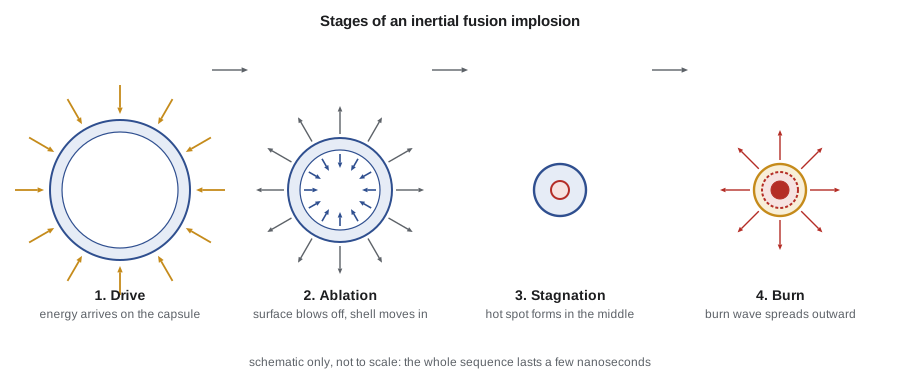
Heating all the compressed fuel to 10 keV would take far more energy than any driver can deliver. The standard scheme instead creates a small, hot, lower-density central hot spot surrounded by a cold, dense shell of fuel. If the hot spot reaches about 5 to 10 keV with an areal density of about 0.3 g/cm², which is the range in which alpha particles are stopped within it, the alphas deposit their energy locally, heat the hot spot further and launch a burn wave outward into the cold fuel. This bootstrap is ignition in the inertial sense, and it is the reason a target gain well above 1 is possible.
Compression is achieved by ablation. The outer surface of a spherical capsule is heated so rapidly that it blows off, and by reaction the rest of the shell is driven inward like a rocket. The shell decelerates as it stagnates on the hot spot, converting its kinetic energy into compression and heat. The process is limited by hydrodynamic instability. The Rayleigh-Taylor instability amplifies any small roughness on the capsule or nonuniformity in the drive, much as a heavy fluid resting on a light one overturns, and if the perturbations grow too large they mix cold shell material into the hot spot and quench it. Much of the progress of the last decade came from smoother capsules, better control of drive symmetry and better understanding of these mixing processes.
Direct and indirect drive
There are two ways to deliver the drive energy. In direct drive, many laser beams illuminate the capsule itself. The coupling of laser energy to the capsule is relatively efficient, but the illumination must be extremely uniform and laser-plasma instabilities near the surface can scatter light and generate fast electrons that preheat the fuel. The OMEGA laser at the University of Rochester's Laboratory for Laser Energetics is the leading direct-drive facility.
In indirect drive, used at the National Ignition Facility, the capsule sits inside a small gold cylinder called a hohlraum. The laser beams enter through holes at the ends and heat the inner wall, which re-radiates the energy as soft X-rays that bathe the capsule. The X-ray drive is smoother than direct laser light, which helps with symmetry, but only a small fraction of the laser energy, around 10 to 15 percent, ends up in the capsule. Heavy-ion beams and pulsed-power machines, which drive targets with intense magnetic fields from very large electrical currents, are alternative drivers that some programs are pursuing because they may be more efficient and cheaper to repeat than lasers.
Ignition at the National Ignition Facility
The National Ignition Facility, completed in 2009, has 192 laser beams that together deliver about 2 MJ of ultraviolet light in a few nanoseconds. For a decade its yields stayed far below the ignition goal. In August 2021 a shot produced 1.3 MJ, near the threshold, and on 5 December 2022 a shot with 2.05 MJ of laser energy produced 3.15 MJ of fusion energy, the first time a laboratory fusion experiment had produced more fusion energy than the driver energy delivered to the target. The facility repeated and improved the result several times. In February 2024 it reached 5.2 MJ, and on 7 April 2025 a shot with 2.08 MJ of laser energy produced 8.6 MJ, a target gain of 4.13. Those results confirmed that a burning, igniting plasma behaves as theory and simulation predicted.
# Inertial fusion energy bookkeeping: target gain from published NIF shots,
# and the gain a power plant needs once driver and thermal efficiencies are counted.
shots = [("Aug 2021", 1.9, 1.3), ("Dec 2022", 2.05, 3.15),
         ("Feb 2024", 2.2, 5.2), ("Apr 2025", 2.08, 8.6)]   # (date, laser MJ, yield MJ)
print(f"{'shot':10s}{'laser (MJ)':>11s}{'yield (MJ)':>11s}{'target gain':>13s}")
for d, E, Y in shots:
    print(f"{d:10s}{E:11.2f}{Y:11.2f}{Y / E:13.2f}")
# The NIF laser draws roughly 300 MJ from the grid for each 2 MJ shot (about 0.7 percent).
print(f"wall-plug view of the 2025 shot: {8.6 / 300:.3f} (yield / electricity drawn)")

def plant(eta_driver, G, eta_th=0.40, M=1.1, f_aux=0.05):
    """Net electric per unit driver energy. M = blanket energy multiplication."""
    gross = G * M * eta_th                         # electricity per unit driver energy
    recirc = 1 / eta_driver                        # electricity to make one unit of driver energy
    net = gross - recirc - f_aux * gross
    return net, recirc / gross

print("\nengineering view: recirculating fraction f = (1/eta_driver) / (G M eta_th)")
for eta in (0.01, 0.10, 0.15):
    for G in (10, 50, 100):
        net, f = plant(eta, G)
        tag = "net producer" if net > 0 and f < 0.25 else ("marginal" if net > 0 else "net consumer")
        print(f"  driver efficiency {eta:4.0%}  target gain {G:4d}:  recirculating {f:6.1%}  -> {tag}")
# A plant also needs repetition: P_fus = yield per shot x shots per second.
for Y, rate in ((100, 10), (500, 2)):
print(f"{Y} MJ targets at {rate} Hz -> {Y * rate:.0f} MW of fusion power")shot laser (MJ) yield (MJ) target gain Aug 2021 1.90 1.30 0.68 Dec 2022 2.05 3.15 1.54 Feb 2024 2.20 5.20 2.36 Apr 2025 2.08 8.60 4.13 wall-plug view of the 2025 shot: 0.029 (yield / electricity drawn) engineering view: recirculating fraction f = (1/eta_driver) / (G M eta_th) driver efficiency 1% target gain 10: recirculating 2272.7% -> net consumer driver efficiency 1% target gain 50: recirculating 454.5% -> net consumer driver efficiency 1% target gain 100: recirculating 227.3% -> net consumer driver efficiency 10% target gain 10: recirculating 227.3% -> net consumer driver efficiency 10% target gain 50: recirculating 45.5% -> marginal driver efficiency 10% target gain 100: recirculating 22.7% -> net producer driver efficiency 15% target gain 10: recirculating 151.5% -> net consumer driver efficiency 15% target gain 50: recirculating 30.3% -> marginal driver efficiency 15% target gain 100: recirculating 15.2% -> net producer 100 MJ targets at 10 Hz -> 1000 MW of fusion power 500 MJ targets at 2 Hz -> 1000 MW of fusion power
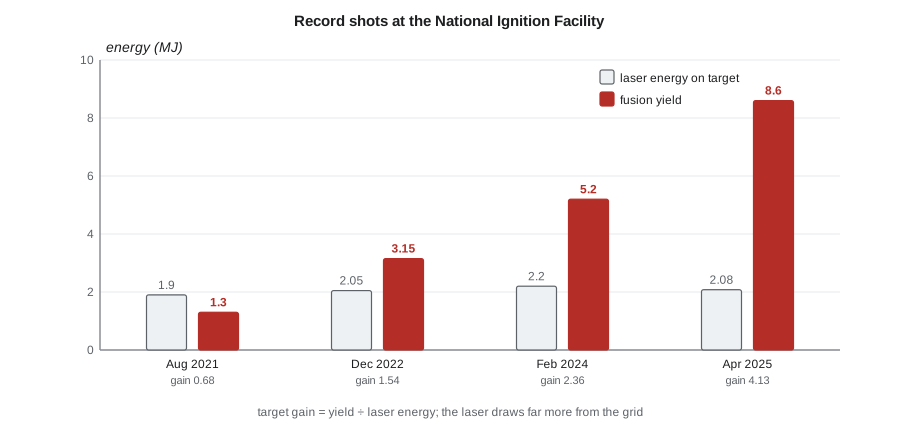
The wall-plug figure in the code output is the honest answer to the board chair. The NIF laser is a research instrument built in the 1990s and 2000s with flashlamp-pumped glass amplifiers; it draws on the order of 300 MJ from the grid for each shot and can fire only a few times a day. A target gain of 4 against a driver that is less than 1 percent efficient leaves the facility hundreds of times short of producing net electricity. Ignition was a necessary scientific step, not a demonstration of a power plant.
From a shot to a power plant
An inertial fusion energy plant would need several things at once. Its driver must be efficient, on the order of 10 percent or better from the wall plug, which points to diode-pumped solid-state lasers, excimer lasers such as krypton fluoride or argon fluoride, or pulsed power. Target gains must reach roughly 50 to 100, which most designs expect to need either higher driver energy or advanced schemes. The plant must fire several to tens of times per second, every second, for years, so a 1 GW plant at 10 Hz needs about 100 MJ per target and close to a million targets a day, each manufactured to micrometer tolerances for well under a dollar. And the target chamber must survive the X-rays, debris and neutrons of each explosion, be cleared before the next shot, and contain a breeding blanket.
| Requirement | NIF today | Power plant need |
|---|---|---|
| Driver efficiency (wall plug) | below 1 percent | about 10 percent or more |
| Target gain | about 4 | about 50 to 100 |
| Repetition rate | a few shots per day | 5 to 20 shots per second |
| Target cost | very high, hand-assembled | well under a dollar each, mass-produced |
| Chamber | experimental target chamber | wall and blanket surviving millions of shots a day |
The Department of Energy launched an inertial fusion energy program in 2023 with research hubs that combine national laboratories, universities and companies, and its milestone-based fusion development program includes companies pursuing laser and pulsed-power concepts. Hana adds a paragraph noting that none of them yet operates a high-repetition-rate driver at power plant energies, so any timeline for the consortium should treat inertial fusion as a longer-range option than the leading magnetic designs.
Magnetized target fusion
Between the two extremes lies magnetized target fusion, in which a magnetized plasma of moderate density is compressed mechanically or electromagnetically over microseconds to milliseconds. The magnetic field reduces heat loss during compression, so the driver can be much slower and cheaper than a laser. Densities and times fall between those of magnetic and inertial confinement, so the triple product can be reached at more modest technical extremes, but the plasma must stay stable and well confined while it is compressed.
General Fusion, founded in 2002 near Vancouver, Canada, is the best-known example. Its LM26 machine, operating since 2025, compresses a magnetized plasma with a lithium liner; the company reported its first magnetized plasma in 2025 and aims for 10 million degrees, then 100 million degrees and scientific breakeven by about 2028. Helion, in Washington State, uses a related pulsed approach, colliding and magnetically compressing field-reversed configuration plasmas and aiming to recover electricity directly from the expanding plasma. In August 2025 Helion began construction of its Orion plant at Malaga, Washington, intended to supply Microsoft from 2028, while its Polaris prototype tests the approach. Ingrid asks Hana to present both neutrally: important programs, still at the stage of demonstrating plasma performance.
Worked problem
Repetition rate for a fusion power plant
An inertial fusion plant is to produce 1000 MW of net electricity. Each target yields 150 MJ, the blanket multiplies fusion energy by 1.1, the thermal cycle is 42 percent efficient, and 20 percent of gross electricity is recirculated to the driver and plant loads. How many shots per second are needed?
Show solution
- Gross electricity per shot = 150 × 1.1 × 0.42 = 69.3 MJ.
- Net electricity per shot = 69.3 × (1 − 0.20) = 55.4 MJ.
- Shots per second = 1000 MJ/s ÷ 55.4 MJ = 18.
Answer: About 18 shots per second, or roughly 1.6 million targets a day.
Common mistakes
MistakeNIF ignition proved that laser fusion can produce net electricity.
InsteadIt proved target gain above 1; the laser draws about a hundred times more electricity than the target releases.
MistakeInertial confinement uses a container to hold the fuel.
InsteadNothing holds the fuel; it burns in the time it takes to fly apart.
MistakeAll of the fuel must be heated to ignition temperature.
InsteadOnly a small central hot spot is heated; a burn wave then spreads through the cold, dense fuel.
MistakeIndirect drive is more efficient than direct drive.
InsteadIndirect drive is smoother, but only about 10 to 15 percent of the laser energy reaches the capsule.
Summary and key terms
- Inertial confinement compresses fuel so quickly that it burns before it disassembles; the figure of merit is areal density ρR.
- Hot-spot ignition needs about 5 to 10 keV and ρR of about 0.3 g/cm² in the hot spot.
- Rayleigh-Taylor instability limits how smoothly a shell can implode.
- NIF reached target gain above 1 in December 2022 and 4.13 in April 2025.
- A power plant needs efficient, repetitive drivers, cheap targets and a survivable chamber.
- Magnetized target fusion works at intermediate density and timescales.
- Areal density
- Density times radius of the compressed fuel, ρR.
- Hot spot
- The small central region of a compressed target heated to ignition.
- Ablation
- Blow-off of a target surface that drives the shell inward by reaction.
- Hohlraum
- A small cylinder that converts laser light to X-rays for indirect drive.
- Target gain
- Fusion yield divided by driver energy delivered to the target.
- Magnetized target fusion
- Compression of a magnetized plasma over microseconds to milliseconds.
Practice problems
Work each problem on paper first, then reveal the answer to check.
Why is ρR the figure of merit for inertial confinement?
Show answer
Confinement time is proportional to radius, so the number of reactions scales with density times radius.
What role do alpha particles play in hot-spot ignition?
Show answer
They deposit energy in the hot spot and drive a burn wave into the cold fuel.
What was the target gain of the April 2025 NIF record shot?
Show answer
About 4.13: 8.6 MJ from 2.08 MJ.
Roughly how efficient must a driver be for an inertial fusion power plant?
Show answer
About 10 percent or more from the wall plug.
How does magnetized target fusion differ from laser fusion?
Show answer
It compresses a magnetized plasma more slowly, at lower density, using a cheaper driver.
Lesson quiz · 5 questions
Score 60% or more to complete this lesson.
Create a free account to save your progress, take quizzes and earn a certificate.