
NUC-450 · Lesson 4 of 12 · 20 min
Plasma heating
Andrea Kowalczyk, who leads Meridian's instrumentation and control group, stops by Hana's desk with a question from the consortium's electrical planners. “They've read that a fusion plant needs tens of megawatts of heating just to start. What is that equipment, how efficient is it, and does it run all the time? If it's a big parasitic load, it changes the grid connection.” Ingrid agrees the heating chapter should answer exactly that, so Hana starts from the power balance and works out to the hardware.
This lesson sets up the zero-dimensional power balance of a magnetically confined plasma and uses it to show why external heating is needed and how alpha heating takes over. It then describes the three families of heating systems used on tokamaks and stellarators, ohmic heating, neutral beam injection and radio-frequency waves, their physics, efficiencies and engineering, and their second job of driving current for steady-state operation.
The power balance
In steady state the heating delivered to a plasma must equal the power it loses. For a D-T plasma the balance per unit volume reads
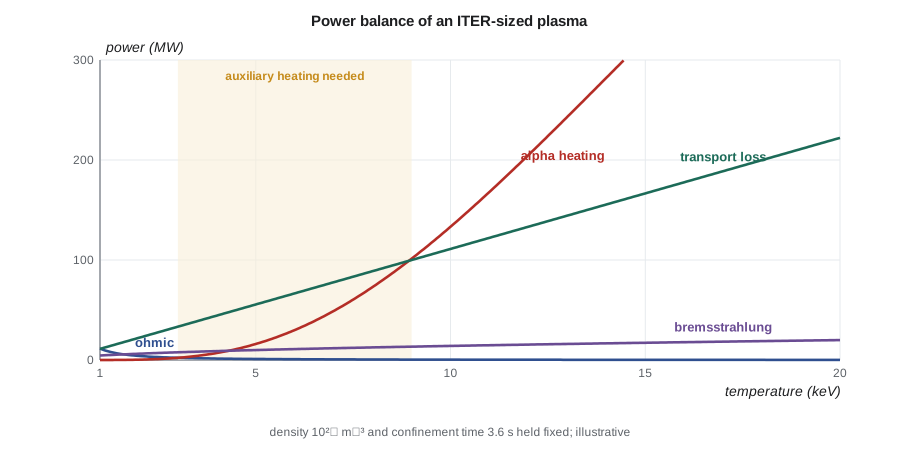
where p_Ω is ohmic heating by the plasma current, p_aux external auxiliary heating, p_α alpha heating, the first term on the right transport loss and p_rad radiation, chiefly bremsstrahlung, which in a clean D-T plasma scales as n²√T. Each term behaves differently with temperature. Ohmic heating falls as the plasma gets hotter, alpha heating rises steeply between 5 and 20 keV, transport loss rises roughly in proportion to temperature, and bremsstrahlung rises slowly. The fusion gain Q is the fusion power divided by p_aux; ignition is the state where p_aux is zero.
Ohmic heating and its limit
A tokamak's plasma current flows through a resistive medium, so it heats the plasma just as current heats a wire. The resistivity of a plasma, given by Spitzer's formula, depends on electron temperature and on the effective ionic charge Z_eff, but not on density:
where ln Λ, the Coulomb logarithm, is about 17 in fusion plasmas. At 1 keV a plasma's resistivity is similar to that of copper at room temperature; at 10 keV it is some twenty times lower. Ohmic heating is therefore efficient early in a discharge and self-limiting later: the hotter the plasma, the less it heats. Large tokamaks reach a few keV by ohmic heating alone, well short of the 10 to 20 keV needed for significant fusion power. Raising the current to heat more is not possible because of the safety factor limit described in lesson 2.
# Zero-dimensional power balance of a D-T tokamak plasma: ohmic heating,
# alpha heating, bremsstrahlung and transport losses, and the auxiliary power needed.
import math
keV = 1.602e-16
def sv_dt(T):                                   # Bosch-Hale, m^3/s
    BG, mc2 = 34.3827, 1124656
    c = (1.17302e-9, 1.51361e-2, 7.51886e-2, 4.60643e-3, 1.35e-2, -1.0675e-4, 1.366e-5)
    th = T / (1 - T * (c[1] + T * (c[3] + T * c[5])) / (1 + T * (c[2] + T * (c[4] + T * c[6]))))
    xi = (BG ** 2 / (4 * th)) ** (1 / 3)
    return c[0] * th * math.sqrt(xi / (mc2 * T ** 3)) * math.exp(-3 * xi) * 1e-6

R, a, kappa, I = 6.2, 2.0, 1.7, 15e6            # ITER-like geometry and current
V = 2 * math.pi ** 2 * R * a ** 2 * kappa
j = I / (math.pi * a ** 2 * kappa)               # average current density (A/m^2)
n, tau = 1.0e20, 3.6                             # density (m^-3) and confinement time (s)
print(f"plasma volume {V:.0f} m3, average current density {j / 1e6:.2f} MA/m2")
print(f"{'T keV':>6s}{'ohmic MW':>10s}{'alpha MW':>10s}{'brems MW':>10s}{'transport MW':>13s}{'aux needed MW':>14s}{'Q':>7s}")
for T in (1, 2, 3, 5, 8, 10, 12, 15, 20):
    eta = 1.65e-9 * 17 / T ** 1.5               # Spitzer resistivity, ln(Lambda) = 17 (ohm m)
    P_oh = eta * j ** 2 * V / 1e6
    P_fus = n ** 2 / 4 * sv_dt(T) * 17.6e3 * keV * V / 1e6
    P_al = P_fus / 5
    P_br = 5.35e-37 * n ** 2 * math.sqrt(T) * V / 1e6
    P_tr = 3 * n * T * keV * V / tau / 1e6
    aux = max(P_tr + P_br - P_al - P_oh, 0.0)
    Q = P_fus / aux if aux > 0 else float('inf')
    print(f"{T:6d}{P_oh:10.1f}{P_al:10.1f}{P_br:10.1f}{P_tr:13.1f}{aux:14.1f}{Q:7.1f}")
# Neutral beam: energy needed to reach the core and the beam power from a source.
E_b, I_b = 1.0e6, 16.5                           # 1 MeV deuterium beam, 16.5 A of neutrals
print(f"\none 1 MeV beam of {I_b} A neutrals delivers {E_b * I_b / 1e6:.1f} MW")plasma volume 832 m3, average current density 0.70 MA/m2
T keV ohmic MW alpha MW brems MW transport MW aux needed MW Q
1 11.5 0.0 4.5 11.1 4.0 0.0
2 4.1 0.3 6.3 22.2 24.1 0.1
3 2.2 2.2 7.7 33.3 36.6 0.3
5 1.0 16.0 10.0 55.5 48.5 1.7
8 0.5 73.0 12.6 88.9 28.0 13.1
10 0.4 133.3 14.1 111.1 0.0 inf
12 0.3 205.0 15.4 133.3 0.0 inf
15 0.2 321.5 17.2 166.6 0.0 inf
20 0.1 508.0 19.9 222.2 0.0 inf
one 1 MeV beam of 16.5 A neutrals delivers 16.5 MWThe table shows the shape of the problem. Ohmic heating is about 10 MW at 1 keV but below 1 MW at 10 keV; alpha heating grows from nothing to hundreds of megawatts. In between lies a hump of auxiliary power: tens of megawatts must be supplied to carry the plasma through the region where transport losses are large and alpha heating is still small. Holding the confinement time fixed makes the plasma appear to ignite at 10 keV. In practice confinement degrades as total heating rises, according to the scaling of lesson 2, which is why ITER is designed for Q = 10 with about 50 MW of auxiliary power rather than for ignition.
Neutral beam injection
A magnetic field deflects charged particles, so a beam of fast ions cannot be fired into a confined plasma. Neutral beam injection gets around this by accelerating ions, neutralizing them by passing them through a gas cell, and injecting the fast neutral atoms, which cross the field freely. Inside the plasma the atoms are ionized by collisions, become fast ions trapped on field lines, and give up their energy to the electrons and ions by Coulomb collisions as they slow down.
The beam energy has to be matched to the plasma. If it is too low the atoms are ionized near the edge and heat only the outside; if too high they pass straight through. Machines like JET used beams of 80 to 140 keV. ITER needs about 1 MeV to reach the core of its large, dense plasma, and at such energies positive ions can no longer be neutralized efficiently: the fraction drops to a few percent. ITER's beams therefore start from negative deuterium ions, which shed their extra electron easily and neutralize at about 60 percent. Each of ITER's planned injectors delivers about 16.5 MW, from a source the size of a room, accelerated by a 1 MV power supply, and the Neutral Beam Test Facility in Padua, Italy, was built to develop them.
Neutral beams also deliver momentum, which spins the plasma and helps suppress some instabilities, and they drive current, because the fast ions circulate preferentially in one direction. Their disadvantages are size, cost, wall-plug efficiency of roughly 20 to 30 percent including neutralization and transmission losses, and the large ducts they need through the blanket, which cost tritium breeding area and let neutrons stream out toward the beam components.
Radio-frequency heating
Electromagnetic waves can carry power into a plasma from antennas or waveguides at the wall and deposit it where the wave frequency matches a natural resonance of the plasma particles. Three frequency ranges are used.
Ion cyclotron resonance heating, at tens of megahertz, couples to the gyration of ions, typically a minority species such as hydrogen or helium-3 or a harmonic of deuterium or tritium. The power comes from tetrode or solid-state amplifiers and is launched from large antenna straps close to the plasma edge. The technology is mature and efficient, but coupling depends sensitively on the edge density, and the antennas interact with the edge plasma.
Electron cyclotron resonance heating, at about 100 to 170 GHz in present and planned tokamaks, couples to the gyration of electrons. The waves are generated by gyrotrons, vacuum tubes that each produce about 1 MW for long pulses, and are carried through evacuated waveguides and steered by mirrors. Because the resonance depends on the local field, which varies across the plasma, the deposition can be placed to within a few centimeters. That makes electron cyclotron systems the most precise tool for controlling instabilities, for example by driving current inside a growing magnetic island. They need no antenna near the plasma, which suits a nuclear environment.
Lower hybrid waves, at a few gigahertz, are absorbed by electrons moving along the field and are efficient at driving current off-axis, but have proved difficult to couple at high power in large machines and are not part of the ITER baseline.
| System | Typical frequency or energy | Source | Main uses | Notes |
|---|---|---|---|---|
| Ohmic | not applicable | central solenoid | start-up, early heating | self-limiting above a few keV |
| Neutral beam injection | 0.1 to 1 MeV | ion source, accelerator, neutralizer | bulk heating, rotation, current drive | large ducts; negative ions above about 150 keV |
| Ion cyclotron | 30 to 80 MHz | tetrodes or solid-state amplifiers | ion heating | coupling depends on edge plasma |
| Electron cyclotron | 100 to 170 GHz | gyrotrons, about 1 MW each | electron heating, local current drive, start-up | precise, no antenna near plasma |
| Lower hybrid | 2 to 5 GHz | klystrons | off-axis current drive | coupling difficult in large machines |
ITER's revised baseline, announced in 2024, shifts its emphasis toward electron cyclotron heating. It plans about 40 MW of electron cyclotron power for the first research phase, rising to some 60 MW or more for the D-T phases, together with 33 MW of neutral beams and an ion cyclotron system whose role is still being assessed. Compact high-field tokamaks such as SPARC rely mainly on ion cyclotron heating.
Current drive and steady state
A transformer can drive current only while its flux changes, so an inductively driven tokamak is a pulsed machine. A power plant would prefer to run steadily, both for the turbine and for the fatigue life of its components. Steady-state operation requires the plasma current to be sustained without the transformer. Part of it can come from the plasma itself: in a high-pressure plasma, collisions between trapped and passing particles generate the bootstrap current, which can supply half or more of the total in advanced scenarios. The rest must come from neutral beams or radio-frequency waves, at a cost of roughly 0.2 to 0.4 A per watt in today's systems, which is a large recirculating power for a plant carrying 10 MA or more.
The current drive efficiency, together with the wall-plug efficiency of the heating systems, enters the plant energy balance directly. If a steady-state plant needs 100 MW of current drive power and its systems are 40 percent efficient from the wall plug, it draws 250 MW of electricity, a large slice of the output of a plant designed for perhaps 1000 MW gross. This is one of the arguments for the stellarator, which needs no driven current, and for pulsed tokamaks with long burns and short dwell periods.
Hana's answer to Andrea's question goes into the draft as a box: start-up and auxiliary heating systems in a fusion plant would be tens to a hundred megawatts of electrical load, highly intermittent at start-up and possibly continuous in a steady-state design, with fast-acting power electronics that the grid planners at TVA would want to see modeled.
Worked problem
Wall-plug power of a heating system
A pilot plant needs 50 MW of absorbed auxiliary heating: 30 MW of electron cyclotron power and 20 MW of neutral beam power. Gyrotron systems deliver 35 percent of their electrical input to the plasma, and the beams 25 percent. What electrical power do the heating systems draw?
Show solution
- Electron cyclotron: 30 ÷ 0.35 = 85.7 MW electrical.
- Neutral beams: 20 ÷ 0.25 = 80.0 MW electrical.
- Total = 166 MW electrical.
Answer: About 166 MW of electricity for 50 MW in the plasma; at Q = 10 the 500 MW of fusion power must cover this load before the plant exports anything.
Common mistakes
MistakeIncreasing the plasma current is a good way to heat a hot plasma.
InsteadResistivity falls as T^−3/2 and the current is capped by the safety factor limit, so ohmic heating stalls at a few keV.
MistakeNeutral beams are made of neutral atoms because ions would be too energetic.
InsteadCharged particles cannot cross the confining field; neutral atoms can, and are ionized inside.
MistakeAll heating systems deposit their power uniformly.
InsteadElectron cyclotron heating can be placed within a few centimeters; beams deposit according to energy and density.
MistakeHeating systems can be switched off once a plasma reaches Q = 10.
InsteadAt Q = 10 external heating still supplies a third of the plasma heating; only ignition needs none.
Summary and key terms
- The power balance sets ohmic, auxiliary and alpha heating against transport and radiation losses.
- Ohmic heating weakens as T rises because plasma resistivity falls as T^−3/2.
- Neutral beams inject fast atoms that ionize inside the plasma; ITER's 1 MeV beams start from negative ions.
- Ion cyclotron, electron cyclotron and lower hybrid waves deposit power at resonances.
- Steady-state tokamaks need bootstrap and driven current; current drive is a large recirculating load.
- Heating system efficiency enters the plant's net electrical output directly.
- Ohmic heating
- Resistive heating by the plasma current.
- Spitzer resistivity
- The collisional resistivity of a plasma, falling as electron temperature to the power −3/2.
- Neutral beam injection
- Heating by fast neutral atoms that are ionized inside the plasma.
- Gyrotron
- A vacuum tube that generates high-power millimeter waves for electron cyclotron heating.
- Bootstrap current
- Current generated by the plasma pressure gradient itself.
- Current drive efficiency
- Plasma current driven per watt of absorbed power.
Practice problems
Work each problem on paper first, then reveal the answer to check.
Why does ohmic heating become ineffective in a hot plasma?
Show answer
Spitzer resistivity falls as T^−3/2 and the current cannot be raised past the q limit.
Why does ITER use negative ions for its neutral beams?
Show answer
Positive ions at 1 MeV neutralize poorly; negative ions neutralize at about 60 percent.
Which heating method is best for suppressing a magnetic island?
Show answer
Electron cyclotron current drive, aimed at the island.
What is the bootstrap current?
Show answer
A current produced by the pressure gradient through trapped-passing particle collisions.
Why is current drive power a concern for a steady-state plant?
Show answer
It must be supplied continuously and its low efficiency makes a large recirculating load.
Lesson quiz · 5 questions
Score 60% or more to complete this lesson.
Create a free account to save your progress, take quizzes and earn a certificate.