
NUC-450 · Lesson 7 of 12 · 20 min
ITER and private fusion efforts
Elena Marchetti, Meridian's director of regulatory affairs, joins the review of the fusion half of the options study. She has watched new reactor schedules for thirty years. “The physics chapters are solid,” she tells Hana and Ingrid. “Now the client needs the part they can't get from a textbook: who is building what, by when, and how much they should believe the dates.” Hana's assignment for chapter seven is a fair survey of ITER, the national programs and the private companies, ending with a planning view for the consortium.
This lesson surveys the state of fusion development as of 2026. It describes ITER's purpose, design, history and present schedule, the other major public programs, and the private fusion industry that has grown rapidly since about 2018, with its main technical bets. It ends with the emerging regulatory frameworks for fusion and a simple way to turn announced dates into planning ranges.
ITER: purpose and design
ITER grew out of a 1985 summit between the Soviet Union and the United States and became a formal international project with the ITER Agreement of 2006. Its members are the European Union, which as host pays almost half of construction, and China, India, Japan, Korea, Russia and the United States, which share the rest equally, contributing mostly components rather than cash. It is being built at Saint-Paul-lez-Durance in southern France.
ITER's goal is to demonstrate a burning plasma at reactor scale: 500 MW of fusion power from 50 MW of heating, Q = 10, in pulses of about 400 seconds, and to test steady-state scenarios at Q = 5. It is a superconducting tokamak with a major radius of 6.2 m, a plasma volume of about 830 m³, a toroidal field of 5.3 T produced by eighteen niobium-tin coils, and a plasma current of 15 MA. It is not designed to generate electricity, and it will not breed most of its own tritium, but it will test blanket modules, remote handling, tritium processing at scale and the licensing of a fusion facility under French nuclear regulation.
ITER's schedule
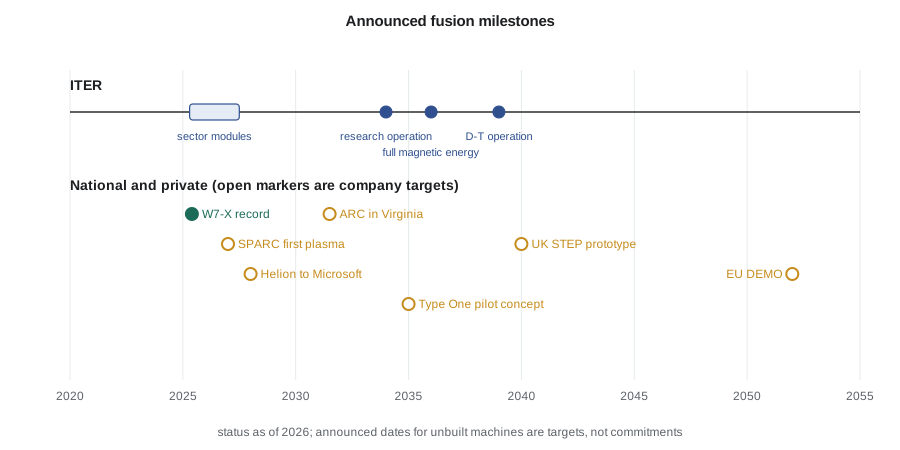
ITER's schedule has moved repeatedly. Plans at the time of the Agreement anticipated first plasma around 2016; a 2016 baseline set it for 2025. In 2022 the project found defects in the bevels of vacuum vessel sectors, where they are welded together, and corrosion cracking in the cooling pipes of the thermal shield, both requiring repair. A new baseline proposed in 2024 replaced first plasma with a more complete start of research operation in 2034, followed by full magnetic energy in 2036 and the start of deuterium-tritium operation in 2039, at an additional cost to the members of about five billion euros.
Since then, assembly has gone better than the revised plan. Installation of the nine vacuum vessel sector modules, each about 1,100 metric tons with two toroidal field coils, began in April 2025; by late July 2026 the sixth module was in place, bringing two-thirds of the torus together and putting the project about six months ahead of the new schedule, with the last module targeted for mid-2027.
The United States has been an ITER member throughout, apart from a period around 1999 to 2003 when it withdrew and later rejoined, and US ITER is managed by Oak Ridge National Laboratory in Tennessee. It supplies hardware including central solenoid modules built in California, parts of the tokamak cooling water system, and electron cyclotron transmission lines. Hana notes for the consortium that the Oak Ridge connection gives Tennessee an unusual concentration of fusion engineering experience.
Other public programs
Several national machines bridge the gap to ITER and beyond. JT-60SA, a large superconducting tokamak built jointly by Japan and Europe at Naka, achieved first plasma in 2023 and is exploring high-beta scenarios relevant to ITER and DEMO. China's EAST and Korea's KSTAR superconducting tokamaks hold records for long-pulse H-mode operation, and China is building a burning plasma tokamak in Hefei, with ambitions for an engineering test reactor afterwards. In Europe, Wendelstein 7-X leads stellarator research, and JET, the large tokamak at Culham in the UK, ended operations in December 2023 after a final D-T campaign that set a record of 69 MJ of fusion energy in a single pulse. The UK is designing STEP, a spherical tokamak prototype at West Burton in Nottinghamshire intended to deliver net electricity around 2040, and the European roadmap leads to DEMO, a demonstration power plant in the 2050s.
The private fusion industry
Private investment in fusion has grown from a few companies to dozens, with cumulative funding approaching ten billion US dollars by 2025. Companies argue that new technologies, especially high-temperature superconductors, better simulation, and modern manufacturing and power electronics, allow faster and cheaper development than large public projects. They span every confinement family:
| Approach | Examples | Main technical bet |
|---|---|---|
| High-field tokamak | Commonwealth Fusion Systems (SPARC, ARC); Tokamak Energy | HTS magnets allow compact devices with high power density |
| Optimized stellarator | Type One Energy; Proxima Fusion; Thea Energy | no disruptions; HTS or simplified coils make 3-D shapes buildable |
| Magnetized target fusion | General Fusion | mechanical compression of a magnetized plasma with a liquid metal liner |
| Field-reversed configuration, pulsed | Helion | compact pulsed machine with direct electricity recovery |
| Laser inertial fusion | Focused Energy; Xcimer Energy | efficient lasers and targets for high repetition rates |
| Sheared-flow Z-pinch | Zap Energy | no magnets: plasma current confines itself |
Commonwealth Fusion Systems, spun out of MIT, is the best-funded tokamak company. In 2021 it tested a large high-temperature superconducting magnet at 20 T. Its SPARC tokamak in Devens, Massachusetts, has a major radius of 1.85 m, a field of 12.2 T and a design goal of Q greater than 1, with simulations suggesting Q of about 11 and up to 140 MW of fusion power in short pulses. The first of its eighteen toroidal field magnets was completed in January 2026, and first plasma is targeted for 2027. CFS plans its first power plant, ARC, of about 400 MW, in Chesterfield County, Virginia, for the early 2030s, and in 2025 Google agreed to buy 200 MW of its output.
Helion, described in lesson 3, began building its Orion plant at Malaga, Washington, in 2025 to supply Microsoft from 2028, a target that would come well before any other company's. Type One Energy has worked with TVA on a stellarator pilot plant concept at TVA's former Bull Run coal plant site near Oak Ridge, a project of direct interest to the consortium.
The Department of Energy's Milestone-Based Fusion Development Program, begun in 2023, pays companies only when they meet agreed technical milestones toward a pilot plant design, in the style of the program that helped commercial spaceflight. Its first awards went to eight companies, including Commonwealth Fusion Systems, Focused Energy, Tokamak Energy, Type One Energy, Xcimer Energy and Zap Energy, and in 2025 the department opened the program to new teams. Ingrid's view, which Hana records, is that the program is a useful filter: a milestone reached and verified is worth more than any announced date.
Regulating fusion
Regulators have concluded that fusion's hazards differ from fission's. A fusion plant has no chain reaction to lose control of, little decay heat, and a radioactive inventory dominated by tritium and activated materials. In the United Kingdom, legislation in 2023 placed fusion under the regulators for radiation safety and the environment rather than the nuclear site licensing regime. In the United States, the NRC decided in 2023 to regulate fusion machines under its byproduct material framework, a choice reinforced by the ADVANCE Act of 2024, and published a proposed rule in February 2026 that adds a fusion pathway to 10 CFR Part 30, with a final rule targeted for later in 2026. Because most states are Agreement States, many fusion facilities would be licensed by state regulators.
In Canada, the CNSC regulates fusion under the Nuclear Safety and Control Act and consulted in 2025 on how its framework should adapt. Hana's draft notes that a fusion plant at a chemical and metals industrial park near Chattanooga would most likely be licensed by Tennessee as an Agreement State under the NRC's byproduct material framework, a lighter path than a fission reactor license, though the final rule and state implementation were still being completed in 2026.
Turning announcements into planning ranges
# Comparing fusion devices by power density, and a simple look at schedule slip
# in ITER's published baselines as an input to planning risk.
machines = [  # name, fusion power (MW), plasma volume (m^3), field on axis (T), target Q
    ("ITER (D-T phase)", 500, 830, 5.3, 10),
    ("SPARC (design)", 140, 20, 12.2, 11),
    ("ARC-class plant (concept)", 525, 140, 9.2, 13)]
print(f"{'device':28s}{'P_fus MW':>9s}{'V m3':>7s}{'MW/m3':>8s}{'B T':>6s}{'aux MW':>8s}")
for n, P, V, B, Q in machines:
    print(f"{n:28s}{P:9.0f}{V:7.0f}{P / V:8.2f}{B:6.1f}{P / Q:8.1f}")
# Schedule history: year of each baseline and its date for first plasma or start of operation
baselines = [(2006, 2016, "first plasma, ITER Agreement era"),
             (2016, 2025, "first plasma, 2016 baseline"),
             (2024, 2034, "start of research operation, 2024 baseline")]
print("\nbaseline year -> planned start   (years ahead)")
for y, start, note in baselines:
    print(f"  {y} -> {start}   ({start - y:2d})   {note}")
slip = (baselines[-1][1] - baselines[0][1]) / (baselines[-1][0] - baselines[0][0])
print(f"planned start moved {slip:.2f} years per calendar year between 2006 and 2024")
# A planner can turn a promised date into a range with a simple slip factor
for promise, years_out in (("pilot plant electricity", 8), ("first commercial plant", 13)):
    for k in (0.0, 0.5, 1.0):
print(f" {promise:24s} promised in {years_out:2d} y, slip factor {k:.1f} -> {years_out * (1 + k):4.1f} y")device P_fus MW V m3 MW/m3 B T aux MW ITER (D-T phase) 500 830 0.60 5.3 50.0 SPARC (design) 140 20 7.00 12.2 12.7 ARC-class plant (concept) 525 140 3.75 9.2 40.4 baseline year -> planned start (years ahead) 2006 -> 2016 (10) first plasma, ITER Agreement era 2016 -> 2025 ( 9) first plasma, 2016 baseline 2024 -> 2034 (10) start of research operation, 2024 baseline planned start moved 1.00 years per calendar year between 2006 and 2024 pilot plant electricity promised in 8 y, slip factor 0.0 -> 8.0 y pilot plant electricity promised in 8 y, slip factor 0.5 -> 12.0 y pilot plant electricity promised in 8 y, slip factor 1.0 -> 16.0 y first commercial plant promised in 13 y, slip factor 0.0 -> 13.0 y first commercial plant promised in 13 y, slip factor 0.5 -> 19.5 y first commercial plant promised in 13 y, slip factor 1.0 -> 26.0 y
The table of devices shows why the high-field approach is attractive: SPARC's design aims for more than ten times ITER's power density, so the same physics could be reached in a much smaller and cheaper machine. The schedule history is sobering: across three baselines, ITER's planned start moved by about one year for every calendar year that passed. That is not unusual for first-of-a-kind megaprojects, fission plants included, and private companies may do better, but no fusion company has yet built a machine that produces net electricity.
Elena suggests that Hana present dates for the consortium as ranges with explicit slip factors, and tie each option to verifiable milestones: SPARC reaching Q greater than 1, a pilot plant producing net electricity, a blanket demonstrating a breeding ratio above 1, and regulatory approval of a first plant. Only once those are met would fusion become a firm option for supply in the 2040s.
Worked problem
Planning range for a fusion supply date
A company announces that its first commercial plant will deliver power 11 years from now. Historical first-of-a-kind energy projects in a planner's database show schedule slips of 30 to 100 percent of the original duration. What range should a client use, and what milestone would narrow it?
Show solution
- Low end: 11 × 1.3 = 14.3 years.
- High end: 11 × 2.0 = 22 years.
- A milestone such as a pilot plant producing net electricity, verified independently, would remove the largest technical uncertainty and justify moving toward the low end.
Answer: About 14 to 22 years, to be revisited when verifiable milestones are met.
Common mistakes
MistakeITER will generate electricity.
InsteadITER is designed to show Q = 10 at reactor scale; it has no power conversion system.
MistakePrivate companies have already reached net electricity.
InsteadNo fusion device has yet produced more electricity than it consumes; plant-level targets are company plans.
MistakeFusion plants will be regulated exactly like fission reactors.
InsteadThe NRC and UK use radiation and materials frameworks; the CNSC is adapting its framework for fusion's different hazards.
MistakeITER's 2024 baseline set a date for first plasma in 2025.
InsteadIt replaced first plasma with start of research operation in 2034, and D-T from 2039.
Summary and key terms
- ITER, built by seven members in France, aims for Q = 10 and 500 MW in 400-second pulses.
- Its 2024 baseline sets research operation in 2034 and D-T operation from 2039; assembly was ahead of that plan in 2026.
- National programs include JT-60SA, EAST, KSTAR, Wendelstein 7-X, the UK's STEP and European DEMO.
- Private companies pursue high-field tokamaks, stellarators, pulsed and inertial concepts; announced dates are targets.
- The NRC regulates fusion under its byproduct material rules; the CNSC is adapting its framework.
- Planners should use ranges and verifiable milestones rather than single dates.
- ITER
- The international burning-plasma tokamak under construction in France.
- Start of research operation
- The first ITER operating phase in the 2024 baseline, with hydrogen and deuterium plasmas.
- High-temperature superconductor
- A superconductor such as REBCO that carries high currents at high fields and temperatures above 20 K.
- Milestone-based funding
- Public funding released only when agreed technical milestones are met.
- Byproduct material framework
- NRC rules for radioactive material, applied to fusion machines.
Practice problems
Work each problem on paper first, then reveal the answer to check.
What are ITER's main performance goals?
Show answer
500 MW of fusion power with Q = 10 for about 400 seconds, and Q = 5 in long pulses.
When does the 2024 baseline schedule D-T operation at ITER?
Show answer
From 2039.
What is the main technical bet of Commonwealth Fusion Systems?
Show answer
High-temperature superconducting magnets that allow a compact, high-field tokamak.
How does the DOE Milestone program differ from a conventional grant?
Show answer
Payments are made only when verified technical milestones are met.
Under what framework does the NRC propose to license fusion machines?
Show answer
The byproduct material rules of 10 CFR Part 30.
Lesson quiz · 5 questions
Score 60% or more to complete this lesson.
Create a free account to save your progress, take quizzes and earn a certificate.