
NUC-450 · Lesson 12 of 12 · 21 min
Economics of advanced nuclear
The last chapter of the options study is the one the consortium's finance committee will read first. Ingrid, Rohan and Elena meet with Hana to agree its structure. “Every option in this report is a capital project with long lead times,” Elena says. “The technology chapters tell them what is possible. This chapter tells them what it might cost, what drives the cost, and which risks they would be carrying.” Rohan adds one rule: every number must show its assumptions, especially the discount rate.
This lesson develops the economic tools used to compare nuclear and other energy options: overnight cost, interest during construction, capital recovery, levelized cost and the role of capacity factor. It examines why nuclear costs are dominated by capital and financing, what evidence exists on first-of-a-kind and repeat costs, how learning and standardization might lower them, and how the economics of advanced fission and fusion differ. It ends with the framework Hana uses to bring the options study together.
The structure of nuclear costs
The cost of electricity or heat from a nuclear plant has three parts: capital, operations and maintenance, and fuel. For water reactors, capital and its financing typically make up 60 to 80 percent of the total, operations and maintenance 15 to 30 percent, and fuel only 5 to 15 percent. That structure is the opposite of a gas-fired plant, where fuel dominates. It makes nuclear costs very sensitive to construction cost, construction time and the cost of money, and very insensitive to fuel prices.
Capital cost is usually quoted as an overnight cost: the cost per kilowatt of building the plant as if it were completed instantly, including engineering, equipment, construction labor, owner's costs and contingency, but excluding financing. Interest during construction then adds the cost of money spent years before the plant earns revenue. For a project that spends evenly over six years at a 6 percent cost of capital, interest during construction adds about 20 percent to the overnight cost; at 9 percent and eight years, about 40 percent.
Levelized cost
The levelized cost of electricity (LCOE) is the constant price per megawatt-hour that would recover all costs over a plant's life, including a return on capital at the chosen discount rate. Capital is converted into an annual payment with the capital recovery factor,
for discount rate r and economic life n years, and the LCOE is the sum of the annual capital charge and fixed operating cost, divided by the energy produced per year, plus variable operating and fuel costs per unit of energy. The same approach gives a levelized cost of heat or of hydrogen.
# Levelized cost of electricity for capital-intensive plants: overnight cost, interest during
# construction, discount rate and capacity factor, plus a learning curve for repeat units.
# All costs are illustrative, in US dollars of a common year, per kW of net electrical capacity.
def crf(r, n):
    return r * (1 + r) ** n / ((1 + r) ** n - 1)

def idc_factor(r, T):
    # spending spread evenly over T years, interest compounded to commercial operation
    return sum((1 / T) * (1 + r) ** (T - t - 0.5) for t in range(T))

def lcoe(overnight, T, r, cf, fom=150.0, fuel_vom=12.0, life=40):
    cap = overnight * idc_factor(r, T) * crf(r, life)    # dollars per kW per year
    return (cap + fom) / (8760 * cf) * 1000 + fuel_vom   # dollars per MWh

options = [  # name, overnight cost per kW, construction years
    ("Repeat SMR (nth unit)", 9000, 4), ("First SMR (first of a kind)", 16000, 6),
    ("Gen IV demonstration", 18000, 7), ("Fusion pilot (speculative)", 25000, 8)]
print(f"{'option':30s}{'overnight':>10s}" + "".join(f"{'r=' + str(int(r * 100)) + '%':>9s}" for r in (0.03, 0.06, 0.09)))
for name, oc, T in options:
    vals = "".join(f"{lcoe(oc, T, r, 0.90):9.0f}" for r in (0.03, 0.06, 0.09))
    print(f"{name:30s}{oc:10,d}{vals}")
print("(LCOE in dollars per MWh at 90% capacity factor)")
# Capacity factor matters as much as cost: the same plant at lower utilization
for cf in (0.95, 0.90, 0.75, 0.50):
    print(f"first SMR at r = 6%, capacity factor {cf:.0%}: {lcoe(16000, 6, 0.06, cf):5.0f} dollars/MWh")
# Learning curve: each doubling of units built cuts unit cost to LR times the previous
import math
LR = 0.90
b = math.log2(LR)
for n in (1, 2, 4, 8, 16):
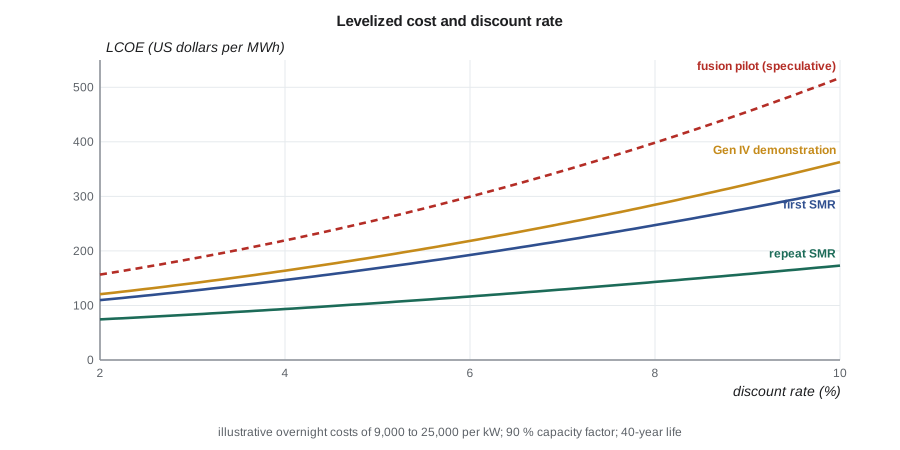
print(f"unit {n:2d}: overnight cost {16000 * n ** b:7,.0f} dollars/kW")option overnight r=3% r=6% r=9% Repeat SMR (nth unit) 9,000 83 116 158 First SMR (first of a kind) 16,000 127 192 278 Gen IV demonstration 18,000 141 218 322 Fusion pilot (speculative) 25,000 186 299 455 (LCOE in dollars per MWh at 90% capacity factor) first SMR at r = 6%, capacity factor 95%: 183 dollars/MWh first SMR at r = 6%, capacity factor 90%: 192 dollars/MWh first SMR at r = 6%, capacity factor 75%: 229 dollars/MWh first SMR at r = 6%, capacity factor 50%: 337 dollars/MWh unit 1: overnight cost 16,000 dollars/kW unit 2: overnight cost 14,400 dollars/kW unit 4: overnight cost 12,960 dollars/kW unit 8: overnight cost 11,664 dollars/kW unit 16: overnight cost 10,498 dollars/kW
Three lessons emerge from the table. First, the discount rate matters as much as the overnight cost: the same first small modular reactor costs about 130 dollars per MWh at 3 percent and nearly 280 at 9 percent. This is why government ownership, loan guarantees, regulated returns and low-cost public lending have been central to almost every nuclear project of the past two decades. Second, capacity factor matters, because a capital-heavy plant must run as much as possible: the same reactor at 50 percent utilization costs nearly twice as much per MWh as at 95 percent. Third, learning can help, but slowly: with a 90 percent learning rate, cost falls by a third only after about sixteen units.
First-of-a-kind costs and the evidence
Recent experience shows how much first-of-a-kind projects cost. Vogtle Units 3 and 4 in Georgia, the first new US reactors in a generation, entered commercial operation in 2023 and 2024, years late and at a total project cost widely reported to exceed 30 billion dollars for about 2,200 MWe. In Canada, Ontario's first BWRX-300 small modular reactor at Darlington is estimated at about 6.1 billion Canadian dollars for the first 300 MWe unit, including shared infrastructure, and about 20.9 billion for four units. TVA has applied to build a BWRX-300 at Clinch River, near Knoxville, and Hana notes that a repeat of the same design in the United States would be a test of how quickly first-of-a-kind costs fall.
Analyses of past programs show both sides. France's fleet of the 1970s and 1980s and South Korea's program of standardized units kept costs fairly stable by building the same design repeatedly with the same teams. The United States in the 1970s and 1980s, and several Western projects since 2005, saw costs rise sharply as designs changed during construction, regulations changed, supply chains and skilled trades atrophied, and projects started before designs were complete. The single strongest predictor of cost overrun is starting construction with an incomplete design.
| Cost driver | Direction for SMRs and Gen IV | Notes |
|---|---|---|
| Plant size | higher cost per kW | economies of scale are lost |
| Factory fabrication and modular construction | lower | more work in controlled conditions, shorter site time |
| Simpler, passive safety systems | lower | fewer pumps, valves, cables and safety-grade buildings |
| Series production and learning | lower over time | needs a pipeline of orders for the same design |
| First-of-a-kind engineering and licensing | higher at first | borne by early projects |
| New fuels and supply chains (HALEU, TRISO) | higher at first | capacity being built |
| Smaller emergency planning zones, siting near users | higher value | enables heat sales and brownfield sites |
The economics of Generation IV
Advanced fission reactors add both cost risks and sources of value. Their first units carry the cost of new fuel types, new coolant technologies and new regulatory reviews, and their supply chains are thin. On the other hand, higher outlet temperatures raise efficiency and open heat markets; low-pressure coolants and passive safety could reduce the scale of safety-grade structures; and features such as Natrium's molten salt storage let a plant sell more of its output when prices are high. For a client like the consortium, the value of steam that replaces natural gas, plus avoided carbon costs, can be compared directly with the levelized cost of heat, which for a given reactor is lower than its levelized cost of electricity per unit of energy because no conversion losses are incurred.
The economics of fusion
Fusion economics are far less certain because no fusion plant has been built, and published cost estimates range widely. A few structural features are nevertheless clear. A fusion plant would be at least as capital-intensive as a fission plant, with expensive magnets or drivers, a large vacuum vessel, extensive remote handling equipment and a tritium plant. Its fuel cost would be negligible. Its recirculating power, for heating, current drive, cryogenics and pumping, would reduce net output, so a plant with an engineering gain of 4 would need to build 33 percent more gross capacity than it sells. Its availability would depend on how often first walls, blankets and divertors must be replaced, and how long each replacement takes; a plant that must stop for six months every four years cannot exceed about 85 percent availability even if nothing else goes wrong. And its licensing, under a lighter framework than fission, might cost less and take less time.
Studies that try to estimate future fusion costs generally find that fusion could compete only if overnight costs fall to levels similar to those hoped for advanced fission, availability exceeds about 75 percent and the physics allows compact, high-power-density designs. Fusion companies argue that high-field magnets and factory-built components will deliver those conditions; skeptics point out that no confinement scheme has yet operated with a breeding blanket, and that the first plants will carry first-of-a-kind costs just as fission plants do. Both sides agree that fusion's first contribution to supply will come later than that of advanced fission.
Policy, risk and financing
Because the cost of capital dominates, the way a project is financed and its risks shared can matter more than its engineering. Federal measures in the United States include clean electricity and hydrogen tax credits, Department of Energy loan programs and cost sharing for demonstrations under the Advanced Reactor Demonstration Program, and large technology companies have begun signing long-term power purchase agreements with advanced fission and fusion developers. For an industrial consortium, the options include buying heat or power under long-term contracts from a utility-owned reactor, joint ownership with a utility, or a build-own-operate arrangement with a vendor, each with different allocations of construction, performance and regulatory risk.
Bringing the options study together
Hana's final chapter for the consortium ranks the options not by a single cost figure but by readiness, cost range, fit to the site's heat demand, and the milestones that would change the ranking. Water-cooled small modular reactors are being built now and could supply steam below 300 °C and electricity in the 2030s, at first-of-a-kind costs that should fall if fleets are built. High-temperature gas reactors and other Generation IV designs fit the site's higher-temperature heat and hydrogen needs better, with first commercial units expected around 2030 and costs still uncertain. Fusion is a strategic option to monitor for the 2040s, to be reassessed as pilot plants demonstrate net electricity, tritium breeding and availability.
Ingrid reads the last page and adds a sentence of her own before the report goes out: the most valuable thing the consortium can do now is to keep its site, grid connection, steam network and permitting options open, so that whichever technology matures first can be used.
Worked problem
Levelized cost of nuclear heat
A 200 MWt high-temperature reactor module costs 1.2 billion dollars overnight, takes five years to build and operates for 40 years at 92 percent availability. Fixed operating costs are 30 million dollars a year and fuel 6 dollars per MWh of heat. At a 7 percent discount rate, what is the levelized cost of heat? Take the interest-during-construction factor as 1.19.
Show solution
- Capital including financing = 1.2 × 1.19 = 1.428 billion dollars.
- CRF at 7 percent for 40 years = 0.07 × 1.07⁴⁰ ÷ (1.07⁴⁰ − 1) = 0.0750.
- Annual capital charge = 1.428 × 10⁹ × 0.0750 = 107 million dollars.
- Heat delivered = 200 × 8760 × 0.92 = 1.612 million MWh per year.
- Levelized cost = (107 + 30) × 10⁶ ÷ 1.612 × 10⁶ + 6 = 85 + 6 = 91 dollars per MWh of heat.
Answer: About 91 dollars per MWh of heat, which can be compared with the cost of gas-fired steam including any carbon charge.
Common mistakes
MistakeNuclear power is expensive because of fuel.
InsteadFuel is 5 to 15 percent of cost; capital and financing dominate.
MistakeOvernight cost is the full cost of the plant.
InsteadIt excludes interest during construction, which can add 20 to 40 percent or more.
MistakeA lower LCOE always means a better option.
InsteadValue also depends on heat quality, flexibility, reliability and risk.
MistakeFusion will be cheap because its fuel is cheap.
InsteadFusion costs will be dominated by capital, recirculating power and availability.
Summary and key terms
- Capital and financing dominate nuclear costs; fuel is a small share.
- LCOE uses the capital recovery factor to annualize capital at a chosen discount rate.
- Discount rate and capacity factor change LCOE as much as overnight cost.
- First-of-a-kind costs are high; standardization and series building lower them over time.
- Fusion economics depend on capital cost, recirculating power and availability, all still uncertain.
- Options should be ranked by readiness, cost range, fit to demand and the milestones that would change the ranking.
- Overnight cost
- Construction cost per kilowatt excluding financing.
- Interest during construction
- Financing cost accumulated before commercial operation.
- Capital recovery factor
- The fraction of capital to be repaid each year at a given discount rate and life.
- Levelized cost
- The constant price per unit of energy that recovers all costs over the plant life.
- Learning rate
- The fraction of unit cost remaining after each doubling of cumulative units built.
- Capacity factor
- Actual energy produced divided by the energy at full output all year.
Practice problems
Work each problem on paper first, then reveal the answer to check.
Why is nuclear electricity so sensitive to the discount rate?
Show answer
Most of its cost is capital paid years before and recovered over decades.
What does a 90 percent learning rate mean?
Show answer
Each doubling of units built reduces unit cost to 90 percent of its previous value.
What is the strongest predictor of nuclear construction cost overruns?
Show answer
Starting construction before the design is complete.
How does engineering gain affect fusion plant economics?
Show answer
Low gain means more gross capacity must be built for each unit of power sold.
Why is the levelized cost of heat lower than the levelized cost of electricity from the same reactor?
Show answer
Heat is sold without the losses of conversion to electricity.
Lesson quiz · 5 questions
Score 60% or more to complete this lesson.
Create a free account to save your progress, take quizzes and earn a certificate.