
NUC-450 · Lesson 11 of 12 · 20 min
Nuclear for process heat and hydrogen
Lise Fortin, Meridian's environmental scientist, has spent a week at a chemical and metals industrial park near Chattanooga with the consortium's energy managers, and she comes back with the numbers that will drive the whole study. The park uses about 520 MW of heat on average, most of it as steam from natural gas boilers, plus some very high-temperature heat for the metals plants, and it expects to need hydrogen for chemicals and low-carbon metal processing within fifteen years. “Electricity is the smaller half of their problem,” she tells Hana. “What they really buy is heat.”
This lesson looks beyond electricity at nuclear heat for industry and for hydrogen production. It matches the temperatures that industrial processes need to the outlet temperatures of different reactors, describes how nuclear heat can be delivered safely across a site boundary, compares the main routes to nuclear hydrogen, and considers siting, coupling and the history of nuclear process heat projects.
Industrial heat demand
Industrial heat accounts for roughly a fifth of final energy use in industrialized economies, and most of it is supplied by burning fossil fuels on site. It is harder to decarbonize than electricity because many processes need temperatures that heat pumps cannot reach, need heat continuously, or use fossil fuels both as heat sources and as chemical feedstocks. The required temperature is the first sorting criterion for nuclear heat.
| Use | Typical temperature | Reactor types that can supply it |
|---|---|---|
| District heating, food processing, desalination | 80 to 200 °C | any reactor, including existing water reactors |
| Pulp and paper, oil sands steam | 150 to 300 °C | water reactors, SMRs |
| Refining, many chemical processes | 300 to 550 °C | sodium, lead, molten salt and gas reactors |
| Steam methane reforming, ethylene cracking | 700 to 900 °C | high-temperature gas reactors, with limits |
| High-temperature electrolysis | about 700 to 850 °C at the cell, steam supplied at 150 to 500 °C | water reactors with topping heat, or high-temperature reactors |
| Steelmaking, cement, glass | above 1,000 °C | not directly by any fission reactor; via hydrogen or electricity |
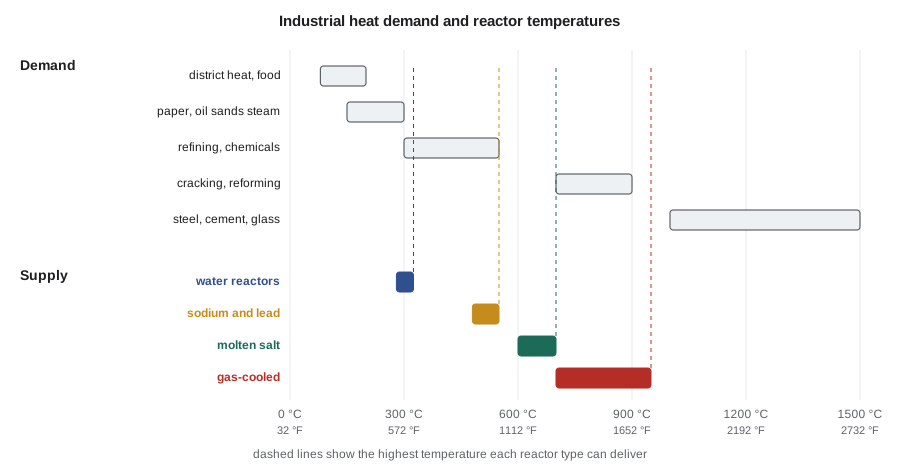
Two features of the table stand out. A large share of industrial steam is below 300 °C and could in principle come from water-cooled reactors, including small modular reactors. And the highest-temperature processes cannot be served directly by any fission reactor; they will be decarbonized, if at all, through hydrogen, electricity, carbon capture or process change.
Delivering heat across the boundary
Nuclear process heat must cross from a licensed nuclear facility to an industrial plant without carrying radioactivity with it, and without letting an industrial accident affect the reactor. Designs place at least one intermediate loop between the reactor coolant and the customer: a steam generator or intermediate heat exchanger on the nuclear side, and often a further heat exchanger or a reboiler that makes clean process steam from a monitored, slightly lower-pressure loop. Pressure differences are arranged so that any leak flows toward the nuclear side. Because steam cannot be piped economically for more than a few kilometers, the reactor must sit close to the users, which raises questions of emergency planning zones, explosion and toxic gas hazards from the chemical plant, and the separation needed between them.
Small reactors help here. Their low power, passive safety and small source terms are the basis of proposals for emergency planning zones at or near the site boundary, which would allow siting next to industrial users. Regulators in both countries have developed approaches for sizing emergency planning zones in proportion to the potential consequences of a specific design rather than using a fixed distance.
Routes to nuclear hydrogen
Most of the world's hydrogen, about 95 million metric tons a year, is made by steam methane reforming of natural gas, releasing about 9 to 10 kg of CO₂ per kilogram of hydrogen. Nuclear energy can make hydrogen in three main ways. Low-temperature electrolysis, with alkaline or proton-exchange-membrane cells, uses only electricity, about 50 to 55 kWh per kilogram of hydrogen at the system level. High-temperature steam electrolysis, with solid oxide cells operating at 700 to 850 °C, needs less electricity, because part of the energy to split water is supplied as heat, and the cells themselves are more efficient: about 37 to 40 kWh of electricity plus about 7 to 10 kWh of heat per kilogram. Thermochemical cycles, such as the sulfur-iodine cycle, split water through a sequence of chemical reactions driven by heat at about 850 °C, promising high efficiency but at an early stage of development.
# Nuclear heat for industry: hydrogen production efficiency by low- and high-temperature
# electrolysis, and the reactor capacity and CO2 avoided for an industrial steam demand.
HHV = 39.4                       # kWh per kg of hydrogen (higher heating value)
cases = [  # name, electricity kWh/kg, heat kWh/kg, plant thermal-to-electric efficiency
    ("Low-temperature electrolysis, LWR power", 52.0, 0.0, 0.33),
    ("High-temperature electrolysis, LWR power and steam", 37.0, 7.0, 0.33),
    ("High-temperature electrolysis, HTGR power and steam", 37.0, 7.0, 0.42)]
print(f"{'route':54s}{'reactor heat kWh/kg':>20s}{'heat to H2 (HHV)':>17s}")
for n, e, q, eta in cases:
    heat = e / eta + q
    print(f"{n:54s}{heat:20.0f}{HHV / heat:17.0%}")
# Hydrogen output of a 300 MWt reactor dedicated to high-temperature electrolysis
P_th = 300e3                     # kW thermal
for n, e, q, eta in cases[1:]:
    kg_h = P_th / (e / eta + q)
    print(f"300 MWt, {n.split(', ')[1]:20s}: {kg_h:6.0f} kg/h = {kg_h * 24 * 0.9 / 1000:5.0f} t/day at 90% capacity")
# Industrial steam: replace gas-fired boilers with reactor modules
demand_MW = 520.0                # MWt average steam demand at the park
module_MW = 200.0                # MWt per high-temperature gas reactor module
avail = 0.93
import math
n_mod = math.ceil(demand_MW / (module_MW * avail))
gas_tCO2_per_MWh = 0.181 / 0.85  # natural gas emission factor over boiler efficiency
co2 = demand_MW * 8760 * gas_tCO2_per_MWh / 1e6
print(f"\n{demand_MW:.0f} MWt demand needs {n_mod} modules of {module_MW:.0f} MWt at {avail:.0%} availability "
f"(one more for N+1 redundancy); avoids about {co2:.2f} Mt CO2 per year")route reactor heat kWh/kg heat to H2 (HHV) Low-temperature electrolysis, LWR power 158 25% High-temperature electrolysis, LWR power and steam 119 33% High-temperature electrolysis, HTGR power and steam 95 41% 300 MWt, LWR power and steam : 2518 kg/h = 54 t/day at 90% capacity 300 MWt, HTGR power and steam: 3155 kg/h = 68 t/day at 90% capacity 520 MWt demand needs 3 modules of 200 MWt at 93% availability (one more for N+1 redundancy); avoids about 0.97 Mt CO2 per year
The comparison shows why high-temperature electrolysis is the leading nuclear hydrogen route. Coupled to a water reactor that supplies steam as well as electricity, it uses about a quarter less reactor heat per kilogram than low-temperature electrolysis; coupled to a high-temperature reactor with a more efficient power cycle, about 40 percent less. A 300 MWt reactor dedicated to the task could make some 55 to 70 metric tons of hydrogen a day, enough for a large refinery or an ammonia plant of modest size.
In the United States, Idaho National Laboratory has led high-temperature electrolysis research, and the Department of Energy has supported demonstrations of hydrogen production at operating nuclear plants, including Constellation's Nine Mile Point plant in New York, which began producing hydrogen with an electrolyzer in 2023. Dow's Long Mott project at Seadrift, Texas, is designed to supply both steam and electricity to a large chemical site from four Xe-100 modules, the clearest current example of a reactor sited to replace industrial gas-fired heat.
Coupling, reliability and economics
An industrial customer cares about reliability more than almost anything else, because an unplanned loss of steam can shut down a whole chemical complex. A single large reactor cannot provide that on its own, since it must be shut down periodically for refueling and maintenance. Process heat projects therefore favor several smaller modules, so that one can be out of service while the others carry the load, or retain backup boilers. Thermal energy storage, such as the molten salt tanks of the Natrium design, can decouple the reactor from fluctuating demand and supply short peaks.
The economics depend on the alternative. Nuclear heat competes with natural gas, which in North America has been inexpensive, so its case rests on carbon prices or regulations, long-term price stability, and the value of hydrogen or clean steam to the customer's products. Industrial customers also face a mismatch of time horizons: chemical companies plan investments over perhaps ten to fifteen years, while a reactor is designed for sixty. Ownership models in which a utility or independent operator owns and runs the reactor and sells heat under long-term contracts are a common answer.
Hana adds a historical caution that Elena suggested. In the 1970s Dow Chemical contracted for a nuclear plant at Midland, Michigan, to supply steam and electricity to its chemical complex; construction problems and soaring costs led to the project's cancellation in the 1980s, long after much of it had been built. Dow's return to the idea at Seadrift fifty years later is a sign that the case has changed, and a reminder to match the customer's risk tolerance with a realistic schedule and contract structure.
Worked problem
Sizing a nuclear hydrogen plant
The consortium expects to need 40 metric tons of hydrogen a day for direct reduction of iron ore. Using high-temperature electrolysis needing 38 kWh of electricity and 8 kWh of heat per kilogram, supplied by a reactor whose power cycle is 40 percent efficient, how much reactor thermal power is needed, assuming 90 percent capacity factor for the electrolysis plant?
Show solution
- Average production rate = 40,000 ÷ (24 × 0.9) = 1,852 kg/h while running.
- Reactor heat per kilogram = 38 ÷ 0.40 + 8 = 103 kWh.
- Reactor thermal power = 1,852 × 103 = 190,700 kW, about 191 MWt.
Answer: About 190 MWt, roughly one high-temperature gas reactor module dedicated to hydrogen, before allowing for redundancy.
Integrated energy systems
A further idea is to operate a reactor as the hub of an integrated energy system that switches its output between products. When electricity prices are high, the reactor sends most of its heat to the turbine; when they are low, it diverts heat and electricity to an electrolysis plant, thermal storage or a process heat customer. This lets the reactor run at full power continuously, which is how its capital is best used, while its output follows the market. Thermal storage in molten salt, concrete or packed beds of rock can hold several hours of heat, and hydrogen can be stored for longer periods in tanks or salt caverns. National laboratories in both countries have built test facilities to study the control and dynamics of such systems, because sudden changes in one product's demand must not disturb the reactor.
For the consortium, Lise and Hana model three supply configurations: electricity only, with the park's boilers converted to electric heating; steam and electricity from small modular water reactors, with natural gas topping for the highest temperatures; and steam, electricity and hydrogen from high-temperature gas reactor modules with high-temperature electrolysis. The third configuration matches the park's needs most closely, but it relies on designs that will have the least operating experience in the 2030s. That trade between fit and maturity becomes the central question of the economics chapter.
Siting and safety interfaces
Placing a reactor next to a chemical plant creates hazards in both directions, and the safety analysis must address each. External hazards from the chemical plant include explosions, fires, toxic gas releases that could affect the control room, and missiles from failed equipment; these are addressed by separation distances, blast-resistant structures and control room habitability systems. Hazards from the reactor to the chemical plant are mainly radiological and are addressed by the reactor's own safety design and emergency planning. Hydrogen production adds a further interface, since a hydrogen leak near the reactor could cause an explosion; hydrogen plants are usually located at a distance from safety-related structures, with the separation justified by analysis of credible release and ignition scenarios.
Common mistakes
MistakeAny reactor can supply any industrial heat demand.
InsteadTemperature limits apply: water reactors serve below about 300 °C, gas reactors up to about 900 °C, and nothing directly above 1,000 °C.
MistakeLow-temperature electrolysis is the most efficient nuclear hydrogen route.
InsteadHigh-temperature electrolysis uses less electricity because part of the energy is supplied as heat.
MistakeProcess steam can be piped economically over long distances.
InsteadSteam losses and cost limit transport to a few kilometers, so the reactor must be close to users.
MistakeOne large reactor is the best supply for an industrial park.
InsteadMultiple modules or backup boilers are needed because a single unit must stop for outages.
Summary and key terms
- Industrial heat is about a fifth of final energy use; its required temperature decides which reactors can serve it.
- Intermediate loops and pressure differences keep radioactivity out of process steam.
- Small reactors with small source terms allow emergency planning zones close to the site boundary.
- High-temperature electrolysis needs about 37 to 40 kWh of electricity plus heat per kilogram, less than low-temperature electrolysis.
- Reliability needs several modules or backup supply; storage can decouple reactor and demand.
- Economics depend on gas prices, carbon policy and long-term contracts.
- Process heat
- Thermal energy used directly in industrial processes.
- Intermediate loop
- A heat transfer circuit that isolates reactor coolant from the customer.
- High-temperature electrolysis
- Splitting steam in solid oxide cells at about 700 to 850 °C.
- Steam methane reforming
- Making hydrogen from natural gas and steam, with CO₂ as a by-product.
- Emergency planning zone
- The area around a nuclear plant where emergency arrangements are made.
- Thermochemical cycle
- A sequence of heat-driven chemical reactions that splits water.
Practice problems
Work each problem on paper first, then reveal the answer to check.
What temperature range can water-cooled reactors supply?
Show answer
Up to about 300 °C.
Why does high-temperature electrolysis need less electricity?
Show answer
Heat supplies part of the energy to split water and the cells are more efficient.
How much CO₂ does steam methane reforming release per kilogram of hydrogen?
Show answer
About 9 to 10 kg.
Why must a process heat reactor be close to its customers?
Show answer
Steam cannot be transported economically more than a few kilometers.
Why do process heat projects favor several modules?
Show answer
So supply continues while one is shut down for refueling or maintenance.
Lesson quiz · 5 questions
Score 60% or more to complete this lesson.
Create a free account to save your progress, take quizzes and earn a certificate.