
MSBA-253 · Lesson 12 of 12 · 29 min
Case study: governing a growing maker community
▶ Video coming soon A video version of this lesson is on the way.
This final lesson is a case study. It describes a different organization, invented for the purpose, at the point Lumenvale had reached in the spring of 2026, and asks you to make the decisions this course has covered. Work through each problem before reading the suggested answer; there is usually more than one reasonable design, and the answers explain the reasoning rather than offering the only right choice. Rupert used an earlier version of this case with the champions in November 2026, and their debrief appears at the end.
The organization
Marrowind Regional Libraries is a public library system with 14 branches across a mostly rural region, a central administration office and about 320 staff, a third of them part-time. Every staff member has a Microsoft 365 license that includes standard Power Platform rights. Two years ago a few enthusiastic staff started building apps, and the platform spread by word of mouth. No one was assigned to govern it. A new IT manager, Corwin Treleaven-Osei, has asked you to help him put things in order without stopping the good work already being done.
Corwin's first inventory, taken from the admin center, shows the following.
| Item | What Corwin found |
|---|---|
| Environments | The default environment; two trial environments created by staff, one expiring in three weeks; one production environment called Libraries, created by a former employee, with Dataverse |
| Apps | 58 canvas apps in the default environment, 9 in Libraries; 21 not opened in six months |
| Flows | 133 cloud flows, almost all in the default environment; 12 owned by people who have left |
| Important solutions | A room and equipment booking app used at every branch; an interlibrary loan request app that emails a regional partner; a volunteer hours tracker with volunteers' home addresses |
| Data policy | None |
| Licenses | Standard Microsoft 365 rights only, plus six Power Apps Premium licenses bought by one branch manager |
| People | One IT manager, one IT technician, and about 25 active makers, four of them very capable |
Problem 1: the first two weeks
Corwin wants to know what to do first. Several things are urgent and he has limited time. Which three actions would you take in the first two weeks, and why those?
Worked problem
Problem 1, suggested answer
Choose three actions for the first two weeks.
Show solution
- Create a tenant-wide baseline data policy, with Microsoft 365 connectors and Dataverse in business, consumer services in non-business, the default group set to non-business, and a short blocked list. Before applying it, use the admin center's connector views to see which flows would be affected and warn their owners. This closes the biggest risk, data leaving the organization through flows, with one change.
- Rescue the expiring trial environment: contact its creator, export anything worth keeping as a solution, and plan to recreate it in a proper environment. Lost work in an expired trial is the fastest way to make makers distrust IT.
- Reassign or document the 12 flows owned by people who have left, starting with any that the booking or interlibrary loan apps depend on, because those will stop working when the former employees' accounts are removed.
Answer: Start with the controls that prevent harm (a baseline data policy), the work about to be lost (the expiring trial) and the flows that will silently fail (orphaned owners). Environments, pipelines and community come next, once nothing is on fire.
Problem 2: environment strategy
With the urgent items handled, Corwin needs an environment plan. The booking app is used at every branch and is the library's most important solution. The interlibrary loan app shares data with a regional partner. The volunteer tracker holds home addresses. Most other apps are personal or small team tools. What environments would you create, and which would be managed?
Worked problem
Problem 2, suggested answer
Design the environments.
Show solution
- Keep the default environment for personal productivity, with a stricter data policy than the governed environments, and turn on default environment routing so new makers get personal developer environments in a Personal Development group.
- Create a Library Services set (Dev, Test, Prod) for the booking app and the interlibrary loan app, which share an owner, the branch services manager, and similar data. Prod and Test are managed; Dev can be a developer environment.
- Create a separate People set for the volunteer tracker, because it holds personal addresses and has a different owner, the volunteer coordinator, with a strict allow-list data policy.
- Retire the existing Libraries environment after moving its useful contents, or rename and reuse it as Library Services Prod if its Dataverse data model is sound. Every environment gets a security group, and the register lists owner, purpose and data.
Answer: Personal work stays in the default and routed developer environments; important shared solutions get dev, test and managed production sets grouped by owner and data sensitivity. Managed Environments in production requires that users of those solutions be licensed with premium rights or covered by pay-as-you-go, so the license plan in Problem 5 matters.
Problem 3: moving the booking app
The booking app lives in the default environment as a canvas app on two SharePoint lists, with four flows that send confirmations and reminders. Its maker, a branch assistant called Hester Pengelly-Ward, is one of the four capable makers. Describe how you would move it into Library Services with ALM in place.
Worked problem
Problem 3, suggested answer
Move the booking app into a governed environment.
Show solution
- Create a Marrowind publisher with a prefix such as mrl, and a Library Bookings solution in Library Services Dev. Recreate or import the canvas app and flows into the solution, so they are solution components.
- Replace hard-coded site addresses and email addresses with environment variables, including a data source variable for the SharePoint site and a yes/no variable that stops test environments from emailing patrons. Replace direct connections with connection references.
- Set up a pipeline with Test and Production stages, a delegated deployment to production as a service principal or pipeline owner, and approval by the branch services manager and Corwin. Prepare a service account for Outlook in production.
- Connect Library Services Dev to a Git repository so that every change is recorded, and agree with Hester that she commits each change with a clear message. Deploy to Test, have two branches test it, then deploy to Prod and switch users over on a quiet day.
Answer: Package the app and flows in a solution, separate environment-specific values and connections, deploy through a pipeline with delegated production deployment and approval, and record changes in source control. The maker stays the builder; the platform now protects her work.
Problem 4: the volunteer tracker
The volunteer tracker was built by a volunteer coordinator on a SharePoint list that holds volunteers' names, phone numbers and home addresses. A flow emails the coordinator's personal account each week with a list of upcoming shifts, because she checks it on her phone. What is wrong, and what should be done?
Worked problem
Problem 4, suggested answer
Fix the volunteer tracker.
Show solution
- The flow sends personal information to a consumer mailbox, the same pattern as Lumenvale's Ridgeview incident. The baseline data policy from Problem 1 will already have suspended it if the consumer connector was placed in non-business.
- Talk to the coordinator before anything else, explain the risk without blame, and offer a better way to see shifts on her phone, such as the Microsoft 365 mobile apps with the organization's account or a Teams notification.
- Move the tracker into the People environments, ideally into Dataverse with a security role that limits addresses to the coordinator and branch managers and column security on the address columns, and an allow-list data policy.
- Ask the organization's privacy lead whether volunteers were told how their information is used, and record the decision.
Answer: Stop personal data leaving through consumer connectors, help the maker rather than blame her, move the data into a protected environment with appropriate security, and involve the privacy lead.
Problem 5: licenses and capacity
Corwin's budget is small. The governed solutions will need premium features: Dataverse for the volunteer tracker, and Managed Environments for production. About 140 staff use the booking app, but most only open it a few times a month. What licensing approach would you suggest, and what capacity questions should he ask?
Worked problem
Problem 5, suggested answer
Plan licenses and capacity.
Show solution
- Use Power Apps Premium licenses for the small number of people who use governed apps heavily, such as branch services staff and the volunteer coordinator, including the six already bought.
- For the large group of occasional booking app users, consider pay-as-you-go billing through an Azure billing policy linked to the Library Services production environment, so the library pays only for monthly active users, and set an Azure budget alert.
- Check Dataverse capacity: each production and sandbox environment uses at least 1 gigabyte of database capacity, so count the planned environments against the tenant's entitlement, and use developer environments for development to avoid using capacity.
- Plan audit retention and avoid storing attachments in database columns, so log and database capacity stay under control as the solutions grow.
Answer: Combine a few premium licenses for heavy users with pay-as-you-go for occasional ones, size capacity before creating environments, and design data to keep capacity use predictable. Confirm current prices and entitlements with Microsoft's licensing guide before buying.
Problem 6: keeping it healthy
Six months from now, Corwin wants to know that the platform is healthy without spending every day on it. What monitoring and community practices would you set up?
Worked problem
Problem 6, suggested answer
Design ongoing governance and support.
Show solution
- Turn on tenant-level analytics, and review Monitor and Advisor monthly for the managed environments. Do not install the CoE Starter Kit as a new tool, because Microsoft no longer maintains it; build one small flow for the clean-up of unused apps if Advisor and usage insights do not cover it.
- Set business-level alerts for the booking app, such as bookings that failed to send confirmations, routed to the branch services team.
- Start a small hub (Corwin, the technician and Hester) and name a champion in each of the four largest branches. Run a monthly clinic, publish a one-page maker guide and a release checklist, and hold a show-and-tell each season.
- Measure active makers, solutions moved into governance, incidents and maker satisfaction, and review the environment register twice a year.
Answer: Use built-in monitoring and recommendations, add business alerts for important solutions, and grow a small hub-and-spoke community with clear, light standards and regular contact.
Debrief from Lumenvale's champions
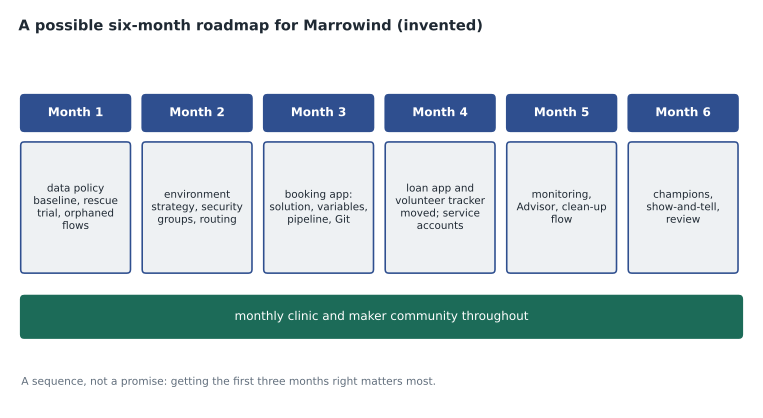
When the champions worked through an earlier version of the case in November, three disagreements came up, and they are worth hearing. Ysaline argued that the volunteer tracker should be fixed before the booking app, because it held the most sensitive data; Maribeth argued that the booking app came first because more people depended on it. Both were right in different ways, and the group agreed that the data policy in Problem 1 bought time for the tracker, so the booking app could go first. Signe argued for using Azure DevOps rather than built-in Git integration for the booking app; Kwabena pointed out that Marrowind had no developers to run build pipelines, and that built-in Git integration was enough. And several champions thought six months was too short. Rupert's view was that the roadmap was a sequence, not a promise: getting the first three months right mattered more than finishing on time.
Connecting the case to the course
Each problem drew on several lessons. Problem 1 used data policies (lesson 7) and the inventory and ownership tools (lessons 9 and 10). Problem 2 used environment strategy, Managed Environments and environment groups (lessons 1 and 2). Problem 3 used solutions, environment variables, connection references, pipelines and source control (lessons 3 to 6). Problem 4 used data policies and maker support (lessons 7 and 11). Problem 5 used capacity and licensing (lessons 2 and 8). Problem 6 used monitoring, the CoE and maker support (lessons 9 to 11).
For AB-410, the case's central lesson is the one the exam's design domain tests: recommend environment types and an ALM strategy that fit the solution. An app builder who can explain why a solution belongs in a managed production environment, how it will be packaged and deployed, and what values will change between environments is ready for those questions, and for the governance team's review.
Common mistakes
MistakeStarting governance by deleting apps and locking everything down.
InsteadStart with controls that prevent harm, rescue work at risk, then build structure with the makers.
MistakeCreating environments before checking licenses and capacity.
InsteadPlan premium licenses or pay-as-you-go and capacity before managed production environments are created.
MistakeMoving a maker's app without involving the maker.
InsteadKeep the maker as the builder and move the solution together.
MistakeTreating the roadmap as fixed.
InsteadTreat it as a sequence and adjust as the community grows.
Summary and key terms
- Begin with a baseline data policy, at-risk work and orphaned flows before building structure.
- Design environments by owner and data sensitivity, with managed production and test environments for important solutions.
- Move important apps into solutions with environment variables, connection references, pipelines and source control.
- Handle personal data leaks by stopping the flow, helping the maker and protecting the data properly.
- Plan licenses and capacity before creating managed environments.
- Keep the platform healthy with built-in monitoring, business alerts and a small hub-and-spoke community.
- Baseline data policy
- A tenant-wide data policy that protects every environment from the start.
- Orphaned flow
- A flow whose owner has left the organization.
- Environment register
- A list of environments with type, purpose, owner, data and review date.
- Roadmap
- An ordered plan of governance work over time.
- Business alert
- An alert based on business outcomes rather than technical failures.
- Champion network
- The set of department champions who link business areas to the CoE hub.
Practice problems
Work each problem on paper first, then reveal the answer to check.
Why is a baseline data policy a good first action?
Show answer
It closes the risk of data leaving through flows across every environment with one change.
Why should the volunteer tracker have its own environments?
Show answer
It holds personal addresses and has a different owner, so it needs a stricter policy and security.
What licensing approach suits many occasional users of one governed app?
Show answer
Pay-as-you-go billing through an Azure billing policy, possibly with premium licenses for heavy users.
Why did the champions prefer built-in Git integration for Marrowind?
Show answer
Marrowind has no developers to run build pipelines, and built-in Git integration is enough for its makers.
Lesson quiz · 5 questions
Score 60% or more to complete this lesson.
Create a free account to save your progress, take quizzes and earn a certificate.