
MSBA-240 · Lesson 10 of 12 · 21 min
Responsible AI in agent design
▶ Video coming soon A video version of this lesson is on the way.
Two weeks before launch, Wendell asked for a meeting he called "the uncomfortable hour". He arrived with a printed list of things that could go wrong with the HR Leave Assistant: it could give a wrong entitlement and someone could plan their family's finances around it; it could reveal a colleague's medical leave; it could respond coldly to someone grieving; it could be tricked into ignoring its rules; and employees might trust it more than they should because it sounded confident. "None of these are reasons not to launch," he said. "They're the reasons we design the way we do." That hour became Quillfield's first responsible AI review.
Responsible AI is not a separate feature you switch on at the end. It is a way of making design decisions so that an agent is fair, reliable, safe, private, inclusive, transparent and accountable. The AB-620 exam lists "plan responsible AI strategy" and "evaluate security and governance considerations" among the first skills of agent planning, and this lesson shows how those ideas turn into concrete choices in Copilot Studio.
Microsoft's principles
Microsoft frames responsible AI around six principles: fairness (treat people equitably), reliability and safety (behave as intended, including in unexpected situations), privacy and security (protect data and respect people's privacy), inclusiveness (work for people of all abilities and backgrounds), transparency (help people understand what the system is and its limits), and accountability (people remain responsible for how the system is designed and used). Principles are only useful when they become questions about a specific agent. For the HR agent, fairness meant checking that answers were the same for part-time and full-time employees where policy said so; inclusiveness meant testing with a screen reader and in French; transparency meant telling people they were talking to an automated assistant.
| Principle | Question for the HR agent | Design response |
|---|---|---|
| Fairness | Do similar employees get the same answers? | Test pairs of questions that differ only by employment type |
| Reliability and safety | What happens when policy is silent or a tool fails? | Say "I don't know", offer HR, handle errors |
| Privacy and security | Can it reveal another employee's leave? | User identity for tools; own records only |
| Inclusiveness | Does it work with assistive technology and in French? | Accessibility and language testing |
| Transparency | Do people know it is an automated assistant? | Clear greeting and catalog description |
| Accountability | Who owns its answers? | Named business owner and agent owner |
Layers of protection
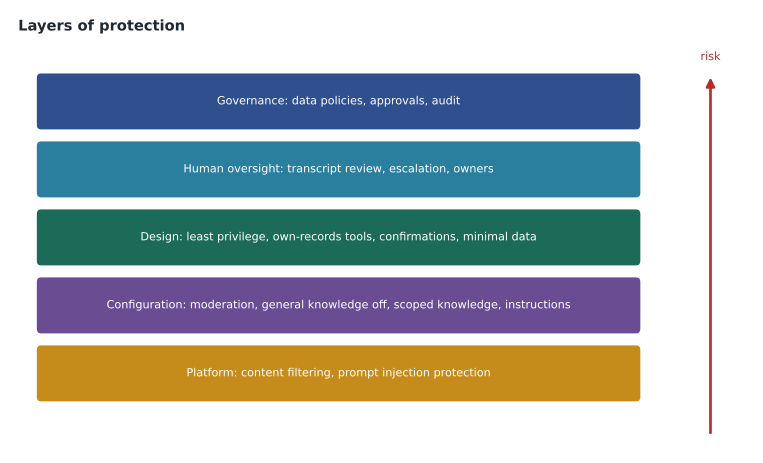
No single control makes an agent safe. Bram drew the protections as layers, each catching what the others miss. The platform layer is what Microsoft provides: content filtering on prompts and responses, protections against prompt injection attacks (both direct ones typed by a user and indirect ones hidden in documents or web pages), and the responsible AI review of the models themselves. The configuration layer is what makers choose: content moderation level, whether general knowledge and web search are allowed, which knowledge sources are connected and what the instructions say. The design layer is how tools and data are built: least-privilege identities, tools that can only act on the signed-in user's records, confirmation before actions, and minimal data collection. The human layer is oversight: review of transcripts and analytics, an escalation path, and named owners. The governance layer is organizational: data policies, environment controls, approval before publishing and audit.
Harms to plan for
A practical way to start is to list potential harms and rate each by how likely and how serious it is. Typical agent harms include inaccurate answers that people act on, harmful or inappropriate content, privacy breaches, over-reliance (people trusting the agent where they should check), unfair outcomes for some groups, misuse by people trying to make it do something it should not, and unwanted actions taken in business systems. For each harm, record the mitigation and who checks it. The list does not need to be long; it needs to be specific. Wendell's list for the HR agent had nine entries, and three of them changed the design.
Worked problem
Mitigating a wrong-entitlement harm
Harm: the agent states the wrong parental leave entitlement and an employee plans around it. How likely and serious is it, and how should it be mitigated?
Show solution
- Likelihood: moderate, because entitlement depends on service length and employment type, which the policy expresses in a table.
- Seriousness: high, because people make financial and family decisions on it.
- Mitigations: answer only from the policy with a citation; state the conditions the answer depends on; tell the employee that the leave case will confirm their exact entitlement; add entitlement questions for several employment types to the test set.
- Owner: the HR policy lead reviews the test results before each release.
Answer: Moderate likelihood, high seriousness, mitigated by grounding, citations, stated conditions, a confirmation step through the leave case, and a test set owned by HR. The agent informs; the case confirms.
Content moderation and sensitive topics
Copilot Studio's content moderation setting controls how strictly generated content is filtered, and some agents can set it per generative answer node. Higher moderation blocks more borderline content and is right for agents that meet the public or sensitive subjects; it can also produce more refusals for innocent questions, which instructions and testing should catch. Sensitive situations need designed responses, not just filters. The HR agent will meet employees who mention a death in the family, a serious illness or distress. Its instructions respond with care, give the Employee Assistance Program contact and offer a person, and a topic handles explicit requests for urgent help in a consistent way. Wendell asked HR's wellness lead to review those messages, because tone in those moments matters more than speed.
Transparency and disclosure
People should know when they are talking to an automated system and what it can and cannot do. Good practice includes a greeting that names the agent as an automated assistant and states its scope, citations for answers drawn from documents, clear statements when the agent does not know, and an easy way to reach a person. The catalog description in Teams and Microsoft 365 Copilot should say the same. Transparency also covers the organization's own records: what the agent does, which data it uses, who owns it and how to report a problem. Quillfield published a short "about this assistant" page on the HR site, linked from the greeting.
Hi {first name}, I'm Quillfield's HR Leave Assistant, an automated
assistant that answers questions from Quillfield's HR policies and can
start a leave case for you. I can't give medical advice or discuss
anyone else's leave. Type "talk to HR" at any time to reach a person.
Privacy and data handling
Responsible design includes knowing where conversation data goes. Copilot Studio stores conversation transcripts in Dataverse in the agent's environment, where they support analytics and can be reviewed by people with the right permissions; retention can be configured, and administrators can control who sees transcripts. Microsoft Purview can audit agent activity and, for agents in Microsoft 365, apply sensitivity labels and data loss prevention to the content agents use. For the HR agent, Wendell set three rules: transcripts visible only to the agent owner and HR policy lead; retention aligned with Quillfield's HR records schedule; and no collection of medical details, enforced by instructions and by removing the optional free-text "reason" question. Agents that run in other countries or serve people elsewhere need the same thinking for each set of privacy rules that applies.
Human oversight and accountability
An agent should never be the last line of responsibility. Name an agent owner (who keeps it working) and a business owner (who decides what it should say), and review a sample of conversations regularly, especially those with low satisfaction, escalations and "I don't know" answers. For actions, keep a person in the loop where the consequences are serious: the HR agent creates a leave case, but an HR adviser reviews and approves every case before it affects pay. The AB-620 skills outline updated for December 2026 includes human-in-the-loop workflows explicitly, reflecting how often agent actions should end in a person's approval rather than a final change.
Worked problem
Designing a human-in-the-loop step
HR wants the agent to approve straightforward bereavement leave of up to three days automatically. Should it?
Show solution
- Identify the consequence: approved leave affects pay and attendance records.
- Identify the risk: the agent cannot verify the circumstances and could be misled.
- Consider the cost of a person: an adviser's approval takes a minute and can be done from a notification.
- Design: the agent creates the case with all details and routes it to an adviser for approval, telling the employee when to expect confirmation.
Answer: No automatic approval. The agent does the collecting and filing; a person makes the decision. Approvals came back within an hour on average, which employees found acceptable.
Responsible AI review before launch
A short, structured review before launch turns these ideas into a checklist. Quillfield's review covered the harms list and mitigations, results of the test set (including fairness pairs, accessibility and language tests, and injection attempts), the identity and data plan, the greeting and catalog description, the escalation path, owners and the monitoring plan. Each item had an owner and a yes or no. Two items were "no" at the first review: the French test results were poor for one policy, and the escalation path had not been tested on mobile. Both were fixed before launch. The review was repeated before every major change, such as adding a new tool.
Fairness and inclusiveness in practice
Fairness problems in agents are usually quiet. Nobody designs an HR agent to treat part-time employees worse, but if the policy describes full-time entitlements in the main text and part-time rules in a footnote, the agent may answer everyone with the full-time figure. Yusra built fairness pairs into the test set: two questions identical except for one attribute that should or should not change the answer, such as full-time and part-time, or head office and branch. Where the answer should be the same, it must be; where it should differ, the difference must be the one the policy states. Three pairs failed in the first run, all traced to how the policy was written, and HR rewrote those sections so the conditions appeared in the main text.
Inclusiveness covers people who use the agent differently. Screen reader users depend on clear structure and alt text in cards. People with lower literacy or who work in a second language benefit from short sentences and common words. Some employees will type very little, others a great deal. Test with a range of colleagues, not only the project team, and treat difficulty for any group as a design defect rather than a user problem.
Over-reliance and appropriate trust
An agent that is usually right invites people to stop checking, which is a problem when the consequences are serious. Appropriate trust means people rely on the agent for what it does well and check where it matters. Design supports this: citations make checking easy, stating the conditions behind an answer shows when it might not apply, and routing consequential decisions to a person keeps the final judgment human. The HR agent ends every entitlement answer with a short line saying that the leave case confirms the exact entitlement, which reminded employees that the agent informs rather than decides.
Security and governance considerations
Responsible design overlaps with security, and the AB-620 outline asks agent planners to evaluate both. Security questions for an agent include: which identities it uses and with what permissions; which connectors it can reach and whether data policies restrict them; whether its knowledge contains anything that should not be repeated; who can edit it and how changes reach production; where its transcripts are stored and who can read them; and how its activity is audited. Governance questions add: who approved it, who owns it, how it appears in the organization's agent inventory, and what happens when it is no longer needed. Microsoft's governance tools for agents, including inventories in the Microsoft 365 admin center and the Power Platform admin center, help administrators see every agent in the tenant, its owner and its usage, and retire agents that have been abandoned.
At Quillfield, the security team asked for one more control before launch: an alert if the HR agent's tool began creating unusual numbers of cases, which could indicate misuse or a bug. Because each case was created as the signed-in employee, the HR system's own audit log showed who created what, and a simple daily report flagged any employee with more than three new cases in a day. It never fired in the first month, which was exactly the point.
Common mistakes
MistakeTreating content filters as the whole of responsible AI.
InsteadCombine platform, configuration, design, human and governance layers.
MistakeLetting an agent take consequential actions without review.
InsteadKeep a person in the loop for decisions that affect people's pay, rights or records.
MistakeHiding that the agent is automated.
InsteadSay so in the greeting and description, cite sources and offer a person.
MistakeCollecting sensitive details the process does not need.
InsteadCollect the minimum and tell the agent not to record what it should not.
Summary and key terms
- Microsoft's six principles are fairness, reliability and safety, privacy and security, inclusiveness, transparency and accountability.
- Protect agents in layers: platform, configuration, design, human oversight and governance.
- List specific harms with likelihood, seriousness, mitigation and owner.
- Disclose that the agent is automated, cite sources, design responses to sensitive situations and plan data handling.
- Keep people accountable and in the loop for consequential actions, and review before launch and after changes.
- Responsible AI
- Designing and using AI so that it is fair, reliable, safe, private, inclusive, transparent and accountable.
- Harm
- A way an agent could hurt people or the organization.
- Prompt injection
- An attempt, typed or hidden in content, to make a model ignore its instructions.
- Content moderation
- Filtering of prompts and generated content for harmful material.
- Human in the loop
- A design in which a person reviews or approves an agent's action before it takes effect.
- Over-reliance
- People trusting an AI system beyond what its accuracy justifies.
Practice problems
Work each problem on paper first, then reveal the answer to check.
Name the six responsible AI principles.
Show answer
Fairness; reliability and safety; privacy and security; inclusiveness; transparency; accountability.
Why shouldn't instructions be the only defense against prompt injection?
Show answer
A model can sometimes be persuaded; design tools and identities so the dangerous action is impossible anyway.
What does a human-in-the-loop design do for the HR agent's leave cases?
Show answer
An adviser reviews and approves each case before it affects pay or records.
Lesson quiz · 5 questions
Score 60% or more to complete this lesson.
Create a free account to save your progress, take quizzes and earn a certificate.