
MSBA-169 · Lesson 11 of 12 · 24 min
A study plan
▶ Video coming soon A video version of this lesson is on the way.
Monday, April 26, two days before the exam, was the session Owen had expected to come first. "Most people make a study plan at the start and then ignore it," Priya said. "We made yours as we went, from your results. Today we write it down properly, for your last two days, and as a template for the next person." The next person already existed: Hélène Martin, an editor at Tidewater's partner publisher, planned to take GH-900 in the autumn, in English, which is not her first language. This lesson builds a study plan from three inputs: the exam weights, the candidate's own results, and the time available. It works through Owen's final two days and a six-week plan for Hélène.
The three inputs
A good plan answers one question: given the time I have, where will an hour of study raise my score the most? Three inputs answer it. The weights from lesson 1 say how much of the exam each area is worth. The results, from a self-assessment and practice questions, say how strong the candidate is in each area. The time says how many hours are really available, after work and life, and when. An hour spent on a heavily weighted area where you are weak is worth far more than an hour on a lightly weighted area you already know.
| Input | Source | Owen's values |
|---|---|---|
| Weights | Skills outline midpoints scaled to 100 (lesson 1) | Basics 30, four middle areas 13.5 each, project management and community 8 each |
| Results | Second practice assessment, by area | Weakest: modern development and project management |
| Time | Calendar | About 8 hours across Monday evening, Tuesday and Tuesday evening |
A simple scoring method
Priya's method gives each area a priority score: its weight times its gap, where the gap is how far the candidate's practice result falls short of the target of about 80 in 100. Areas at or above the target get a small maintenance score instead of zero, because knowledge fades. Hours are then shared in proportion to the scores. It is not precise, but it stops a candidate spending a day on a favorite topic.
| Area | Weight | Practice result (in 100) | Gap to 80 | Priority (weight x gap) |
|---|---|---|---|---|
| Git and GitHub basics | 30 | 92 | 0 (use 2) | 60 |
| Repositories | 13.5 | 83 | 0 (use 2) | 27 |
| Collaboration | 13.5 | 100 | 0 (use 2) | 27 |
| Modern development | 13.5 | 67 | 13 | 175.5 |
| Project management | 8 | 75 | 5 | 40 |
| Privacy, security and administration | 13.5 | 83 | 0 (use 2) | 27 |
| Community | 8 | 100 | 0 (use 2) | 16 |
Worked problem
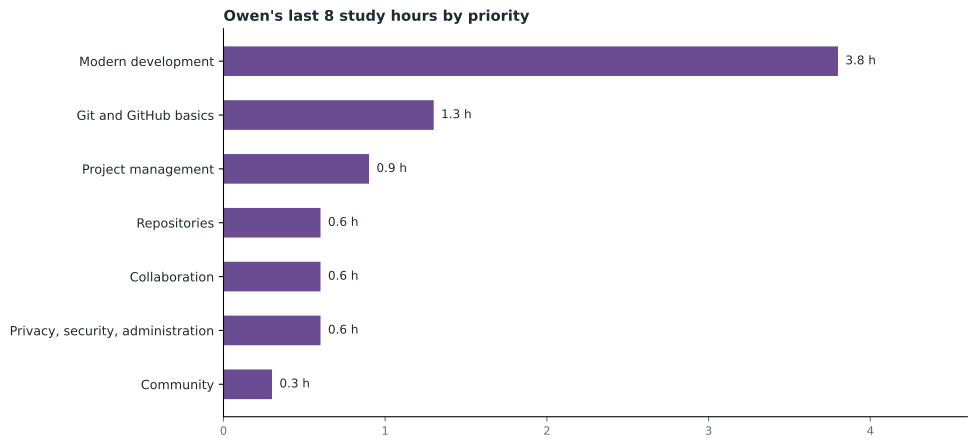
Sharing 8 hours by priority
Using the priority scores above, how many of Owen's 8 hours should go to modern development, and how many to project management?
Show solution
- Total priority: 60 + 27 + 27 + 175.5 + 40 + 27 + 16 = 372.5.
- \[8 \times \frac{175.5}{372.5} \approx 3.8 \text{ hours for modern development}\]
- \[8 \times \frac{40}{372.5} \approx 0.9 \text{ hours for project management}\]
- Basics: 8 times 60 divided by 372.5 is about 1.3 hours.
- The four remaining areas share about 2.1 hours, roughly half an hour each.
Answer: About 3.8 hours on modern development, 0.9 on project management, 1.3 on basics, and about half an hour on each of the others.
The numbers confirmed what Owen felt: modern development deserved nearly half his remaining time. They also stopped him from doing what he wanted to do, which was another hour on collaboration, his favorite area, where he was already scoring full marks.
What to do in each hour
How a candidate studies matters as much as how long. Rereading notes feels productive but builds little. Three methods work much better. Retrieval practice: answering questions from memory, through flash cards, practice questions or explaining a topic aloud, as Owen did in the collaboration teach-back. Spaced review: returning to a topic after a gap, which strengthens memory more than one long session. Interleaving: mixing questions from different areas in one session, which trains the skill the exam needs most, recognizing which feature a question is about. Each hour in Owen's plan had a specific activity.
| When | Activity | Area | Hours |
|---|---|---|---|
| Monday evening | Microsoft Learn module on Codespaces and dev containers, then explain them aloud | Modern development | 2.0 |
| Monday evening | Confusable pairs flash cards | Mixed | 0.5 |
| Tuesday lunch | Final review session (lesson 12) | Mixed | 1.0 |
| Tuesday afternoon | Copilot plans and features page on GitHub Docs; write the plan table from memory | Modern development | 1.8 |
| Tuesday afternoon | Projects layouts, workflows and insights: build a test project | Project management | 0.9 |
| Tuesday evening | Mixed practice questions from all areas, timed | Mixed | 1.0 |
| Tuesday evening | Error log rules and the exam-day checklist; stop by 9 p.m. | Mixed | 0.8 |
The plan ends early on Tuesday on purpose. Sleep consolidates what was learned during the day, and a tired candidate misreads questions, which lesson 10 showed was a large share of Owen's mistakes. Late-night cramming trades a small amount of new knowledge for a larger loss in reading accuracy.
A six-week plan for Hélène
Hélène's situation was different: six weeks, about four hours a week, and no earlier courses. Priya wrote her plan around the same three inputs, starting with the outline and the Microsoft Learn path rather than practice results, because there were none yet.
| Week | Focus | Activities | Hours |
|---|---|---|---|
| 1 | The exam and Git and GitHub basics | Read the study guide; self-assess against the outline; Learn modules on Git, GitHub and GitHub Flow | 4 |
| 2 | Basics continued; repositories | Create a practice repository; commit, branch and open a pull request; key files | 4 |
| 3 | Collaboration; project management | Issues, discussions, notifications; build a small project with views and workflows | 4 |
| 4 | Modern development | Actions basics; Copilot features and plans; try github.dev and a codespace | 4 |
| 5 | Privacy, security, administration; community | Roles, 2FA and passkeys, visibility; open source, Sponsors, inner source; first practice assessment | 4 |
| 6 | Gaps and review | Priority scores from the practice results; confusable pairs; second practice assessment; logistics | 4 |
Worked problem
Checking Hélène's time against the weights
Hélène's plan gives about 6 hours (weeks 1 and half of 2) to basics out of 24. Is that roughly in line with basics' scaled share of about 30 in 100?
Show solution
- Her share for basics: 6 out of 24.
- \[\frac{6}{24} = 0.25\]
- That is 25 in 100, a little under the scaled weight of about 30.
- Week 6 is set aside for gaps, so if her first practice assessment shows basics as weak, more of week 6 goes there.
Answer: About 25 in 100, slightly under the weight, with week 6 available to correct it.
Because Hélène will take the exam in English, Priya added two items. She should request the 30 extra minutes available when an exam is not offered in the candidate's language, early, before booking. And she should do her practice questions in English from the start, so that the vocabulary of the exam, such as "triage", "ruleset" and "dev container", becomes familiar in the language she will read it in.
Fitting study around work
The hours in a plan have to exist in a real calendar. Owen blocked his study time as appointments, the same way he blocked editorial meetings, so that colleagues saw him as busy rather than free. Short sessions of 30 to 50 minutes with a break worked better for him than three-hour blocks, and placing review of a topic two or three days after first studying it gave him spaced review without extra hours. Priya's advice for Hélène was the same: four hours a week works best as four one-hour sessions on different days, not one long evening, because four separate returns to the material do more for memory than one sitting.
Worked problem
Spacing four hours
Hélène can study on Monday, Wednesday, Friday and Saturday mornings. In week 3 she covers collaboration and project management. How should she place the topics to get spaced review within the week?
Show solution
- Monday: collaboration, first pass.
- Wednesday: project management, first pass, then 10 minutes of collaboration flash cards.
- Friday: collaboration practice questions, two days after the first pass.
- Saturday: project management practice questions and a short mixed set.
Answer: Alternate the topics so each is revisited two or three days after first study, with mixed questions at the end of the week.
Practice assessments in the plan
Practice assessments serve two purposes, and the plan uses them for both. Early on, as a diagnostic, they show where the gaps are. Near the end, as a check, they show whether the plan worked. Between the two, they should not be repeated so often that the candidate remembers the questions, which inflates the score without improving knowledge. Owen took the official assessment twice, five working days apart, and used other mixed practice questions in between. A useful rule is that when a practice score rises, ask whether it rose because you remembered the question or because you could explain the answer.
Adjusting the plan as results arrive
A plan is a forecast, and forecasts should change when evidence arrives. Priya's rule for Hélène was to recalculate the priority scores after each practice assessment and move hours accordingly, but never more than once a week, so that one bad session does not throw the plan around. Owen's own plan changed twice: after the baseline assessment, which moved time from collaboration to modern development, and after the second, which showed that repositories had risen to 83 and no longer needed extra time.
Worked problem
Recalculating after a practice result
In week 5, Hélène's first practice assessment shows modern development at 60 in 100 and privacy, security and administration at 72, with every other area at 80 or above. Using weights of 13.5 for both, and a minimum gap of 2 for the five strong areas, how should she share her 4 hours in week 6?
Show solution
- Modern development: gap 20, priority 13.5 times 20 is 270.
- Privacy, security and administration: gap 8, priority 13.5 times 8 is 108.
- Strong areas with a gap of 2: basics 30 times 2 is 60; repositories and collaboration 27 each; project management and community 16 each, so 146 in all.
- Total: 270 + 108 + 146 = 524.
- \[4 \times \frac{270}{524} \approx 2.1 \text{ hours}; \quad 4 \times \frac{108}{524} \approx 0.8 \text{ hours}\]
- The strong areas share the remaining 1.1 hours, mostly through mixed practice.
Answer: About 2.1 hours on modern development, 0.8 on privacy, security and administration, and 1.1 on mixed review.
If the result is a fail
A plan should also say what happens after a failing result, so the candidate does not have to decide while disappointed. Owen's note was short. Keep the score report, which shows performance by area. Wait at least a day before rebooking, which the retake policy requires anyway. Recalculate priority scores from the report, treating any area marked as weaker as having a large gap. Plan two to three weeks of study before the next attempt, because the policy requires 14 days between later attempts and because a quick retake without study usually produces a similar result. And remember that a fail says more about preparation than ability: the score report shows exactly where to aim, and a targeted plan is the best route to passing next time.
| Score report says | What to do |
|---|---|
| One area clearly weaker than the rest | Give it most of the retake hours |
| Several areas slightly weak | Mixed practice and confusable pairs across all of them |
| All areas near the line | Work on reading habits and pacing; the knowledge is nearly there |
Logistics as part of the plan
A study plan includes the exam itself. Owen's plan had logistics items on fixed days: run the OnVUE system test a week before, check the booking confirmation and the name on his ID, confirm the room would be free and quiet, and click through the exam sandbox the day before. These take minutes, and each one removes a way to lose the exam before the first question.
Common mistakes
MistakeStudying favorite topics because they feel good.
InsteadShare hours by weight times gap, so weak, heavy areas get the most time.
MistakeRereading notes as the main method.
InsteadUse retrieval practice, spaced review and interleaved questions.
MistakeRetaking the same practice assessment until the score is high.
InsteadUse it as a diagnostic and a check, with other practice in between.
MistakeStudying late the night before.
InsteadStop early; sleep protects reading accuracy.
Summary and key terms
- A study plan combines the exam weights, the candidate's results and the time available.
- A priority score of weight times gap, with a small minimum for strong areas, shares hours sensibly.
- Owen's final 8 hours went mostly to modern development, his weakest area that carries about 13.5 in 100.
- Retrieval practice, spaced review and interleaving work better than rereading.
- A six-week plan at four hours a week covers every area and leaves the last week for gaps and logistics.
- Candidates taking the exam in a second language can request 30 extra minutes and should practice in the exam language.
- Priority score
- An area's weight multiplied by the gap between the candidate's result and the target.
- Retrieval practice
- Studying by recalling answers from memory rather than rereading.
- Spaced review
- Returning to a topic after a gap to strengthen memory.
- Interleaving
- Mixing questions from different topics in one session.
- Diagnostic assessment
- A practice test used to find gaps rather than to measure readiness.
Practice problems
Work each problem on paper first, then reveal the answer to check.
What two numbers make up an area's priority score?
Show answer
Its weight and the gap between the candidate's result and the target.
Why give strong areas a small minimum score?
Show answer
So they stay in the plan for spaced review, because knowledge fades.
Why should practice assessments not be repeated too often?
Show answer
The candidate remembers the questions, which raises the score without improving knowledge.
Lesson quiz · 5 questions
Score 60% or more to complete this lesson.
Create a free account to save your progress, take quizzes and earn a certificate.