
MSAZ-300 · Lesson 9 of 12 · 21 min
Source control and CI/CD for databases
▶ Video coming soon A video version of this lesson is on the way.
A database project only helps if everyone works from the same copy of it. In the ninth session Hana moved the Finch Rewards project into a GitHub repository, hf-finchrewards, next to the API code, and Elena set up the pipeline that will build, test and deploy every change. Renata Kowal, the cloud lead, joined for the part about credentials, because the pipeline would need permission to change databases and she wanted to be sure it never held a password. By the end of the session, a change to a stored procedure went from Hana's laptop to the test database through a pull request, an automated build, a review and an automatic deployment, and the same path, with one more approval, led to production.
What goes in the repository
The database project lives in its own folder, src/FinchRewards.Database, with the .sqlproj, one file per object, the pre- and post-deployment scripts, the reference data, the publish profiles for each environment and the refactor log. Tests go in tests/FinchRewards.Database.Tests. The pipeline definitions go in .github/workflows. What stays out matters as much: no connection strings with passwords, no dacpacs (they are built by the pipeline from source), no data beyond reference data, and nothing generated by the build. A .gitignore file excludes the bin and obj folders.
hf-finchrewards/
  .github/
    workflows/database.yml
    CODEOWNERS
  src/
    FinchRewards.Api/              application code
    FinchRewards.Database/
      FinchRewards.Database.sqlproj
      FinchRewards.Database.refactorlog
      rewards/Tables/Member.sql
      rewards/Procedures/uspPostPurchase.sql
      Scripts/PostDeployment.sql
      ReferenceData/Tier.sql
      Profiles/test.publish.xml
      Profiles/prod.publish.xml
  tests/
    FinchRewards.Database.Tests/
Keeping the API and the database in one repository was a deliberate choice. Many changes touch both: a new column, the procedure that writes it and the API endpoint that exposes it. In one repository they go into one pull request, are reviewed together and deploy together. Teams whose database serves many applications often keep it in its own repository instead, with its own release cycle; StockLine, which four systems read, will be set up that way.
Branching and pull requests
The team uses short-lived feature branches from main. Hana creates a branch such as feature/offer-expiry, commits her changes, pushes the branch and opens a pull request. The pull request triggers the build and tests, and at least one other developer reviews it before it can merge. Main is always deployable: whatever is on main is either in test or on its way there. Branches that live for weeks drift away from main and produce painful merges, so Elena's rule is that a branch should merge within three working days, splitting a large change into several smaller pull requests if needed.
Merge conflicts in a database project behave like conflicts in any code, because each object is a text file. Two developers adding different columns to Member will conflict in Member.sql, and resolving it means keeping both columns in the CREATE TABLE statement. Because the file describes state, the resolution is easy to check: the merged file should describe the table everyone wants. The project file itself rarely conflicts with SDK-style projects, which include .sql files by default instead of listing each one. The refactor log can conflict when two people rename things at once; both entries must be kept, in order. After resolving a conflict, the build is the check: if the merged model does not validate, the pull request cannot merge.
Protecting main
Branch protection rules, or rulesets in GitHub, enforce the process rather than relying on good intentions. For main in hf-finchrewards: changes only through pull requests, at least one approving review, the database build and tests must pass, the branch must be up to date with main before merging, and nobody can push directly, including administrators. A CODEOWNERS file names the people who must review changes to particular paths. Elena is a code owner for the tables folder and the publish profiles, so every schema change and every change to deployment options needs her approval, while procedure changes need any developer.
# .github/CODEOWNERS
/src/FinchRewards.Database/rewards/Tables/   @hf-dba-team
/src/FinchRewards.Database/Profiles/         @hf-dba-team
/src/FinchRewards.Database/                  @hf-rewards-devs
/.github/workflows/                          @hf-platform-team
The pipeline
Continuous integration builds and tests every change; continuous delivery deploys every change that passes to an environment, with gates before production. The Finch Rewards workflow has four jobs. Build runs on every pull request and on every push to main: it builds the project with dotnet build, which also runs code analysis, and saves the dacpac as an artifact. Test deploys the dacpac to an empty database created for the run, loads test data and runs the unit tests, then deletes the database. Deploy-test runs only on main: it creates a deployment report and script, saves them as artifacts and publishes to the test database. Deploy-prod waits for a manual approval in the GitHub environment named production, then does the same against production.
name: database
on:
  pull_request:
    paths: ['src/FinchRewards.Database/**', 'tests/FinchRewards.Database.Tests/**']
  push:
    branches: [main]
    paths: ['src/FinchRewards.Database/**']
permissions:
  id-token: write        # allow the workflow to request an Entra token (OIDC)
  contents: read
jobs:
  build:
    runs-on: ubuntu-latest
    steps:
      - uses: actions/checkout@v4
      - uses: actions/setup-dotnet@v4
        with: { dotnet-version: '8.0.x' }
      - run: dotnet build src/FinchRewards.Database/FinchRewards.Database.sqlproj -c Release
      - uses: actions/upload-artifact@v4
        with: { name: dacpac, path: src/FinchRewards.Database/bin/Release/*.dacpac }
  deploy-test:
    if: github.ref == 'refs/heads/main'
    needs: build
    runs-on: ubuntu-latest
    environment: test
    steps:
      - uses: actions/download-artifact@v4
        with: { name: dacpac }
      - uses: azure/login@v2
        with:
          client-id: ${{ vars.AZURE_CLIENT_ID }}
          tenant-id: ${{ vars.AZURE_TENANT_ID }}
          subscription-id: ${{ vars.AZURE_SUBSCRIPTION_ID }}
      - uses: azure/sql-action@v2
        with:
          connection-string: ${{ vars.SQL_CONNECTION_TEST }}
          path: FinchRewards.Database.dacpac
          action: publish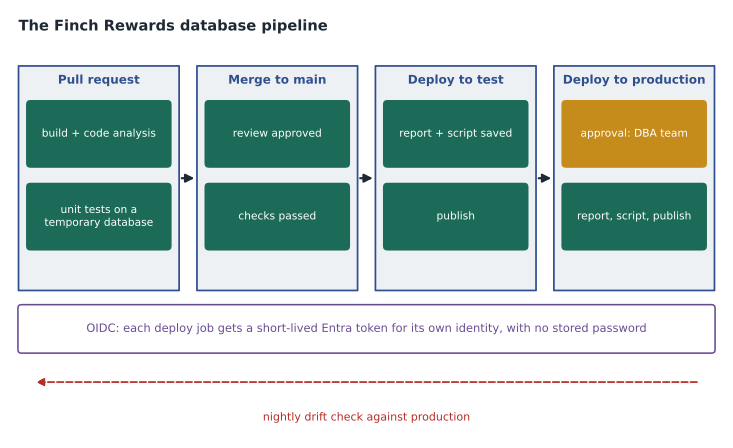
Secrets and credentials
The workflow never sees a password. Renata set up OpenID Connect federation: an Entra app registration, sp-finchrewards-deploy-test, trusts tokens that GitHub issues for this repository's test environment, and a second one trusts the production environment only. When the job runs, GitHub gives it a short-lived token, the azure/login action exchanges it for an Entra token, and the SQL connection uses that Entra identity, as lesson 1 of MSAZ-281 describes. Nothing long-lived is stored in GitHub. The connection strings in the workflow variables name the server and database and say Authentication=Active Directory Default, so they hold no secret.
DP-800 lists secrets management among the pipeline skills, and the rule is simple: no secret in the repository, ever, including in history. Where a secret is unavoidable, such as an API key for a third-party service called by the database in lesson 11, it lives in Azure Key Vault, and the pipeline or the database reads it at run time through a managed identity. GitHub's secret scanning and push protection, enabled on the organization, block a commit that contains something that looks like a key. If a secret is ever committed, it is rotated at once; deleting the commit is not enough, because clones and caches keep it.
| Control | Where it is set | What it prevents |
|---|---|---|
| Branch protection or ruleset on main | Repository settings | Unreviewed or untested changes reaching main |
| Required status checks | Ruleset | Merging a change whose build or tests failed |
| CODEOWNERS | .github/CODEOWNERS | Schema or profile changes without DBA review |
| Environment approval | GitHub environment production | Deploying to production without a person agreeing |
| OIDC federated identity per environment | Entra ID and the workflow | Stored passwords; test credentials reaching production |
| Nightly drift check | Scheduled workflow | Manual changes going unnoticed |
Deploying safely
A database deployment is harder to undo than an application deployment, because data changes cannot simply be rolled back by redeploying the old version. Elena's practices follow from that. Every production deployment publishes the script and the report as artifacts, so the exact change is on record. BlockOnPossibleDataLoss stays on. Breaking changes are split into steps that each deploy safely: to replace a column, first add the new one and write to both, then move the readers, then stop writing the old one, and only in a later release drop it. This expand-and-contract pattern lets the API and the database deploy independently, because every intermediate state works with both the old and new API.
Before production deployments that change large tables, the script is reviewed for operations that rebuild or lock a table, such as changing a column's type, which can hold locks for minutes on PointsTransaction. Those changes are scheduled outside the busy evening hours, and some are done online, for example by creating indexes WITH (ONLINE = ON) where the platform supports it. MSAZ-282 covers the automation and recovery side of these operations from the DBA's point of view.
Where the tests run
The test job needs a real database engine for each run, and there are two practical choices. The first is a SQL Server container started on the hosted runner: the job runs the SQL Server 2025 container image, deploys the dacpac to it, loads the test data and runs the tests, all on the runner, with nothing to clean up afterwards. It is fast and costs nothing beyond the runner, but it is SQL Server, not Azure SQL Database, so a feature that exists only in the cloud cannot be tested this way. The second is a temporary Azure SQL database, created by the job in a test server, ideally on the serverless tier so it costs little while idle, and deleted at the end. Hana's pipeline uses the container for every pull request, because it finishes in about four minutes, and a temporary Azure SQL database for a nightly run of the full suite, which catches the rare differences between the two engines.
Test data is part of the repository too. The tests load a small, synthetic data set from scripts in the test project: 40 members, 6 stores, a few hundred transactions and the reference data, all invented, so no personal information ever leaves production. Each test arranges the rows it needs, runs the procedure and checks the result, and the whole database is thrown away at the end of the run, so tests never depend on the leftovers of other tests.
When a deployment goes wrong
A failed deployment usually fails safely: SqlPackage runs the generated script in a transaction where it can, and the BlockOnPossibleDataLoss check stops before any data is touched. The harder case is a deployment that succeeds but is wrong, for example a procedure with a bug that posts the wrong points. Redeploying the previous dacpac restores the old procedure, but it cannot undo data the bad version wrote. The team's rule is to fix forward: correct the code in a new pull request, deploy it through the pipeline, and repair the affected data with a reviewed script, using the points transactions and the ledger journal to find exactly what changed. For a mistake that damages data badly, the point-in-time restore from MSAZ-282 can recover a copy of the database as it was just before the deployment, from which the right values can be copied back. Every production deployment records its start time in the pipeline log, which tells the team exactly which point in time to restore to.
Worked problem
How long does a change wait to reach production?
Over October, the team merged 18 database changes. For each, the time from opening the pull request to merging averaged 26 hours, the deployment to test took 6 minutes after merge, and changes waited for the weekly production approval on Tuesdays, an average of 3.5 days after reaching test. What is the average lead time from opening a pull request to running in production, in days, and which part dominates?
Show solution
- Review and merge: 26 hours ≈ 1.08 days.
- Deployment to test: 6 minutes ≈ 0.004 days, which is negligible.
- Waiting for the weekly approval: 3.5 days.
- \[1.08 + 0.004 + 3.5 \approx 4.6 \text{ days}\]
- The weekly approval accounts for about 3.5 of 4.6 days, about three quarters of the lead time.
Answer: About 4.6 days on average, of which about three quarters is waiting for the weekly production approval. Elena proposed approving twice a week once the pipeline had a month of clean runs.
Common mistakes
MistakeCommit the dacpac so others can deploy it.
InsteadBuild the dacpac in the pipeline from source; commit only source files.
MistakeStore the SQL password as a GitHub secret.
InsteadUse OIDC federation to an Entra identity, so the workflow holds no long-lived secret.
MistakeA long-lived branch per release keeps main stable.
InsteadShort-lived branches with protected main and required checks keep main stable and merges small.
MistakeIf a secret was committed, delete the commit.
InsteadRotate the secret immediately; history and clones keep it.
MistakeDrop the old column in the same release that adds the new one.
InsteadExpand and contract: add, migrate readers and writers, then drop in a later release.
Summary and key terms
- Keep the database project, tests, profiles and pipeline in source control; build artifacts are not committed.
- Use short-lived feature branches and pull requests; the build checks every merge, including resolved conflicts.
- Protect main with rulesets, required checks and CODEOWNERS.
- Build and test on every pull request; deploy to test on merge and to production after approval.
- Use OIDC federated identities per environment and Key Vault for any unavoidable secret.
- Publish the deployment report and script as records, and detect drift nightly.
- Split breaking changes with expand and contract.
- Continuous integration
- Building and testing every change automatically as it is proposed.
- Continuous delivery
- Deploying every change that passes automatically to an environment, with gates before production.
- CODEOWNERS
- A file naming the people or teams who must review changes to given paths.
- Branch protection
- Rules that control how changes reach a branch, such as required reviews and checks.
- OIDC federation
- A trust that lets a workflow exchange a short-lived token for an Entra identity without a stored secret.
- Expand and contract
- A pattern that splits breaking changes into backward-compatible steps across releases.
Practice problems
Work each problem on paper first, then reveal the answer to check.
Why do the API and the database share one repository for Finch Rewards?
Show answer
Many changes touch both, so one pull request can change, review and deploy them together.
How is a merge conflict in Member.sql resolved?
Show answer
Keep both changes so the CREATE TABLE describes the table everyone wants, then let the build validate it.
What makes Elena a required reviewer for table changes?
Show answer
A CODEOWNERS entry for the Tables folder and a ruleset that requires code owner review.
Why are there two federated identities, one for test and one for production?
Show answer
So a test deployment can never use production permissions.
What is the expand-and-contract pattern?
Show answer
Add the new structure, move writers and readers, and remove the old structure in a later release.
Lesson quiz · 5 questions
Score 60% or more to complete this lesson.
Create a free account to save your progress, take quizzes and earn a certificate.