
MSAZ-190 · Lesson 8 of 12 · 23 min
Reviewing the AI-901 outline
▶ Video coming soon A video version of this lesson is on the way.
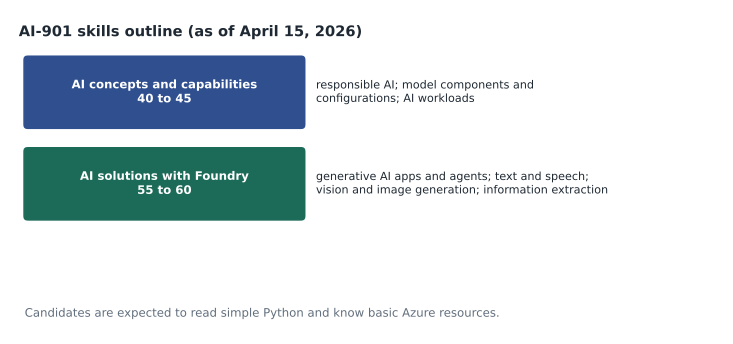
Hana's customer-service assistant pilot has been running in a sandbox for three weeks when she starts her final review for AI-901. It answers questions about store hours and return policies from a set of Harrow & Finch documents, and it has already taught her more than any reading could: why the model sometimes invents a policy that does not exist, why the tone changes when she adjusts one setting, and why the legal team asked to see how it handles a customer who mentions an injury. "That is the exam in miniature," Renata tells her. "Concepts, configurations and responsibility, then building with Foundry." This lesson reviews the AI-901 outline dated April 15, 2026, assuming you have studied MSAZ-110 and MSAZ-111.
What is different about AI-901
AI-901 replaced AI-900 as the exam for Azure AI Fundamentals in 2026; Microsoft's certification page now lists AI-901 as the required exam, and third-party guides report that AI-900 was retired at the end of June 2026. Compared with the other three fundamentals exams, AI-901 leans further toward practice. Its audience profile describes candidates at the start of their AI solution development careers who are familiar with Python syntax and Azure resources, and it says familiarity with REST APIs, SDKs and command-line tools is expected. Its second skill area, weighted 55 to 60, uses the verb implement. You will not write long programs, but you should be able to read a short Python snippet that calls a model or a service, recognize which setting does what, and choose the right Foundry capability for a scenario.
The study guide also says that most questions cover features that are generally available, but that preview features may appear if they are commonly used. In a field that changes as quickly as AI, that matters. Product names have changed several times in recent years, and older study material may use names that Microsoft no longer uses. When your material and Microsoft's current documentation disagree, follow the documentation, and note the old name in your mistakes log so that you recognize it if it appears in a distractor.
Area 1: Identify AI concepts and capabilities (40 to 45)
The responsible AI objectives ask you to describe Microsoft's principles for responsible AI. Microsoft names six: fairness, reliability and safety, privacy and security, inclusiveness, transparency, and accountability. Be ready to match each to a scenario. A loan model that approves applicants at different rates for reasons unrelated to risk raises fairness. An assistant that gives dangerous advice raises reliability and safety. A system trained on customer messages without consent raises privacy and security. An app that does not work with screen readers raises inclusiveness. A system whose users cannot tell they are talking to AI, or why it decided something, raises transparency. And a deployment with no one responsible for reviewing its behavior raises accountability.
| Principle | Question it asks | Hana's pilot |
|---|---|---|
| Fairness | Does it treat people equitably? | Checks answers are equally helpful across customer languages |
| Reliability and safety | Does it behave dependably and avoid harm? | Refuses to give medical advice; hands injury reports to a person |
| Privacy and security | Does it protect data? | Does not store customer names in prompts or logs |
| Inclusiveness | Does it work for everyone? | Tested with a screen reader and plain-language answers |
| Transparency | Do people understand what it is and does? | Tells customers they are chatting with an AI assistant |
| Accountability | Who answers for it? | The customer-service manager owns its behavior and reviews samples weekly |
The model components and configurations objectives cover what a model is made of and the settings you control. Know the difference between training a model and using a pre-trained one; the idea of tokens, the pieces of text a language model reads and writes, and of a context window, the limit on how many tokens a model can consider at once; the role of a system message, which sets the assistant's behavior and boundaries; and common settings such as temperature, which makes output more varied when higher and more predictable when lower, and a maximum number of output tokens. Embeddings, which represent text as lists of numbers so that similar meanings sit close together, underpin search and grounding. Grounding means giving the model relevant source material, such as Harrow & Finch's return policy, so that answers are based on it rather than on whatever the model learned in training.
The AI workloads objectives ask you to recognize the main kinds of AI work: generative AI that creates text, code or images; agents that use a model plus tools to carry out tasks; natural language processing such as sentiment analysis, key phrase extraction, entity recognition and translation; speech recognition and synthesis; computer vision such as image analysis, object detection and optical character recognition; and information extraction from documents and forms. A good review exercise is to list ten business problems and name the workload for each.
A worked example: why embeddings work
Hana's pilot finds the right policy document by comparing embeddings. Each document and each question becomes a vector of numbers, and the system picks the document whose vector points in the most similar direction to the question's. A common measure is cosine similarity, which is 1 for vectors pointing the same way and close to 0 for unrelated ones. Real embeddings have hundreds or thousands of numbers; the toy vectors below have three, but the arithmetic is the same.
import math
def cosine(a, b):
    dot = sum(x * y for x, y in zip(a, b))
    return dot / (math.sqrt(sum(x * x for x in a)) * math.sqrt(sum(y * y for y in b)))

question = [0.9, 0.1, 0.3]            # "Can I return a drill after 40 days?"
docs = {
    "Return policy": [0.8, 0.2, 0.4],
    "Store hours":   [0.1, 0.9, 0.2],
    "Loyalty points": [0.3, 0.3, 0.9],
}
for name, vec in docs.items():
print(f"{name:15} {cosine(question, vec):.3f}")Return policy 0.984 Store hours 0.271 Loyalty points 0.601
What this code does
Measures cosine similarity between a question's tiny made-up embedding and the embeddings of three documents, giving each a score between 0 and 1. The return policy scores highest, so it is the most relevant document. This is the idea behind semantic search in AI-901 questions.
The return policy scores highest, so it is passed to the model as grounding. On the exam you will not calculate cosine similarity, but you may be asked what embeddings are for, or why grounding reduces made-up answers. The answer to the second is that the model is given the relevant facts and instructed to base its answer on them.
Area 2: Implement AI solutions by using Microsoft Foundry (55 to 60)
Microsoft Foundry is Microsoft's platform for building AI applications and agents on Azure. The exam's subskills cover four kinds of solution. Generative AI apps and agents: choosing and deploying a model from the model catalog, testing prompts in a playground, writing a system message, grounding the model in your own data, and building an agent that can call tools. Text and speech: analyzing text, translating it, converting speech to text and text to speech. Computer vision and image generation: analyzing images, reading text in them and generating images from descriptions. Information extraction: pulling structured fields from documents, forms and other content. For each, know what the capability does, when to use it, and what a short code sample that calls it looks like.
Several distinctions recur in practice items. A playground is for experimenting; an application calls a deployed model through an endpoint with a key or an identity. Prompt changes and system messages adjust behavior without retraining; fine-tuning changes the model itself and is rarely the first choice. Content filters and safety settings reduce harmful output but do not replace human review for high-risk uses. And an agent differs from a simple chat app because it can decide to call tools, such as looking up an order, rather than only producing text.
| Scenario | Capability to choose |
|---|---|
| Answer questions using company policy documents | A generative AI app grounded in those documents |
| Look up a customer's order status during a chat | An agent with a tool that queries the order system |
| Convert a recorded phone message to text | Speech to text |
| Read invoice numbers and totals from scanned supplier invoices | Information extraction from documents |
| Detect whether a product photo shows a damaged item | Image analysis |
| Translate store signage text into French | Text translation |
Reading code on the exam
Because the audience profile expects Python familiarity, be ready for items that show a short code fragment and ask what it does or what is missing. Typical fragments create a client with an endpoint and a credential, send a list of messages with a system message and a user message, set a temperature, and print the response. The exam is testing whether you understand the pieces: which line sets the behavior, which line sends the request, where the key or identity comes from, and why a secret should not be written into the code. Hana's practice is to explain each line of the samples in MSAZ-111 aloud. If she cannot, she adds the line to her mistakes log.
Original practice items
Try these before reading the answers. (1) A retailer wants to know whether product reviews are positive or negative. Which workload? Natural language processing, specifically sentiment analysis. (2) True or false: a system message is visible to and written by the end user. False; the developer writes it to set the assistant's behavior, and users normally do not see it. (3) A model gives answers that ignore the company's own policies. Which technique most directly addresses this? Grounding the model in the policy documents. (4) A support line wants callers' speech turned into text so it can be searched later. Which capability? Speech to text. (5) Which principle is raised if nobody can explain why a model recommended a particular price? Transparency.
(6) A developer tests prompts interactively before writing any code. Where in Foundry would they do this? In a playground. (7) An application must stop producing violent or hateful content. Which feature helps? Content filters, alongside human review for sensitive uses. (8) A team wants a model that writes product descriptions in the company's distinctive style, and prompting has not worked after many attempts. Which option might they consider next? Fine-tuning, accepting its extra cost and effort. Several of these test the order in which you would try things, which is a common pattern in AI-901 items.
Machine learning basics still matter
Although the current outline centers on generative AI and Foundry, the idea of a model as something learned from data is still in scope under model components. Know that a model is trained on examples, that training data quality shapes what a model can do and the biases it may carry, and that a model is evaluated on data it did not see during training. Know the difference between predicting a number, such as next month's sales, and predicting a category, such as whether a message is a complaint. These ideas also help with the responsible AI objectives, because many fairness problems begin with unrepresentative training data.
Worked problem
Choosing settings for the pilot
The pilot sometimes gives creative but inaccurate answers about return periods. Hana has four options: raise the temperature; lower the temperature and tell the system message to answer only from the provided policy; fine-tune the model on old chat logs; remove the grounding documents to speed up responses. Which option best fits, and why?
Show solution
- Raising the temperature makes output more varied, which would increase invented details.
- Lowering the temperature makes output more predictable, and a system message limiting answers to the grounding documents directly targets invented policies.
- Fine-tuning on old chat logs is costly, slow and could teach the model past mistakes; it is not the first step.
- Removing grounding would make inaccurate answers more likely, not less.
Answer: Lower the temperature and strengthen the system message to answer only from the grounding documents.
Hana's final mistakes log for AI-901 has nineteen entries. Six are product names she had learned in older forms. "The concepts didn't change," she says. "The labels did."
Common mistakes
MistakeStudying AI-900 material without checking the AI-901 outline.
InsteadAI-901 has a different structure and a larger practical area.
MistakeRaising temperature to make answers more accurate.
InsteadHigher temperature makes output more varied; lower it for predictable answers.
MistakeReaching for fine-tuning first.
InsteadTry prompts, system messages and grounding before changing the model.
MistakeThinking content filters make human review unnecessary.
InsteadFilters reduce harm; high-risk uses still need people accountable.
MistakeWriting keys directly into code samples.
InsteadUse secure configuration or identities, not secrets in code.
Summary and key terms
- AI-901, dated April 15, 2026, has two areas: AI concepts and capabilities 40 to 45, and implementing AI solutions with Microsoft Foundry 55 to 60.
- It expects familiarity with Python, REST APIs, SDKs and command-line tools, and may include commonly used preview features.
- Microsoft's six responsible AI principles: fairness, reliability and safety, privacy and security, inclusiveness, transparency, accountability.
- Know tokens, context windows, system messages, temperature, embeddings and grounding.
- Foundry capabilities cover generative AI apps and agents, text and speech, vision and image generation, and information extraction.
- Prefer prompts, system messages and grounding before fine-tuning.
- Responsible AI
- Designing and operating AI systems according to principles such as fairness and accountability.
- Token
- A piece of text that a language model reads or produces.
- System message
- Instructions that set an assistant's behavior and limits.
- Temperature
- A setting that controls how varied a model's output is.
- Embedding
- A list of numbers representing the meaning of text or other content.
- Grounding
- Supplying relevant source material so a model bases its answer on it.
Practice problems
Work each problem on paper first, then reveal the answer to check.
How are AI-901's two areas weighted?
Show answer
AI concepts and capabilities 40 to 45; implementing solutions with Foundry 55 to 60.
Name Microsoft's six responsible AI principles.
Show answer
Fairness, reliability and safety, privacy and security, inclusiveness, transparency, accountability.
What does lowering temperature do?
Show answer
Makes output more predictable.
What is grounding?
Show answer
Giving the model relevant source material to base its answer on.
How does an agent differ from a simple chat app?
Show answer
It can decide to call tools to carry out tasks.
Which workload reads totals from scanned invoices?
Show answer
Information extraction from documents.
What does cosine similarity of 1 mean?
Show answer
The vectors point in the same direction.
Lesson quiz · 5 questions
Score 60% or more to complete this lesson.
Create a free account to save your progress, take quizzes and earn a certificate.