
MSAZ-190 · Lesson 5 of 12 · 23 min
Using Microsoft Learn and practice assessments
▶ Video coming soon A video version of this lesson is on the way.
Two weeks into his plan, Theo shows Renata a website he found that promises "real AZ-900 questions, updated weekly" for a small fee. Renata reads the page for ten seconds and closes the tab. "Two problems," she says. "If those are real questions, someone broke the candidate agreement to get them, and Microsoft can revoke the certification of anyone caught using them. And if they are not real, you are paying to memorize someone's guesses. Either way, you learn less than you would from the free material Microsoft already gives you." This lesson tours that free material, Microsoft Learn and the official practice assessments, and shows how to use it well. It also explains how to tell legitimate practice material from exam dumps.
How Microsoft Learn is organized
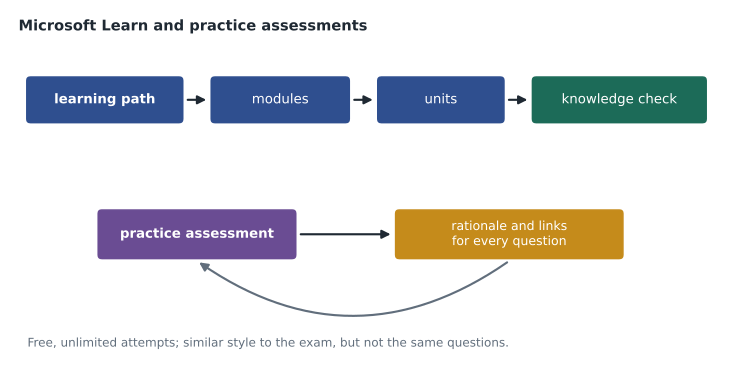
Microsoft Learn is Microsoft's free online training site. Its self-paced content is arranged in three layers. A learning path is a sequence of modules on a theme, often aligned with an exam's skill areas. A module is a lesson-sized unit, typically taking somewhere between half an hour and an hour and a half, made of several units. A unit is a single page or short video, and most modules end with a knowledge check: a few questions that test what the module covered. Every certification page links to a recommended course or collection of learning paths that covers the exam's skills outline.
Microsoft Learn also tracks your progress on your profile, so you can see which modules you have completed and pick up where you left off. You can add modules to a collection, which is a personal list; the Harrow & Finch group builds a shared collection for each of the four exams so that everyone can see the same material. Learn content is updated as products change, which makes it more current than most books. For a fundamentals exam, the official learning paths are usually enough on their own, provided you study them actively rather than just reading.
Hands-on practice
Fundamentals exams test understanding, not configuration, but seeing a service in action makes understanding easier and helps with hot area and active screen items. Some Microsoft Learn modules include exercises that run in a temporary environment provided for the exercise, and others ask you to use your own Azure subscription. If you use your own subscription, set a budget alert first and delete what you create when you finish; MSAZ-102 shows how. Microsoft offers a free Azure account for new customers with a limited amount of credit and some services free for a period, but the terms change, so check the current offer page before signing up rather than relying on what a colleague remembers.
Hana's AI-901 plan has the most hands-on time of the four, because her outline uses the verb implement and expects familiarity with Python, SDKs and REST APIs. She works through the Microsoft Foundry modules in a sandbox subscription that Renata sets up for the developers, with a small monthly budget. Theo uses the company's non-production subscription, hf-nonprod, under the cost-center tag rules that Project Skylight introduced in November. Keiko and Ama do most of their hands-on work in the portals they already use at work: Power BI for Keiko and the Microsoft Defender and Purview portals for Ama.
Studying a Learn module actively
Reading a module from top to bottom feels like studying, but on its own it builds weak memories. Renata gives the group a four-step routine for every module. Before starting, read the module's learning objectives and the matching bullet in the skills outline, and write down one question you expect the module to answer. While reading, pause at the end of each unit and say aloud, or type, two sentences summarizing it without looking back. After the knowledge check, close the module and write the three most important ideas from memory, then compare with the module and correct anything you missed. A day or two later, before starting the next module, answer your earlier question again from memory. The routine adds perhaps ten minutes to a module, and it turns passive reading into retrieval practice.
Videos need the same treatment. Pause every few minutes and summarize. Turn off the urge to keep a second video playing while you take notes. If a learning path offers both a video and a text unit on the same topic, use one to learn and the other as a quick review a few days later.
Practice assessments
Microsoft provides free practice assessments for many of its certifications. Microsoft's page about them says they are available at no cost and can be attempted as many times as you like, that they are created by the same team that develops the certification exams, and that they are updated in step with the certifications. After you finish, the results show the correct answer, a rationale and links to further learning for every question, along with a breakdown of your performance. You need to sign in to your Learn profile to take one. For AI-901, the study guide says the free practice assessment is reached from the certification page on the AI Skills Navigator, and you must sign in to launch it.
Microsoft is also careful about what practice assessments are not. Its page says the questions are not the same as those on the exam, and that the assessment does not show the length or complexity of the real exam, which may include additional question types and case studies. It also says that a practice assessment is not a substitute for training or experience. Use it as a diagnostic and a rehearsal, not as a script.
| Use | When | How |
|---|---|---|
| Diagnostic | Week 1, before new study | Untimed, no notes; mark confidence on each answer |
| Progress check | Every two weeks | Compare area results with the diagnostic and adjust the plan |
| Rehearsal | Final week | Timed to your exam pace, in one sitting, with no interruptions |
| Rationale study | After each attempt | Read the rationale for every question, including the ones you got right |
Using rationales properly
The most valuable part of a practice assessment is not the score but the rationale behind every answer. After each attempt, read the rationale for every question, including the ones you answered correctly. A correct answer reached for the wrong reason is a weakness that the score hides. When a rationale links to a Learn page, follow it and read the relevant section. Then add an entry to your mistakes log in your own words. Theo's rule is that for every question he misses, he writes one new practice question of his own on the same objective, with different wording and a different scenario. That stops him from simply remembering the answer to the practice question.
Because practice assessments can be repeated as often as you like, there is a trap: by the third or fourth attempt, you start to recognize the questions. High scores at that point measure your memory of the assessment, not your knowledge of the subject. Space your attempts out, and between them practice with questions written by you, your study group or a reputable training provider.
Other legitimate sources
Beyond Microsoft Learn, there are many good sources of study material. Instructor-led courses, offered by Microsoft's training partners, follow the same official course outlines and can suit people who learn better with a teacher and a timetable. Microsoft also runs free online training events from time to time, sometimes with exam discounts attached; the offers change, so check Microsoft's events pages rather than relying on old announcements. Books and video courses from established publishers can be excellent, but check when they were last updated against the study guide's change log. Practice tests sold by reputable providers are fine, as long as they are original questions written to the published outline.
Writing good practice questions of your own
Writing questions is one of the best ways to study, but only if the questions are good. A good practice question tests one objective from the outline, has one clearly correct answer that you can justify from Microsoft's documentation, and has wrong options that a person with a specific misunderstanding might choose. Weak questions test trivia, such as the year a service was launched, or use options so silly that no one would pick them. Theo's first attempt was "Which of these is an Azure service? A: Azure Policy. B: a toaster." His second was much better: "A company wants to prevent anyone from creating virtual machines outside Canadian regions. Which feature should it use? Azure Policy, a resource lock, a tag or a budget." Each wrong option there matches a real confusion: locks protect existing resources, tags label them, and budgets warn about cost.
When your study group swaps questions, discuss the wrong options as much as the right one. Explaining why an option is wrong is often the moment a concept becomes clear. Keep the best questions in a shared document, organized by skill area, and you will have a growing bank of original practice material that matches the outline and breaks no rules.
When your material and the outline disagree
Sooner or later you will find a book, video or older Learn page that disagrees with the current outline: a renamed product, a retired tool or a feature that has moved. When that happens, the current study guide wins, followed by current Microsoft documentation. MSAZ-102 noted one example: Microsoft Learn now says the old Total Cost of Ownership calculator has been retired, while many older courses still teach it. Another is product renaming, which Lesson 11 covers. Record each discrepancy in your notes so that you do not relearn the old version later.
How to recognize an exam dump
An exam dump is a collection of questions claimed to be from a real exam, usually with answers. Signs include promises of "actual exam questions", "pass guaranteed", "verified answers" or "updated after every exam"; questions that reproduce exam screenshots; very cheap or anonymous sellers; and answer keys that disagree with Microsoft's own documentation. Microsoft's candidate agreement forbids sharing or using exam content, and Microsoft can revoke certifications, ban candidates from future exams and decertify people involved. Even setting the rules aside, dumps are poor study material: their answers are often wrong, and memorizing answers builds no understanding for the job or for the next exam.
If you are not sure whether a source is legitimate, ask two questions. Does it teach the subject, with explanations you can check against Microsoft's documentation? And would you be comfortable telling your employer and Microsoft exactly how you used it? If the answer to either is no, leave it alone.
Worked problem
Planning practice for SC-900
Ama has five weeks before her February exam. She has finished the first learning path and scored 640 on her diagnostic practice assessment, weakest in compliance solutions. How should she use the practice assessment and other material over the remaining weeks?
Show solution
- Week 1: read every rationale from the diagnostic, follow the links for each compliance question she missed or guessed, and add them to her mistakes log.
- Weeks 2-3: study the compliance learning path and the Purview portal at work; write her own questions on each compliance objective and swap them with the study group.
- Week 4: take the practice assessment again as a progress check, untimed; compare the area breakdown with the diagnostic.
- Week 5: one timed rehearsal at exam pace, early in the week; then mistakes log review and rest. No new material in the last two days.
Answer: Diagnostic and rationales first, targeted study of the weak area, a progress check, then one timed rehearsal with time left to consolidate.
Renata expects the group's shared collections to hold more than sixty modules between them by early December. Theo deletes the bookmark for the dump site that afternoon. "I realized I'd been looking for a shortcut because I was behind," he tells Renata. "The shortcut is doing the knowledge checks properly."
Common mistakes
MistakeTreating a practice assessment score as a prediction of the exam score.
InsteadIt is a diagnostic and rehearsal; the real exam differs in length and question types.
MistakeReading rationales only for wrong answers.
InsteadRead every rationale; correct answers can hide wrong reasoning.
MistakeRetaking the practice assessment many times in a row.
InsteadSpace attempts out; repeated attempts measure memory of the questions.
MistakeUsing material that promises real exam questions.
InsteadDumps break the candidate agreement and can cost you the certification.
MistakeExperimenting in a personal subscription without a budget alert.
InsteadSet a budget alert first and delete resources when finished.
Summary and key terms
- Microsoft Learn arranges free training into learning paths, modules and units, with knowledge checks.
- Some modules provide a temporary exercise environment; others use your own subscription, which needs a budget alert.
- Practice assessments are free, can be repeated, are written by the exam team and show a rationale and links for every question.
- Practice questions are not the exam's questions and do not show its length or complexity.
- Use the practice assessment as a diagnostic, progress check and timed rehearsal, spaced apart.
- Exam dumps break the candidate agreement and can lead to revocation and bans; legitimate material teaches the subject.
- Learning path
- A sequence of Microsoft Learn modules on one theme.
- Module
- A lesson-sized set of units on Microsoft Learn, usually ending in a knowledge check.
- Knowledge check
- Short questions at the end of a module.
- Practice assessment
- Microsoft's free official practice test for a certification.
- Rationale
- The explanation of why an answer is right or wrong.
- Exam dump
- A collection of questions claimed to come from a real exam, used in breach of the candidate agreement.
Practice problems
Work each problem on paper first, then reveal the answer to check.
What are the three layers of Microsoft Learn content?
Show answer
Learning paths, modules and units.
How much does a Microsoft practice assessment cost?
Show answer
Nothing; they are free and can be repeated.
Who writes the practice assessment questions?
Show answer
The same team that develops the certification exams.
Are practice assessment questions the same as exam questions?
Show answer
No. Microsoft says they are not the same.
Why read the rationale for questions you got right?
Show answer
Because a correct answer may have been reached for the wrong reason.
Where is the AI-901 practice assessment reached?
Show answer
From the certification page on the AI Skills Navigator, after signing in.
Name two warning signs of an exam dump.
Show answer
Promises of actual exam questions or a guaranteed pass, among others.
Lesson quiz · 5 questions
Score 60% or more to complete this lesson.
Create a free account to save your progress, take quizzes and earn a certificate.